Ram Janmbhoomi Babri Masjid Judgement - High Court of Allahabad
Sep 30, 2010
Coram :-
Hon'ble Sibghat Ullah Khan ,J.
Hon'ble Sudhir Agarwal, J.
Hon'ble Dharam Veer Sharma, J.
Gist of Judgements :-
Hon'ble Sibghat Ullah Khan ,J.
Hon'ble Sudhir Agarwal, J.
Hon'ble Dharam Veer Sharma, J.
Brief summary
Issues for briefing
Case Details
1. Other Original Suit No. 1 of 1989 Gopal Singh Visharad (Now Dead) & Others
Vs.
Zahoor Ahmad & Others
2. Other Original Suit No. 3 of 1989 Nirmohi Akhara & Others
Vs.
Baboo Priya Dutt Ram and Others
3. Other Original Suit No. 4 of 1989 The Sunni Central Board of Waqfs U.P.& Others
Vs.
Gopal Singh Visharad (Now Dead) & Others.
4. Other Original Suit No. 5 of 1989 Bhagwan Sri Ram Virajman and Others
Vs.
Rajendra Singh and Others
Judgments Per
Hon'ble Sibghat Ullah Khan ,J. Hon'ble Sudhir Agarwal, J. Hon'ble Dharam Veer Sharma, J.
Consolidated Judgment in
OOS No. 1 of 1989,
OOS No. 3 of 1989,
OOS No. 4 of 1989 &
OOS No. 5 of 1989 Consolidated Judgment in
OOS No. 1 of 1989,
OOS No. 3 of 1989,
OOS No. 4 of 1989 &
OOS No. 5 of 1989 : Vol 1 Judgment in OOS No. 1 of 1989
- do - : Vol 2 Judgment in OOS No. 3 of 1989
- do - : Vol 3 Judgment in
OOS No. 4 of 1989 : Vol 1
- do - : Vol 4 Judgment in
OOS No. 4 of 1989 : Vol 2
- do - : Vol 5 Judgment in
OOS No. 4 of 1989 : Vol 3
- do - : Vol 6 Judgment in
OOS No. 4 of 1989 : Vol 4
- do - : Vol 7
Judgment in OOS No. 5 of 1989
- do - : Vol 8 Index of Annexure - I to III
- do - : Vol 9 Annexure - I
- do - : Vol 10 Annexure - II
- do - : Vol 11 Annexure - III
- do - : Vol 12 Page wise Index of Annexure IV
- do - : Vol 13 Annexure IV - Page 1 to 125
- do - : Vol 14 Annexure IV - Page 126 to 128
- do - : Vol 15 Annexure IV - Page 129 to 162
- do - : Vol 16 Page wise Index of Annexure V
- do - : Vol 17 Annexure V - Page 1 to 14
- do - : Vol 18 Annexure V - Page 15 to 59
- do - : Vol 19 Annexure V - Page 60 to 117
- do - : Vol 20 Annexure V - Page 112A
- do - : Vol 21* Annexure V - Page 118 to 189
Annexure V - Page 190 to 220
Annexure V - Page 221 to 281
*Vol 21 Per Hon'ble Sudhir Agarwal J. includes :
1. Appendix 8 : General Index
2. Appendix 9 : Citation Index
3. Appendix 10 : Reference Book Index
Full text at: http://rjbm.nic.in/
o o o
See also: http://timesofindia.indiatimes.com/india/Text-of-Allahabad-high-court-order-on-Ayodhya-dispute/articleshow/6659163.cms#ixzz112PlC0NL
|

September 30, 2010
How ideologues manipulated masses is unparalleled
The Times of India
Dec 2, 2009
File photo of Dec 6, 1992, when the Babri Masjid in Ayodhya was razed to the ground by Hindu activists. (TOI)
Sequence of events leading to the destruction of the Ram Janambhoomi-Babri Masjid structure
The single-minded agenda of the RSS and VHP; and the extremely patient and focused manner in which the handful of ideologues and theologians manipulated the masses and turned them into a frenzied mob, capable of acts of the gravest depravity, is unparalleled.
It is established that the events of and leading up to the 6th of December in the birthplace of the virtuous Lord Ram were tainted by a joint conspiratorial enterprise... Lured by the prospect of power or wealth, a rank of leaders emerged within the BJP, RSS, VHP, Shiv Sena, Bajrang Dal, etc who were neither guided by any ideology nor imbued with any dogma nor restrained by any moral trepidation. These leaders saw the Ayodhya issue as their road to success and sped down this highway mindless of the casualties they scattered about. These leaders were the executioners wielding the sword handed to them by the ideologues.
The role played the chief minister and ministers of Uttar Pradesh and by individuals and organizations in connection with the destruction of the RJBM structure.
The BJP's claim that it was carrying out the people's mandate makes it inexplicable why it had to resort to subterfuge in order to effect the destruction of the disputed structure... Kalyan Singh, his ministers and his handpicked bureaucrats created manmade and cataclysmic circumstances which could result in no consequences other than the demolition of the disputed structure and broadened the cleavage between the religious communities resulting in massacres all over the country...The parallel government run by the RSS has also been exposed and analysed in my report. ... Paramhans Ramchander Das, Ashok Singhal, Vinay Katiyar, Vishnu Hari Dalmia, Vamdes, KS Sudarshan, H V Sheshadri, Lalji Tandon, Kalraj Mishra, Govindacharya and others named in my report formed this complete cartel led by Kalyan Singh and supported by the icons of the movement like Advani, Joshi and Vajpayee.
The RSS, BJP and VHP core have turned the tables — they have redefined secularism and turned the definition on its head to mean the exact opposite of what it has always been held to be and understood. Their version of secularism is neither benign nor tolerant of the ideals enshrined in our Constitution.
The deficiencies in the security measures contributing to the demolition
The state government did not arrange for a single video camera to record the events which were unfolding for posterity... Even the CCTV cameras, which the state had promised the Central government would be monitoring every inch of the disputed structure, were either inoperative or their footage has been hidden. In either case, the results are a betrayal of the nation and of history.
By far, the worst sin of omission of the state government was leaking into the public domain the information that the police personnel had been hobbled and would not react or retaliate under any circumstances... The only non-manageable variable, from the Sangh Parivar's point of view, was the possible deployment of Central forces in the state, either at the behest of the Central government or sanctioned by the Supreme Court. This threat was also neutralized by senior and well-respected individuals stating blatant lies on oath before the Supreme Court.
The state had become a willing ally and co-conspirator in the joint common enterprise to announce the revival of a rabid breed of Hindutva, by demolishing the structure they had denounced as a symbol of Islam.
Events leading to the assault on media persons at Ayodhya
To frustrate the attempts of future investigations, including efforts by commissions like this one, the leadership at the spot had evolved a common strategy to deny the world an accurate record of the unfolding events... The first step in this direction was to identify the journalists who were present at the spot. The accreditation of the media was entrusted to their own cadres... Dramatic situations were precipitated to paint the foreign and domestic media with hostile colours and the stage was set to instigate the mobs.
As soon as the pre-programmed assault on the structure commenced, the journalists were subjected to systematic harassment... The reporters were confined to small rooms or molested or otherwise threatened so that their attention was less on the events they were supposed to cover, and more on their very survival... Photojournalists became recipients of especially violent treatment at the hands of the kar sevaks... The attack on the media is in itself an admission by the perpetrators of the events of December 6, 1992 that they were aware of the illegality of their acts.
Standards of culpability.
For the purpose of quantifying their culpability, the various persons and organizations named in this report have been divided into three groups.
The first group represents those who bear the primary and greatest responsibility... These people had complete knowledge of the events as were scripted. These individuals and organizations were part of the decision-making process and instrumental in the assault of the structure... Those found guilty of primary responsibility had the means to prevent the assaults, they were the active leaders of the cadres and without their participation, December 6 would have occurred.
The second group consists of those who bear physical, ideological and intellectual responsibility. These persons were not decision-makers and would not change the course charted by those bearing primary responsibility. Nevertheless, without their sins of omission or commission, the situation would not have deteriorated as much as it did. These included those who portrayed the benign face of the Ayodhya campaign and gave false reassurances to the courts, the people and the nation as a whole. Those who have been put in the second category in these conclusions are referred to as ''pseudo moderates'' in contrast to the radicals forming part of the first group.
There are those who bear tertiary responsibility for the situation. These people may or may not have been associated with the Sangh or had any influence over the situation at all. However, it was their sworn and statutory duty to prevent exactly the kind of event which took place around December 6... Their complicity stems from their sins of omission rather than of commission.
Pseudo moderate elements within the Sangh Parivar
It cannot be assumed even for a moment that L K Advani, A B Vajpayee or M M Joshi did not know of the designs of the Sangh Parivar. These people, who may be called pseudo moderates, could not have defied the mandate of the Sangh Parivar, more specifically RSS diktat, without having bowed out of public life as leaders of the BJP. The pseudo moderate leadership of the BJP was as much a tool in the hands of the RSS as any other organization or entity and these leaders stood to inherit the political success engineered by the RSS.
The BJP was and remains an appendage of the RSS which had the purpose of providing only an acceptable veneer to the less popular decisions and a facade for the brash members of the Sangh Parivar. The much repeated and much denied remarks attributed to Govindacharya who called Vajpayee a mukhota or mask may be more appropriately applied to BJP's top leadership at the time collectively. Without leaders like Joshi, Advani and Vajpayee, the RSS might have been able to achieve de facto clout, but would not have been able to legitimize its hold on the Indian system by translating that clout into political success.
These leaders have violated the trust of the people and have allowed their actions to be dictated not by the voters but by a small group of individuals who have used them to implement agendas unsanctioned by the will of the common person. There can be no greater betrayal or crime in a democracy and this commission has no hesitation in condemning these pseudo moderates for their sins of omission.
Read more: How ideologues manipulated masses is unparalleled - The Times of India http://timesofindia.indiatimes.com/india/How-ideologues-manipulated-masses-is-unparalleled/articleshow/5265656.cms#ixzz112MbYrqz
Dec 2, 2009
File photo of Dec 6, 1992, when the Babri Masjid in Ayodhya was razed to the ground by Hindu activists. (TOI)
Sequence of events leading to the destruction of the Ram Janambhoomi-Babri Masjid structure
The single-minded agenda of the RSS and VHP; and the extremely patient and focused manner in which the handful of ideologues and theologians manipulated the masses and turned them into a frenzied mob, capable of acts of the gravest depravity, is unparalleled.
It is established that the events of and leading up to the 6th of December in the birthplace of the virtuous Lord Ram were tainted by a joint conspiratorial enterprise... Lured by the prospect of power or wealth, a rank of leaders emerged within the BJP, RSS, VHP, Shiv Sena, Bajrang Dal, etc who were neither guided by any ideology nor imbued with any dogma nor restrained by any moral trepidation. These leaders saw the Ayodhya issue as their road to success and sped down this highway mindless of the casualties they scattered about. These leaders were the executioners wielding the sword handed to them by the ideologues.
The role played the chief minister and ministers of Uttar Pradesh and by individuals and organizations in connection with the destruction of the RJBM structure.
The BJP's claim that it was carrying out the people's mandate makes it inexplicable why it had to resort to subterfuge in order to effect the destruction of the disputed structure... Kalyan Singh, his ministers and his handpicked bureaucrats created manmade and cataclysmic circumstances which could result in no consequences other than the demolition of the disputed structure and broadened the cleavage between the religious communities resulting in massacres all over the country...The parallel government run by the RSS has also been exposed and analysed in my report. ... Paramhans Ramchander Das, Ashok Singhal, Vinay Katiyar, Vishnu Hari Dalmia, Vamdes, KS Sudarshan, H V Sheshadri, Lalji Tandon, Kalraj Mishra, Govindacharya and others named in my report formed this complete cartel led by Kalyan Singh and supported by the icons of the movement like Advani, Joshi and Vajpayee.
The RSS, BJP and VHP core have turned the tables — they have redefined secularism and turned the definition on its head to mean the exact opposite of what it has always been held to be and understood. Their version of secularism is neither benign nor tolerant of the ideals enshrined in our Constitution.
The deficiencies in the security measures contributing to the demolition
The state government did not arrange for a single video camera to record the events which were unfolding for posterity... Even the CCTV cameras, which the state had promised the Central government would be monitoring every inch of the disputed structure, were either inoperative or their footage has been hidden. In either case, the results are a betrayal of the nation and of history.
By far, the worst sin of omission of the state government was leaking into the public domain the information that the police personnel had been hobbled and would not react or retaliate under any circumstances... The only non-manageable variable, from the Sangh Parivar's point of view, was the possible deployment of Central forces in the state, either at the behest of the Central government or sanctioned by the Supreme Court. This threat was also neutralized by senior and well-respected individuals stating blatant lies on oath before the Supreme Court.
The state had become a willing ally and co-conspirator in the joint common enterprise to announce the revival of a rabid breed of Hindutva, by demolishing the structure they had denounced as a symbol of Islam.
Events leading to the assault on media persons at Ayodhya
To frustrate the attempts of future investigations, including efforts by commissions like this one, the leadership at the spot had evolved a common strategy to deny the world an accurate record of the unfolding events... The first step in this direction was to identify the journalists who were present at the spot. The accreditation of the media was entrusted to their own cadres... Dramatic situations were precipitated to paint the foreign and domestic media with hostile colours and the stage was set to instigate the mobs.
As soon as the pre-programmed assault on the structure commenced, the journalists were subjected to systematic harassment... The reporters were confined to small rooms or molested or otherwise threatened so that their attention was less on the events they were supposed to cover, and more on their very survival... Photojournalists became recipients of especially violent treatment at the hands of the kar sevaks... The attack on the media is in itself an admission by the perpetrators of the events of December 6, 1992 that they were aware of the illegality of their acts.
Standards of culpability.
For the purpose of quantifying their culpability, the various persons and organizations named in this report have been divided into three groups.
The first group represents those who bear the primary and greatest responsibility... These people had complete knowledge of the events as were scripted. These individuals and organizations were part of the decision-making process and instrumental in the assault of the structure... Those found guilty of primary responsibility had the means to prevent the assaults, they were the active leaders of the cadres and without their participation, December 6 would have occurred.
The second group consists of those who bear physical, ideological and intellectual responsibility. These persons were not decision-makers and would not change the course charted by those bearing primary responsibility. Nevertheless, without their sins of omission or commission, the situation would not have deteriorated as much as it did. These included those who portrayed the benign face of the Ayodhya campaign and gave false reassurances to the courts, the people and the nation as a whole. Those who have been put in the second category in these conclusions are referred to as ''pseudo moderates'' in contrast to the radicals forming part of the first group.
There are those who bear tertiary responsibility for the situation. These people may or may not have been associated with the Sangh or had any influence over the situation at all. However, it was their sworn and statutory duty to prevent exactly the kind of event which took place around December 6... Their complicity stems from their sins of omission rather than of commission.
Pseudo moderate elements within the Sangh Parivar
It cannot be assumed even for a moment that L K Advani, A B Vajpayee or M M Joshi did not know of the designs of the Sangh Parivar. These people, who may be called pseudo moderates, could not have defied the mandate of the Sangh Parivar, more specifically RSS diktat, without having bowed out of public life as leaders of the BJP. The pseudo moderate leadership of the BJP was as much a tool in the hands of the RSS as any other organization or entity and these leaders stood to inherit the political success engineered by the RSS.
The BJP was and remains an appendage of the RSS which had the purpose of providing only an acceptable veneer to the less popular decisions and a facade for the brash members of the Sangh Parivar. The much repeated and much denied remarks attributed to Govindacharya who called Vajpayee a mukhota or mask may be more appropriately applied to BJP's top leadership at the time collectively. Without leaders like Joshi, Advani and Vajpayee, the RSS might have been able to achieve de facto clout, but would not have been able to legitimize its hold on the Indian system by translating that clout into political success.
These leaders have violated the trust of the people and have allowed their actions to be dictated not by the voters but by a small group of individuals who have used them to implement agendas unsanctioned by the will of the common person. There can be no greater betrayal or crime in a democracy and this commission has no hesitation in condemning these pseudo moderates for their sins of omission.
Read more: How ideologues manipulated masses is unparalleled - The Times of India http://timesofindia.indiatimes.com/india/How-ideologues-manipulated-masses-is-unparalleled/articleshow/5265656.cms#ixzz112MbYrqz


September 26, 2010
Ayodhya: is a solution possible? (K N Panikkar)
(The Hindu, 27 September 2010)
by K.N. Panikkar
It should be clear to everyone, most of all to the judges who ordered the judgment deferred, that if the issue has defied a solution for a hundred years, no miracle is likely in less than a week.
Religious leaders at a harmony rally appealing for peace ahead of the Allahabad High Court verdict (since postponed) on Ayodhya title suits in Ranchi. —
The Supreme Court of India on September 23 gave a pause to the vexed Mandir-Masjid controversy and the contending title claims to the site made by the Muslim Waqf Board and the Hindu Dharam Sansad, by directing the Allahabad High Court to defer the pronouncement of the long-awaited judgment. Now, a three-judge bench headed by Chief Justice of India S.H. Kapadia is set to decide on the matter on September 28.
The learned judges of the Supreme Court, whatever their publicly stated positions, are not so naïve as to believe that within less than a week a solution could be found for the contentious case. It should be clear to everyone, most of all to the judges, that if the issue has defied a solution for more than a hundred years, no miracle is likely to happen within less than a week. All the water that has flowed down the Sarayu river through all these years has not helped Ayodhya to recover the meaning of its name — a place without war. On the contrary, the claims and counter-claims by the parties involved in the dispute have only helped to harden the respective positions, which have spread the hatred and distrust thus generated to the whole country.
Given these facts and the situation, what prompted the judges last week to grant a stay could not be the possibility of an imminent solution. They were probably trying to convey a message to the nation, particularly to those who are party to the dispute, as well as to the government. The case has dragged on for such a long time under the assumption that it could be resolved by the intervention of the judiciary. The court now seems to suggest that it is not the case; a real solution lies in the political domain, with the active participation of civil society.
The salience of the civil suit lies in the fact that it is implicated in the larger issue of the dispute pertaining to the Mandir and the Masjid on which the court cannot really pronounce a judgment, even if it gathered evidence from historians. The government was using the judiciary as an escape route. And the judiciary, instead of dismissing the case, attempted to overreach itself. As far as the civil suit for the title of the land is concerned, it was in fact decided in 1885-86. It was in the post-1857 period when political conditions were fluid that the mahant of Ayodhya constructed a chabutara on the land leading to the masjid and started worship, claiming it to be the janmasthan of Sri Ram. The mahant filed a case in 1885 claiming title to the land, but it was dismissed. So were his appeals to the superior courts. The British officials favoured the status quo, for religious and political reasons.
Record of aggression
The history of the Mandir-Masjid dispute during the post-Independence period is but a record of aggression by Hindu communal forces, and a series of compromises and reconciliation bids by the Central government led by the Indian National Congress, particularly under Prime Minister Rajiv Gandhi and Prime Minister P.V. Narasimha Rao.
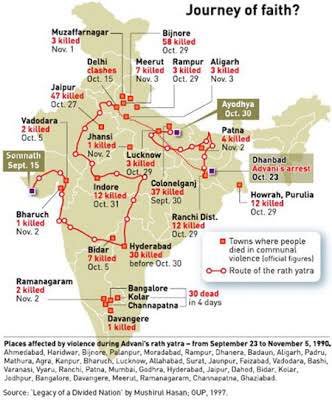
In 1949, Hindu communal forces conducted a seven-day continuous recitation of Ramcharitamanas, which proved to be the precursor to the installation of an idol of Ram Lalla in the mosque. The fact that they got away with the defiance of the state not only emboldened them to indulge in further aggression, leading ultimately to the demolition of the Masjid. During this period, the Sangh Parivar not only organised a series of agitations to mobilise Hindus in the name of Ram but also made preparations for the construction of the temple. It assiduously built up a tempo of aggression, with Uma Bharti and Rithambara leading the charge. The finale of this carefully constructed aggression was the Rath Yatra led by Lal Krishna Advani 20 years ago, which finally led to the demolition of the Masjid in 1992. The demolition was a criminal act according to the laws of the country, as the mosque was a 400-year-old historical monument that the state was committed to protect.
While the Hindu communal forces were engaged in a progressive assault, the state was unable to solve its own political dilemma. The Congress which led the government during this period was committed to secularism in principle, but the party realised that it was not possible to survive without the electoral support of Hindus. As a consequence, the party indulged in secular rhetoric, but followed communal politics in practice. It pursued what has now come to be termed ‘soft Hindutva'. Through this means it hoped to outsmart the Hindu communal forces.
The leader who initiated this disastrous policy was Rajiv Gandhi. He ordered the opening of the locks of the Masjid, thereby permitting Hindus to perform puja inside. He did this in order to steal the thunder from the Hindu communal forces. His successor-Prime Minister pursued the policy of compromise much more vigorously, and ‘officially arranged' the shilanyas of the temple. The Congress thus became an appendage of communal forces; that is what emboldened a mob to demolish the Masjid, thus inflicting a major blow on democracy and secularism.
Decisive factor
The failure of the Indian state was a most decisive factor behind the act of demolition. As is evident from the account given later by Narasimha Rao, it is clear that the state failed to discharge its duty of protecting the monument. It failed to prevent Mr. Advani's Rath Yatra, which led to the loss of several lives: everybody knew it would have disastrous consequences. Even after the demolition, the construction of a temporary temple was not stopped. At least now the state can rectify its mistakes by charting out a bold and innovative step in line with the principles of secularism.
The parties to the dispute and those who indulged in violence in the name of Ram are not representatives of India's Hindus and Muslims. They have no authority to speak on behalf of Hindus and Muslims. They are actually seeking to coerce the members of these communities by claiming to speak on their behalf.
(Dr. K.N. Panikkar is a former Professor of Modern History with Jawaharlal Nehru University, Delhi. He is currently Vice-Chairman of the Kerala State Higher Education Council, Thiruvananthapuram.)
by K.N. Panikkar
It should be clear to everyone, most of all to the judges who ordered the judgment deferred, that if the issue has defied a solution for a hundred years, no miracle is likely in less than a week.
Religious leaders at a harmony rally appealing for peace ahead of the Allahabad High Court verdict (since postponed) on Ayodhya title suits in Ranchi. —
The Supreme Court of India on September 23 gave a pause to the vexed Mandir-Masjid controversy and the contending title claims to the site made by the Muslim Waqf Board and the Hindu Dharam Sansad, by directing the Allahabad High Court to defer the pronouncement of the long-awaited judgment. Now, a three-judge bench headed by Chief Justice of India S.H. Kapadia is set to decide on the matter on September 28.
The learned judges of the Supreme Court, whatever their publicly stated positions, are not so naïve as to believe that within less than a week a solution could be found for the contentious case. It should be clear to everyone, most of all to the judges, that if the issue has defied a solution for more than a hundred years, no miracle is likely to happen within less than a week. All the water that has flowed down the Sarayu river through all these years has not helped Ayodhya to recover the meaning of its name — a place without war. On the contrary, the claims and counter-claims by the parties involved in the dispute have only helped to harden the respective positions, which have spread the hatred and distrust thus generated to the whole country.
Given these facts and the situation, what prompted the judges last week to grant a stay could not be the possibility of an imminent solution. They were probably trying to convey a message to the nation, particularly to those who are party to the dispute, as well as to the government. The case has dragged on for such a long time under the assumption that it could be resolved by the intervention of the judiciary. The court now seems to suggest that it is not the case; a real solution lies in the political domain, with the active participation of civil society.
The salience of the civil suit lies in the fact that it is implicated in the larger issue of the dispute pertaining to the Mandir and the Masjid on which the court cannot really pronounce a judgment, even if it gathered evidence from historians. The government was using the judiciary as an escape route. And the judiciary, instead of dismissing the case, attempted to overreach itself. As far as the civil suit for the title of the land is concerned, it was in fact decided in 1885-86. It was in the post-1857 period when political conditions were fluid that the mahant of Ayodhya constructed a chabutara on the land leading to the masjid and started worship, claiming it to be the janmasthan of Sri Ram. The mahant filed a case in 1885 claiming title to the land, but it was dismissed. So were his appeals to the superior courts. The British officials favoured the status quo, for religious and political reasons.
Record of aggression
The history of the Mandir-Masjid dispute during the post-Independence period is but a record of aggression by Hindu communal forces, and a series of compromises and reconciliation bids by the Central government led by the Indian National Congress, particularly under Prime Minister Rajiv Gandhi and Prime Minister P.V. Narasimha Rao.
In 1949, Hindu communal forces conducted a seven-day continuous recitation of Ramcharitamanas, which proved to be the precursor to the installation of an idol of Ram Lalla in the mosque. The fact that they got away with the defiance of the state not only emboldened them to indulge in further aggression, leading ultimately to the demolition of the Masjid. During this period, the Sangh Parivar not only organised a series of agitations to mobilise Hindus in the name of Ram but also made preparations for the construction of the temple. It assiduously built up a tempo of aggression, with Uma Bharti and Rithambara leading the charge. The finale of this carefully constructed aggression was the Rath Yatra led by Lal Krishna Advani 20 years ago, which finally led to the demolition of the Masjid in 1992. The demolition was a criminal act according to the laws of the country, as the mosque was a 400-year-old historical monument that the state was committed to protect.
While the Hindu communal forces were engaged in a progressive assault, the state was unable to solve its own political dilemma. The Congress which led the government during this period was committed to secularism in principle, but the party realised that it was not possible to survive without the electoral support of Hindus. As a consequence, the party indulged in secular rhetoric, but followed communal politics in practice. It pursued what has now come to be termed ‘soft Hindutva'. Through this means it hoped to outsmart the Hindu communal forces.
The leader who initiated this disastrous policy was Rajiv Gandhi. He ordered the opening of the locks of the Masjid, thereby permitting Hindus to perform puja inside. He did this in order to steal the thunder from the Hindu communal forces. His successor-Prime Minister pursued the policy of compromise much more vigorously, and ‘officially arranged' the shilanyas of the temple. The Congress thus became an appendage of communal forces; that is what emboldened a mob to demolish the Masjid, thus inflicting a major blow on democracy and secularism.
Decisive factor
The failure of the Indian state was a most decisive factor behind the act of demolition. As is evident from the account given later by Narasimha Rao, it is clear that the state failed to discharge its duty of protecting the monument. It failed to prevent Mr. Advani's Rath Yatra, which led to the loss of several lives: everybody knew it would have disastrous consequences. Even after the demolition, the construction of a temporary temple was not stopped. At least now the state can rectify its mistakes by charting out a bold and innovative step in line with the principles of secularism.
The parties to the dispute and those who indulged in violence in the name of Ram are not representatives of India's Hindus and Muslims. They have no authority to speak on behalf of Hindus and Muslims. They are actually seeking to coerce the members of these communities by claiming to speak on their behalf.
(Dr. K.N. Panikkar is a former Professor of Modern History with Jawaharlal Nehru University, Delhi. He is currently Vice-Chairman of the Kerala State Higher Education Council, Thiruvananthapuram.)
September 24, 2010
Sangh’s stand in Babri case is feeble
(Mail Today, 20 September 2010)
by Rajeev Dhavan
IN 1528 or so, the Babri Masjid was constructed. Controversies about it erupted in the 19th century. On January 29, 1885, Mahant Raghubar Das filed Suit 61/280 as the Mahant of Ramjanmasthan. On December 24, 1885, sub judge Pandit Hari Kishan favoured the Hindu claim without granting relief. On March 18, 1886, on appeal district judge Chamier denied relief and commented, “It was most unfortunate that a Masjid has been built on land held sacred by the Hindus, but as that event occurred 356 years ago, it was too late to remedy the grievance.”
An order to maintain the status quo was made. Chamier’s comment that the Masjid was built on sacral Hindu lands was without foundation. But his judgment denying the Hindu claim is final under our Constitution.
In the 1940’s, after a Sunni- Shia legal dispute over the Masjid, which the Sunnis won, there was little scope for controversy. That decision also became final.
Chronology
The new dispute is the product of mischief. On December 22- 23, 1949, idols supposedly found their way into the Masjid! No one claimed credit. It ill becomes a believer to tell lies in the name of the Lord and not own up to the ‘ miracle’. The first two suits for the Hindus ( Gopal Singh Visharad and Param Hansa ( 1950)) were for worshipping the miraculous ‘ idols’ and preventing their removal. These were symbolic litigations which were forgotten about. In 1959, the Nirmohi Akhara made claims to the possession and delivery of the property. The Muslim Sunni Board had no choice but to assert their claim and title to the site. It was only in 1989 that Justice Deoki Nandan’s suit tried to expand the issues into claims of divinity, sentiment and history. The Param Hansa suit was withdrawn when Justice Deoki Nandan died.
These issues would have died down. Political resurrection came when the BJP unfurled the Babri campaign. More miracles were in the offing. Eventually, in 1986, a lower court order was passed to open the gates enclosing the idols. Miraculously, they were opened within minutes of passing the order.
At the time, Rajiv Gandhi was flirting with the Muslim vote over Shah Banu’s case but wanted the Hindu vote also.
While the Congress dithered, the BJP seized the moment. The Advani and Joshi yatras culminated in the destruction of the Babri Masjid on December 6, 1992. That day India’s secularism suffered a blow, denting its reputation throughout the world.
What followed was mayhem— mostly against the Muslims — using the power of the State. Justice Sri Krishna records this for Mumbai. The Supreme Court’s judgment of 1994 ordered status quo; allowing Hindu worship on the insulting grounds that Muslims can pray anywhere, even in the open! Hindus were also promised the return of surrounding acquired Hindu land.
Between 1994 and 2010, nothing should have happened. In 1995, Kalyan Singh garnered much political capital after being imprisoned for contempt by the Supreme Court for flouting its orders. On February 3, 1993, Vajpayee decried the court’s intervention as this was a matter of faith. The pressure was maintained.
After BJP’s hawala fiasco was quelled, between 2000 and 2002, a new campaign found notoriety.
On December 6, 2000, the Bajrang Dal wanted the ‘ Babri destruction’ day to be called shourya diwas ( gallantry) day.
The next day, Vajpayee seemed to suggest a Hindu temple had to be built. Vajpayee’s Kumarakom musings declared him to be, first and foremost, a sewak . The Kumbh Mela was chosen as the stage to gather the Parivar at the Dharam Sansad of January 19- 22, 2001 amidst protests by the Shankaracharya and others.
Prime Minister Vajpayee was threatened with an ultimatum on March 27, 2001, calling for the temple’s immediate construction, with ceremonies earmarked for September- October, collective jaypayajnas from November and a handing over of land by Mahashivratri on March 12, 2002.
The Parivar made frenetic initiatives to excite everyone, planning Ram sankalp raths ( Ram chariots) and the like. On March 13- 15, 2002, the BJP ( supported by its attorney general Soli Sorabji who had earlier appeared for Muslim groups!) moved the Supreme Court to build on the land and, perforce, upset the 1994 status quo.
Verdict
The Supreme Court declined.
Throughout, the Sangh Parivar has been relentless — treating the Liberhan Commission and court proceedings as side shows.
Meanwhile, the BJP changed tracks to lose an election on their slogan that ‘ India was shining’. Recently, the Lucknow Bench has asked the parties to negotiate before it pronounces its final judgment on September 24. Earlier, attempts were made by Rajiv Gandhi for a settlement between the VHP and the AIBMAC in 1989, which collapsed with the VHP churlishly saying in an intergenerational collective damnation of all Muslims, “ We ask for only three shrines out of thousands destroyed during the Mughal period.” In this, and further negotiations under Narsimha Rao in 1991- 2, the Muslims were conciliatory and asked for proof that this was indeed, the birthplace of Lord Ram. This proof was not forthcoming. Vajpayee as PM created a cell to assist a settlement on October 11, 2002. On October 17, 2002 the VHP stormed the temple.
The Lucknow Court has ordered a further negotiation. Why? Has the judgment been leaked? Are the judges afraid of the consequences of their own judgment? The atmosphere is getting charged. Little may come out of the last minute negotiations.
Muslims do not want to surrender to the Hindu juggernaut of the Sangh Parivar and succumb under threat of violence. Ayodhya has helped the BJP before and is tempting their lack of statesmanship again. Does the Sangh Parivar’s calm suggest that they know the result? In 1991, Parliament arbitrated all other claims by passing the Places of Worship ( Special Provisions) Act, 1991, to provide, with respect to all religious places, a status quo as on August 15, 1947. But, it did not have the courage to include Ayodhya.
The issues before the Court are both simple and complex. In one sense, it is more than a title case and a plea for Hindu prayer.
That the title lies with the Sunnis is beyond dispute. The Hindu claim was rejected in 1885, just as the Muslim claim to the Shahid Ganj Mosque was lost to the Sikhs by a Privy Council decision in 1940 on the grounds that an earlier decision in 1855 was final; and too much time had passed since 1722! Applying these principles from the Shahid Ganj case to the Babri Masjid, the Sangh Parivar’s legal case should fail.
Calm
Many loose issues have been read into the Babri case, based on historical titles, the Muslim destruction of a Hindu temple, the birthplace of Lord Ram, which are not legally relevant to the right to title or prayer. The title vests with the Muslims.
Hindu prayer is of recent origin based on court orders. The Bench has one Muslim and two Hindu judges. It is never a question of mathematics. But, a split decision will undermine the result.
The BJP White Paper of 1993 holds that these mosques were created by political conquest and humiliation. It also states that “ the legal battle frustrates the Hindus and highlights the truth admitted by the judiciary that the issue is beyond the judicial domain”. This implies a willingness to ignore legal decisions and resort to violence and threats.
Whichever way the Lucknow decision goes, on appeal the Supreme Court will grant a status quo. That is another reason to stay calm.
The writer is a Supreme Court lawyer
by Rajeev Dhavan
IN 1528 or so, the Babri Masjid was constructed. Controversies about it erupted in the 19th century. On January 29, 1885, Mahant Raghubar Das filed Suit 61/280 as the Mahant of Ramjanmasthan. On December 24, 1885, sub judge Pandit Hari Kishan favoured the Hindu claim without granting relief. On March 18, 1886, on appeal district judge Chamier denied relief and commented, “It was most unfortunate that a Masjid has been built on land held sacred by the Hindus, but as that event occurred 356 years ago, it was too late to remedy the grievance.”
An order to maintain the status quo was made. Chamier’s comment that the Masjid was built on sacral Hindu lands was without foundation. But his judgment denying the Hindu claim is final under our Constitution.
In the 1940’s, after a Sunni- Shia legal dispute over the Masjid, which the Sunnis won, there was little scope for controversy. That decision also became final.
Chronology
The new dispute is the product of mischief. On December 22- 23, 1949, idols supposedly found their way into the Masjid! No one claimed credit. It ill becomes a believer to tell lies in the name of the Lord and not own up to the ‘ miracle’. The first two suits for the Hindus ( Gopal Singh Visharad and Param Hansa ( 1950)) were for worshipping the miraculous ‘ idols’ and preventing their removal. These were symbolic litigations which were forgotten about. In 1959, the Nirmohi Akhara made claims to the possession and delivery of the property. The Muslim Sunni Board had no choice but to assert their claim and title to the site. It was only in 1989 that Justice Deoki Nandan’s suit tried to expand the issues into claims of divinity, sentiment and history. The Param Hansa suit was withdrawn when Justice Deoki Nandan died.
These issues would have died down. Political resurrection came when the BJP unfurled the Babri campaign. More miracles were in the offing. Eventually, in 1986, a lower court order was passed to open the gates enclosing the idols. Miraculously, they were opened within minutes of passing the order.
At the time, Rajiv Gandhi was flirting with the Muslim vote over Shah Banu’s case but wanted the Hindu vote also.
While the Congress dithered, the BJP seized the moment. The Advani and Joshi yatras culminated in the destruction of the Babri Masjid on December 6, 1992. That day India’s secularism suffered a blow, denting its reputation throughout the world.
What followed was mayhem— mostly against the Muslims — using the power of the State. Justice Sri Krishna records this for Mumbai. The Supreme Court’s judgment of 1994 ordered status quo; allowing Hindu worship on the insulting grounds that Muslims can pray anywhere, even in the open! Hindus were also promised the return of surrounding acquired Hindu land.
Between 1994 and 2010, nothing should have happened. In 1995, Kalyan Singh garnered much political capital after being imprisoned for contempt by the Supreme Court for flouting its orders. On February 3, 1993, Vajpayee decried the court’s intervention as this was a matter of faith. The pressure was maintained.
After BJP’s hawala fiasco was quelled, between 2000 and 2002, a new campaign found notoriety.
On December 6, 2000, the Bajrang Dal wanted the ‘ Babri destruction’ day to be called shourya diwas ( gallantry) day.
The next day, Vajpayee seemed to suggest a Hindu temple had to be built. Vajpayee’s Kumarakom musings declared him to be, first and foremost, a sewak . The Kumbh Mela was chosen as the stage to gather the Parivar at the Dharam Sansad of January 19- 22, 2001 amidst protests by the Shankaracharya and others.
Prime Minister Vajpayee was threatened with an ultimatum on March 27, 2001, calling for the temple’s immediate construction, with ceremonies earmarked for September- October, collective jaypayajnas from November and a handing over of land by Mahashivratri on March 12, 2002.
The Parivar made frenetic initiatives to excite everyone, planning Ram sankalp raths ( Ram chariots) and the like. On March 13- 15, 2002, the BJP ( supported by its attorney general Soli Sorabji who had earlier appeared for Muslim groups!) moved the Supreme Court to build on the land and, perforce, upset the 1994 status quo.
Verdict
The Supreme Court declined.
Throughout, the Sangh Parivar has been relentless — treating the Liberhan Commission and court proceedings as side shows.
Meanwhile, the BJP changed tracks to lose an election on their slogan that ‘ India was shining’. Recently, the Lucknow Bench has asked the parties to negotiate before it pronounces its final judgment on September 24. Earlier, attempts were made by Rajiv Gandhi for a settlement between the VHP and the AIBMAC in 1989, which collapsed with the VHP churlishly saying in an intergenerational collective damnation of all Muslims, “ We ask for only three shrines out of thousands destroyed during the Mughal period.” In this, and further negotiations under Narsimha Rao in 1991- 2, the Muslims were conciliatory and asked for proof that this was indeed, the birthplace of Lord Ram. This proof was not forthcoming. Vajpayee as PM created a cell to assist a settlement on October 11, 2002. On October 17, 2002 the VHP stormed the temple.
The Lucknow Court has ordered a further negotiation. Why? Has the judgment been leaked? Are the judges afraid of the consequences of their own judgment? The atmosphere is getting charged. Little may come out of the last minute negotiations.
Muslims do not want to surrender to the Hindu juggernaut of the Sangh Parivar and succumb under threat of violence. Ayodhya has helped the BJP before and is tempting their lack of statesmanship again. Does the Sangh Parivar’s calm suggest that they know the result? In 1991, Parliament arbitrated all other claims by passing the Places of Worship ( Special Provisions) Act, 1991, to provide, with respect to all religious places, a status quo as on August 15, 1947. But, it did not have the courage to include Ayodhya.
The issues before the Court are both simple and complex. In one sense, it is more than a title case and a plea for Hindu prayer.
That the title lies with the Sunnis is beyond dispute. The Hindu claim was rejected in 1885, just as the Muslim claim to the Shahid Ganj Mosque was lost to the Sikhs by a Privy Council decision in 1940 on the grounds that an earlier decision in 1855 was final; and too much time had passed since 1722! Applying these principles from the Shahid Ganj case to the Babri Masjid, the Sangh Parivar’s legal case should fail.
Calm
Many loose issues have been read into the Babri case, based on historical titles, the Muslim destruction of a Hindu temple, the birthplace of Lord Ram, which are not legally relevant to the right to title or prayer. The title vests with the Muslims.
Hindu prayer is of recent origin based on court orders. The Bench has one Muslim and two Hindu judges. It is never a question of mathematics. But, a split decision will undermine the result.
The BJP White Paper of 1993 holds that these mosques were created by political conquest and humiliation. It also states that “ the legal battle frustrates the Hindus and highlights the truth admitted by the judiciary that the issue is beyond the judicial domain”. This implies a willingness to ignore legal decisions and resort to violence and threats.
Whichever way the Lucknow decision goes, on appeal the Supreme Court will grant a status quo. That is another reason to stay calm.
The writer is a Supreme Court lawyer
Ayodhya: The Redefining of India
(EPW, VOL 45 No. 38 September 18 - September 24, 2010)
How this dispute over a place of worship has redefined much of India.
Full text at: http://epw.in/epw/uploads/articles/15170.pdf
How this dispute over a place of worship has redefined much of India.
Full text at: http://epw.in/epw/uploads/articles/15170.pdf
September 18, 2010
Ayodhya Verdict
by Rajindar Sachar
Both government and opposition and the public in general are rightly in panic awaiting the verdict on Babri Masjid by Allahabad High Court – a situation brought about by the faltering non secular stand by all the concerned governments. The High Court is to give verdict t on the following points;
1. Was the place under Babri Majid the birth place of Lord Ram.
2. Was there or not a temple on the land on which Babri Masjid was built.
Now it is obvious to the meanest intelligence that it is impossible to prove that birth place of Lord Ram was under the Masjid – it may be a matter of faith, genuine or contrived or otherwise, but that is no proof, nor can it ever be put forward as a legal ground to take away the land from the Mosque.
If the finding is that Masjid was not built on a temple, then the Muslims get the land back and free to use it in any way including the building of Mosque.
In the alternative it may be held that there was a temple on the land of Babri Mosque. But even with this finding the suit by VHP/RSS has to be dismissed. Admittedly Babri Masjid has been in existence for over 400 years till it was demolished by goons of VHP/RSS in 1992. Legally, speaking the Sangh Parivar would have no right even if a temple had been demolished to build the Babri Masjid.
I say this in view of the precedent of the case of Masjid Shahid Ganj in Lahore decided by the Privy Council in (1940). In that case there was admittedly a Mosque existing since 1722 A.D. But by 1762, the building came under Sikh rule and was being used as a Gurdawara. It was only in 1935 that a suit was filed claiming the building was a Mosque and should be returned to Muslims.
The Privy Council while observing “their Lordship have every sympathy with a religious sentiment which would ascribe sanctity and in violability to a place of worship, they cannot under the Limitation Act accept the contentions that such a building cannot be possessed adversely” and then
went on to hold “The Property now in question having been possessed by Sikhs adversely to the waqf and to all interests thereunder for more than 12 years, the right of the mutawali to possession for the purposes of the waqf came to an end under Limitation Act. “On the same parity of reasoning even if temple existed prior to the building of Masjid 400 years ago, suit by VHP etc has to fail”.
There is another reason why in such a situation, suit would fail because in common law, even a rightful heir if he kills his ancestor, forfeits his right of inheritance. In the Masjid case too, there was ‘murder most foul’ and hence the murderer cannot be allowed to take the benefit of his own dastardly deeds, whatever the legal position may be.
It is true that sometime some Muslims groups in a spirit of large heartedness and as a measure of mutual accommodation, suggest that if it was found that the Masjid was built on the site of a temple, they would not like to now build a Mosque on the said site because the Koran forbids Muslims to build a mosque by demolishing any other religious place. But even them, if Muslims choose not to build a Masjid on this site, the ownership and use of the land remains with them. Hindu cannot under any circumstances lay a claim to this site which was under Babri Masjid.
Some well intentioned persons come out with apparently neutral suggestion of building a multi Religious complex on the site. To me this would be surrender to rabid Hindu Communal sentiment - whatever explanation you may give, a Muslim then would feel less equal citizen if even after he has won, he is asked to share this site with the goons who destroyed the Holy Mosque. This would be a defeat of secularism and against our constitution which mandates that all citizens, whether Hindus, Muslims have equal Rights and are equal before law.
A multi Religious Complex or multi culture Centre or a hospital can obviously be built by the joint free will efforts of both Hindus and Muslims. But such a complex if it is to be built necessarily must be on the land away and outside the Masjid complex, and that too only if the Muslims give their consent - obviously as vacant land belongs to the Muslims. But under all circumstances, the site under Babri Masjid must remain in the exclusive possession of Muslims who will be free to use it in any way the community decides.
I feel that the government should start doing an exercise of consultation, preparation on these lines – to await helplessly trying to anticipate what the verdict would be is like a pigeon who on seeing a cat closes its eyes with the delusion that cat will go away – the result is obvious.
Equally I feel that leaders of all communities, political parties, social workers should start planning to meet the situation, because this matter requires the involvement of people at grass root level and the matter does not brook any delay.
The legal position is clear. It is only the weakness of political will that is responsible for the Ayodhya imbroglio to continue as one of the most bitter disputes within the country. By keeping the Ayodhya issue alive, the country has been kept away from addressing it’s most urgent task – how to meet the challenge of the growing pauperization of the masses. And that includes both Hindus and Muslims.
Dated : 13-09-2010
Published in The Tribune on 17/09/2010
Both government and opposition and the public in general are rightly in panic awaiting the verdict on Babri Masjid by Allahabad High Court – a situation brought about by the faltering non secular stand by all the concerned governments. The High Court is to give verdict t on the following points;
1. Was the place under Babri Majid the birth place of Lord Ram.
2. Was there or not a temple on the land on which Babri Masjid was built.
Now it is obvious to the meanest intelligence that it is impossible to prove that birth place of Lord Ram was under the Masjid – it may be a matter of faith, genuine or contrived or otherwise, but that is no proof, nor can it ever be put forward as a legal ground to take away the land from the Mosque.
If the finding is that Masjid was not built on a temple, then the Muslims get the land back and free to use it in any way including the building of Mosque.
In the alternative it may be held that there was a temple on the land of Babri Mosque. But even with this finding the suit by VHP/RSS has to be dismissed. Admittedly Babri Masjid has been in existence for over 400 years till it was demolished by goons of VHP/RSS in 1992. Legally, speaking the Sangh Parivar would have no right even if a temple had been demolished to build the Babri Masjid.
I say this in view of the precedent of the case of Masjid Shahid Ganj in Lahore decided by the Privy Council in (1940). In that case there was admittedly a Mosque existing since 1722 A.D. But by 1762, the building came under Sikh rule and was being used as a Gurdawara. It was only in 1935 that a suit was filed claiming the building was a Mosque and should be returned to Muslims.
The Privy Council while observing “their Lordship have every sympathy with a religious sentiment which would ascribe sanctity and in violability to a place of worship, they cannot under the Limitation Act accept the contentions that such a building cannot be possessed adversely” and then
went on to hold “The Property now in question having been possessed by Sikhs adversely to the waqf and to all interests thereunder for more than 12 years, the right of the mutawali to possession for the purposes of the waqf came to an end under Limitation Act. “On the same parity of reasoning even if temple existed prior to the building of Masjid 400 years ago, suit by VHP etc has to fail”.
There is another reason why in such a situation, suit would fail because in common law, even a rightful heir if he kills his ancestor, forfeits his right of inheritance. In the Masjid case too, there was ‘murder most foul’ and hence the murderer cannot be allowed to take the benefit of his own dastardly deeds, whatever the legal position may be.
It is true that sometime some Muslims groups in a spirit of large heartedness and as a measure of mutual accommodation, suggest that if it was found that the Masjid was built on the site of a temple, they would not like to now build a Mosque on the said site because the Koran forbids Muslims to build a mosque by demolishing any other religious place. But even them, if Muslims choose not to build a Masjid on this site, the ownership and use of the land remains with them. Hindu cannot under any circumstances lay a claim to this site which was under Babri Masjid.
Some well intentioned persons come out with apparently neutral suggestion of building a multi Religious complex on the site. To me this would be surrender to rabid Hindu Communal sentiment - whatever explanation you may give, a Muslim then would feel less equal citizen if even after he has won, he is asked to share this site with the goons who destroyed the Holy Mosque. This would be a defeat of secularism and against our constitution which mandates that all citizens, whether Hindus, Muslims have equal Rights and are equal before law.
A multi Religious Complex or multi culture Centre or a hospital can obviously be built by the joint free will efforts of both Hindus and Muslims. But such a complex if it is to be built necessarily must be on the land away and outside the Masjid complex, and that too only if the Muslims give their consent - obviously as vacant land belongs to the Muslims. But under all circumstances, the site under Babri Masjid must remain in the exclusive possession of Muslims who will be free to use it in any way the community decides.
I feel that the government should start doing an exercise of consultation, preparation on these lines – to await helplessly trying to anticipate what the verdict would be is like a pigeon who on seeing a cat closes its eyes with the delusion that cat will go away – the result is obvious.
Equally I feel that leaders of all communities, political parties, social workers should start planning to meet the situation, because this matter requires the involvement of people at grass root level and the matter does not brook any delay.
The legal position is clear. It is only the weakness of political will that is responsible for the Ayodhya imbroglio to continue as one of the most bitter disputes within the country. By keeping the Ayodhya issue alive, the country has been kept away from addressing it’s most urgent task – how to meet the challenge of the growing pauperization of the masses. And that includes both Hindus and Muslims.
Dated : 13-09-2010
Published in The Tribune on 17/09/2010
September 17, 2010
Ayodhya: Waiting for the Verdict
Ayodhya: Waiting for the Verdict
Ram Puniyani
The Allahabad High Court is to give its verdict on the Ayodhya issue on 24th September 2010. The case has been in the court for long years. The court is essentially going to touch upon three major issues. Whether there was a temple at the disputed site before 1538, whether the suit filed by the Babri Committee in 1961 is barred by limitation and whether Muslims perfected their title through adverse possession.
While the judgment is awaited there is a lot of tension in the air about the same. The whole issue has been deeply linked to the faith and has been used to whip up communal hysteria. As such Muslim minority has been the major victim of the violence due to communal issue which has used the emotive appeal around Lord Ram. Just to recall, the matter came to surface when some Hindutva forces forcibly entered the Babri mosque on the night of 22 December 1949 and installed the Ram Lalla idols in the mosque. Despite the repeated messages of the then Prime Minister Jawaharlal Nehru the local administration let the matter drag. Incidentally, the local District Magistrate K.K. Nayyar who let the issue sow the seeds of discord in times to come, joined Bharatiya Jana Sangh, the previous avatar of BJP, after his retirement. He became the Member of Parliament from the area.
During the decade of 1980s BJP took Babri issue as its main plank. The pressure of VHP and others on political scenario went up and the then Prime Minister Rajiv Gandhi, in a thoughtless move got the locks of Masjid opened and Shilanyas for the temple was perfumed. Advani’s Rath Yatras stepped up the temperature; violence followed and prepared the ground for the final assault on the Mosque, the Kar Seva of 6th December 1992. This demolition was coordinated by BJP-VHP-Bajrang Dal under the supervision of their father organization, RSS. The demolition of the mosque was followed by ghastly violence, in Mumbai Surat and Bhopal in particular. This also led to the strengthening of BJP, whose number of MPs went on increasing and it could come to power at the center. Despite its communal rhetoric BJP had to bite the dust during last two general elections, 2004 and 2009.
BJP has been trying to experiment with different emotive issues through its sister organizations but no other issue has been as powerful as to bring it to center of political power again. And now with this forthcoming verdict in offing its sister organizations have stepped up the campaign to demand the building of Ram temple irrespective of the judgment.
In anticipation of the judgment, there are various types of efforts which are on in the society. The local peace groups in Ayodhya, which have played a significant part in maintaining peace in the aftermath of the demolition, are trying to appeal that whatever be the court verdict it should be accepted by both the parties, and that will be a fair way for the social harmony. The Government is trying to put forward a legalistic view and is appealing for calm in the society. Most of the Muslim groups have requested for maintaining law and order. They are also committing to accept the court verdict.
The RSS affiliates on the other hand, claiming to represent ‘all’ the Hindus, are on a different trip. For them the court verdict is immaterial and irrespective of the court verdict they are asserting that Ram temple has to be built at the site as that is the ‘wish ‘ of Hindus. The RSS chief has repeatedly said that Ram Temple has not only to be built but also that Muslims themselves should accept the Ram Temple coming up there to prove that they are’ patriots! In RSS camp BJP at the moment seems to have taken a back seat as it feels that the verdict of last two elections has amply proved that people of India are not in favor such issues coming to political arena. But even if BJP is on the back foot, RSS has no problems as it has its other wings which are doing that job. VHP has launched a multi-pronged effort through meetings, leaflets, booklets and SMS campaigns, exhorting Hindus to call for Ram Temple at the site. Its message is laced in the emotive language aimed to rouse passions. It is also planning to bring in the ‘sadhus’ to restart the campaign and has called a ‘Dharam Sansad’ (Religious Parliament) to react to the court verdict, i.e. to ask for temple irrespective of the judgment.
In this context there is a section amongst thinkers who are calling for establishment of permanent ‘History and Truth Commission’ to investigate and authenticate historical claims of ‘rights and wrongs’. It just shows how much history has been ‘used’ for current political goals. It was British who had introduced ‘communal historiography’ to pursue the policy of ‘divide and rule’. While Muslim League and Hindu Mahsabha-RSS picked up the communal view of History, the National movement led by Gandhi took a different view, which was more in tune with uniting all the people. The likes of Bhagat Singh and Ambedkar saw the history as the history of either class or caste oppression irrespective of the rule of the Kings of one or the other religion. At one level the formation of such a commission is welcome since so much muck has been left behind by the British policy, which continues to shape the ‘social common sense’ even today. History cannot be looked at as just the history of rulers and that too seen through the prism of religion. Other components of society, workers, women, dalits and adivasis also must be given the Historical space, which is due to them.
Today we are at a crucial juncture. The core issues of society, bread, shelter, employment and Human Rights need to be brought to the front stage and the Temple-Masque disputes can be left to the rational historians and the law of the land. All of us need to adopt this attitude and accept the process of law and the values of Indian Constitution.
Ram Puniyani
The Allahabad High Court is to give its verdict on the Ayodhya issue on 24th September 2010. The case has been in the court for long years. The court is essentially going to touch upon three major issues. Whether there was a temple at the disputed site before 1538, whether the suit filed by the Babri Committee in 1961 is barred by limitation and whether Muslims perfected their title through adverse possession.
While the judgment is awaited there is a lot of tension in the air about the same. The whole issue has been deeply linked to the faith and has been used to whip up communal hysteria. As such Muslim minority has been the major victim of the violence due to communal issue which has used the emotive appeal around Lord Ram. Just to recall, the matter came to surface when some Hindutva forces forcibly entered the Babri mosque on the night of 22 December 1949 and installed the Ram Lalla idols in the mosque. Despite the repeated messages of the then Prime Minister Jawaharlal Nehru the local administration let the matter drag. Incidentally, the local District Magistrate K.K. Nayyar who let the issue sow the seeds of discord in times to come, joined Bharatiya Jana Sangh, the previous avatar of BJP, after his retirement. He became the Member of Parliament from the area.
During the decade of 1980s BJP took Babri issue as its main plank. The pressure of VHP and others on political scenario went up and the then Prime Minister Rajiv Gandhi, in a thoughtless move got the locks of Masjid opened and Shilanyas for the temple was perfumed. Advani’s Rath Yatras stepped up the temperature; violence followed and prepared the ground for the final assault on the Mosque, the Kar Seva of 6th December 1992. This demolition was coordinated by BJP-VHP-Bajrang Dal under the supervision of their father organization, RSS. The demolition of the mosque was followed by ghastly violence, in Mumbai Surat and Bhopal in particular. This also led to the strengthening of BJP, whose number of MPs went on increasing and it could come to power at the center. Despite its communal rhetoric BJP had to bite the dust during last two general elections, 2004 and 2009.
BJP has been trying to experiment with different emotive issues through its sister organizations but no other issue has been as powerful as to bring it to center of political power again. And now with this forthcoming verdict in offing its sister organizations have stepped up the campaign to demand the building of Ram temple irrespective of the judgment.
In anticipation of the judgment, there are various types of efforts which are on in the society. The local peace groups in Ayodhya, which have played a significant part in maintaining peace in the aftermath of the demolition, are trying to appeal that whatever be the court verdict it should be accepted by both the parties, and that will be a fair way for the social harmony. The Government is trying to put forward a legalistic view and is appealing for calm in the society. Most of the Muslim groups have requested for maintaining law and order. They are also committing to accept the court verdict.
The RSS affiliates on the other hand, claiming to represent ‘all’ the Hindus, are on a different trip. For them the court verdict is immaterial and irrespective of the court verdict they are asserting that Ram temple has to be built at the site as that is the ‘wish ‘ of Hindus. The RSS chief has repeatedly said that Ram Temple has not only to be built but also that Muslims themselves should accept the Ram Temple coming up there to prove that they are’ patriots! In RSS camp BJP at the moment seems to have taken a back seat as it feels that the verdict of last two elections has amply proved that people of India are not in favor such issues coming to political arena. But even if BJP is on the back foot, RSS has no problems as it has its other wings which are doing that job. VHP has launched a multi-pronged effort through meetings, leaflets, booklets and SMS campaigns, exhorting Hindus to call for Ram Temple at the site. Its message is laced in the emotive language aimed to rouse passions. It is also planning to bring in the ‘sadhus’ to restart the campaign and has called a ‘Dharam Sansad’ (Religious Parliament) to react to the court verdict, i.e. to ask for temple irrespective of the judgment.
In this context there is a section amongst thinkers who are calling for establishment of permanent ‘History and Truth Commission’ to investigate and authenticate historical claims of ‘rights and wrongs’. It just shows how much history has been ‘used’ for current political goals. It was British who had introduced ‘communal historiography’ to pursue the policy of ‘divide and rule’. While Muslim League and Hindu Mahsabha-RSS picked up the communal view of History, the National movement led by Gandhi took a different view, which was more in tune with uniting all the people. The likes of Bhagat Singh and Ambedkar saw the history as the history of either class or caste oppression irrespective of the rule of the Kings of one or the other religion. At one level the formation of such a commission is welcome since so much muck has been left behind by the British policy, which continues to shape the ‘social common sense’ even today. History cannot be looked at as just the history of rulers and that too seen through the prism of religion. Other components of society, workers, women, dalits and adivasis also must be given the Historical space, which is due to them.
Today we are at a crucial juncture. The core issues of society, bread, shelter, employment and Human Rights need to be brought to the front stage and the Temple-Masque disputes can be left to the rational historians and the law of the land. All of us need to adopt this attitude and accept the process of law and the values of Indian Constitution.
September 05, 2010
Three pogroms held together by a common thread
(The Hindu, September 04, 2010)
by Vidya Subrahmaniam
Secular, democratic India has seen pogroms against all three significant minorities — Sikhs, Muslims and Christians.
– PHOTO: LINGARAJ PANDA
DECEPTIVE: An idyllic scene does not mask the trauma. A burnt church in Kandhamal, Orissa.
The accounts of murder, arson, and crimes against women sounded horribly familiar: Each detail, each grisly fact seemed taken out of a script enacted before; the sequence of events was as predictable as the shattering, gut-wrenching climax.
It was like a macabre replay of Gujarat 2002 and Delhi 1984, as 43 communal violence victims from Orissa — who had come all the way to the national Capital — testified recently before the National People's Tribunal on Kandhamal headed by A.P. Shah, former Chief Justice of the Delhi High Court. As the narratives ended, the audience was left with another chilling thought: In secular, democratic India, there had been pogroms against all three significant minorities — Sikhs, Muslims and Christians.
Kanaka Rekha Nayak, from village Budedipada, spoke of her husband, Parikhita, being beaten up, murdered and quartered as her family helplessly watched (FIR no: 58 U/S 147/148/436/302/201/149 IPC, dated August 28 2008). Today, Kanaka is in hiding with her two minor children.
Priyatama Nayak, from village Barpalli, said her husband, Abhimanyu, was tied to a tree and burnt alive in her presence. Amidst religious chants the mob looted her house and destroyed it. Priyatama's young son went to the local police station and begged for help. The police reached the village 10 days later by which time dogs had preyed on Abhimanyu's body. (FIR no 90 u/s 147/148/436/506/302/149, dated August 31, 2008). And though Priyatama named her husband's killers in the FIR, the police made no arrests. In March 2009, following unceasing threats from those named in the FIR, Priyatama, who had also petitioned the Chief Minister and the Governor, took her case to the Orissa Human Rights Commission, which ordered the Kandhamal District Magistrate and the Superintendent of Police to hold an inquiry into the case and take action against the errant policemen.
Twenty-four-year-old Narsingho Digal from Dudukagaon testified that a 600-strong armed gang looted and destroyed his house. His mother was gang-raped and his parents were dragged into the forests and murdered. Narasingho, who — like many other Kandhamal Christians — faces a social boycott, said the rioters had made his conversion back to Hinduism a condition for his being allowed to return to his village.
Many of the victims said they spotted Bharatiya Janata Party MLA Manoj Pradhan among the attackers. In June this year, a fast-track court in Orissa sentenced Pradhan to seven years' rigorous imprisonment.
The Orissa violence, which targeted Dalit-tribal Christians, was undoubtedly smaller in scale compared to Gujarat 2002 and Delhi 1984. Human rights estimates of deaths, damages and sexual violations are many times higher in all three cases, but going only by the government figures for the dead, there were 38 killed in Kandhamal in Orissa, 1,180 murdered (including Hindus killed in Godhra and in police firing) in the 15 affected districts of Gujarat, and 2,700 put to death in the national Capital. Yet despite these variations, the three pogroms could have been written, produced and directed by a single satanic mind, judging by the astonishing similarity in the detail and sequence of events and the stunning brutality of the crimes committed.
Tribunal foreword
In his November 2002 foreword to the report of the Concerned Citizens Tribunal, which collected 2,094 oral and written testimonies from Gujarat's victim-survivors as well as human rights groups, Justice V.R. Krishna Iyer said: “The gravamen of this pogrom-like operation was that the administration reversed its constitutional role, and by omission and commission, engineered the loot, ravishment and murder which was methodically perpetrated through planned process …”
Eight years later, the jury at the Kandhamal Tribunal had similar words to say: “The jury records its shock and deep concern for the heinous and brutal manner in which the members of the Christian community were killed, dismembered, sexually assaulted and tortured … There was rampant and systematic looting and destruction of houses and places of worship and means of livelihood … The jury is further convinced that the communal violence in Kandhamal was the consequence of a subversion of constitutional governance in which state agents were complicit.”
‘Action-reaction' theory
When, in the aftermath of Indira Gandhi's 1984 assassination, thousands of Sikhs were massacred on the streets of Delhi, the commonly-held view was that it was an aberration brought about by an extraordinary situation. Comparisons were made with the 1947 Partition riots but few could have known at that time that the clinically planned and executed anti-Sikh pogrom would serve as a model for two more episodes of mass aggression against minorities.
Consider the features of the 1984 violence: Indira Gandhi's assassination by two Sikh guards was the “action” which justified the “reactive” killings. Rajiv Gandhi's insensitive equation of the mob rage to tremors arising from a falling tree was taken as licence by the rioters to plunder, rape and kill. Members of the ruling establishment lent tacit support to the killings, and in some instances were seen directing the violence. The police abandoned their protective instincts, becoming either bystanders or collaborators in the crimes. The hooligans did not just kill, they used innovative techniques to kill, such as fitting burning car tyres over the necks of little, helpless children. In the days following the anti-Sikh orgy, the community was further victimised by an unwritten social boycott.
As in Delhi, so in Gujarat and Orissa. Delhi 1984 went beyond “an eye for an eye” to justify the extermination of an entire community for the perceived crimes of a handful. It established the legitimacy of the administration and the police slipping into supporting roles in mob violence. It also established that killing was not enough, killing must be perverse. In Gujarat, Muslims as a whole had to pay for Godhra. Here too, the action-reaction theory was propounded at the highest level, with the police and the administration wilfully abdicating their duties.
The testimonies recorded by the Krishna Iyer Tribunal brought out the sadistic, bestial nature of the Gujarat killings: “The widespread violence that targeted Muslims in urban and rural Gujarat was marked by utter bestiality and brutality … Evidence recorded before us shows how in the macabre dance of death, human beings were quartered and the killing protracted while the terrorised survivors looked on …” Violence over, the majority community enforced a social and economic boycott against Muslims.
In the “action-reaction” sequence in Orissa, rioters targeted the Dalit-tribal Christian community for revenge killings despite the lack of direct evidence linking the community to the murder of Swami Lakshmanananda Saraswati. Here the Chief Minister, to his credit, did not justify the killings. On the contrary, he appeared contrite and eventually broke his ties with the Bharatiya Janata Party. Yet during the violence, the levers of administration remained cruelly unresponsive to the cries of Kandhamal's Christian citizenry. As in Delhi and Gujarat, the victims found the police curiously missing or standing by, when the mobs, armed to the teeth and shouting inflammatory slogans, went on the rampage. The torture and violence were again extreme; murder was by burning alive, by dismembering the person. And as previously, the violence was followed by a crippling social boycott.
Abuse of women
All three pogroms had another common feature: Rampant abuse of women. Women were gang-raped, invariably in front of their families, not for sexual gratification but as a demonstration of power, to heap humiliation on male relatives. At the hearing organised by the Kandhamal Tribunal, Vrinda Grover, a member of the jury, remarked that the Orissa rioters had “used women's bodies as sites for punishment.” The Hindu of September 30, 2008 reported the case of a Catholic nun who was stripped naked and brutally gang-raped in front of a police post with 12 policemen from the Orissa State Armed Police present and watching. The Catholic priest who was with her was mercilessly thrashed for refusing to participate in the atrocity. Incidents of rape in Gujarat 2002 have been too well documented to bear repetition here.
But here again, the trend was set 26 years ago in Delhi. Until recently, the dominant perception about 1984 was that the mob violence largely spared the women.
The myth was conclusively demolished in 2007 following publication of the painstakingly documented book, “When a tree shook Delhi”. Lifting the “veil of silence” over the rape cases, authors Manoj Mitta and H.S. Phoolka pieced together evidence placed before the Nanavati Commission to establish rape as a commonly used weapon in the anti-Sikh pogrom.
In one case, the rioters killed all the men in the family, raped the woman of the house in front of her young son, and left her naked so that she could not go out to save the child when he too was dragged out and burnt alive (case reported in Manushi magazine and submitted to the Commission).
The Kandhamal tribunal, as the Krishna Iyer tribunal before it, noted the “institutionalised bias of State agencies, their deliberate dereliction of constitutionally mandated duties, their connivance with communal forces, participation in and support to the violence, and a deliberate scuttling of the processes of justice …” Each of the findings applied to Delhi 1984 as well.
Perhaps that is why, a questioner asked the jury of the Kandhamal tribunal, if it was not a shame that 26 years after 1984 — and two more pogroms later — India was still trying to find a solution to planned violence against minorities.
by Vidya Subrahmaniam
Secular, democratic India has seen pogroms against all three significant minorities — Sikhs, Muslims and Christians.
– PHOTO: LINGARAJ PANDA
DECEPTIVE: An idyllic scene does not mask the trauma. A burnt church in Kandhamal, Orissa.
The accounts of murder, arson, and crimes against women sounded horribly familiar: Each detail, each grisly fact seemed taken out of a script enacted before; the sequence of events was as predictable as the shattering, gut-wrenching climax.
It was like a macabre replay of Gujarat 2002 and Delhi 1984, as 43 communal violence victims from Orissa — who had come all the way to the national Capital — testified recently before the National People's Tribunal on Kandhamal headed by A.P. Shah, former Chief Justice of the Delhi High Court. As the narratives ended, the audience was left with another chilling thought: In secular, democratic India, there had been pogroms against all three significant minorities — Sikhs, Muslims and Christians.
Kanaka Rekha Nayak, from village Budedipada, spoke of her husband, Parikhita, being beaten up, murdered and quartered as her family helplessly watched (FIR no: 58 U/S 147/148/436/302/201/149 IPC, dated August 28 2008). Today, Kanaka is in hiding with her two minor children.
Priyatama Nayak, from village Barpalli, said her husband, Abhimanyu, was tied to a tree and burnt alive in her presence. Amidst religious chants the mob looted her house and destroyed it. Priyatama's young son went to the local police station and begged for help. The police reached the village 10 days later by which time dogs had preyed on Abhimanyu's body. (FIR no 90 u/s 147/148/436/506/302/149, dated August 31, 2008). And though Priyatama named her husband's killers in the FIR, the police made no arrests. In March 2009, following unceasing threats from those named in the FIR, Priyatama, who had also petitioned the Chief Minister and the Governor, took her case to the Orissa Human Rights Commission, which ordered the Kandhamal District Magistrate and the Superintendent of Police to hold an inquiry into the case and take action against the errant policemen.
Twenty-four-year-old Narsingho Digal from Dudukagaon testified that a 600-strong armed gang looted and destroyed his house. His mother was gang-raped and his parents were dragged into the forests and murdered. Narasingho, who — like many other Kandhamal Christians — faces a social boycott, said the rioters had made his conversion back to Hinduism a condition for his being allowed to return to his village.
Many of the victims said they spotted Bharatiya Janata Party MLA Manoj Pradhan among the attackers. In June this year, a fast-track court in Orissa sentenced Pradhan to seven years' rigorous imprisonment.
The Orissa violence, which targeted Dalit-tribal Christians, was undoubtedly smaller in scale compared to Gujarat 2002 and Delhi 1984. Human rights estimates of deaths, damages and sexual violations are many times higher in all three cases, but going only by the government figures for the dead, there were 38 killed in Kandhamal in Orissa, 1,180 murdered (including Hindus killed in Godhra and in police firing) in the 15 affected districts of Gujarat, and 2,700 put to death in the national Capital. Yet despite these variations, the three pogroms could have been written, produced and directed by a single satanic mind, judging by the astonishing similarity in the detail and sequence of events and the stunning brutality of the crimes committed.
Tribunal foreword
In his November 2002 foreword to the report of the Concerned Citizens Tribunal, which collected 2,094 oral and written testimonies from Gujarat's victim-survivors as well as human rights groups, Justice V.R. Krishna Iyer said: “The gravamen of this pogrom-like operation was that the administration reversed its constitutional role, and by omission and commission, engineered the loot, ravishment and murder which was methodically perpetrated through planned process …”
Eight years later, the jury at the Kandhamal Tribunal had similar words to say: “The jury records its shock and deep concern for the heinous and brutal manner in which the members of the Christian community were killed, dismembered, sexually assaulted and tortured … There was rampant and systematic looting and destruction of houses and places of worship and means of livelihood … The jury is further convinced that the communal violence in Kandhamal was the consequence of a subversion of constitutional governance in which state agents were complicit.”
‘Action-reaction' theory
When, in the aftermath of Indira Gandhi's 1984 assassination, thousands of Sikhs were massacred on the streets of Delhi, the commonly-held view was that it was an aberration brought about by an extraordinary situation. Comparisons were made with the 1947 Partition riots but few could have known at that time that the clinically planned and executed anti-Sikh pogrom would serve as a model for two more episodes of mass aggression against minorities.
Consider the features of the 1984 violence: Indira Gandhi's assassination by two Sikh guards was the “action” which justified the “reactive” killings. Rajiv Gandhi's insensitive equation of the mob rage to tremors arising from a falling tree was taken as licence by the rioters to plunder, rape and kill. Members of the ruling establishment lent tacit support to the killings, and in some instances were seen directing the violence. The police abandoned their protective instincts, becoming either bystanders or collaborators in the crimes. The hooligans did not just kill, they used innovative techniques to kill, such as fitting burning car tyres over the necks of little, helpless children. In the days following the anti-Sikh orgy, the community was further victimised by an unwritten social boycott.
As in Delhi, so in Gujarat and Orissa. Delhi 1984 went beyond “an eye for an eye” to justify the extermination of an entire community for the perceived crimes of a handful. It established the legitimacy of the administration and the police slipping into supporting roles in mob violence. It also established that killing was not enough, killing must be perverse. In Gujarat, Muslims as a whole had to pay for Godhra. Here too, the action-reaction theory was propounded at the highest level, with the police and the administration wilfully abdicating their duties.
The testimonies recorded by the Krishna Iyer Tribunal brought out the sadistic, bestial nature of the Gujarat killings: “The widespread violence that targeted Muslims in urban and rural Gujarat was marked by utter bestiality and brutality … Evidence recorded before us shows how in the macabre dance of death, human beings were quartered and the killing protracted while the terrorised survivors looked on …” Violence over, the majority community enforced a social and economic boycott against Muslims.
In the “action-reaction” sequence in Orissa, rioters targeted the Dalit-tribal Christian community for revenge killings despite the lack of direct evidence linking the community to the murder of Swami Lakshmanananda Saraswati. Here the Chief Minister, to his credit, did not justify the killings. On the contrary, he appeared contrite and eventually broke his ties with the Bharatiya Janata Party. Yet during the violence, the levers of administration remained cruelly unresponsive to the cries of Kandhamal's Christian citizenry. As in Delhi and Gujarat, the victims found the police curiously missing or standing by, when the mobs, armed to the teeth and shouting inflammatory slogans, went on the rampage. The torture and violence were again extreme; murder was by burning alive, by dismembering the person. And as previously, the violence was followed by a crippling social boycott.
Abuse of women
All three pogroms had another common feature: Rampant abuse of women. Women were gang-raped, invariably in front of their families, not for sexual gratification but as a demonstration of power, to heap humiliation on male relatives. At the hearing organised by the Kandhamal Tribunal, Vrinda Grover, a member of the jury, remarked that the Orissa rioters had “used women's bodies as sites for punishment.” The Hindu of September 30, 2008 reported the case of a Catholic nun who was stripped naked and brutally gang-raped in front of a police post with 12 policemen from the Orissa State Armed Police present and watching. The Catholic priest who was with her was mercilessly thrashed for refusing to participate in the atrocity. Incidents of rape in Gujarat 2002 have been too well documented to bear repetition here.
But here again, the trend was set 26 years ago in Delhi. Until recently, the dominant perception about 1984 was that the mob violence largely spared the women.
The myth was conclusively demolished in 2007 following publication of the painstakingly documented book, “When a tree shook Delhi”. Lifting the “veil of silence” over the rape cases, authors Manoj Mitta and H.S. Phoolka pieced together evidence placed before the Nanavati Commission to establish rape as a commonly used weapon in the anti-Sikh pogrom.
In one case, the rioters killed all the men in the family, raped the woman of the house in front of her young son, and left her naked so that she could not go out to save the child when he too was dragged out and burnt alive (case reported in Manushi magazine and submitted to the Commission).
The Kandhamal tribunal, as the Krishna Iyer tribunal before it, noted the “institutionalised bias of State agencies, their deliberate dereliction of constitutionally mandated duties, their connivance with communal forces, participation in and support to the violence, and a deliberate scuttling of the processes of justice …” Each of the findings applied to Delhi 1984 as well.
Perhaps that is why, a questioner asked the jury of the Kandhamal tribunal, if it was not a shame that 26 years after 1984 — and two more pogroms later — India was still trying to find a solution to planned violence against minorities.
September 03, 2010
Uncorking the Babri genie
Dawn, 02 September 2010
by Jawed Naqvi
What if Hindus take a similar approach over the Babri dispute? We can expect endless confabulations between the government and religious groups. We can expect yet another eclipse of the liberal middle ground that is not enamoured of religious disputes. - Photo by AP.
Maulana Jalaluddin Umri was fasting when he met a clutch of journalists last week. India’s mainstream media had shown no interest in him so he decided to invite a few of those he believed could be trusted with his time-sensitive message.
As it turned out what the 75-year old head of the Jamaat-i-Islami-i-Hind had to say could redefine the fate of democracy, secularism and justice in India.
Indian Muslims, the maulana said softly, had decided to abide by the coming court verdict on the Babri Masjid dispute. Taking a pause to allow his message to sink in, he added: “We don’t know if the other side would be willing to heed the imminent ruling of the Allahabad High Court.”
After a long wait a three-member bench of Uttar Pradesh state’s high court is expected to deliver its globally-watched verdict any time in September. The Babri Masjid dispute has kept the nation of a billion plus divided along fault lines that otherwise have done little to ease the people’s daily struggle for dignity and livelihood.
A mob of zealots razed the 16th century mosque on Dec 6, 1992, claiming it stood at the site of Lord Ram’s birth. The main opposition, the Bharatiya Janata Party (BJP), has campaigned for the site to be given to Hindus, saying that the Mughal emperor Babar had ordered the destruction of a temple to Ram to build the Babri Masjid on the site. There are different myths and legends surrounding this claim.
A few months before its destruction, I visited the mosque in Ayodhya. Hindu activists who carefully stick to legalese call it vivaadit dhaancha or disputed structure and refuse to accept it as a mosque. Under its central dome a Hindu priest was marshalling devotees to small idols of Ram and his consort Sita. This practice was on since 1987 when Prime Minister Rajiv Gandhi’s administration removed the locks on the mosque, allowing Hindu worshippers to perform puja. The locks were placed by a legal order in 1949 after the idols mysteriously appeared at the site leading to a communal upsurge. A paan-chewing police constable with an archaic 303 rifle slung clumsily over his shoulder was keeping vigil on the proceedings.
He volunteered to explain the history of the disputed structure to me. I asked him when he believed Lord Ram was born in Ayodhya. He turned his mouth up to hold back the spit from the paan and offered his insights in gurgling Avadhi. “Ye jaano, koi nav lakh saal bataawat hain.” (‘They say it happened about 900,000 years ago.’) Where exactly within the mosque was the place where Lord Ram had first appeared? The knowledgeable constable pointed to the busy priest. “Wo jo pujaariji khade hain, wahi ke jaano chaar paanch phoot yahar wahar.” (‘He was born where the priest is standing — give or take four or five feet.’)
Matters of faith cannot be decided in a secular court. There is nothing to indicate other than oral tradition, legends and myths that the Hindu god of war was born at the exact place the police constable was pointing to. The high court verdict is more likely to be about the ownership of the land where the mosque stood. The Sunni Waqf Board and groups of Hindu claimants have locked horns. While Maulana Umri says his community would go along with the verdict, Hindus have yet to take a call.
A BJP pamphlet brought out soon after the mosque’s destruction offers some clues. “Can any court order the removal of Ram Lala (idols)?” it asks. “Apart from the fact that this suit (by Muslims) is frivolous, even if legally tenable, can any court in India order the idols to be removed? And even if a court did, can any government implement that order?”
The stance masks a warning and a vicarious opportunity for the Manmohan Singh government. With its economic reforms going horribly wrong for the poor, indeed for a majority of Indians, there is already an anticipation of a restive period in politics. It is for no other reason that the prime minister recently asked police chiefs to think of non-lethal ways of crowd control.
The government is expecting people to go out of control over sheer want and deprivation, not on any communal slogan. Turning the discourse into a communal one would suit both — the government and the right-wing opposition. The losers will be the poor and of course the flock of supposedly law-abiding Muslims that Maulana Umri represents.
Should the high court decide the suit in favour of the Sunni Waqf Board, as is widely expected, there is apprehension of street violence by the groups that tore down the mosque in the first place. If on the other hand, Hindu groups get the award, there could be an appeal by the Muslims in the Supreme Court.
However, while Rajiv Gandhi had pandered to Hindu sentiments by reopening the locks of the Babri Masjid for Ram’s worshippers, he had also set a questionable precedent in seeking to balance his obscurantist politics by similarly pampering Muslim groups, including those that Maulana Umri represents.
The infamous Shahbano case saw the Muslim orthodoxy prevailing on the Congress government to overturn a secular judgment of the Supreme Court. The court had ordered that a Muslim divorcee should be paid maintenance by her former husband as was the case with divorced women of other Indian communities.
The maulana had at that time rejected the Supreme Court’s decision because it interfered with his community’s personal laws. He and his fellow leaders got Rajiv Gandhi to overturn the apex court’s fair verdict.
What if Hindus take a similar approach over the Babri dispute? We can expect endless confabulations between the government and religious groups. We can expect yet another eclipse of the liberal middle ground that is not enamoured of religious disputes. However, the government is preparing to meet the contingency the only way it knows — by asking the police to try rubber pellets to ward off street protesters.
These ‘harmless’ contraptions are not working in Kashmir. Will they work in the rest of the country? The Babri genie is raring to come out of the loosely corked bottle of Indian politics. It is set to communalise Indian politics once again. It’s a win-win situation for the Congress and the BJP. Communal politics over Ayodhya and Manmohan Singh’s reforms are inseparable twins. One will not survive without the other.
The writer is Dawn’s correspondent in Delhi.
by Jawed Naqvi
What if Hindus take a similar approach over the Babri dispute? We can expect endless confabulations between the government and religious groups. We can expect yet another eclipse of the liberal middle ground that is not enamoured of religious disputes. - Photo by AP.
Maulana Jalaluddin Umri was fasting when he met a clutch of journalists last week. India’s mainstream media had shown no interest in him so he decided to invite a few of those he believed could be trusted with his time-sensitive message.
As it turned out what the 75-year old head of the Jamaat-i-Islami-i-Hind had to say could redefine the fate of democracy, secularism and justice in India.
Indian Muslims, the maulana said softly, had decided to abide by the coming court verdict on the Babri Masjid dispute. Taking a pause to allow his message to sink in, he added: “We don’t know if the other side would be willing to heed the imminent ruling of the Allahabad High Court.”
After a long wait a three-member bench of Uttar Pradesh state’s high court is expected to deliver its globally-watched verdict any time in September. The Babri Masjid dispute has kept the nation of a billion plus divided along fault lines that otherwise have done little to ease the people’s daily struggle for dignity and livelihood.
A mob of zealots razed the 16th century mosque on Dec 6, 1992, claiming it stood at the site of Lord Ram’s birth. The main opposition, the Bharatiya Janata Party (BJP), has campaigned for the site to be given to Hindus, saying that the Mughal emperor Babar had ordered the destruction of a temple to Ram to build the Babri Masjid on the site. There are different myths and legends surrounding this claim.
A few months before its destruction, I visited the mosque in Ayodhya. Hindu activists who carefully stick to legalese call it vivaadit dhaancha or disputed structure and refuse to accept it as a mosque. Under its central dome a Hindu priest was marshalling devotees to small idols of Ram and his consort Sita. This practice was on since 1987 when Prime Minister Rajiv Gandhi’s administration removed the locks on the mosque, allowing Hindu worshippers to perform puja. The locks were placed by a legal order in 1949 after the idols mysteriously appeared at the site leading to a communal upsurge. A paan-chewing police constable with an archaic 303 rifle slung clumsily over his shoulder was keeping vigil on the proceedings.
He volunteered to explain the history of the disputed structure to me. I asked him when he believed Lord Ram was born in Ayodhya. He turned his mouth up to hold back the spit from the paan and offered his insights in gurgling Avadhi. “Ye jaano, koi nav lakh saal bataawat hain.” (‘They say it happened about 900,000 years ago.’) Where exactly within the mosque was the place where Lord Ram had first appeared? The knowledgeable constable pointed to the busy priest. “Wo jo pujaariji khade hain, wahi ke jaano chaar paanch phoot yahar wahar.” (‘He was born where the priest is standing — give or take four or five feet.’)
Matters of faith cannot be decided in a secular court. There is nothing to indicate other than oral tradition, legends and myths that the Hindu god of war was born at the exact place the police constable was pointing to. The high court verdict is more likely to be about the ownership of the land where the mosque stood. The Sunni Waqf Board and groups of Hindu claimants have locked horns. While Maulana Umri says his community would go along with the verdict, Hindus have yet to take a call.
A BJP pamphlet brought out soon after the mosque’s destruction offers some clues. “Can any court order the removal of Ram Lala (idols)?” it asks. “Apart from the fact that this suit (by Muslims) is frivolous, even if legally tenable, can any court in India order the idols to be removed? And even if a court did, can any government implement that order?”
The stance masks a warning and a vicarious opportunity for the Manmohan Singh government. With its economic reforms going horribly wrong for the poor, indeed for a majority of Indians, there is already an anticipation of a restive period in politics. It is for no other reason that the prime minister recently asked police chiefs to think of non-lethal ways of crowd control.
The government is expecting people to go out of control over sheer want and deprivation, not on any communal slogan. Turning the discourse into a communal one would suit both — the government and the right-wing opposition. The losers will be the poor and of course the flock of supposedly law-abiding Muslims that Maulana Umri represents.
Should the high court decide the suit in favour of the Sunni Waqf Board, as is widely expected, there is apprehension of street violence by the groups that tore down the mosque in the first place. If on the other hand, Hindu groups get the award, there could be an appeal by the Muslims in the Supreme Court.
However, while Rajiv Gandhi had pandered to Hindu sentiments by reopening the locks of the Babri Masjid for Ram’s worshippers, he had also set a questionable precedent in seeking to balance his obscurantist politics by similarly pampering Muslim groups, including those that Maulana Umri represents.
The infamous Shahbano case saw the Muslim orthodoxy prevailing on the Congress government to overturn a secular judgment of the Supreme Court. The court had ordered that a Muslim divorcee should be paid maintenance by her former husband as was the case with divorced women of other Indian communities.
The maulana had at that time rejected the Supreme Court’s decision because it interfered with his community’s personal laws. He and his fellow leaders got Rajiv Gandhi to overturn the apex court’s fair verdict.
What if Hindus take a similar approach over the Babri dispute? We can expect endless confabulations between the government and religious groups. We can expect yet another eclipse of the liberal middle ground that is not enamoured of religious disputes. However, the government is preparing to meet the contingency the only way it knows — by asking the police to try rubber pellets to ward off street protesters.
These ‘harmless’ contraptions are not working in Kashmir. Will they work in the rest of the country? The Babri genie is raring to come out of the loosely corked bottle of Indian politics. It is set to communalise Indian politics once again. It’s a win-win situation for the Congress and the BJP. Communal politics over Ayodhya and Manmohan Singh’s reforms are inseparable twins. One will not survive without the other.
The writer is Dawn’s correspondent in Delhi.
September 01, 2010
Interim Report The National People’s Tribunal on Kandhamal
"Exerpts: The jury observes that communal forces have used religious conversions as an issue for political mobilisation and to incite horrific forms of violence and discrimination against the Christians of SC origin and their supporters in Kandhamal. The object is to dominate them and ensure that they never rise above their low caste status and remain subservient to the upper castes. The jury observes, with deep concern, that a range of coercive tactics have been used by the communal forces for conversion or re-conversion of a person into the Hindu fold, including threat, intimidation, social and economic boycott and coercion, as well as the institutionalization of humiliating rituals. The state and district administrations have, on no occasion, intervened to protect the freedom of religion and freedom of expression."
Full Text at: http://www.sacw.net/article1575.html
Full Text at: http://www.sacw.net/article1575.html
Press Release National People's Tribunal on Kandhamal Violence
Dear Friends,
The National People's Tribunal on Kandhamal Violence took place at the Constitution Club in Delhi on 22, 23 and 24 August, 2010. 43 victims from Kandhamal and several study and fact finding reports were deposed before the Jury Panel headed by the former Chief Justice, Delhi High Court - Justice A.P.Shah. The Jury presented their PRELIMINARY FINDINGS & RECOMMENDATIONS (Interim Report) in a large gathering of 400 people along with several media representatives. Please find the Interim Report along with an Additional Note by Admiral Vishnu Bhagwat, member of the Jury Panel, attached herewith for your kind information and reference. The Panel will relaese their final report within a couple of months.
Also, please see the press release done by the National Solidarity Forum in this regard - that organised the NPT.
Requesting your kind response on it,
Regards,
Moderator, Common Concern
NATIONAL PEOPLES’ TRIBUNAL ON KANDHAMAL
Press Release
August 24, 2010
STATE COMPLICITY AND IMPUNITY RULE AS JUSTICE IS DENIED VICTIMS OF KANDHAMAL
The National People’s Tribunal (NPT) on Kandhamal is an initiative promoted by the National Solidarity Forum , a nationwide platform of civil society actors, with the purpose of seeking justice for the victims of communal violence in Kandhamal district of Orissa state.
Kandhamal witnessed an upsurge of violence against the minority Christian community beginning on Christmas-eve 2007, which was considerably aggravated in August 2008, following the killing of VHP leader Swami Lakshmananda. Official statistics, which understate its magnitude, testify to an unacceptable level of violence against the religious minority, who are mostly of dalit and adivasi origin. The recorded cases cover a range of gross violations of human rights, particularly the right to life and security.
The NPT heard testimonies of murder, torture and sexual assault. Many of the victims have suffered displacement from their places of residence and have had their homesteads and means of livelihood destroyed. Many of them have been coerced into repudiating their faith as the price for returning to the villages that they were supplanted from.
The NPT has concluded on the basis of the testimonies of 43 victim-survivors of Kandhamal that the violence there was the consequence of the subversion of constitutional governance in which state agencies were complicit. The NPT has found evidence of a shocking level of institutional bias on the part of the state agencies, leading to their collusion in the violence and connivance in efforts to block the subsequent processes of justice and accountability.
Witness and victim testimonies have shown that women and children have been especially vulnerable in recent outbreaks of violence. The continuing failure of the state and district administration to provide redress for the violence suffered, puts India in default on constitutional guarantees and commitments made under international covenants.
The NPT has recommended among other things
· that all officials who held positions of authority in Kandhamal during the violence, should have their records scrutinised and strict disciplinary action taken where they have been found wanting;
· The continuing programme of communal provocation that the groups and organisations of the Hindutva ideology have been engaged in should be ended forthwith through strict administrative action.
· Legal aid procedures should be instituted to help the victim survivors seek justice and to identify the many roadblocks that have been placed in their way;
· A special investigation should be undertaken into the accuracy of the First Information Reports (FIRs) that have already been filed;
· Where trial procedures have been compromised by weak and ineffective prosecution and wilfully recording crimes of lesser magnitude in the FIRs, these should be reopened with fresh charges instituted under applicable provisions of the law;
· The state government greatly increase the scope of the compensation packages offered, that rehabilitation of victims be done on an accelerated time frame and security threats they face be dealt with.
A.P. Shah, former Chief Justice of the Delhi High Court, presided over the NPT.
“The incidents of Kandhamal are a national shame and a complete defacement of humanity”, said Justice Shah.
Mahesh Bhatt, eminent filmmaker, also a member of the NPT, adds: “Preventing, stopping and punishing the guilty of Kandhamal is in all our interests; it is in fact a matter of urgent national importance”.
National Solidarity Forum
Ram Punyani, Dhirendra Panda and Organising Committee
The National People's Tribunal on Kandhamal Violence took place at the Constitution Club in Delhi on 22, 23 and 24 August, 2010. 43 victims from Kandhamal and several study and fact finding reports were deposed before the Jury Panel headed by the former Chief Justice, Delhi High Court - Justice A.P.Shah. The Jury presented their PRELIMINARY FINDINGS & RECOMMENDATIONS (Interim Report) in a large gathering of 400 people along with several media representatives. Please find the Interim Report along with an Additional Note by Admiral Vishnu Bhagwat, member of the Jury Panel, attached herewith for your kind information and reference. The Panel will relaese their final report within a couple of months.
Also, please see the press release done by the National Solidarity Forum in this regard - that organised the NPT.
Requesting your kind response on it,
Regards,
Moderator, Common Concern
NATIONAL PEOPLES’ TRIBUNAL ON KANDHAMAL
Press Release
August 24, 2010
STATE COMPLICITY AND IMPUNITY RULE AS JUSTICE IS DENIED VICTIMS OF KANDHAMAL
The National People’s Tribunal (NPT) on Kandhamal is an initiative promoted by the National Solidarity Forum , a nationwide platform of civil society actors, with the purpose of seeking justice for the victims of communal violence in Kandhamal district of Orissa state.
Kandhamal witnessed an upsurge of violence against the minority Christian community beginning on Christmas-eve 2007, which was considerably aggravated in August 2008, following the killing of VHP leader Swami Lakshmananda. Official statistics, which understate its magnitude, testify to an unacceptable level of violence against the religious minority, who are mostly of dalit and adivasi origin. The recorded cases cover a range of gross violations of human rights, particularly the right to life and security.
The NPT heard testimonies of murder, torture and sexual assault. Many of the victims have suffered displacement from their places of residence and have had their homesteads and means of livelihood destroyed. Many of them have been coerced into repudiating their faith as the price for returning to the villages that they were supplanted from.
The NPT has concluded on the basis of the testimonies of 43 victim-survivors of Kandhamal that the violence there was the consequence of the subversion of constitutional governance in which state agencies were complicit. The NPT has found evidence of a shocking level of institutional bias on the part of the state agencies, leading to their collusion in the violence and connivance in efforts to block the subsequent processes of justice and accountability.
Witness and victim testimonies have shown that women and children have been especially vulnerable in recent outbreaks of violence. The continuing failure of the state and district administration to provide redress for the violence suffered, puts India in default on constitutional guarantees and commitments made under international covenants.
The NPT has recommended among other things
· that all officials who held positions of authority in Kandhamal during the violence, should have their records scrutinised and strict disciplinary action taken where they have been found wanting;
· The continuing programme of communal provocation that the groups and organisations of the Hindutva ideology have been engaged in should be ended forthwith through strict administrative action.
· Legal aid procedures should be instituted to help the victim survivors seek justice and to identify the many roadblocks that have been placed in their way;
· A special investigation should be undertaken into the accuracy of the First Information Reports (FIRs) that have already been filed;
· Where trial procedures have been compromised by weak and ineffective prosecution and wilfully recording crimes of lesser magnitude in the FIRs, these should be reopened with fresh charges instituted under applicable provisions of the law;
· The state government greatly increase the scope of the compensation packages offered, that rehabilitation of victims be done on an accelerated time frame and security threats they face be dealt with.
A.P. Shah, former Chief Justice of the Delhi High Court, presided over the NPT.
“The incidents of Kandhamal are a national shame and a complete defacement of humanity”, said Justice Shah.
Mahesh Bhatt, eminent filmmaker, also a member of the NPT, adds: “Preventing, stopping and punishing the guilty of Kandhamal is in all our interests; it is in fact a matter of urgent national importance”.
National Solidarity Forum
Ram Punyani, Dhirendra Panda and Organising Committee
Subscribe to:
Posts (Atom)