The News International (Pakistan)
February 06, 2003
by Praful Bidwai
Even the staunchest critics of the Bharatiya Janata Party must concede that it is a driven and extraordinarily focused party which rarely does anything without a purpose, however narrow, sectarian or malign. Its will to power is today unmatched by any other force in India. As is its deviousness and communal passion.
The latest reshuffle of the Vajpayee cabinet bears ample testimony to this. It sends out many signals: the BJP is likely to steer India into an early general election, before October 2004, when the term of the present Lok Sabha ends. The power balances within the BJP have shifted further in favour of its rightwing, led by Deputy Prime Minister LK Advani. Non-BJP parties in the National Democratic Alliance have been further squeezed and marginalised.
Worst of all, the BJP is about to revive the Babri mosque/Ram temple issue in Ayodhya by trying to legally manipulate the transfer of land to a Vishwa Hindu Parishad-controlled trust on which to start building a temple -- to erase the mosque's memory for good.
The land, consisting of both disputed and undisputed plots, was taken over by the government through a special Act in 1993, with a view to facilitating either an out-of-court settlement between all concerned parties, or adjudication. The BJP-VHP manoeuvres will subvert that purpose and widen the communal divide.
Advani was the principal architect of the re-allotment of portfolios, most detailed decisions pertaining to which were made while Vajpayee was away from Delhi, mainly in consultation with party president M Venkaiah Naidu, himself an Advani man.
Among the important decisions were the dropping of Telecom and Information Technology Minister Pramod Mahajan, re-induction of Arun Jaitley as Law Minister with additional portfolios, further expansion of Disinvestment Minister Arun Shourie's powers and the sacking of Vijay Goel as a junior minister in the Prime Minister's Office.
Shourie's ascendancy is explained by the BJP's anxiety to project a strongly neo-liberal, pro-business, pro-privatisation image. Shourie is the cabinet's sole "foreign-educated" minister, with his World Bank background duly matching his neo-liberal zeal.
Jaitley was brought back partly because of changed corporate-power equations related to the mess over mobile phones, but mainly because he is expected to "manage" to get a judicial order to transfer the so-called "undisputed" part of the taken-over land to the VHP.
This is part of the BJP's design to rake up the temple agenda after the Supreme Court last March thwarted the plan to permit a VHP pooja there. The entire rationale of taking over land adjacent to the site where the Babri stood was to ensure that an eventual dispute settlement wouldn't be made infructuous with the construction of new structures on the surrounding plots.
The VHP is bent on acquiring those plots and start temple construction. It is being encouraged by the BJP which is trying to put up a "neutral" party to start a process of judicial manipulation. Discussions have already begun through the mediation of Jayendra Saraswati, the Kanchi Shankaracharya. Reviving the temple issue is the BJP's desperate way of trying to extract political mileage from rank hatred. It is playing with fire.
Jaitley's re-entry into government is inseparable from this design. This was to be "balanced" by Mahajan's shift to the party. In reality, the shift has more to do with Advani's distaste for Mahajan and his role in favouring certain mobile operators, whose competitors are close to Advani, besides some personal controversies. Mahajan, a capable second-generation BJP leader, stands badly demoted. All this leaves Vajpayee few trustworthy allies in the cabinet, barring Murli Manohar Joshi.
This reshuffle further tilts the balance within the NDA between the BJP and others. Over the years, the non-BJP "secular" parties have got marginalised. Since 1999, their share of cabinet posts (nine) has remained stagnant, but the BJP's has risen from 14 to 23. Of the 39 Ministers of State, 33 are from the BJP.
Mr Vajpayee has also hinted at a reshuffle of non-BJP ministers in the NDA, probably in April. This is a strong-arm tactic to secure their tacit or explicit compliance with the BJP's divisive agenda on Ayodhya.
In this reshuffle, Vajpayee has yielded a lot to Advani. But Vajpayee's biggest gain is that he will lead the BJP in an early election. Vajpayee is already trying to recoup his losses. He had the Central Bureau of Investigation hived off the Department of Personnel portfolio given to Advani, and transferred back to himself. After the next Parliament session, he might even ask Advani to devote himself to party work, and appoint Joshi as Deputy PM.
For the moment, Vajpayee has tried to give his cabinet a broad-based election-oriented profile, important in a diverse and big polity like India's. Thus, there is more nominal representation for non-upper caste communities like the Dalits in Uttaranchal, Adivasis in Chhattisgarh, Bhumihars in Bihar, Patels in Gujarat and Meenas in Rajasthan. These are the only faces of "multiculturalism" which the quintessentially upper-caste BJP can show.
After the Gujarat results, Vajpayee has hardened his soft-Hindutva stance and articulated rabidly anti-Muslim positions. The next few months will see a sharpening of the Vajpayee-Advani rivalry, understated and covert as it is. Politically, Vajpayee may have the better of his rival. But ideologically, he will have to yield ground to the Right.
The BJP is set to evolve with a strong communal orientation, in which terrorism is equated with Islam, divisive Hindutva with nationalism, and the sangh parivar as India's sole guarantor of "security". In the coming state elections, the party will do its utmost to capitalise on prejudice (against religious conversion), ignorance (of Islam and pro-reform currents in India's Muslim communities) and on paranoid hatred of India's multi-religious, multi-racial identity.
If the BJP wins in Himachal, where elections are due later this month, it will unleash a virulent communal campaign nationwide, as well as capitalise on the anti-incumbency factor in Rajasthan, Madhya Pradesh, Chhattisgarh and Delhi. However, its Lok Sabha election plans will depend critically on what happens to its uneasy alliance with Dalit leader Mayawati in Uttar Pradesh. Its top priority in UP is to keep her on its side.
The BJP's ability to manipulate public opinion will be compromised by its elitist economic policies. The Planning Commission wants the government to extend Rs134,000 crores in budgetary support to programmes largely related to basic services. But the government only has Rs100,000 crores to spend. So, social sector programmes will be drastically cut. Cooking gas and kerosene prices are set to be jacked up sharply.
Luckily for the BJP, its opponents haven't yet got their act together. They are unable or unwilling to mount a serious ideological challenge to Hindutva. If the Congress adopts a principled stand on issues like secularism and national security, it could frontally challenge the BJP. But it seems more inclined to do "cow-protection" politics, as in Madhya Pradesh.
All this bodes ill for the future of South Asia. A rabidly Hindutva government in New Delhi will create horrible enmities in the neighbourhood, as the ugly happenings at the India-Bangladesh border clearly suggest. One can only hope, pray and work for the BJP's electoral defeat in the coming round of elections.
|

February 06, 2003
February 05, 2003
Secular Perspective,
Feb. 1-15, 2003
HINDUTVA AND MINORITIES
by Asghar Ali Engineer
After the carnage in Gujarat and subsequent victory of Narendra Modi-led BJP in Gujarat has intensified threat of Hindutva forces. The Hindutva forces not only celebrated the victory in Gujarat but also declared their intention to repeat the Gujarat model in other states in coming elections. It is not so surprising after all that even the Prime Minister Vajpayee when asked about it, confirmed it. When reporters asked him would you repeat Gujarat model in other states he said, “Will Godhra be repeated”?
The implication of this cryptic reply is that if Godhra is repeated (or created?) in other states Gujarat model will be justified and the BJP Government will neither owe responsibility to prevent Godhra-like occurrence nor the subsequent events that followed in Gujarat. Thus the BJP owes no responsibility to enforce rule of law but rule of hate, blind revenge and violence.
Such hateful and revengeful Hindutva (which believes in even worshipping weapons on every Dasehra day) is bound to terrify minorities against whom its ire is directed. A question now is being asked what should be the response of minorities to the aggressive Hindutva? Should they submit to its demands for complete submission and accept the concept of Hindu Rashtra and status of mleccha? Or should they resist such demands and fight back with equal militancy?
I think no saner elements would advocate either course. To submit to such demands would amount to demise of democracy in our country and to fight back militantly would only strengthen the hands of Hindutva forces. What is better course then if both the above courses are not advisable? Before we discuss this we would like to throw some light on the stand taken by Jamat-e-Islami during sixties. It is again being advocated by some Muslims today.
The Jamat-e-Islami had advocated during the sixties that Muslims should not participate in the electoral process for two reasons: one, the Jamat was against secular politics and, second, it thought, as Sir Syed did in nineteenth century, it is in the interest of security and progress of Muslims to keep away from turbulent politics.
But both arguments go against the grain of democracy. Of course the Jamat has also accepted secular polity in India and no more advocates that Muslims keep away from electoral politics. Neither is tenable any more. Every one has realised that democracy can work only if it is secular. Hindu democracy or Islamic democracy prioritises religion over the notion of citizenship. In secular democracy citizenship is most fundamental, not religion. In Hindu Rashtra or Islamic democracy a Hindu or a Muslim will be more privileged than a non-Hindu or a non-Muslim. Thus such a course cannot be acceptable.
Not to participate in the electoral democracy is equally highly doubtful course. It clearly amounts to debunking democracy just because an aggressive section of majority community so demands or because it misuses electoral politics for forcing majoritarian values on minorities. Misuse of democracy cannot be negation of democracy. It amounts to throwing away baby along with bath water. Moreover, all Muslims cannot agree to such a course. They are 150 million in India and no leader of such a huge community can succeed in building consensus in the community on such a controversial course of action. Also, the Indian democracy will collapse if a community of 150 million keeps away from electoral process. There is no such precedent in any country of the world. If we add other minorities to this the problem assumes more massive dimension.
We have thus to evolve proper strategy for meeting the menace of Hindutva to the minorities. This can more easily be done by meeting this menace by winning the confidence of that major section of majority, which is aware of this menace or can be made aware of it. Hindutva forces, one should note, would ultimately set up an highly authoritarian regime and would undermine democracy. Thus the majority community should also understand that it is menace not only to minorities but also to majority itself. Its democratic freedoms would be in peril.
It is not true, as often claimed by the Hindutva forces, that Hinduism cant yield to theocratic or authoritarian set up and that only Hindus can be secular and democratic. Hinduism may not be a religion with one god, one prophet and one book but it does have many sects and panths with rigid shastric traditions and orthodoxies. The Hindutvawadis do talk of Manuvad and even advocated Manu’s laws in place of modern Indian constitution. Originally the Constitution Review Commission was set up with a clandestine agenda to import Manu’s laws back into the Indian mainstream. But thanks to hue and cry raised by democratic forces in the country that it did not succeed.
This shows that an aware secular democratic forces from the majority community can better stall Hindutva forces than an aggressive minority or minorities. However, most of the minority leaders either lack this wisdom or have ambition of their own to acquire instant leadership by using highly emotive issues. The Shah Bano and Babri Masjid issues, if handled with tact and wisdom by Muslim leadership, would not have had such disastrous implications they had.
There is need for think tanks at state and national level to tackle such controversial issues. The minorities should not respond to any emotional controversies impetuously without giving serious thought as to the consequences of taking a particular stand. Some ambitious leaders take hasty stand and put entire minority community in danger. The latest example is of an imam of the mosque in Gujarat appealing Muslims for coming out in large numbers to vote for the Congress and this appeal was published in a Gujarati paper Gujarat Today.
The BJP think tank immediately thought of exploiting it and various news paper advertisements were issued appealing the Hindus to come out in large numbers and vote for the BJP to frustrate the conspiracy against the Hindus. This also helped the Hindutva forces in registering 2/3rd majority in Gujarat. I was told by some secular Hindus in Gujarat that the imam was close to the BJP and he did so at the instance of the Sangh Parivar. Whether the imam was BJP agent or not it proves that how the Hindutva forces can exploit to hilt any mistake made by minority leaders.
Thus whenever such controversies arise – or are made to arise by the Hindutva forces – the minority leaders must restrain themselves and debate the issue preferably in a meeting of think tank from all possible angles and then take any stand. There are several issues like the Ramjanmabhoomi and Babri Masjid, which should be left to democratic and secular forces from majority community to fight it out. If this issue had not been projected majority versus minority and had been projected as secular democratic versus majoritarianism it would have had very different consequences.
The whole nature of fight would have been different. Of course the democratic secular forces also did not intervene effectively in the matter (the Congress Government led by
Shri Narsimha Rao even allowing demolition of the mosque) and the whole nation had to face the consequences. The country would not have faced bloodbath in Mumbai in 1992-93 and in Gujarat if secular forces had effectively intervened in the matter.
The secular and democratic forces in majority community also have high stakes in strengthening secularism in the country. A pluralist democracy cannot survive without secularism. Our Constitution incorporated pluralism even without mentioning the word ‘secular’ as equal citizenship rights irrespective of caste, creed or race is not possible without secular politics. If the Hindutva forces win the greatest danger will be to our constitution and our pluralism.
Also, it is important for minorities, especially for Muslims to thoroughly imbibe democratic and secular values. A progressive and secular outlook is very necessary. Clinging to old traditions in the name of religion is not in the interests of the community even otherwise. There should be great stress on modern education and concerted efforts should also be made to modernise madrasas. Those who resist modern knowledge will have no where to go.
We should also convince the Hindu majority that the Qur’nic term kaifr does not apply to them. It had its connotation in the Arab society in which the Prophet of Islam (PBUH) preached. Our ancestors like Mazhar Jan-I-Janan did precisely this. The RSS, the most important and ideological force behind Hindutva has convinced many Hindus that Muslims consider them as kafirs and the Qur’an requires all kafirs to be killed. This misinformation campaign has to be fought very effectively to carry majority of Hindus with Muslims.
It is also necessary for various minorities and weaker sections of society like dalits and tribals to come together along with secular and democratic forces of the majority community. One should not, however, form a separate block of minorities and dalits. It only provokes large majority to consolidate itself and goes to the advantage of Hindutva forces. In Gujarat the Hindutva forces have effectively used dalits and tribals against minorities. One has to deeply reflect on Hinduva’s success in doing so.
On the whole it is very complex problem and minorities have to take various aspects of this multi-dimensional problem to tackle it effectively and successfully. It would also require constant evaluation of fast developing political situation and adopting effective strategies from time to time.
(Centre for Study of Society and Secularism
Mumbai:- 400 055.)
Feb. 1-15, 2003
HINDUTVA AND MINORITIES
by Asghar Ali Engineer
After the carnage in Gujarat and subsequent victory of Narendra Modi-led BJP in Gujarat has intensified threat of Hindutva forces. The Hindutva forces not only celebrated the victory in Gujarat but also declared their intention to repeat the Gujarat model in other states in coming elections. It is not so surprising after all that even the Prime Minister Vajpayee when asked about it, confirmed it. When reporters asked him would you repeat Gujarat model in other states he said, “Will Godhra be repeated”?
The implication of this cryptic reply is that if Godhra is repeated (or created?) in other states Gujarat model will be justified and the BJP Government will neither owe responsibility to prevent Godhra-like occurrence nor the subsequent events that followed in Gujarat. Thus the BJP owes no responsibility to enforce rule of law but rule of hate, blind revenge and violence.
Such hateful and revengeful Hindutva (which believes in even worshipping weapons on every Dasehra day) is bound to terrify minorities against whom its ire is directed. A question now is being asked what should be the response of minorities to the aggressive Hindutva? Should they submit to its demands for complete submission and accept the concept of Hindu Rashtra and status of mleccha? Or should they resist such demands and fight back with equal militancy?
I think no saner elements would advocate either course. To submit to such demands would amount to demise of democracy in our country and to fight back militantly would only strengthen the hands of Hindutva forces. What is better course then if both the above courses are not advisable? Before we discuss this we would like to throw some light on the stand taken by Jamat-e-Islami during sixties. It is again being advocated by some Muslims today.
The Jamat-e-Islami had advocated during the sixties that Muslims should not participate in the electoral process for two reasons: one, the Jamat was against secular politics and, second, it thought, as Sir Syed did in nineteenth century, it is in the interest of security and progress of Muslims to keep away from turbulent politics.
But both arguments go against the grain of democracy. Of course the Jamat has also accepted secular polity in India and no more advocates that Muslims keep away from electoral politics. Neither is tenable any more. Every one has realised that democracy can work only if it is secular. Hindu democracy or Islamic democracy prioritises religion over the notion of citizenship. In secular democracy citizenship is most fundamental, not religion. In Hindu Rashtra or Islamic democracy a Hindu or a Muslim will be more privileged than a non-Hindu or a non-Muslim. Thus such a course cannot be acceptable.
Not to participate in the electoral democracy is equally highly doubtful course. It clearly amounts to debunking democracy just because an aggressive section of majority community so demands or because it misuses electoral politics for forcing majoritarian values on minorities. Misuse of democracy cannot be negation of democracy. It amounts to throwing away baby along with bath water. Moreover, all Muslims cannot agree to such a course. They are 150 million in India and no leader of such a huge community can succeed in building consensus in the community on such a controversial course of action. Also, the Indian democracy will collapse if a community of 150 million keeps away from electoral process. There is no such precedent in any country of the world. If we add other minorities to this the problem assumes more massive dimension.
We have thus to evolve proper strategy for meeting the menace of Hindutva to the minorities. This can more easily be done by meeting this menace by winning the confidence of that major section of majority, which is aware of this menace or can be made aware of it. Hindutva forces, one should note, would ultimately set up an highly authoritarian regime and would undermine democracy. Thus the majority community should also understand that it is menace not only to minorities but also to majority itself. Its democratic freedoms would be in peril.
It is not true, as often claimed by the Hindutva forces, that Hinduism cant yield to theocratic or authoritarian set up and that only Hindus can be secular and democratic. Hinduism may not be a religion with one god, one prophet and one book but it does have many sects and panths with rigid shastric traditions and orthodoxies. The Hindutvawadis do talk of Manuvad and even advocated Manu’s laws in place of modern Indian constitution. Originally the Constitution Review Commission was set up with a clandestine agenda to import Manu’s laws back into the Indian mainstream. But thanks to hue and cry raised by democratic forces in the country that it did not succeed.
This shows that an aware secular democratic forces from the majority community can better stall Hindutva forces than an aggressive minority or minorities. However, most of the minority leaders either lack this wisdom or have ambition of their own to acquire instant leadership by using highly emotive issues. The Shah Bano and Babri Masjid issues, if handled with tact and wisdom by Muslim leadership, would not have had such disastrous implications they had.
There is need for think tanks at state and national level to tackle such controversial issues. The minorities should not respond to any emotional controversies impetuously without giving serious thought as to the consequences of taking a particular stand. Some ambitious leaders take hasty stand and put entire minority community in danger. The latest example is of an imam of the mosque in Gujarat appealing Muslims for coming out in large numbers to vote for the Congress and this appeal was published in a Gujarati paper Gujarat Today.
The BJP think tank immediately thought of exploiting it and various news paper advertisements were issued appealing the Hindus to come out in large numbers and vote for the BJP to frustrate the conspiracy against the Hindus. This also helped the Hindutva forces in registering 2/3rd majority in Gujarat. I was told by some secular Hindus in Gujarat that the imam was close to the BJP and he did so at the instance of the Sangh Parivar. Whether the imam was BJP agent or not it proves that how the Hindutva forces can exploit to hilt any mistake made by minority leaders.
Thus whenever such controversies arise – or are made to arise by the Hindutva forces – the minority leaders must restrain themselves and debate the issue preferably in a meeting of think tank from all possible angles and then take any stand. There are several issues like the Ramjanmabhoomi and Babri Masjid, which should be left to democratic and secular forces from majority community to fight it out. If this issue had not been projected majority versus minority and had been projected as secular democratic versus majoritarianism it would have had very different consequences.
The whole nature of fight would have been different. Of course the democratic secular forces also did not intervene effectively in the matter (the Congress Government led by
Shri Narsimha Rao even allowing demolition of the mosque) and the whole nation had to face the consequences. The country would not have faced bloodbath in Mumbai in 1992-93 and in Gujarat if secular forces had effectively intervened in the matter.
The secular and democratic forces in majority community also have high stakes in strengthening secularism in the country. A pluralist democracy cannot survive without secularism. Our Constitution incorporated pluralism even without mentioning the word ‘secular’ as equal citizenship rights irrespective of caste, creed or race is not possible without secular politics. If the Hindutva forces win the greatest danger will be to our constitution and our pluralism.
Also, it is important for minorities, especially for Muslims to thoroughly imbibe democratic and secular values. A progressive and secular outlook is very necessary. Clinging to old traditions in the name of religion is not in the interests of the community even otherwise. There should be great stress on modern education and concerted efforts should also be made to modernise madrasas. Those who resist modern knowledge will have no where to go.
We should also convince the Hindu majority that the Qur’nic term kaifr does not apply to them. It had its connotation in the Arab society in which the Prophet of Islam (PBUH) preached. Our ancestors like Mazhar Jan-I-Janan did precisely this. The RSS, the most important and ideological force behind Hindutva has convinced many Hindus that Muslims consider them as kafirs and the Qur’an requires all kafirs to be killed. This misinformation campaign has to be fought very effectively to carry majority of Hindus with Muslims.
It is also necessary for various minorities and weaker sections of society like dalits and tribals to come together along with secular and democratic forces of the majority community. One should not, however, form a separate block of minorities and dalits. It only provokes large majority to consolidate itself and goes to the advantage of Hindutva forces. In Gujarat the Hindutva forces have effectively used dalits and tribals against minorities. One has to deeply reflect on Hinduva’s success in doing so.
On the whole it is very complex problem and minorities have to take various aspects of this multi-dimensional problem to tackle it effectively and successfully. It would also require constant evaluation of fast developing political situation and adopting effective strategies from time to time.
(Centre for Study of Society and Secularism
Mumbai:- 400 055.)


Hindus to reignite Ayodhya dispute
The Financial Times (London)
Wednesday Feb 5 2003.
Hindus to reignite Ayodhya dispute
By Edward Luce in New Delhi
Published: February 5 2003 4:00 | Last Updated: February 5 2003 4:00
Rightwing Hindu groups in India are to launch a national campaign to build a temple in the town of Ayodhya on the site of a former mosque that was demolished by amob 10 years ago.
Atal Behari Vajpayee, India's prime minister, yesterday said he wanted the dispute - which has aggravated relations between the country's majority Hindu and minority Muslim communities - to be resolved through peaceful mediation.
Mr Vajpayee yesterday met the Kanchi Shankaracharya, a prominent Hindu religious figure, who has offered to mediate between the Vishwa Hindu Parishad - the World Council of Hindus - and Muslim groups seeking to rebuild their mosque on the disputed site.
The VHP, which is closely allied to Mr Vajpayee's ruling Bharatiya Janata Party, has threatened to ignore a supreme court ruling that forbids any group from entering the site to begin construction until the question of ownership has been legally resolved.
Rightwing groups think the site is the birthplace of Lord Ram, an important god in the Hindu pantheon. The destruction of the Babri Masjid in December 1992 triggered some of India's bloodiest communal rioting since the country was partitioned in 1947.
"The new campaign to build a temple in Ayodhya is a very calculated political decision to raise communal tensions ahead of the next national election in 2004," said Gautam Navlakha, an anti-communal activist.
Political analysts say that the VHP's campaign to start construction of the temple has been encouraged by the dramatic election victory of the BJP in the state of Gujarat last December. The BJP's landslide win followed widespread anti-Muslim rioting last year in Gujarat that was triggered by the massacre of 58 Hindu train passengers by a Muslim mob.
Many of the passengers were VHP activists returning from an earlier agitation in Ayodhya to build a Ram temple. Up to 2,000 Muslims were killed in the riots.
"The Gujarat election victory has given Hindus the confidence to agitate for their rights," said Tarun Vijay, editor of Panchjanya, a Hindu nationalist newspaper. "This includes a final push to build a temple on the site in Ayodhya." But there is widespread scepticism that the Kanchi Shankaracharya, who has close connections with the VHP, would be accepted as a neutral mediator by Muslim groups.
"The Shankaracharya has ambitions to become a kind of Hindu pope," said Ravi Nair, a human rights campaigner. "In order for his ambitions to be accepted he has to deliver a Ram temple." There is also criticism of Mr Vajpayee for failing to quash the VHP's demands by pointing out that the dispute is still under legal deliberation. Mr Vajpayee faces important assembly elections in November in the states of Madhya Pradesh, Rajasthan, New Delhi and Chattisgarh.
"The BJP and the VHP are playing 'good cop, bad cop'," said Mr Nair. "It is in the government's interests to appear to want to resolve the dispute calmly. But the poll in Gujarat shows that the BJP derives electoral benefits from heightened communal tension."
Wednesday Feb 5 2003.
Hindus to reignite Ayodhya dispute
By Edward Luce in New Delhi
Published: February 5 2003 4:00 | Last Updated: February 5 2003 4:00
Rightwing Hindu groups in India are to launch a national campaign to build a temple in the town of Ayodhya on the site of a former mosque that was demolished by amob 10 years ago.
Atal Behari Vajpayee, India's prime minister, yesterday said he wanted the dispute - which has aggravated relations between the country's majority Hindu and minority Muslim communities - to be resolved through peaceful mediation.
Mr Vajpayee yesterday met the Kanchi Shankaracharya, a prominent Hindu religious figure, who has offered to mediate between the Vishwa Hindu Parishad - the World Council of Hindus - and Muslim groups seeking to rebuild their mosque on the disputed site.
The VHP, which is closely allied to Mr Vajpayee's ruling Bharatiya Janata Party, has threatened to ignore a supreme court ruling that forbids any group from entering the site to begin construction until the question of ownership has been legally resolved.
Rightwing groups think the site is the birthplace of Lord Ram, an important god in the Hindu pantheon. The destruction of the Babri Masjid in December 1992 triggered some of India's bloodiest communal rioting since the country was partitioned in 1947.
"The new campaign to build a temple in Ayodhya is a very calculated political decision to raise communal tensions ahead of the next national election in 2004," said Gautam Navlakha, an anti-communal activist.
Political analysts say that the VHP's campaign to start construction of the temple has been encouraged by the dramatic election victory of the BJP in the state of Gujarat last December. The BJP's landslide win followed widespread anti-Muslim rioting last year in Gujarat that was triggered by the massacre of 58 Hindu train passengers by a Muslim mob.
Many of the passengers were VHP activists returning from an earlier agitation in Ayodhya to build a Ram temple. Up to 2,000 Muslims were killed in the riots.
"The Gujarat election victory has given Hindus the confidence to agitate for their rights," said Tarun Vijay, editor of Panchjanya, a Hindu nationalist newspaper. "This includes a final push to build a temple on the site in Ayodhya." But there is widespread scepticism that the Kanchi Shankaracharya, who has close connections with the VHP, would be accepted as a neutral mediator by Muslim groups.
"The Shankaracharya has ambitions to become a kind of Hindu pope," said Ravi Nair, a human rights campaigner. "In order for his ambitions to be accepted he has to deliver a Ram temple." There is also criticism of Mr Vajpayee for failing to quash the VHP's demands by pointing out that the dispute is still under legal deliberation. Mr Vajpayee faces important assembly elections in November in the states of Madhya Pradesh, Rajasthan, New Delhi and Chattisgarh.
"The BJP and the VHP are playing 'good cop, bad cop'," said Mr Nair. "It is in the government's interests to appear to want to resolve the dispute calmly. But the poll in Gujarat shows that the BJP derives electoral benefits from heightened communal tension."
February 01, 2003
The Other Face of Fanaticism
The New York Times
February 2, 2003
Magazine
The Other Face of Fanaticism
By PANKAJ MISHRA
On the evening of Jan. 30, 1948, five months after the independence and partition of India, Mohandas Gandhi was walking to a prayer meeting on the grounds of his temporary home in New Delhi when he was shot three times in the chest and abdomen. Gandhi was then 78 and a forlorn figure. He had been unable to prevent the bloody creation of Pakistan as a separate homeland for Indian Muslims. The violent uprooting of millions of Hindus and Muslims across the hastily drawn borders of India and Pakistan had tainted the freedom from colonial rule that he had so arduously worked toward. The fasts he had undertaken in order to stop Hindus and Muslims from killing one another had weakened him, and when the bullets from an automatic pistol hit his frail body at point-blank range, he collapsed and died instantly. His assassin made no attempt to escape and, as he himself would later admit, even shouted for the police.
Millions of shocked Indians waited for more news that night. They feared unspeakable violence if Gandhi's murderer turned out to be a Muslim. There was much relief, also some puzzlement, when the assassin was revealed as Nathuram Godse, a Hindu Brahmin from western India, a region relatively untouched by the brutal passions of the partition.
Godse had been an activist in the Rashtriya Swayamsevak Sangh (National Volunteers Association, or R.S.S.), which was founded in the central Indian city of Nagpur in 1925 and was devoted to the creation of a militant Hindu state. During his trial, Godse made a long and eloquent speech claiming that Gandhi's ''constant and consistent pandering to the Muslims'' had left him with no choice. He blamed Gandhi for the ''vivisection of the country, our motherland'' and said that he hoped with Gandhi dead ''the nation would be saved from the inroads of Pakistan.'' Godse requested that no mercy be shown him at his trial and went cheerfully to the gallows in November 1949, singing paeans to the ''living Motherland, the land of the Hindus.''
Now, more than half a century later, many Indians feel that the R.S.S. has never been closer to fulfilling its dream. Its political wing, the Bharatiya Janata Party (Indian People's Party, B.J.P.), the most important among the ''Sangh Parivar'' -- the ''family'' of various Hindu nationalist groups supervised by the R.S.S. -- has dominated the coalition government in New Delhi since 1998. Both Atal Bihari Vajpayee, India's prime minister, and his hard-line deputy and likely heir, L.K. Advani, belong to the R.S.S., and neither has ever repudiated its militant ideology.
In the last five years, the Hindu nationalists have conducted nuclear tests and challenged Pakistan to a fourth and final war with India. They have taken a much harsher line than previous governments with the decadelong insurgency in the Muslim majority state of Kashmir, which is backed by radical Islamists in Pakistan. After a terrorist attack on the Indian Parliament in December 2001, they mobilized hundreds of thousands of troops on India's border with Pakistan. The troops were partly withdrawn last October, but a war with Pakistan -- one involving nuclear weapons -- remains a terrifying possibility and is in fact supported by powerful, pro-Hindu nationalist sections of the Indian intelligentsia.
The Hindu nationalists' attempts to stoke Hindu fears about Muslims also appear to be succeeding among many of India's disaffected voters. In December, the B.J.P. won elections in the western state of Gujarat, despite being blamed by many journalists and human rights organizations for the vicious killings of more than 2,000 Muslims in Gujarat early last year.
According to a report by Human Rights Watch, the worst violence occurred in the commercial city of Ahmedabad: ''Between Feb. 28 and March 2 the attackers descended with militia-like precision on Ahmedabad by the thousands, arriving in trucks and clad in saffron scarves and khaki shorts, the signature uniform of Hindu nationalist -- Hindutva -- groups. Chanting slogans of incitement to kill, they came armed with swords, trishuls (three-pronged spears associated with Hindu mythology), sophisticated explosives and gas cylinders. They were guided by computer printouts listing the addresses of Muslim families and their properties . . . and embarked on a murderous rampage confident that the police was with them. In many cases, the police led the charge, using gunfire to kill Muslims who got in the mobs' way.''
The scale of the violence was matched only by its brutality. Women were gang-raped before being killed. Children were burned alive. Gravediggers at mass burial sites told investigators ''that most bodies that had arrived . . . were burned and butchered beyond recognition. Many were missing body parts -- arms, legs and even heads. The elderly and the handicapped were not spared. In some cases, pregnant women had their bellies cut open and their fetuses pulled out and hacked or burned before the women were killed.''
Narenda Modi, the chief minister of Gujarat, who is also a member of the R.S.S., explained the killings as an ''equal and opposite reaction'' (a statement he later denied) to the murder in late February of almost 60 people, most of whom were Hindu activists, by a mob of Muslims. The Human Rights Watch report disputed this defense, charging that the Hindu nationalists had planned the Gujarat killings well in advance of the attack on the Hindu activists. It cited widespread reports in the Indian media that suggest that a senior Hindu nationalist minister sat in the police control room in Ahmedabad issuing orders not to rescue Muslims from murder, rape and arson.
Many secular Indians saw the ghost of Nathuram Godse presiding over the killings in Gujarat. In an article in the prestigious monthly Seminar, Ashis Nandy, India's leading social scientist, lamented that the ''state's political soul has been won over by [Gandhi's] killers.'' This seems truer after Hindu nationalists implicated in India's worst pogrom won state elections held in Gujarat in December -- a fact that Praful Bidwai, a widely syndicated Indian columnist, described to me as ''profoundly shameful and disturbing.''
Not much is known about the R.S.S. in the West. After Sept. 11, the Hindu nationalists have presented themselves as reliable allies in the fight against Muslim fundamentalists. But in India their resemblance to the European Fascist movements of the 1930's has never been less than clear. In his manifesto ''We, or Our Nationhood Defined'' (1939), Madhav Sadashiv Golwalkar, supreme director of the R.S.S. from 1940 to 1973, said that Hindus could ''profit'' from the example of the Nazis, who had manifested ''race pride at its highest'' by purging Germany of the Jews. According to him, India was Hindustan, a land of Hindus where Jews and Parsis were ''guests'' and Muslims and Christians ''invaders.''
Golwalkar was clear about what he expected the guests and invaders to do: ''The foreign races in Hindustan must either adopt the Hindu culture and language, must learn to respect and hold in reverence Hindu religion, must entertain no ideas but those of glorification of the Hindu race and culture . . . or may stay in the country, wholly subordinated to the Hindu nation, claiming nothing, deserving no privileges.''
Fears about the rise of militant Hindu nationalism, present since the day Godse killed Gandhi, have been particularly intense since the late 1980's, when the Congress -- the party of Gandhi and Nehru that had ruled India for much of the previous four decades -- was damaged by a series of corruption scandals and allegations of misrule. The B.J.P., which began under another name in 1951, saw an opportunity in the decay of the Congress Party.
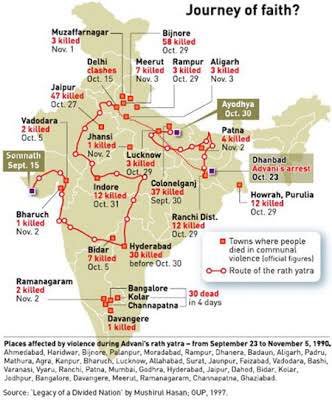
In 1989, it officially began a campaign to build a temple over the birthplace of the Hindu god Rama in the northern town of Ayodhya. (The Hindu activists whose train was attacked last February had been assisting in the construction of the temple.) Hindu nationalists have long claimed that the mosque that stood over the site was built in the 16th century by the first Mogul emperor, Babur, as an act of contempt toward Hinduism. The mosque was a symbol of slavery and shame, B.J.P. leaders declared, and removing it and building a grand temple in its place was a point of honor for all Hindus.
In December 1992, senior B.J.P. politicians watched as an uncontrollable crowd of Hindus, armed with shovels, pickaxes and crowbars and shouting ''Death to Muslims,'' demolished the mosque. It is estimated that at least 1,700 people, most of them Muslim, died during the riots that followed. In March 1993, Muslim gangsters, reportedly aided by the Pakistani intelligence agency, retaliated with simultaneous bomb attacks that killed more than 300 civilians.
The struggle over the construction of a Rama temple on the site continued throughout the 90's, inflaming both sides. Muslims (who form 12 percent of India's population of more than one billion) and secular Indians protested the Hindu nationalist attempt to rewrite history. But the nationalists fed on a growing dissatisfaction among upper-caste and middle-class Hindus. In March 1998, facing a fragmented opposition, the B.J.P. emerged as the single strongest party in the Indian Parliament, and Vajpayee and Advani took the top two jobs in the federal government.
After the massacres in Gujarat last year, the Hindu nationalist response was shockingly blunt. ''Let Muslims understand,'' an official R.S.S. resolution said in March, ''that their safety lies in the goodwill of the majority.'' Speaking at a public rally in April, Prime Minister Vajpayee seemed to blame Muslims for the recent violence. ''Wherever Muslims live,'' he said, ''they don't want to live in peace.'' Replying to international criticism of the killings in Gujarat, he said, ''No one should teach us about secularism.''
Vajpayee has worked hard to build close ties with the United States. Recent joint naval exercises in the Indian Ocean and frequent visits by Colin Powell seem to confirm Washington's view of India as a long-term ally against radical Islamism and China. But Vajpayee's efforts can also be seen as part of R.S.S.'s millenarian vision of India as a great superpower -- and not just in Asia. A clearer sense of his worldview can be had from a long discourse K.S. Sudarshan, the present supreme director of the R.S.S. and an adviser to Vajpayee and Advani, delivered to R.S.S. members in 1999.
In the address, he described how a new epic war was about to commence between the demonic and divine powers that forever contended for supremacy in the world. Sudarshan identified the United States as the biggest example of the ''rise of inhumanity'' in the contemporary world.
He claimed that India exercised the ''greatest terror'' over America, a theme he had touched on in his praise of India's nuclear tests in 1998 when he said that ''our history has proved that we are a heroic, intelligent race capable of becoming world leaders, but the one deficiency that we had was of weapons, good weapons.'' He ended his speech by predicting the ''final victory'' of Hindu nationalism.
"The Hindu nationalists are especially cautious at present,'' an Indian journalist told me this fall. ''Their fascistic nature has been obscured so far in the West by the fact that India is a democracy and a potentially large consumer market. They have managed to speak with two voices, one for foreign consumption and the other for local. But they know that religious extremists are under closer scrutiny worldwide after 9/11, and they know that they don't look too good after the killings of 2,000 Muslims in Gujarat.''
When I arrived at the R.S.S.'s media office in Delhi, I was told by the brusque young man in charge, ''The R.S.S. is not interested in publicity.'' Sudarshan declined my request for an interview. Deputy Prime Minister Advani also declined to be interviewed on his connection with the R.S.S. Other members bluntly refused to talk to what they described as an ''anti-Hindu'' foreign newspaper.
One person who would talk was Tarun Vijay, the young editor of an R.S.S. weekly who was described as the ''modern face of Hindu nationalism.'' Vijay shows up frequently on STAR News, India's most prominent news channel, and speaks both Hindi and English fluently. He is known as one of Advani's closest confidants.
When I ask Vijay about the R.S.S.'s role in the killings in Gujarat, his normally suave manner falters. ''Westerners don't understand,'' he says agitatedly, ''that the R.S.S. is a patriotic organization working for the welfare of all Indians.''
It must be said that his own career seems to prove this. He was so impressed by the ''selflessness'' and ''patriotism'' of the R.S.S. members he met as a young man, he says, that he left his home and went to work in western India protecting tribal peoples from discrimination. ''Some of my best friends are Muslims,'' he says. ''My wife wears jeans, and she wears her hair short. We eat at Muslim homes. There are reasonable people among Muslims, but they are afraid to speak out their minds. We are trying to have a dialogue with them. We are trying to talk with Christians also. After all, Jesus Christ is my greatest hero. But the left-wing and secular people are always portraying us as anti-Muslim and anti-Christian fanatics.''
'The superior organization of the R.S.S., which now reaches up to the highest levels of the Indian government, is its strength in a chaotic country like India. Christophe Jaffrelot, a French scholar and the leading authority on Hindu nationalism, says he believes that the mission of the R.S.S. is to ''fashion society, to sustain it, improve it and finally merge with it when the point [is] reached where society and the organization [are] co-extensive.'' Bharat Bhushan, a prominent Indian journalist, agrees. The R.S.S., he says, is ''the only organization which has consistently geared itself to micro-level politics.'' Its members run not just the biggest political party in India but also educational institutions, trade unions, literary societies and religious sects; they work to indoctrinate low-caste groups as well as affluent Indians living in the West.
The scale and diversity of this essentially evangelical effort is remarkable. Highly placed members of the R.S.S. conduct nuclear tests, strike a belligerent attitude toward Muslims and Pakistan and push India's claims to superpower status, while other members are involved in almost absurd small-time social engineering.
I was startled, for instance, when Vijay triumphantly showed me the headline in his magazine about the patenting of cow urine in the United States. Western science, he said, had validated an ancient Hindu belief in the holiness of the cow -- yet further proof of how the Hindu way of life anticipated and indeed was superior to the discoveries of modern science.
This was more than rhetoric. Forty miles out of Nagpur, at a clearing in a teak forest, I came across an R.S.S.-run laboratory devoted to showcasing the multifarious benefits of cow urine. Most of the cows were out grazing, but there were a few calves in a large shed that, according to the lab's supervisor, had been ''rescued'' recently from nearby Muslim butchers. In one room, its whitewashed walls spattered with saffron-hued posters of Lord Rama, devout young Hindus stood before test tubes and beakers full of cow urine, distilling the holy liquid to get rid of the foul-smelling ammonia and make it drinkable. In another room, tribal women in garishly colored saris sat on the floor before a small hill of white powder -- dental powder made from cow urine.
The nearest, and probably unwilling, consumers of the various products made from cow urine were the poor tribal students in the primary school next to the lab, one of 13,000 educational institutions run by Hindu nationalists. In gloomy rooms, where students studied and slept and where their frayed laundry hung from the iron bars of the windows, there were large gleaming portraits of militant Hindu freedom fighters.
I sat in the small office of the headmaster, a thin excitable young man. From the window, above which hung a large fantastical map of undivided India, I could see tribal women who had walked from their homes and now sat on the porch examining the sores and calluses on their bare feet, waiting to meet their children during recess. The principal explained to me how the R.S.S. member in charge of the federal government's education department was making sure that the new history textbooks carried the important message of Hindu pride and Muslim cruelty to every school and child in the country. His own work was to make the students aware of the glorious Hindu culture from which tribal living had sundered them. The message of the R.S.S., he said, was egalitarian and modern; it believed in raising low-caste people and tribals to a higher level of culture.
According to John Dayal, the vice president of the All India Catholic Union, the R.S.S. has spent millions of dollars trying to convert tribal people to Hindu nationalism. Dayal, who monitors the missionary activities of the R.S.S. very closely, claimed that in less than one year the R.S.S. distributed one million trishuls, or tridents, in three tribal districts in central India.
B.L. Bhole, a political scientist at Nagpur University, saw a Brahminical ploy in these attempts. ''The R.S.S. can't attract young middle-class people anymore, so they hope for better luck among the poor,'' he said. ''But the basic values the R.S.S. promotes are drawn from the high Sanskritic culture of Hinduism, which seeks to maintain a social hierarchy with Brahmins at the very top. The united Hindu nation they keep talking about is one where basically low-caste Hindus and Muslims and Christians don't complain much while accepting the dominance of a Brahmin minority.
''The R.S.S. has been most successful in Gujarat, where low-caste Hindus and tribals were indoctrinated at the kind of schools you went to. They were in the mobs led by upper-caste Hindu nationalists that attacked Muslims and Christians. But the R.S.S. still doesn't have much support outside Gujarat. This is a serious setback for them, and the only thing they can do to increase their mass base is keep stoking anti-Muslim and anti-Christian passions and hope they can get enough Hindus, both upper caste and low caste, behind them.''
The consistent demonizing of Muslims and Christians by Hindu nationalists may seem gratuitous -- Christians in India are a tiny and scattered minority, and the Muslims are too poor, disorganized and fearful to pose any kind of threat to Hindus -- but it is indispensable to the project of a Hindu nation. The attempt to unite low- and upper-caste Hindus in a united front against Muslims and Christians has certainly worked in the state of Gujarat. Ashok Singhal, the president of the Vishwa Hindu Parishad (World Hindu Council, V.H.P.), yet another R.S.S. affiliate, seemed to accept proudly the charge of inciting anti-Muslim hatred when he described last year's pogrom in Gujarat as a ''victory for Hindu society.'' Whole villages, he said, had been ''emptied of Islam.'' ''We were successful,'' he said, ''in our experiment of raising Hindu consciousness, which will be repeated all over the country now.''
This sounds like an empty threat, but the B.J.P.'s gains in the recent elections in Gujarat, where it did best in riot-affected areas, may have encouraged hard-liners to think that they can win Hindu votes by whipping up anti-Muslim hysteria elsewhere in India. Narendra Modi is to be the star campaigner for the B.J.P. in the local elections later this month in the north Indian state of Himachal Pradesh, an area with almost no Hindu-Muslim tensions to date. Virbhadra Singh, a senior opposition leader from the Congress, wonders if the Hindu nationalists have hatched an ''ill-conceived plan to stage-manage some terrorist incident in the state.''
John Dayal fears that Hindu nationalists may also target Christians. ''They have never been more afraid,'' he told me. ''I have been expecting the very worst since the B.J.P. came to power, and the worst, I think, may still be in the future.''
The worst possibility at present is of a militant backlash by Muslims. In the villages and towns near Ayodhya, I found Muslims full of anxiety. They spoke of the insidious and frequent threats and beatings they received from local Hindu politicians and policemen. At one mosque in the countryside, a young man loudly asserted that Muslims were not going to suffer injustice anymore, that they were going to retaliate. His elders shouted him down, and then a mullah gently led me out of the madrasa with one arm around my shoulders, assuring me that the Muslims were loyal to India, their homeland, where they had long lived in peace with their Hindu brothers.
Saghir Ahmad Ansari, a Muslim social activist in Nagpur, told me that the Muslims he knew felt ''that the Hindu nationalists, who were implacably opposed to their existence in India, now controlled everything, the government, our rights, our future.'' He said he worried about the Muslim response to Gujarat. ''When the government itself supervises the killing of 2,000 Muslims, when Hindu mobs rape Muslim girls with impunity and force 100,000 Muslims into refugee camps, you can't hope that the victims won't dream of revenge,'' he said. ''I fear, although I don't like saying or thinking about this, that the ideology of jihad and terrorist violence will find new takers among the 130 million Muslims of India. This will greatly please the Islamic fundamentalists of Pakistan and Afghanistan.''
His fears about vengeful Muslims were proved right in September, when terrorists reportedly from Pakistan murdered more than 30 Hindus at the famous Akshardham temple in Gujarat in ostensible retaliation for the massacres last winter. It was the biggest attack in recent years by Muslim terrorists outside of Kashmir, and the Hindu rage it provoked further ensured the victory of Hindu nationalist hard-liners in December's elections.
The growth of religious militancy in South Asia is likely to excite many Hindus. As they see it, Gujarat proved to be a successful ''laboratory'' of Hindu nationalism in which carefully stoked anti-Muslim sentiments eventually brought about a pogrom, and a Muslim backlash seemed to lead to even greater Hindu unity. A few months ago, I met Nathuram Godse's younger brother, Gopal Godse, who spent 16 years in prison for conspiring with his brother and a few other Brahmins to murder Gandhi. He lives in Pune, a western city known now for its computer software engineers. In his tiny two-room apartment, where the dust from the busy street thickly powders a mess of files and books and the framed garlanded photographs of Gandhi's murderer, Godse, a frail man of 83, at first seems like someone abandoned by history.
But recent events seem to Godse to have vindicated his Hindu nationalist cause. Gujarat proved that the Hindus were growing more militant and patriotic and that the Muslims were on the run not just in India but everywhere in the world. India had nuclear bombs; it was growing richer and stronger while Pakistan was slowly imploding. Only recently, Godse reminds me, Advani advocated the dismemberment of Pakistan.
India has turned its back on Gandhi, Godse claims, and has come close to embracing his brother's vision. Nathuram did not die in vain. He asked for his ashes to be immersed in the Indus, the holy river of India that flows through Pakistan, only when the Mother India was whole again. For over half a century, Godse has waited for the day when he could travel to the Indus with the urn containing his brother's ashes. Now, he says, he won't have to wait much longer.
Pankaj Mishra is the author of ''The Romantics,'' a novel, and is at work on a book about Buddha.
February 2, 2003
Magazine
The Other Face of Fanaticism
By PANKAJ MISHRA
On the evening of Jan. 30, 1948, five months after the independence and partition of India, Mohandas Gandhi was walking to a prayer meeting on the grounds of his temporary home in New Delhi when he was shot three times in the chest and abdomen. Gandhi was then 78 and a forlorn figure. He had been unable to prevent the bloody creation of Pakistan as a separate homeland for Indian Muslims. The violent uprooting of millions of Hindus and Muslims across the hastily drawn borders of India and Pakistan had tainted the freedom from colonial rule that he had so arduously worked toward. The fasts he had undertaken in order to stop Hindus and Muslims from killing one another had weakened him, and when the bullets from an automatic pistol hit his frail body at point-blank range, he collapsed and died instantly. His assassin made no attempt to escape and, as he himself would later admit, even shouted for the police.
Millions of shocked Indians waited for more news that night. They feared unspeakable violence if Gandhi's murderer turned out to be a Muslim. There was much relief, also some puzzlement, when the assassin was revealed as Nathuram Godse, a Hindu Brahmin from western India, a region relatively untouched by the brutal passions of the partition.
Godse had been an activist in the Rashtriya Swayamsevak Sangh (National Volunteers Association, or R.S.S.), which was founded in the central Indian city of Nagpur in 1925 and was devoted to the creation of a militant Hindu state. During his trial, Godse made a long and eloquent speech claiming that Gandhi's ''constant and consistent pandering to the Muslims'' had left him with no choice. He blamed Gandhi for the ''vivisection of the country, our motherland'' and said that he hoped with Gandhi dead ''the nation would be saved from the inroads of Pakistan.'' Godse requested that no mercy be shown him at his trial and went cheerfully to the gallows in November 1949, singing paeans to the ''living Motherland, the land of the Hindus.''
Now, more than half a century later, many Indians feel that the R.S.S. has never been closer to fulfilling its dream. Its political wing, the Bharatiya Janata Party (Indian People's Party, B.J.P.), the most important among the ''Sangh Parivar'' -- the ''family'' of various Hindu nationalist groups supervised by the R.S.S. -- has dominated the coalition government in New Delhi since 1998. Both Atal Bihari Vajpayee, India's prime minister, and his hard-line deputy and likely heir, L.K. Advani, belong to the R.S.S., and neither has ever repudiated its militant ideology.
In the last five years, the Hindu nationalists have conducted nuclear tests and challenged Pakistan to a fourth and final war with India. They have taken a much harsher line than previous governments with the decadelong insurgency in the Muslim majority state of Kashmir, which is backed by radical Islamists in Pakistan. After a terrorist attack on the Indian Parliament in December 2001, they mobilized hundreds of thousands of troops on India's border with Pakistan. The troops were partly withdrawn last October, but a war with Pakistan -- one involving nuclear weapons -- remains a terrifying possibility and is in fact supported by powerful, pro-Hindu nationalist sections of the Indian intelligentsia.
The Hindu nationalists' attempts to stoke Hindu fears about Muslims also appear to be succeeding among many of India's disaffected voters. In December, the B.J.P. won elections in the western state of Gujarat, despite being blamed by many journalists and human rights organizations for the vicious killings of more than 2,000 Muslims in Gujarat early last year.
According to a report by Human Rights Watch, the worst violence occurred in the commercial city of Ahmedabad: ''Between Feb. 28 and March 2 the attackers descended with militia-like precision on Ahmedabad by the thousands, arriving in trucks and clad in saffron scarves and khaki shorts, the signature uniform of Hindu nationalist -- Hindutva -- groups. Chanting slogans of incitement to kill, they came armed with swords, trishuls (three-pronged spears associated with Hindu mythology), sophisticated explosives and gas cylinders. They were guided by computer printouts listing the addresses of Muslim families and their properties . . . and embarked on a murderous rampage confident that the police was with them. In many cases, the police led the charge, using gunfire to kill Muslims who got in the mobs' way.''
The scale of the violence was matched only by its brutality. Women were gang-raped before being killed. Children were burned alive. Gravediggers at mass burial sites told investigators ''that most bodies that had arrived . . . were burned and butchered beyond recognition. Many were missing body parts -- arms, legs and even heads. The elderly and the handicapped were not spared. In some cases, pregnant women had their bellies cut open and their fetuses pulled out and hacked or burned before the women were killed.''
Narenda Modi, the chief minister of Gujarat, who is also a member of the R.S.S., explained the killings as an ''equal and opposite reaction'' (a statement he later denied) to the murder in late February of almost 60 people, most of whom were Hindu activists, by a mob of Muslims. The Human Rights Watch report disputed this defense, charging that the Hindu nationalists had planned the Gujarat killings well in advance of the attack on the Hindu activists. It cited widespread reports in the Indian media that suggest that a senior Hindu nationalist minister sat in the police control room in Ahmedabad issuing orders not to rescue Muslims from murder, rape and arson.
Many secular Indians saw the ghost of Nathuram Godse presiding over the killings in Gujarat. In an article in the prestigious monthly Seminar, Ashis Nandy, India's leading social scientist, lamented that the ''state's political soul has been won over by [Gandhi's] killers.'' This seems truer after Hindu nationalists implicated in India's worst pogrom won state elections held in Gujarat in December -- a fact that Praful Bidwai, a widely syndicated Indian columnist, described to me as ''profoundly shameful and disturbing.''
Not much is known about the R.S.S. in the West. After Sept. 11, the Hindu nationalists have presented themselves as reliable allies in the fight against Muslim fundamentalists. But in India their resemblance to the European Fascist movements of the 1930's has never been less than clear. In his manifesto ''We, or Our Nationhood Defined'' (1939), Madhav Sadashiv Golwalkar, supreme director of the R.S.S. from 1940 to 1973, said that Hindus could ''profit'' from the example of the Nazis, who had manifested ''race pride at its highest'' by purging Germany of the Jews. According to him, India was Hindustan, a land of Hindus where Jews and Parsis were ''guests'' and Muslims and Christians ''invaders.''
Golwalkar was clear about what he expected the guests and invaders to do: ''The foreign races in Hindustan must either adopt the Hindu culture and language, must learn to respect and hold in reverence Hindu religion, must entertain no ideas but those of glorification of the Hindu race and culture . . . or may stay in the country, wholly subordinated to the Hindu nation, claiming nothing, deserving no privileges.''
Fears about the rise of militant Hindu nationalism, present since the day Godse killed Gandhi, have been particularly intense since the late 1980's, when the Congress -- the party of Gandhi and Nehru that had ruled India for much of the previous four decades -- was damaged by a series of corruption scandals and allegations of misrule. The B.J.P., which began under another name in 1951, saw an opportunity in the decay of the Congress Party.
In 1989, it officially began a campaign to build a temple over the birthplace of the Hindu god Rama in the northern town of Ayodhya. (The Hindu activists whose train was attacked last February had been assisting in the construction of the temple.) Hindu nationalists have long claimed that the mosque that stood over the site was built in the 16th century by the first Mogul emperor, Babur, as an act of contempt toward Hinduism. The mosque was a symbol of slavery and shame, B.J.P. leaders declared, and removing it and building a grand temple in its place was a point of honor for all Hindus.
In December 1992, senior B.J.P. politicians watched as an uncontrollable crowd of Hindus, armed with shovels, pickaxes and crowbars and shouting ''Death to Muslims,'' demolished the mosque. It is estimated that at least 1,700 people, most of them Muslim, died during the riots that followed. In March 1993, Muslim gangsters, reportedly aided by the Pakistani intelligence agency, retaliated with simultaneous bomb attacks that killed more than 300 civilians.
The struggle over the construction of a Rama temple on the site continued throughout the 90's, inflaming both sides. Muslims (who form 12 percent of India's population of more than one billion) and secular Indians protested the Hindu nationalist attempt to rewrite history. But the nationalists fed on a growing dissatisfaction among upper-caste and middle-class Hindus. In March 1998, facing a fragmented opposition, the B.J.P. emerged as the single strongest party in the Indian Parliament, and Vajpayee and Advani took the top two jobs in the federal government.
After the massacres in Gujarat last year, the Hindu nationalist response was shockingly blunt. ''Let Muslims understand,'' an official R.S.S. resolution said in March, ''that their safety lies in the goodwill of the majority.'' Speaking at a public rally in April, Prime Minister Vajpayee seemed to blame Muslims for the recent violence. ''Wherever Muslims live,'' he said, ''they don't want to live in peace.'' Replying to international criticism of the killings in Gujarat, he said, ''No one should teach us about secularism.''
Vajpayee has worked hard to build close ties with the United States. Recent joint naval exercises in the Indian Ocean and frequent visits by Colin Powell seem to confirm Washington's view of India as a long-term ally against radical Islamism and China. But Vajpayee's efforts can also be seen as part of R.S.S.'s millenarian vision of India as a great superpower -- and not just in Asia. A clearer sense of his worldview can be had from a long discourse K.S. Sudarshan, the present supreme director of the R.S.S. and an adviser to Vajpayee and Advani, delivered to R.S.S. members in 1999.
In the address, he described how a new epic war was about to commence between the demonic and divine powers that forever contended for supremacy in the world. Sudarshan identified the United States as the biggest example of the ''rise of inhumanity'' in the contemporary world.
He claimed that India exercised the ''greatest terror'' over America, a theme he had touched on in his praise of India's nuclear tests in 1998 when he said that ''our history has proved that we are a heroic, intelligent race capable of becoming world leaders, but the one deficiency that we had was of weapons, good weapons.'' He ended his speech by predicting the ''final victory'' of Hindu nationalism.
"The Hindu nationalists are especially cautious at present,'' an Indian journalist told me this fall. ''Their fascistic nature has been obscured so far in the West by the fact that India is a democracy and a potentially large consumer market. They have managed to speak with two voices, one for foreign consumption and the other for local. But they know that religious extremists are under closer scrutiny worldwide after 9/11, and they know that they don't look too good after the killings of 2,000 Muslims in Gujarat.''
When I arrived at the R.S.S.'s media office in Delhi, I was told by the brusque young man in charge, ''The R.S.S. is not interested in publicity.'' Sudarshan declined my request for an interview. Deputy Prime Minister Advani also declined to be interviewed on his connection with the R.S.S. Other members bluntly refused to talk to what they described as an ''anti-Hindu'' foreign newspaper.
One person who would talk was Tarun Vijay, the young editor of an R.S.S. weekly who was described as the ''modern face of Hindu nationalism.'' Vijay shows up frequently on STAR News, India's most prominent news channel, and speaks both Hindi and English fluently. He is known as one of Advani's closest confidants.
When I ask Vijay about the R.S.S.'s role in the killings in Gujarat, his normally suave manner falters. ''Westerners don't understand,'' he says agitatedly, ''that the R.S.S. is a patriotic organization working for the welfare of all Indians.''
It must be said that his own career seems to prove this. He was so impressed by the ''selflessness'' and ''patriotism'' of the R.S.S. members he met as a young man, he says, that he left his home and went to work in western India protecting tribal peoples from discrimination. ''Some of my best friends are Muslims,'' he says. ''My wife wears jeans, and she wears her hair short. We eat at Muslim homes. There are reasonable people among Muslims, but they are afraid to speak out their minds. We are trying to have a dialogue with them. We are trying to talk with Christians also. After all, Jesus Christ is my greatest hero. But the left-wing and secular people are always portraying us as anti-Muslim and anti-Christian fanatics.''
'The superior organization of the R.S.S., which now reaches up to the highest levels of the Indian government, is its strength in a chaotic country like India. Christophe Jaffrelot, a French scholar and the leading authority on Hindu nationalism, says he believes that the mission of the R.S.S. is to ''fashion society, to sustain it, improve it and finally merge with it when the point [is] reached where society and the organization [are] co-extensive.'' Bharat Bhushan, a prominent Indian journalist, agrees. The R.S.S., he says, is ''the only organization which has consistently geared itself to micro-level politics.'' Its members run not just the biggest political party in India but also educational institutions, trade unions, literary societies and religious sects; they work to indoctrinate low-caste groups as well as affluent Indians living in the West.
The scale and diversity of this essentially evangelical effort is remarkable. Highly placed members of the R.S.S. conduct nuclear tests, strike a belligerent attitude toward Muslims and Pakistan and push India's claims to superpower status, while other members are involved in almost absurd small-time social engineering.
I was startled, for instance, when Vijay triumphantly showed me the headline in his magazine about the patenting of cow urine in the United States. Western science, he said, had validated an ancient Hindu belief in the holiness of the cow -- yet further proof of how the Hindu way of life anticipated and indeed was superior to the discoveries of modern science.
This was more than rhetoric. Forty miles out of Nagpur, at a clearing in a teak forest, I came across an R.S.S.-run laboratory devoted to showcasing the multifarious benefits of cow urine. Most of the cows were out grazing, but there were a few calves in a large shed that, according to the lab's supervisor, had been ''rescued'' recently from nearby Muslim butchers. In one room, its whitewashed walls spattered with saffron-hued posters of Lord Rama, devout young Hindus stood before test tubes and beakers full of cow urine, distilling the holy liquid to get rid of the foul-smelling ammonia and make it drinkable. In another room, tribal women in garishly colored saris sat on the floor before a small hill of white powder -- dental powder made from cow urine.
The nearest, and probably unwilling, consumers of the various products made from cow urine were the poor tribal students in the primary school next to the lab, one of 13,000 educational institutions run by Hindu nationalists. In gloomy rooms, where students studied and slept and where their frayed laundry hung from the iron bars of the windows, there were large gleaming portraits of militant Hindu freedom fighters.
I sat in the small office of the headmaster, a thin excitable young man. From the window, above which hung a large fantastical map of undivided India, I could see tribal women who had walked from their homes and now sat on the porch examining the sores and calluses on their bare feet, waiting to meet their children during recess. The principal explained to me how the R.S.S. member in charge of the federal government's education department was making sure that the new history textbooks carried the important message of Hindu pride and Muslim cruelty to every school and child in the country. His own work was to make the students aware of the glorious Hindu culture from which tribal living had sundered them. The message of the R.S.S., he said, was egalitarian and modern; it believed in raising low-caste people and tribals to a higher level of culture.
According to John Dayal, the vice president of the All India Catholic Union, the R.S.S. has spent millions of dollars trying to convert tribal people to Hindu nationalism. Dayal, who monitors the missionary activities of the R.S.S. very closely, claimed that in less than one year the R.S.S. distributed one million trishuls, or tridents, in three tribal districts in central India.
B.L. Bhole, a political scientist at Nagpur University, saw a Brahminical ploy in these attempts. ''The R.S.S. can't attract young middle-class people anymore, so they hope for better luck among the poor,'' he said. ''But the basic values the R.S.S. promotes are drawn from the high Sanskritic culture of Hinduism, which seeks to maintain a social hierarchy with Brahmins at the very top. The united Hindu nation they keep talking about is one where basically low-caste Hindus and Muslims and Christians don't complain much while accepting the dominance of a Brahmin minority.
''The R.S.S. has been most successful in Gujarat, where low-caste Hindus and tribals were indoctrinated at the kind of schools you went to. They were in the mobs led by upper-caste Hindu nationalists that attacked Muslims and Christians. But the R.S.S. still doesn't have much support outside Gujarat. This is a serious setback for them, and the only thing they can do to increase their mass base is keep stoking anti-Muslim and anti-Christian passions and hope they can get enough Hindus, both upper caste and low caste, behind them.''
The consistent demonizing of Muslims and Christians by Hindu nationalists may seem gratuitous -- Christians in India are a tiny and scattered minority, and the Muslims are too poor, disorganized and fearful to pose any kind of threat to Hindus -- but it is indispensable to the project of a Hindu nation. The attempt to unite low- and upper-caste Hindus in a united front against Muslims and Christians has certainly worked in the state of Gujarat. Ashok Singhal, the president of the Vishwa Hindu Parishad (World Hindu Council, V.H.P.), yet another R.S.S. affiliate, seemed to accept proudly the charge of inciting anti-Muslim hatred when he described last year's pogrom in Gujarat as a ''victory for Hindu society.'' Whole villages, he said, had been ''emptied of Islam.'' ''We were successful,'' he said, ''in our experiment of raising Hindu consciousness, which will be repeated all over the country now.''
This sounds like an empty threat, but the B.J.P.'s gains in the recent elections in Gujarat, where it did best in riot-affected areas, may have encouraged hard-liners to think that they can win Hindu votes by whipping up anti-Muslim hysteria elsewhere in India. Narendra Modi is to be the star campaigner for the B.J.P. in the local elections later this month in the north Indian state of Himachal Pradesh, an area with almost no Hindu-Muslim tensions to date. Virbhadra Singh, a senior opposition leader from the Congress, wonders if the Hindu nationalists have hatched an ''ill-conceived plan to stage-manage some terrorist incident in the state.''
John Dayal fears that Hindu nationalists may also target Christians. ''They have never been more afraid,'' he told me. ''I have been expecting the very worst since the B.J.P. came to power, and the worst, I think, may still be in the future.''
The worst possibility at present is of a militant backlash by Muslims. In the villages and towns near Ayodhya, I found Muslims full of anxiety. They spoke of the insidious and frequent threats and beatings they received from local Hindu politicians and policemen. At one mosque in the countryside, a young man loudly asserted that Muslims were not going to suffer injustice anymore, that they were going to retaliate. His elders shouted him down, and then a mullah gently led me out of the madrasa with one arm around my shoulders, assuring me that the Muslims were loyal to India, their homeland, where they had long lived in peace with their Hindu brothers.
Saghir Ahmad Ansari, a Muslim social activist in Nagpur, told me that the Muslims he knew felt ''that the Hindu nationalists, who were implacably opposed to their existence in India, now controlled everything, the government, our rights, our future.'' He said he worried about the Muslim response to Gujarat. ''When the government itself supervises the killing of 2,000 Muslims, when Hindu mobs rape Muslim girls with impunity and force 100,000 Muslims into refugee camps, you can't hope that the victims won't dream of revenge,'' he said. ''I fear, although I don't like saying or thinking about this, that the ideology of jihad and terrorist violence will find new takers among the 130 million Muslims of India. This will greatly please the Islamic fundamentalists of Pakistan and Afghanistan.''
His fears about vengeful Muslims were proved right in September, when terrorists reportedly from Pakistan murdered more than 30 Hindus at the famous Akshardham temple in Gujarat in ostensible retaliation for the massacres last winter. It was the biggest attack in recent years by Muslim terrorists outside of Kashmir, and the Hindu rage it provoked further ensured the victory of Hindu nationalist hard-liners in December's elections.
The growth of religious militancy in South Asia is likely to excite many Hindus. As they see it, Gujarat proved to be a successful ''laboratory'' of Hindu nationalism in which carefully stoked anti-Muslim sentiments eventually brought about a pogrom, and a Muslim backlash seemed to lead to even greater Hindu unity. A few months ago, I met Nathuram Godse's younger brother, Gopal Godse, who spent 16 years in prison for conspiring with his brother and a few other Brahmins to murder Gandhi. He lives in Pune, a western city known now for its computer software engineers. In his tiny two-room apartment, where the dust from the busy street thickly powders a mess of files and books and the framed garlanded photographs of Gandhi's murderer, Godse, a frail man of 83, at first seems like someone abandoned by history.
But recent events seem to Godse to have vindicated his Hindu nationalist cause. Gujarat proved that the Hindus were growing more militant and patriotic and that the Muslims were on the run not just in India but everywhere in the world. India had nuclear bombs; it was growing richer and stronger while Pakistan was slowly imploding. Only recently, Godse reminds me, Advani advocated the dismemberment of Pakistan.
India has turned its back on Gandhi, Godse claims, and has come close to embracing his brother's vision. Nathuram did not die in vain. He asked for his ashes to be immersed in the Indus, the holy river of India that flows through Pakistan, only when the Mother India was whole again. For over half a century, Godse has waited for the day when he could travel to the Indus with the urn containing his brother's ashes. Now, he says, he won't have to wait much longer.
Pankaj Mishra is the author of ''The Romantics,'' a novel, and is at work on a book about Buddha.
January 31, 2003
Communalism Combat
January 2003
Year 9 No.83
Protest
------------------------------------------------------------------------
India's Milosevic
Peace activists challenge corporate India’s courting of Narendra Modi
BY JAIRUS BANAJI
Some members of the Forum against Oppression of Women (FAOW) decided that we shouldn’t let the Confederation of Indian Industry (CII)’s honeymoon with Narendra Modi pass unprotested. So at the last minute we decided we would try and intervene in some way.
About 14 of us (including some from the group Insaaniyat) gathered in the Oberoi hotel lobby as corporate highfliers streamed into the elevators to fill the conference room on the terrace above floor 40. I smuggled myself in fairly early when security was lax and the room half-empty. Some of the Forum activists also managed to infiltrate. But Modi was late by over an hour and hotel security working with CID managed to weed out everyone who seemed inappropriately dressed for the occasion, once the alert went out that there was a ‘group’ in the hotel. Had there been even just 7-8 of us in the conference room, the impact would of course have been more disruptive, but possibly also less successful.
The atmosphere was depressingly obsequious, with corporate chieftains close to genuflection–disgusting stuff. One had to sit through Modi’s string of promises and self-proclaimed achievements till the meeting was thrown open. (Capital has fled Gujarat since the violence and the aim of this ‘interactive session’ was to give Modi a chance to woo investors back. The slogan was ‘Gujarat Unlimited’.)
After several rounds of the usual lobbying (privatisation, labour laws, etc.), Jamshed Godrej could no longer ignore my hand and said, "The gentleman in the brown shirt." I first introduced myself (as from Insaaniyat and the Oxford Corporate Governance Study; several of my interviewees were there and would have recognised me), then said:
"You cannot have a strong economy without justice, and you can’t have justice without the rule of law. By now there is considerable evidence that the Gujarat government actively connived in the slaughter of innocent men, women, and children in Gujarat last year." (Panic, consternation. Godrej interrupts, tries to shut me up, says, "This isn’t relevant to our meeting".) I respond, "Of course it’s relevant. How do you conduct business without the enforcement of contracts?" (Consternation mounts...Then the final blow.) My question is to the CII - "Why is the CII lending credibility to political forces that have blood on their hands?"
There seemed at that point a sort of corporate roar, the backlash of a wounded lion, and the CID moved in rapidly to haul me away, when Modi told them (in Hindi) to stop. He wanted me there so he could reply. All I did hear him say was that every meeting of his was being ‘hijacked’ by people like me ‘raising the same issues’ and seeking publicity. I was in no mood to allow him the luxury of replying, especially since my question had been directed to the CII, so (divested of the mike by this stage and at the back of the hall) I simply shouted, twice and very clearly so it would resonate in their heads forever: "There is no justice in Gujarat!"
Outside the room I was questioned briefly by the CID, then handed over to the police who took me and a whole group of Forum activists, who in the meantime had been detained in the basement of the Oberoi, to the nearest station where they kept us for about five hours. They were surprisingly gentle with us, and when Modi had finally left their South Bombay jurisdiction (after visiting the Ambanis at their home, late in the evening), we were released.
The women especially were thrilled that at least something had been done, otherwise everyone would have felt dejected and inordinately tired.
It is outrageous that a corporate body like the CII which claims to be in the forefront of modernisation in India should give credibility and support to a politician with Modi’s track record. It is a mere technicality that Modi and his ministers are not being tried in the Hague today before the International Criminal Court, the way Milosevic is being tried.
In India we have a tradition of not confronting painful events and experiences and deluding ourselves that we can grow without confronting our past. That is no more possible for societies than it is for individuals, and until we come out of this awful mindset we shall never be able to undermine the culture of impunity that allows politicians to commit crimes in the name of religion and get away with it.
January 2003
Year 9 No.83
Protest
------------------------------------------------------------------------
India's Milosevic
Peace activists challenge corporate India’s courting of Narendra Modi
BY JAIRUS BANAJI
Some members of the Forum against Oppression of Women (FAOW) decided that we shouldn’t let the Confederation of Indian Industry (CII)’s honeymoon with Narendra Modi pass unprotested. So at the last minute we decided we would try and intervene in some way.
About 14 of us (including some from the group Insaaniyat) gathered in the Oberoi hotel lobby as corporate highfliers streamed into the elevators to fill the conference room on the terrace above floor 40. I smuggled myself in fairly early when security was lax and the room half-empty. Some of the Forum activists also managed to infiltrate. But Modi was late by over an hour and hotel security working with CID managed to weed out everyone who seemed inappropriately dressed for the occasion, once the alert went out that there was a ‘group’ in the hotel. Had there been even just 7-8 of us in the conference room, the impact would of course have been more disruptive, but possibly also less successful.
The atmosphere was depressingly obsequious, with corporate chieftains close to genuflection–disgusting stuff. One had to sit through Modi’s string of promises and self-proclaimed achievements till the meeting was thrown open. (Capital has fled Gujarat since the violence and the aim of this ‘interactive session’ was to give Modi a chance to woo investors back. The slogan was ‘Gujarat Unlimited’.)
After several rounds of the usual lobbying (privatisation, labour laws, etc.), Jamshed Godrej could no longer ignore my hand and said, "The gentleman in the brown shirt." I first introduced myself (as from Insaaniyat and the Oxford Corporate Governance Study; several of my interviewees were there and would have recognised me), then said:
"You cannot have a strong economy without justice, and you can’t have justice without the rule of law. By now there is considerable evidence that the Gujarat government actively connived in the slaughter of innocent men, women, and children in Gujarat last year." (Panic, consternation. Godrej interrupts, tries to shut me up, says, "This isn’t relevant to our meeting".) I respond, "Of course it’s relevant. How do you conduct business without the enforcement of contracts?" (Consternation mounts...Then the final blow.) My question is to the CII - "Why is the CII lending credibility to political forces that have blood on their hands?"
There seemed at that point a sort of corporate roar, the backlash of a wounded lion, and the CID moved in rapidly to haul me away, when Modi told them (in Hindi) to stop. He wanted me there so he could reply. All I did hear him say was that every meeting of his was being ‘hijacked’ by people like me ‘raising the same issues’ and seeking publicity. I was in no mood to allow him the luxury of replying, especially since my question had been directed to the CII, so (divested of the mike by this stage and at the back of the hall) I simply shouted, twice and very clearly so it would resonate in their heads forever: "There is no justice in Gujarat!"
Outside the room I was questioned briefly by the CID, then handed over to the police who took me and a whole group of Forum activists, who in the meantime had been detained in the basement of the Oberoi, to the nearest station where they kept us for about five hours. They were surprisingly gentle with us, and when Modi had finally left their South Bombay jurisdiction (after visiting the Ambanis at their home, late in the evening), we were released.
The women especially were thrilled that at least something had been done, otherwise everyone would have felt dejected and inordinately tired.
It is outrageous that a corporate body like the CII which claims to be in the forefront of modernisation in India should give credibility and support to a politician with Modi’s track record. It is a mere technicality that Modi and his ministers are not being tried in the Hague today before the International Criminal Court, the way Milosevic is being tried.
In India we have a tradition of not confronting painful events and experiences and deluding ourselves that we can grow without confronting our past. That is no more possible for societies than it is for individuals, and until we come out of this awful mindset we shall never be able to undermine the culture of impunity that allows politicians to commit crimes in the name of religion and get away with it.
31 JANUARY 2003
Will CBI ever catch Advani?
The country had all but forgotten that Deputy Prime Minister Lal Krishna Advani is a suspect in a criminal case which the Central Bureau of Investigation is probing, in the same manner in which it is after other suspects ranging from Dawood Ibrahim to the businessmen involved in the many scandals that have marked the Atal Behari Vajpayee government’s four years in office. The momentary transfer of the CBI to the Deputy Prime Minister’s Home ministry, and the quick change back to the control of the Cabinet Secretariat which reports directly to the Prime minister, has in a way once again reopened the debate on whether persons facing a CBI enquiry should continue to hold high office. The other question, on when will judicial retribution finally catch up with the guilty of the Babri Masjid demolition in 1992 – the charge that Advani faces together with Uma Bharati and other stalwarts of the BJP government, will remain unanswered till the BJP remains in power. Advani had wriggled out of the Hawala racket case – and the judge who exonerated him has since gone on from one lucrative assignment to another.
Kya, Babri Masjid ka kalank nahin mit sakta?" (Can the Babri Mosque stigma ever be erased?) Advani reportedly asked Vinay Katiyar – now President of the Uttar Pradesh Bharatiya Janata party and then head of the Bajrang Dal -- in a meeting just before leaving for the rath yatra. "Hum to aapke aadesh ka intezar kar rahein hain, aur agar aap bole to Masjid ka namo-nishan mita de (we are awaiting your orders. If you say, we will eradicate all signs of the mosque)” - Vinay Katiyar to L. K. Advani when they met on December 1, 1992, just before the start of the rath yatra to Ayodhya, as quoted by Advani’s daughter in law Gauri Advani. `Babri demolition will unite Hindu vote bank', Advani said. "Iska kaam kar do.”
By John Dayal
This one embarrassed Prime miser Atal Behari Vajpayee, one of the few things that ever did. Earlier in the evening of Wednesday, 29th January 2003, he had reshuffled his cabinet, bringing in once again the smooth talking spin doctor Arun Jaitely, and giving former World Bank economist and one time Editor Arun Shourie some of the meatiest ministries available in the cabinet. Later in the evening, in what would have been a routine redefining of responsibilities, he asked President APJ Abdul Kalam to issue orders transferring the Central Bureau of Investigations, India’s ace criminal detection agency in charge of major fraud probes, to the Ministry of Home Affairs, controlled by Deputy Prime Minister Lal Krishna Advani. The President signed the orders. There the matter rested for a few hours.
It is not clear who first noticed that a situation could arise putting Vajpayee and his government in a spot. Perhaps it was the President’s Information Officer, Khan, who had earlier been the Public relations officer of the Central Bureau of Investigations for almost a decade. Anyway, whoever it was, both prime minister Vajpayee and President Kalam were told that there was a impropriety in Advani controlling the CBI, as the honourable home Union home minister, in his capacity as a former President of the Bharatiya Janata party, was facing a criminal investigation in which the CBI was probing his role in the demolition of the Babri Mosque on 6th de ember 1992 by a gang of Sangh parivar activists headed by Advani, Vinay Katiyar, Um Bharati, current union HRD minister Murli Manohar Joshi and others. Their gleeful photographs - specially the one of Uma embracing Joshi, had made the front pages of world newspapers. As had indeed Advani’s statements, and allegations made by his estranged daughter in law, Gauri.
Government wheels moved fast, and within twenty-four hours, Rashtrapati Bhawan issued another communication saying that the CBI had been taken out of the purview of the Home ministry and had been entrusted to the Cabinet secretariat, under the charge of the ;rime minister.
In fact, the morning newspapers pointed out, the CBI had for a long time been under the Prime minister, ever since Indira Gandhi and Rajiv Gandhi made their PMO and Cabinet secretariats the main repository of political power. The CBI, nominally controlled by the Department of Personnel, obeyed Prime ministerial orders conveyed to its directors through the Cabinet secretary, much as was he case with the Research and Analysis Wing, the espionage and government’s dirty tricks department together with a clutch of other top secret organisations going under various aliases.
The CBI, for all its political misuse, remains with the Supreme Court one of then most publicly trusted organisations in the eyes of the general public. There have been exposures of its fallibility, and the ease with which it allows itself to become a pawn in the hands of the government of the day, or the political powers that be. There is all too much evidence that it has been repeatedly misused by the ruling party to target political foes and inconvenient politicians – be they Laloo Yadav or some bureaucrat not toeing the official line.
But the fact remains that in a country with very few honest institutions that the public can trust, the Supreme Court and the CBI rise head and shoulders above the rest. The Supreme Court has in fact taken measures in response to several public interest litigations to try to make the CBI more honest and more powerful, and to insulate it from routine political interference. It has also enjoined on the CBI director, the second most senior posting for a police officer after that if the Director of the Intelligence Bureau, that certain guidelines of speed and integrity are demanded of CBI officials and of the institution as a whole.
Whenever there is a major scandal or crime, the popular demand is for a judicial enquiry or a CBI enquiry in the hope that the apex bodies would ensure a fair probe and ensure some modicum of justice.
Needless to say, the Special Police Establishment of 1941, which is the formal name of the Central Bureau of Investigations, is investigating cases against former Prime ministers POV Narasimha Rao and Rajiv Gandhi (the Bofors case) as also cases against a host of chief ministers and central ministers, their children, and some of the top businessmen of the country.
The CBI is also investigating the demolition of the Babri masjid at the hands of the Sangh parivar, though in this case, its wonted speed has not really been seen. Fourteen years after the event, the CBI and other ck missions are yet to complete their work against Advani and his political gangsters.
Needless to say, the Prime minister has been spared of a grave embarrassment. And thankfully for Civil Society, the incident has again focussed the glare of publicity on the Babri Case, the Advani’s involvement in it.
In fact, Advani is also involved in several other cases by association, most of them elating to his infamous Rath yatra in whose wake occurred dozens of communal riots across the length and breadth of the country in which hundreds of people, most of them from the minority community, were killed as the BJP marched forward to hone its Hindutva card.
Question are bound to be asked now by the Opposition now and in the forthcoming Budget session of Parliament as to the course of investigations, and the proceedings in the Commission of enquiry where Advani has himself deposed, and has been grilled by the counsel. Advani’s statement of his sorrow at the events of 2nd December 1992 has not been accepted by the public at large, and his political regret has not been borne out by his subsequent political conduct, including his recent defence of Narendra Modi’s single minded pogrom against Muslims in Gujarat on the run up to the State assembly elections in 2002.
Advani’s political pronouncements have repeatedly short circuited free and fair enquiry into major incidents of communal violence.
The public will remember his statements, as those of Prime minister Atal Behari Vajpayee after the destruction of three dozen churches in the Dangs district of Gujarat after Christmas of 1998. Vajpayee called for a debate on conversions and Advani though these were isolated incidents with which the Sangh had nothing to do.
When Graham Stuart Staines and his sons Timothy and Phillips were burnt alive by Dara Singh’s Bajrang Dal hordes in Manouherpur in Orissa in January 1999, Advani was he first to give the Bajrang Dal a clean bill of health, his certificate officially lifting suspicion from that killer organisation. Incidentally, three years on, the CBI through an Inspector now says the Bajrang Dal is not involved in the murder of the Staines. The CBI does not say how it came to a conclusion, or whether it has a comprehensive list of the Bajrang Dal, its members, followers, supporters and hangers on in Orissa and in the country. (For that matter, does the CBI have a comprehensive list of the membership of the RSS an the Shiv Sena, organisations involved in cases ranging from the murders of Mahatma Gandhi to the mass murder of Muslims in Mumbai in 1992 and in Gujarat in 2002?)
Advani was also the one who dismissed the anti Christian violence as isolated incidents, though he is quick to see an ISI hand in any incident in any part of the country even before the local police has collected the first shred of evidence from the ground.
As Union Home Minister and chief policeman of the country, Advani is possibly the most powerful and feared person in the country. His agencies have dossiers on all living politicians, information that comes in useful when taming a BJP chief minister or even an Opposition Member of parliament. No one actually believes he will ever be brought to book, or even indicted.
It is a tragedy in Indian politics that the CBI incident will not reopen the fist public debate that it should – Is it proper for a man facing a CBI probe to be a minister in the central Cabinet at all? Even if he is not directly in charge of the CBI, the CBI director and his staff know who is boss.
Morality would say it is grossly improper for Advani to be in office at all.
But there is little morality in politics.
And if this moral code were to be honestly implemented, most chief ministers, central ministers and senior bureaucrats would have to resign.
Even the Opposition is not going to back such transparency.
That is the real tragedy of the Republic of India.
o o o
Box Item with John Dayal’s Article
The Mumbai based MID DAY, in its edition of Saturday January 12, 2002 dropped a bombshell when it quoted Advani's estranged London-based lawyer daughter-in-law Gauri Advani telling the Liberhan Commission that the BJP leader plotted demolition of Ayodhya mosque with Vinay Katiyar in her presence.
Gauri, daughter of a journalist, got married to Lal Krishna Advani’s son Jayant in October 1991. Right from November 1989 till her wedding in October 1991, she had worked as Special Assistant with Advani and was looking after the New Delhi constituency from where he had contested and won the election.
On 28 November 1992, an application was moved in the Supreme Court seeking permission to carry out symbolic kar seva in Ayodhya. Anticipating favourable orders from the Court, Advani decided to start another rath yatra from Varanasi in eastern UP to mobilize kar sevaks for the kar seva. Gauri and her mother in law Kamla Advani accompanied. Advani to Lucknow on 30 November 1992 morning when all of them left for Varanasi by North East Express from Delhi. Advani started his rath yatra on 1.12.1992 from Varanasi. Before the start of the Rath Yatra, Vinay Katiyar came to meet L. K. Advani.
In her application filed before the commission, Gauri claimed she was present at the meeting when the two leaders allegedly discussed plans for the Babri demolition, Gauri requested she be made a witness before the commission to bring out the truth about the demolition. In her 10-page application, the estranged daughter-in-law derided Advani's statement before the commission that he was anguished by the Babri demolition and that he had nothing to do with it.
Gauri, a practising solicitor in London, said, "This is nothing but bundle of lies based upon concocted and false facts." She is embroiled in a divorce case with Advani's son, Jayant. Gauri said in her application that as Advani's special assistant she had looked after his New Delhi constituency from where he contested and won election to the Lok Sabha. Gauri said "The applicant (Gauri) at that time had deep faith in the ideology which Shri L. K. Advani used to propagate and bonafidely believed whatever Advani used to tell her as gospel truth".
According to her, on or around November 28, 1991, an application was moved in the Supreme Court seeking permission to carry out a symbolic kar seva in Ayodhya. Anticipating favourable orders from the Supreme Court, Advani decided to start another rath yatra from Varanasi to mobilise kar sevaks, Gauri said she and Advani's wife Kamala accompanied Advani to Lucknow on the morning of November 30, 1992, when all of them left for Varanasi. "Before the start of the rath yatra (on December 1, 1992), Shri Vinay Katiyar came to meet Shri L. K. Advani. The applicant (Gauri) was also present in this meeting. It was in this meeting Shri L. K. Advani and Shri Vinay Katiyar, in the presence of the applicant, conspired to demolish the Babri mosque. Shri L. K. Advani told Shri Vinay Katiyar that the ultimate aim of the Rath yatra... is not only to do kar seva and appease Hindu sentiment but also to garner votes and come to power at the Centre," Gauri said in her application, alleging that Advani told Katiyar that, "the movement to build the Ram Temple at Babri mosque had to be taken to its logical end, i.e. coming to power at the Centre, and that would not be possible without demolishing the Babri mosque as that will unite the Hindu vote bank in favour of the BJP."
Gauri goes on to say: "The applicant remembers that Shri L. K. Advani said, `Iska kaam kar do,' and again said, 'Kya, Babri Masjid ka kalank nahin mit sakta?' Shri Vinay Katiyar looked at the applicant and then said to Shri L. K. Advani that, `Hum to aapke aadesh ka intizaar kar rahen hain aur agar aap bole to masjid ka namo-nishaan mita de.' Shri L. K. Advani at that time smiled and then said, `To intizaar kis baat ka? Kaam kar do, ghulaami ke nishaan kab tak rahenge. Masjid ko dhawasth karke dikhao - sahi samay aa gaya hai.'
Gauri claimed she was not surprised at Advani's "outpourings" as "even at home the family members used to say that the kar seva in Ayodhya would not remain restricted to bhajan or kirtan". "It was the common refrain during discussions at home that the BJP can only come to power by playing the religion card," she said.
Gauri alleged that after the Babri demolition, Advani exulted on returning home: "Jo karne gaye the, wob kar aye".
Will CBI ever catch Advani?
The country had all but forgotten that Deputy Prime Minister Lal Krishna Advani is a suspect in a criminal case which the Central Bureau of Investigation is probing, in the same manner in which it is after other suspects ranging from Dawood Ibrahim to the businessmen involved in the many scandals that have marked the Atal Behari Vajpayee government’s four years in office. The momentary transfer of the CBI to the Deputy Prime Minister’s Home ministry, and the quick change back to the control of the Cabinet Secretariat which reports directly to the Prime minister, has in a way once again reopened the debate on whether persons facing a CBI enquiry should continue to hold high office. The other question, on when will judicial retribution finally catch up with the guilty of the Babri Masjid demolition in 1992 – the charge that Advani faces together with Uma Bharati and other stalwarts of the BJP government, will remain unanswered till the BJP remains in power. Advani had wriggled out of the Hawala racket case – and the judge who exonerated him has since gone on from one lucrative assignment to another.
Kya, Babri Masjid ka kalank nahin mit sakta?" (Can the Babri Mosque stigma ever be erased?) Advani reportedly asked Vinay Katiyar – now President of the Uttar Pradesh Bharatiya Janata party and then head of the Bajrang Dal -- in a meeting just before leaving for the rath yatra. "Hum to aapke aadesh ka intezar kar rahein hain, aur agar aap bole to Masjid ka namo-nishan mita de (we are awaiting your orders. If you say, we will eradicate all signs of the mosque)” - Vinay Katiyar to L. K. Advani when they met on December 1, 1992, just before the start of the rath yatra to Ayodhya, as quoted by Advani’s daughter in law Gauri Advani. `Babri demolition will unite Hindu vote bank', Advani said. "Iska kaam kar do.”
By John Dayal
This one embarrassed Prime miser Atal Behari Vajpayee, one of the few things that ever did. Earlier in the evening of Wednesday, 29th January 2003, he had reshuffled his cabinet, bringing in once again the smooth talking spin doctor Arun Jaitely, and giving former World Bank economist and one time Editor Arun Shourie some of the meatiest ministries available in the cabinet. Later in the evening, in what would have been a routine redefining of responsibilities, he asked President APJ Abdul Kalam to issue orders transferring the Central Bureau of Investigations, India’s ace criminal detection agency in charge of major fraud probes, to the Ministry of Home Affairs, controlled by Deputy Prime Minister Lal Krishna Advani. The President signed the orders. There the matter rested for a few hours.
It is not clear who first noticed that a situation could arise putting Vajpayee and his government in a spot. Perhaps it was the President’s Information Officer, Khan, who had earlier been the Public relations officer of the Central Bureau of Investigations for almost a decade. Anyway, whoever it was, both prime minister Vajpayee and President Kalam were told that there was a impropriety in Advani controlling the CBI, as the honourable home Union home minister, in his capacity as a former President of the Bharatiya Janata party, was facing a criminal investigation in which the CBI was probing his role in the demolition of the Babri Mosque on 6th de ember 1992 by a gang of Sangh parivar activists headed by Advani, Vinay Katiyar, Um Bharati, current union HRD minister Murli Manohar Joshi and others. Their gleeful photographs - specially the one of Uma embracing Joshi, had made the front pages of world newspapers. As had indeed Advani’s statements, and allegations made by his estranged daughter in law, Gauri.
Government wheels moved fast, and within twenty-four hours, Rashtrapati Bhawan issued another communication saying that the CBI had been taken out of the purview of the Home ministry and had been entrusted to the Cabinet secretariat, under the charge of the ;rime minister.
In fact, the morning newspapers pointed out, the CBI had for a long time been under the Prime minister, ever since Indira Gandhi and Rajiv Gandhi made their PMO and Cabinet secretariats the main repository of political power. The CBI, nominally controlled by the Department of Personnel, obeyed Prime ministerial orders conveyed to its directors through the Cabinet secretary, much as was he case with the Research and Analysis Wing, the espionage and government’s dirty tricks department together with a clutch of other top secret organisations going under various aliases.
The CBI, for all its political misuse, remains with the Supreme Court one of then most publicly trusted organisations in the eyes of the general public. There have been exposures of its fallibility, and the ease with which it allows itself to become a pawn in the hands of the government of the day, or the political powers that be. There is all too much evidence that it has been repeatedly misused by the ruling party to target political foes and inconvenient politicians – be they Laloo Yadav or some bureaucrat not toeing the official line.
But the fact remains that in a country with very few honest institutions that the public can trust, the Supreme Court and the CBI rise head and shoulders above the rest. The Supreme Court has in fact taken measures in response to several public interest litigations to try to make the CBI more honest and more powerful, and to insulate it from routine political interference. It has also enjoined on the CBI director, the second most senior posting for a police officer after that if the Director of the Intelligence Bureau, that certain guidelines of speed and integrity are demanded of CBI officials and of the institution as a whole.
Whenever there is a major scandal or crime, the popular demand is for a judicial enquiry or a CBI enquiry in the hope that the apex bodies would ensure a fair probe and ensure some modicum of justice.
Needless to say, the Special Police Establishment of 1941, which is the formal name of the Central Bureau of Investigations, is investigating cases against former Prime ministers POV Narasimha Rao and Rajiv Gandhi (the Bofors case) as also cases against a host of chief ministers and central ministers, their children, and some of the top businessmen of the country.
The CBI is also investigating the demolition of the Babri masjid at the hands of the Sangh parivar, though in this case, its wonted speed has not really been seen. Fourteen years after the event, the CBI and other ck missions are yet to complete their work against Advani and his political gangsters.
Needless to say, the Prime minister has been spared of a grave embarrassment. And thankfully for Civil Society, the incident has again focussed the glare of publicity on the Babri Case, the Advani’s involvement in it.
In fact, Advani is also involved in several other cases by association, most of them elating to his infamous Rath yatra in whose wake occurred dozens of communal riots across the length and breadth of the country in which hundreds of people, most of them from the minority community, were killed as the BJP marched forward to hone its Hindutva card.
Question are bound to be asked now by the Opposition now and in the forthcoming Budget session of Parliament as to the course of investigations, and the proceedings in the Commission of enquiry where Advani has himself deposed, and has been grilled by the counsel. Advani’s statement of his sorrow at the events of 2nd December 1992 has not been accepted by the public at large, and his political regret has not been borne out by his subsequent political conduct, including his recent defence of Narendra Modi’s single minded pogrom against Muslims in Gujarat on the run up to the State assembly elections in 2002.
Advani’s political pronouncements have repeatedly short circuited free and fair enquiry into major incidents of communal violence.
The public will remember his statements, as those of Prime minister Atal Behari Vajpayee after the destruction of three dozen churches in the Dangs district of Gujarat after Christmas of 1998. Vajpayee called for a debate on conversions and Advani though these were isolated incidents with which the Sangh had nothing to do.
When Graham Stuart Staines and his sons Timothy and Phillips were burnt alive by Dara Singh’s Bajrang Dal hordes in Manouherpur in Orissa in January 1999, Advani was he first to give the Bajrang Dal a clean bill of health, his certificate officially lifting suspicion from that killer organisation. Incidentally, three years on, the CBI through an Inspector now says the Bajrang Dal is not involved in the murder of the Staines. The CBI does not say how it came to a conclusion, or whether it has a comprehensive list of the Bajrang Dal, its members, followers, supporters and hangers on in Orissa and in the country. (For that matter, does the CBI have a comprehensive list of the membership of the RSS an the Shiv Sena, organisations involved in cases ranging from the murders of Mahatma Gandhi to the mass murder of Muslims in Mumbai in 1992 and in Gujarat in 2002?)
Advani was also the one who dismissed the anti Christian violence as isolated incidents, though he is quick to see an ISI hand in any incident in any part of the country even before the local police has collected the first shred of evidence from the ground.
As Union Home Minister and chief policeman of the country, Advani is possibly the most powerful and feared person in the country. His agencies have dossiers on all living politicians, information that comes in useful when taming a BJP chief minister or even an Opposition Member of parliament. No one actually believes he will ever be brought to book, or even indicted.
It is a tragedy in Indian politics that the CBI incident will not reopen the fist public debate that it should – Is it proper for a man facing a CBI probe to be a minister in the central Cabinet at all? Even if he is not directly in charge of the CBI, the CBI director and his staff know who is boss.
Morality would say it is grossly improper for Advani to be in office at all.
But there is little morality in politics.
And if this moral code were to be honestly implemented, most chief ministers, central ministers and senior bureaucrats would have to resign.
Even the Opposition is not going to back such transparency.
That is the real tragedy of the Republic of India.
o o o
Box Item with John Dayal’s Article
The Mumbai based MID DAY, in its edition of Saturday January 12, 2002 dropped a bombshell when it quoted Advani's estranged London-based lawyer daughter-in-law Gauri Advani telling the Liberhan Commission that the BJP leader plotted demolition of Ayodhya mosque with Vinay Katiyar in her presence.
Gauri, daughter of a journalist, got married to Lal Krishna Advani’s son Jayant in October 1991. Right from November 1989 till her wedding in October 1991, she had worked as Special Assistant with Advani and was looking after the New Delhi constituency from where he had contested and won the election.
On 28 November 1992, an application was moved in the Supreme Court seeking permission to carry out symbolic kar seva in Ayodhya. Anticipating favourable orders from the Court, Advani decided to start another rath yatra from Varanasi in eastern UP to mobilize kar sevaks for the kar seva. Gauri and her mother in law Kamla Advani accompanied. Advani to Lucknow on 30 November 1992 morning when all of them left for Varanasi by North East Express from Delhi. Advani started his rath yatra on 1.12.1992 from Varanasi. Before the start of the Rath Yatra, Vinay Katiyar came to meet L. K. Advani.
In her application filed before the commission, Gauri claimed she was present at the meeting when the two leaders allegedly discussed plans for the Babri demolition, Gauri requested she be made a witness before the commission to bring out the truth about the demolition. In her 10-page application, the estranged daughter-in-law derided Advani's statement before the commission that he was anguished by the Babri demolition and that he had nothing to do with it.
Gauri, a practising solicitor in London, said, "This is nothing but bundle of lies based upon concocted and false facts." She is embroiled in a divorce case with Advani's son, Jayant. Gauri said in her application that as Advani's special assistant she had looked after his New Delhi constituency from where he contested and won election to the Lok Sabha. Gauri said "The applicant (Gauri) at that time had deep faith in the ideology which Shri L. K. Advani used to propagate and bonafidely believed whatever Advani used to tell her as gospel truth".
According to her, on or around November 28, 1991, an application was moved in the Supreme Court seeking permission to carry out a symbolic kar seva in Ayodhya. Anticipating favourable orders from the Supreme Court, Advani decided to start another rath yatra from Varanasi to mobilise kar sevaks, Gauri said she and Advani's wife Kamala accompanied Advani to Lucknow on the morning of November 30, 1992, when all of them left for Varanasi. "Before the start of the rath yatra (on December 1, 1992), Shri Vinay Katiyar came to meet Shri L. K. Advani. The applicant (Gauri) was also present in this meeting. It was in this meeting Shri L. K. Advani and Shri Vinay Katiyar, in the presence of the applicant, conspired to demolish the Babri mosque. Shri L. K. Advani told Shri Vinay Katiyar that the ultimate aim of the Rath yatra... is not only to do kar seva and appease Hindu sentiment but also to garner votes and come to power at the Centre," Gauri said in her application, alleging that Advani told Katiyar that, "the movement to build the Ram Temple at Babri mosque had to be taken to its logical end, i.e. coming to power at the Centre, and that would not be possible without demolishing the Babri mosque as that will unite the Hindu vote bank in favour of the BJP."
Gauri goes on to say: "The applicant remembers that Shri L. K. Advani said, `Iska kaam kar do,' and again said, 'Kya, Babri Masjid ka kalank nahin mit sakta?' Shri Vinay Katiyar looked at the applicant and then said to Shri L. K. Advani that, `Hum to aapke aadesh ka intizaar kar rahen hain aur agar aap bole to masjid ka namo-nishaan mita de.' Shri L. K. Advani at that time smiled and then said, `To intizaar kis baat ka? Kaam kar do, ghulaami ke nishaan kab tak rahenge. Masjid ko dhawasth karke dikhao - sahi samay aa gaya hai.'
Gauri claimed she was not surprised at Advani's "outpourings" as "even at home the family members used to say that the kar seva in Ayodhya would not remain restricted to bhajan or kirtan". "It was the common refrain during discussions at home that the BJP can only come to power by playing the religion card," she said.
Gauri alleged that after the Babri demolition, Advani exulted on returning home: "Jo karne gaye the, wob kar aye".
Indian Journal of Secularism
A Journal of Centre for Study of Society and Secularism
Vol. 6, No.4, January - March 2003
Contents
I. Articles
Power Sharing - the Significance of the Malaysia
Experience for Muslims in Multi-religious Societies
- Chandra Muzaffar
The Agony in Gujarat - A Report on Gujarat Riots
- Shree Shankar Sharan
The BJP Sweep in Gujarat - A Moment of Reflection for India
- Dr. Asghar Ali Engineer
Muslims and Gujarat: Some observations
- Babasaheb Kazi
Voice from the Valley: Contemporary Kashmiri Sufi Perspectives
- Irfan Hamdani & Yoginder Sikand
The Mahdi of Panna: A Short History of the Pranamis (Part - I)
- Dominique-Sila Khan
II. Special Report
Glimpse of Gujarat in a Martyrs' City
(A Fact Finding Report on Sholapur Communal Riots)
- Dr. Anand Teltumbde, Hari Das & Gopal
III. Book Review
Pan-Islam in British Indian Politics: A Study of the Khilafat Movement 1918-24
- Hamza Alavi
Subscription Rates
India Abroad
Single Issue - Rs.50/- Single Issue US$10
Annual (individuals) - Rs. 200/- Annual (Individual) - US$35
Annual (Institution & Annual (Institutions &
Libraries) - Rs.350/- Libraries) - US$50
For Copies Contact
he Circulation Manager,
Centre for Study of Society and Secularism,
9B, Himalaya Apts., 1st Floor,
6th Road, Santacruz (E),
Mumbai:- 400 055,
India.
E-mail:-csss@vsnl.com
A Journal of Centre for Study of Society and Secularism
Vol. 6, No.4, January - March 2003
Contents
I. Articles
Power Sharing - the Significance of the Malaysia
Experience for Muslims in Multi-religious Societies
- Chandra Muzaffar
The Agony in Gujarat - A Report on Gujarat Riots
- Shree Shankar Sharan
The BJP Sweep in Gujarat - A Moment of Reflection for India
- Dr. Asghar Ali Engineer
Muslims and Gujarat: Some observations
- Babasaheb Kazi
Voice from the Valley: Contemporary Kashmiri Sufi Perspectives
- Irfan Hamdani & Yoginder Sikand
The Mahdi of Panna: A Short History of the Pranamis (Part - I)
- Dominique-Sila Khan
II. Special Report
Glimpse of Gujarat in a Martyrs' City
(A Fact Finding Report on Sholapur Communal Riots)
- Dr. Anand Teltumbde, Hari Das & Gopal
III. Book Review
Pan-Islam in British Indian Politics: A Study of the Khilafat Movement 1918-24
- Hamza Alavi
Subscription Rates
India Abroad
Single Issue - Rs.50/- Single Issue US$10
Annual (individuals) - Rs. 200/- Annual (Individual) - US$35
Annual (Institution & Annual (Institutions &
Libraries) - Rs.350/- Libraries) - US$50
For Copies Contact
he Circulation Manager,
Centre for Study of Society and Secularism,
9B, Himalaya Apts., 1st Floor,
6th Road, Santacruz (E),
Mumbai:- 400 055,
India.
E-mail:-
Subscribe to:
Posts (Atom)