Resources for all concerned with culture of authoritarianism in society, banalisation of communalism, (also chauvinism, parochialism and identity politics) rise of the far right in India (and with occasional information on other countries of South Asia and beyond)
84% Of 12 Million Married Children Under 10 Are Hindus
by Devanik Saha
India Spend, 1 June, 2016)
Nearly 12 million Indian children were married before the age of 10 years--84% of them Hindu and 11% Muslim--reveals an IndiaSpend analysis of recently released census data.
To put it in context, this number is equivalent to Jammu & Kashmir’s population.
As
many of 7.84 million (65%) married children were female, reinforcing
the fact that girls are significantly more disadvantaged; eight in 10
illiterate children who were married were also girls. [ . . . ]
Why fears over rising Muslim population share, immigration unfounded
October 2, 2021, 9:49 PM IST SA Aiyar in Swaminomics, India, TOI
The rise of communal tension in recent years owes much to the BJP’s stress on two themes. One is high Muslim fertility that supposedly threatens the majority status of Hindus. The second is the threat to India from Muslim immigrants from Bangladesh, who have been called “termites” by Home Minister Amit Shah. Both themes have been torpedoed by recent analysis of India’s own data by the Pew Research Centre, a non-partisan US think tank. [ . . . ]
https://timesofindia.indiatimes.com/blogs/Swaminomics/why-fears-over-rising-muslim-population-share-immigration-unfounded/
This map is an interactive tool depicting incidents of communal violence
that have taken place across India between 2013-2016, based on official
statistics from the Ministry of Home Affairs (MHA).
GOVERNMENT OF INDIA MINISTRY OF HOME AFFAIRS
LOK SABHA UNSTARRED QUESTION NO. 849
TO BE ANSWERED ON THE 7TH FEBRUARY, 2017/ MAGHA 18, 1938 (SAKA) COMMUNAL VIOLENCE
849. PROF. PREM SINGH CHANDUMAJRA: SHRI M.B. RAJESH:
ANSWER
MINISTER OF STATE IN THE MINISTRY OF HOME AFFAIRS (SHRI KIREN RIJIJU)
Fact check: Are illegal Bangladeshi migrants responsible for increase in Assam's Muslim population?
As National Register of Citizens is updated to identify illegal immigrants, a former statistics professor’s book busts a few myths about the state’s demography.
Reuters
Census reports have long been a pivot of Assam’s politics, spawning anxiety among its people that “unabated infiltration” from Bangladesh would endanger their cultural identity. It is claimed that the influx from the neighbouring nation is why Muslims have grown from being 24.68% of the state’s population in 1951 to 28.43% in 1991 and 34.22% in 2011.
It is a myth that Infiltration: Genesis of Assam Movement busts conclusively.Thebook, published last year, is written by Abdul Mannan, former professor of statistics at Gauhati University. He concludes that Assam’s Muslim population has increased because of the community’s high birth rate and not because of illegal immigration from Bangladesh. Illegal immigrants in Assam are estimated to number between 16 lakh and 84 lakh, in a total population of 3.12 crore according to the 2011 Census.
Discussing Mannan’s findings in a recent article in the Economic and Political Weekly, the political scientist Akhil Ranjan Dutta wrote:
“Successive censuses have proved, as Abdul Mannan has established using extensive data in his recent book on immigration in Assam, that birth rates among Scheduled Tribes, Scheduled Castes, and Christians in Assam had been even higher than among Muslims during 1971-91. This was due to the backwardness of these communities in all dimensions of development.”
But that is getting ahead of the story.
In the 1950s and 1960s, successive Congress governments expelled lakhs of Bengali Muslims from Assam on the ground that they were illegal infiltrators from what was then East Pakistan. It was not until Bangladesh became an independent country in 1971, however, that popular anger against the so-called foreigners acquired intensity. Bangladeshi Muslims were perceived to be flooding into Assam through the porous border to escape poverty.
By 1979-80, the All Assam Students Union was spearheading the anti-foreigner movement, cashing in on wild estimates of the number of Bangladeshi immigrants to gain wide support. One estimate numbered the Bangladeshis at 45% of Assam’s estimated population of 1.6 crore in 1981. Such claims were hard to refute, not least because the 1981 Census could not be conducted owing to the Assam agitation, then at its peak.
In 1991, the Census reported that Muslims were 28.43% of Assam’s population, up from 24.56% in 1971. Several publications interpreted these figures to reach an alarming conclusion: Bangladeshis were demographically colonising Assam.
For instance, Asam Bani, a popular weekly, claimed in its August 18, 1994 edition that 16 lakh Bangladeshis had entered Assam between 1971 and 1991. Who were they? Muslims, Asam Bani declared, after analysing the Census data. Since Hindus had a growth rate of 41.89% in 1971-1991 and Muslims 77.42%, the weekly argued that the excess growth rate of Muslims was primarily because of the Bangladeshis.
It further argued that had the influx from Bangladesh been negligible, the growth rate of Muslims would not have exceeded 45%. Why? It did not offer a reason. Still, such claims became common sense in Assam.
It is this common sense that Mannan challenges: the rise in Assam’s Muslim population was not unusual and it was not a consequence of immigration from Bangladesh. After all, the all-India growth rate of Muslims between 1971 and 1991 was 71.47%, just a little lower than the 77.42% that the Muslims of Assam clocked in the same period.
More significantly, the growth rate of Assam’s Muslims in 1971-1991 compared favourably with the community’s growth rate in states such as Uttar Pradesh (76.30%), West Bengal (77.32%), Madhya Pradesh (80.76%), Rajasthan (98.29%), Tripura (89%), Punjab (110.32%) and Himachal Pradesh (77.64%). Barring Punjab, all these states have always had sizeable Muslim populations.
In this context, Mannan asks a crucial question: “If it is assumed that the high growth rate among Muslims in Maharashtra, Punjab and Haryana is due to the migration of Muslim workers from Uttar Pradesh, Bihar, Assam or West Bengal, then how would we explain the high growth rate in Uttar Pradesh, Himachal Pradesh, Madhya Pradesh, Odisha, Rajasthan and West Bengal?”
Certainly not on account of Bangladeshi infiltrators, with West Bengal perhaps being the exception.
The growth rate of Hindus (41.89%) in Assam in 1971-1991 was indeed much lower than that of Muslims (77.42%). But parsing this low growth rate throws up a story: Assam’s Scheduled Castes and Scheduled Tribes grew at a higher rate than even Muslims – Scheduled Castes at 81.84% and Scheduled Tribes at 78.91%.
The high growth rate of Scheduled Castes and Scheduled Tribes too is not unique to Assam. As Table 2 shows, the growth rate of Scheduled Castes was far higher than that of Hindus generally in most states. In fact, Scheduled Castes in Andhra Pradesh (83.43%), Maharashtra (189.44%) and Karnataka (91.41%) grew at a higher rate than in Assam. The growth rate of Scheduled Tribes followed similar trends as Table 2 shows. (Remember that Scheduled Tribes, unlike Scheduled Castes, are more concentrated in some states.)
Referring to these trends, Mannan asks: Is the higher growth rate among Muslims, Scheduled Castes and Scheduled Tribes linked to poverty, illiteracy and social backwardness?
He proceeds to answer this question through another statistical comparison. Table 3 shows the growth rates of various communities in each of Assam’s 23 districts between 1971 and 1991. (There are now 33 districts). The growth rate of the Scheduled Castes is higher than that of Muslims in 10 districts. In eight districts, the Scheduled Tribes outstrip the growth rate of Muslims.
Significantly, Mannan compares the growth rates of Muslims in Upper Assam and Lower Assam in this period. This is because Muslims in Upper Assam are largely of indigenous origin while Lower Assam is home to Muslims of Bengali origin. The latter are not infiltrators. They are descendants of Bengali Muslim peasants settled by the British in marshy and riverine areas of Assam to boost agriculture. Some also migrated voluntarily in search of livelihood, but, in undivided India, they were just moving from one part of the country to another.
Assam’s districts have been repeatedly divided to create new ones, leading to a peculiar trend in Dhemaji. When this district was carved out of Lakhimpur in 1989, a large number of Muslims moved to the latter for reasons of livelihood. Dhemaji thus registered a negative growth rate for Muslims, as Table 3, prepared soon after the new district was created, shows.
In 2011, Hindus comprised 95.47% of Dhemaji’s population and Muslims just 1.96%. “Dhemaji’s Muslim population was low even in 1987,” Mannan told Scroll.in. “The migration of Muslims brought down the population sharply and led to the community’s growth rate being negative. But the growth rate of Muslims in Dhemaji in 2001-2011 crawled up to 20%.”
Leave out Dhemaji as an anomaly then. In all other districts of Upper Assam except Jorhat and Sibsagar (now Sivasagar), the growth rate of Muslims was over 68%. In Jorhat, it was 60.80% and in Sibsagar 59.01%.
What Jorhat and Sibsagar have in common is a high literacy rate. In 1991, it was 65.89% for Jorhat and 64.84% for Sibsagar, much higher than the state average of 52.89%. The high literacy rates are a consequence of their relative prosperity – a large number of Assam’s tea gardens and oil fields are concentrated in these two districts, and they hum with business.
Literacy and prosperity translated, not surprisingly, in the low growth rate of Hindus in Jorhat (33.54%) and Sibsagar (35.91%). But why was the growth rate of Muslims still substantially higher than that of Hindus in the two districts? “The reason may be the social backwardness and relative poverty among Muslims,” Mannan suggests.
He also points out another statistical peculiarity: “If those who say Bangladeshi immigrants have ballooned the population of Muslims in Lower Assam, then how would they explain their high growth rate in the districts of Tinsukia (89.56%), Golaghat (97.24%) and Dibrugarh (68.43%), which are in Upper Assam, where the presence of migrant Muslims is negligible?”
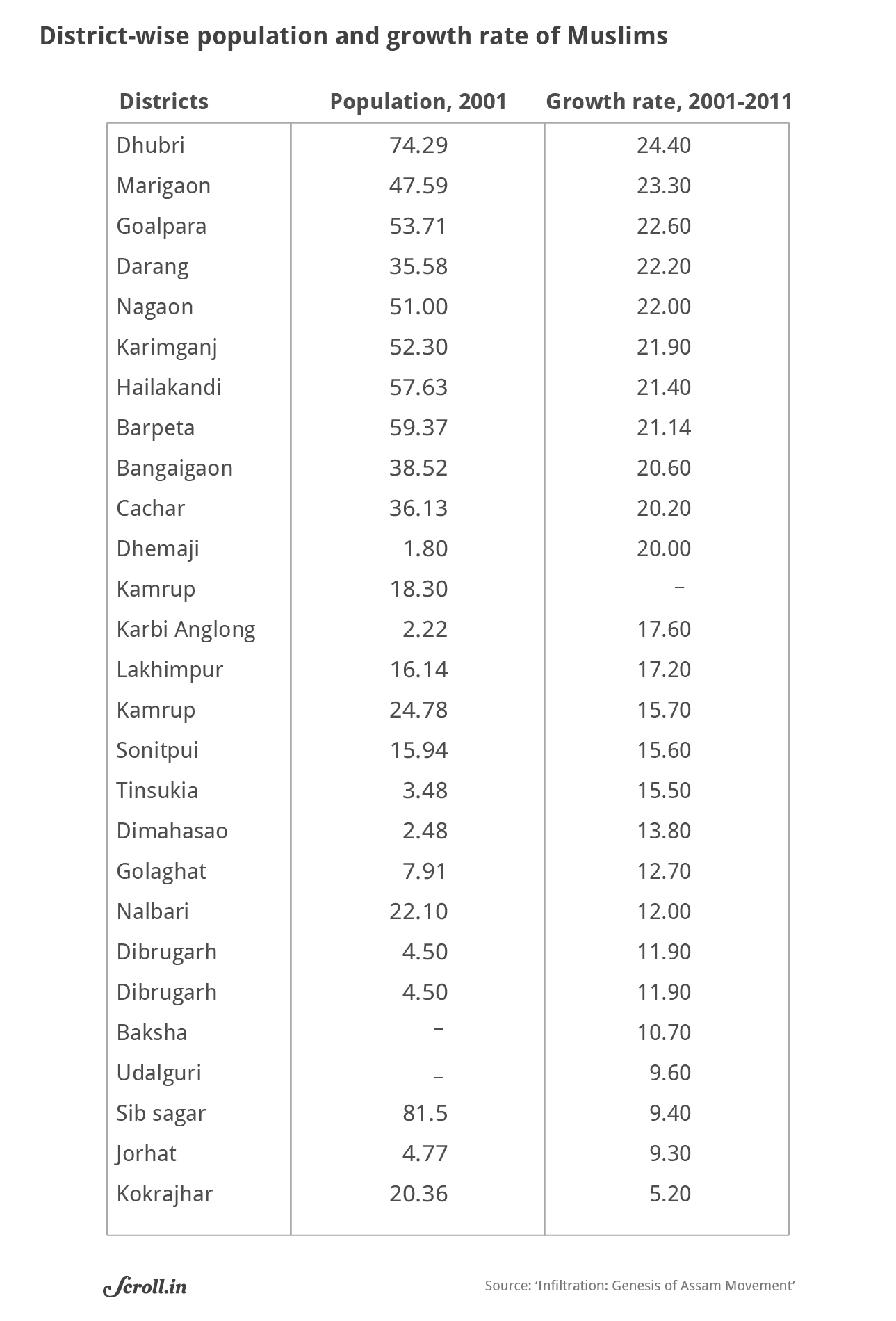
Mannan then turns the spotlight on Table 4, based on the Census figures of 2001 and 2011. It shows that districts with a growth rate of 21% and above also have a high percentage of Muslims. What explains this phenomenon? Mannan chooses two districts – Jorhat and Dhubri – for comparison. In 2001-2011, Dhubri registered the highest growth rate (24.4%) among all districts of Assam. By contrast, Jorhat clocked the lowest growth rate of 9.3%.
This gulf between the population growth rates was mirrored in other social indicators. Dhubri had an infant mortality rate of 72 in 2011 as against Jorhat’s 57. In Dhubri, there was a doctor for every 10,844 people as compared to one for every 7,189 people in Jorhat. Dhubri’s literacy rate of 48.21% was far behind Jorhat’s 76.21%. There was one lower primary school for every 1,129 people in Dhubri as against one for every 638 people in Jorhat. Dhubri had a bank branch for every 29,239 people while Jorhat had one for every 11,355 people. The per capita loan disbursal in Jorhat was three times more than Dhubri’s.
It is truism in demographic studies that population explosion is a consequence of poverty, illiteracy, insufficient health and sanitation services, and a sluggish economy. “This is precisely true of Assam too,” Mannan writes.
Indeed, many foot soldiers of the Assam agitation have veered around to thinking that the presence of Bangladeshi Muslims is not as high as was previously believed. One of them is popular TV anchor and author of Assam After Independence Mrinal Talukdar. In his college days, he was deeply engaged with the All Assam Students Union’s movement. “During those days I believed Bangladeshi Muslims had a substantial presence in Assam,” Talukdar told Scroll.in. “I have a neutral position on the issue now. I am willing to go by whatever number the National Register of Citizens throws up.”
Mannan says he is certain that if the ongoing exercise to update the National Register of Citizens is carried out honestly, Bangladeshi Muslims in Assam will be counted in thousands, not in lakhs.
Regardless of how many Bangladeshi Muslims the National Register of Citizens identifies, there is no denying that the truth about Assam’s demography was sacrificed on the altar of politics. It seems spurious theories about Bangladeshi Muslims were spun not out of ignorance, but with intent. In this, two Assam police officers and the Rashtriya Swayamsevak Sangh played a crucial role. The RSS deftly turned the All Assam Students Union’s movement against outsiders, that is, Indians from other states, into one against foreigners, that is, Bangladeshi Muslims.
The second part of this series will look at how the two police officers and the RSS changed the course of the Assam movement. This is the first part of a two-part series. Ajaz Ashraf is a journalist in Delhi.
How two police officers and RSS changed the script of the Assam agitation against outsiders in 1980s
When it started in 1979, All Assam Students Union’s stir was
against Indians from other states, but it soon morphed into a movement
against Muslim immigrants.
In 1979, the All Assam Students Union launched a mass
agitation to evict outsiders. By outsiders, the union’s leaders meant
Indians from elsewhere who were perceived to control Assam’s economy. In
a few months, though, they changed tack and started railing against
foreigners, specifically illegal immigrants from Bangladesh.
This
alteration in the course of the agitation has long been ascribed to the
union’s leaders realising that the Assamese people were bothered more
about Bangladeshi migrants than Indians from other states. Abdul Mannan
turns this thesis on its head. He shows the change came about in no
small measure because of the efforts of two senior police officers and
the Rashtriya Swayamsevak Sangh.
In his book Infiltration: Genesis of Assam Movement,
published last year, the former professor of statistics at Gauhati
University cites the forgotten memoir of one of the officers to show how
they courted the union’s leaders and persuaded them to redirect popular
anger towards Bangladeshi immigrants.
The officers were Hiranya Kumar Bhattacharyya and Premkanta Mahanta. The memoir Mannan draws on is Rajbhaganar Para Kal Thokalaike
– the title roughly translates as “from dethronement to the plantain
grove” – which Mahanta wrote and self-published in 1994. His intention
behind writing it, Mahanta stated, was “to help historians with some
truths” that might be forgotten.
Mahanta’s story begins in 1978,
the year Golap Borbora’s Janata Party swept the Congress from power in
Assam. The Janata Party was a medley of organisations, including the
Jana Sangh, which would be rechristened the Bharatiya Janata Party in
1980.
On October 1, 1978, the new government appointed Deputy
Inspector General of Police Bhattacharyya to head the Border Police
Division. It was a historic “historic event for Assam”, Mahanta writes
in his memoir, as was his own appointment in the same division the
following February.
Mahanta’s was not a routine transfer. He
claims that Bhattacharyya “zealously…got me transferred from the post of
Head of the Police Training Camp to that of the SP of the Border Police
Division”.
By then, Bhattacharyya had already started identifying
and expelling Bangladeshi migrants, Muslim and Hindu, from Nalapara,
Mangaldoi and Tamulpur in Rangia, kicking off a political storm, Mahanta
writes. “I affirm that...the six-year-long Assam movement [1979 to
1985] would not have taken place if we hadn’t come together at this
point,” he says.
In March 1979, about a month after Mahanta joined
the Border Police Division, the All Assam Students Union held a
conference in Sibsagar, now Sivasagar, where Prafulla Kumar Mahanta was
elected its president and Bhrigu Kumar Phukan the general secretary. The
conference, Mannan notes, adopted 21 resolutions, one of which spoke of
the “menace posed to the existence of the Assamese by the outsiders who
controlled Assam’s economy”. The idea of Bangladeshi immigrants
threatening the state’s cultural identity had not yet been formulated.
Fuelling the fire
That
same month, Hiralal Patowari, MP from Mangaldoi, died, necessitating a
bye-election. On April 27, 1979, the customary notice to revise the
electoral rolls went out in Mangaldoi. The two police officers feared
that Bangladeshi immigrants would try to get their names on the rolls –
and use it to claim citizenship. To thwart them, Mahanta thought of
sending a Border Police Division officer with every Registrar of Voters.
The problem was, Bhattacharyya pointed out, there was not sufficient
time to train them for such a task.
Bhattacharyya had another
idea. He persuaded Chief Secretary RS Paramasivam to ask Chief Election
Commissioner SL Shakdhar for more time to revise the roll. Shakdhar gave
them an extra week. But instead of trying to prevent Bangladeshi
migrants from enrolling as voters, Mahanta writes, Bhattacharyya “came
up with the idea that since more time was granted, the names of foreign
nationals on the rolls of 1978 might also be struck off.”
This was
a cumbersome process. The rules demanded that for a name to be removed
from a particular electoral register, a voter from that polling booth
must submit a complaint in a form costing 10 paise and another voter
from the same booth must second the complaint. Bhattacharyya and Mahanta
figured that mobilising public opinion was the only way to achieve
their goal, and they launched a publicity blitz. The media began
tracking the identification process.
Next, Mahanta suggested
that they should rope in leaders who could sway public opinion on the
matter. So, Bhattacharyya hosted Purbanchaliya Loka Parishad’s Nibaran
Bora and Asam Jatiyatabadi Dal’s Nagen Hazirka for dinner. Both were
known to Mahanta from school. The memoir does not disclose what they
discussed over dinner other than that they decided to focus on the
students union leaders.
“Almost about the same time in March, the
news of Sri Prafulla Kumar Mahanta being elected as president and Shri
Bhrigu Phukan being elected as general secretary of the All Assam
Students Union…was published,” Mahanta writes. “The 21-Point Charter of
the AASU carried in it a significant point of the alarming proportion of
the unbridled influx of outsiders into Assam. At our suggestion, the
two student leaders were brought from their University hostels in order
to drive home to them the problem caused by foreign nationals…We
provided them with adequate data and information. Thenceforth, they
agreed to give priority to the issue of foreign nationals and deletion
of their names from voters’ list.”
Mahanta does not identify who organised his and Bhattacharyya’s meeting with the student leaders.
The
two officers were successful in achieving their objective: at its
executive meeting on May 23, 1979, the students union adopted a
resolution calling for a 12-hour state-wide bandh the next month to
press for the expulsion of “Bangladeshi infiltrators”.
In the
meantime, as names started being struck off voter lists in Mangaldoi,
Congress leaders complained to the Election Commission that “police had
been hatching a conspiracy by indicting genuine Indian citizens as
foreigners”, Mahanta recalls. The commission ordered a halt to the
deportation of allegedly illegal migrants and deletion of their names
from the electoral rolls. By then, however, complaints had been received
about 47,658 voters and 36,780 of them had been identified as
foreigners, Mahanta notes.
Mahanta, despite his candour, does not
mention what became of these thousands of people identified as
foreigners, Manan points out. “Were they driven out of Assam?” he asks.
“Or is it that they are still in Assam? What is the status of their
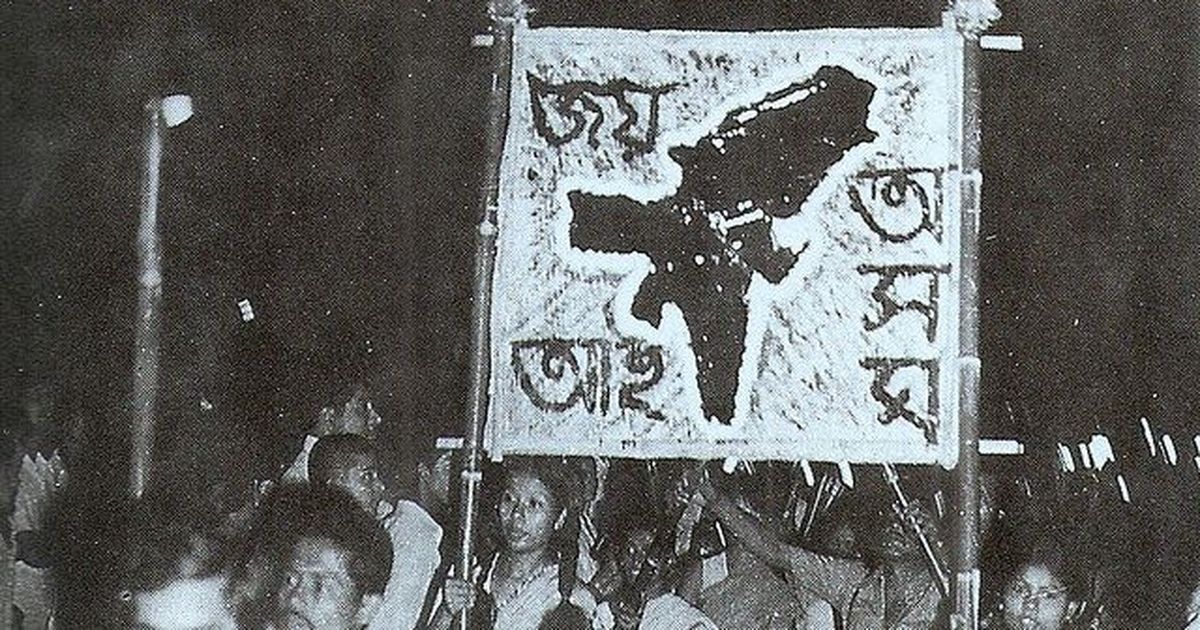
citizenship?” All Assam Students Union leaders meet Prime Minister Indira Gandhi. Photo via archive.is/txIiq
A cause transformed
The
controversy over Mangaldoi’s electoral rolls became a lightning rod for
the Assam agitation. Successive governments fell, and the students
union’s war cry was now “three Ds” – detection of Bangladeshi
immigrants, deletion of their names from voter lists, and their
deportation. Assam went into shutdown for nearly a year.
In April
1980, Union Home Minister Giani Singh visited Assam to try and break the
impasse. This was followed by a midnight call from Prime Minister
Indira Gandhi to Governor LP Singh, asking whether December 31, 1965 as
the cutoff date for identifying foreigners – anyone who could not prove
they had lived in Assam before that date would be deemed a foreigner and
expelled – would be acceptable to the people. It was not to the
political leadership the governor turned to.
“The governor called
Bhattacharyya and wanted to know if the student leaders would accept the
proposal,” Mahanta writes in his memoir. “Bhattacharyya with certainty
assured the governor that it would be accepted.” Clearly, the governor
was well aware of Bhattacharyya’s relationship with the student leaders.
Bhattacharyya
immediately went to Mahanta’s residence. “We were overjoyed, sensing
the possibility of such a great success,” Mahanta recalls. “With rapture
and passion we awaited the sun to rise. That night we imagined a bunch
of thoughts and ambitious plans. Rented buildings of the Maruwari, where
the office of the Border Police Division was housed whence the
foreigners expulsion movement originated, we will purchase that and
construct a memorial there.”
Of their own role in the movement,
Mahanta declares, “If we two had not come together, the movement called
‘Assam movement’ would not have happened. I repeat it would not have
happened.”
In 1981, Bhattacharyya was dismissed from service and
imprisoned for a year under the National Security Act for his
involvement in the Assam agitation. Subsequently, the Supreme Court set
aside his dismissal and granted him post-retirement benefits.
But did the two police officers act out of their own conviction? Or were they merely puppets whose strings someone else pulled?
In the shadows
In those days, Bhattacharyya came across as an enigmatic personality. When the journalist Chaitanya Kalbag, then at India Today magazine,
met Bhattacharyya in 1983, he lived in a luxurious house bizarrely
called Wilderness. To Kalbag, Bhattacharyya cavilled against people who
believed the Assam agitation against foreigners was communal. After
Mangaldoi, Bhattacharyya claimed, 55% of the 5.8 lakh foreigners he had
helped detect were Hindu.
Bhattacharyya was also vehemently
opposed to communists. “Every Hindu [Bangladeshi] means a vote for the
communists,” he told Kalbag. “The entire Brahmaputra valley, once an
oasis of nationalism in this desert of insurgency, is surrounded by
Marxist expansionists and Bengali cultural expansionists.”
Mannan
believes Bhattacharyya and Mahanta were deeply influenced by the
ideology of the RSS, which, alarmed at the Left’s growing clout in
Assam, was willing to raise the spectre of “global multinational
neo-imperialist forces”. Not only had the Left won 24 seats in the 1978
Assembly election, it was “ruling the roost” in the universities. The
RSS wanted to smother its ideological rival in Assam, says Mannan.
In
his book, Mannan quotes leaders of the RSS, the BJP and the Asom Gana
Parishad, the name the All Assam Students Union adopted to fight
elections, to establish that the Hindutva forces were deeply involved in
the Assam movement. Even Prime Minister Narendra Modi worked there
during those stormy years. “A well-known [former] BJP state president
also revealed in one of his private conversations [to him] that during
the Assam agitation, Narendra Modi used to move about as a pillion rider
behind him on his scooter in many places in Guwahati,” Mannan writes.
But
was it really the RSS that shifted the focus of the Assam agitation
from Indian outsiders to illegal Bangladeshis? Yes, declares The Last Battle of Saraighat: The story of the BJP’s rise in the North-east by Rajat
Sethi and Shubhrastha. The book’s foreword is by RSS leader and BJP
general secretary Ram Madhav. The book identifies Shubhrastha to be
working with Madhav’s office and Sethi as the political adviser of
Manipur Chief Minister N Biren Singh, who left the Congress for the BJP
in 2016. Considering such credentials of its authors, the Last Battle of Saraighatshould be treated as an authoritative voice from the Sangh Parivar.
“RSS first transformed the agitation from being anti-bahirgat to being an anti-videshi
movement,” Sethi and Shubhrastha write, using the Assamese expressions
for outsider and foreigner. “In gradual course of time, the sentiments
were further directed against the immigrant Bangladeshis and later
against the Bangladeshi Muslims.”
It was precisely the trajectory the Assam movement took.
The
transformation of the Assam movement into a communal enterprise
happened in 1980, as Mahanta’s memoir and Mannan’s book show. The
timeline provided in The Last Battle of Saraighat confirms this. “After a series of meetings, in 1980, the RSS stated its opinion that Hindus were sharanarthis (asylum seekers) and Muslims were anupraveshkaaris
(infiltrators),” Sethi and Shubhrastha write. In this view, the Hindus
had fled Bangladesh to escape religious persecution while the Muslims
had slipped into Assam in search of better economic opportunities.
“Therefore,
RSS cleverly delineated its position on the Bangladeshi migration
issue,” Sethi and Shubhrastha write. “It took a severe position against
the Muslim migrants, articulating its idea of selective protection to
Hindu migrants in Assam.” In doing so, the RSS preyed upon the fear of
Bangladeshi Muslims demographically colonising Assam. The fear was
insidiously exaggerated, as the first part of this series shows.
The popular TV anchor and author of Assam After Independence Mrinal Talukdarwas
a foot soldier of the Assam agitation. “It has always been an article
of faith in Left circles that the Assam movement was a CIA project
called Brahmaputra,” he said. “The theory is that the Left had gained
West Bengal and Tripura and Assam was in its crosshairs. The Left had to
be checked. Obviously, it is just a theory, but there is no doubt that
subnationalism killed the Left in Assam. In hindsight, there is a case
for saying that the Assam movement was hijacked.”
The Left was
indeed killed in Assam, but so were many people for a cause that was
framed differently from how it had been conceived. This is the second part of a two-part series. Ajaz Ashraf is a journalist in Delhi.
Theodore Mascarenhas, secretary-general of the Catholic
Bishops Council of India, the apex body of Roman Catholics, recently
appealed to Prime Minister Narendra Modi to curb the “spread of hatred
by [Jharkhand] Chief Minister Raghubar Das”. Mascarenhas pointed out
that a manifestation of this hatred was the advertisement the Das
government issued in August, accusing Christian missionaries of
converting Dalits and Adivasis to Christianity.
The advertisement was published just before the state legislature adopted the Religious Freedom Bill, 2017,
which prescribes stringent punishment to those convicted of using force
or allurement to proselytise people. It is hard to tell whether hatred
motivates Das, but he is undeniably paranoid about Christians and
Muslims outstripping Hindus in Jharkhand, which, according to the 2011
Census, is nowhere near facing such a threat.
Christians account
for just 4.3% of Jharkhand’s population, Muslims 14.53% and Hindus
67.83%, according to the Census. If the figure for Hindus is relatively
low in comparison to many states, it is because 12.84% of the state’s
population counted themselves as followers of “Other Religions”, an
omnibus category of local faiths in the Census.
In Jharkhand,
followers of “Other Religions” are primarily those of the Sarna faith,
who worship nature. For long, they have been campaigning to have Sarna
assigned a separate code during the Census so that it is recognised as a
distinct religion, instead of being subsumed in the category of “Other
Religions.”
Despite Jharkhand having a minority population of
31.67% (including Muslims, Christians and Other Religions), Hinduism is
the majority religion in 19 out of 24 districts of the state. Only
Simdega is a Christian majority district, with 51.4% of the population
following that faith. But Simdega is also the third least populated
district. Topping the list of least populated districts are Lohardaga
and Khunti, both of which have Hindus in the minority. None of these
three districts has a population of over six lakhs. In addition, Hindus
are also in the minority in Gumla and Paschimi Singhbhum, both of which
have a population of over 1 crore each. Except
for Simdega, it is Sarna followers who are dominant in the four
remaining districts in which Hindus are a minority. Sarnas account for
51.1% of Lohardaga’s population, 44.62% of Gumla’s, 45.37% of Khunti’s,
and a whopping 62.96% of Paschimi Singhbhum. In contrast, Christians
comprise just 3.63% of Lohardaga’s population, 19.75% of Gumla’s, a
substantial 25.65% of Khunti’s and 5.83% of Paschimi Singhbhum’s.
It
is obvious that after decades of providing healthcare and education
facilities, apart from their alleged evangelism, Christian missionaries
have not managed to convert Adivasis on a scale as is alleged.
Given
that Christians in Jharkhand are also largely Adivasis, the leaders of
the Sarna faith support the anti-conversion law, dismayed as they are to
see their numbers dwindle. But the alleged propensity of Christian
missionaries to covert Adivasis is just a factor in their decreasing
population.
As Krishna Kant Toppo, a former secretary of the now-defunct Sarna Central Committee, told the Indian Express,
“The best thing would be the Sarna code, which would enable us to get
enumerated in the Census as a separate religion. Otherwise…some give in
to the Church, others migrate, and a few of them get to recite Hanuman
Chalisa in the morning.”
Spectre of conversions
For
well over a century, India’s Census, conducted every 10 years, has been
a crucial factor in bolstering caste and religious consciousness. This
is precisely why Hindutva leaders are reluctant to support the demand
for Sarna to be treated as a separate religion. They insist that those
classified under the category of “Other Religions” in the Census are
Hindu, on the basis of which they invent a Hindu identity for them.
They
also raise the spectre of India turning Christian with a little help
from the West. This was the rationale behind passing anti-conversion
laws in a slew of states – Odisha, Chhattisgarh, Madhya Pradesh,
Himachal Pradesh, Gujarat and now Jharkhand.
When the Census
religion data of 2011 was released in 2015, newspapers carried alarmist
stories saying that the Christian population in Odisha has grown by 478%
and Muslims by 323% in the last 50 years, as against Hindus increasing
by just 130%. Who would ever put out a headline saying that despite
growing by 478%, Christians are just 2.77% of Odisha’s population today,
rising from 1.15% in 1961. (Muslims are 2.17% and Hindus 93.63%.) Between
2001 and 2011, Odisha’s Hindu population dipped by 0.72%. In 1961, they
constituted 97.57% of the state’s population. They are nowhere near
being swamped. All districts in Odisha are Hindu majority. The Christian
population has crossed double digits in percentage terms in only three
of them. These are Sundargarh (18.39%), Kandhamal (20.31%) and Gajapati
(37.98%). The category of Other Religions constitutes just 1.14% of the
state’s population. In
Chhattisgarh, for all the talk of missionaries converting Adivasis, the
state’s 18 districts at the time of the 2011 Census (nine new districts
were carved out in 2012) have an overwhelming Hindu majority.
Christians comprise just 1.92% of the state’s population, Muslims 2.02%
and Hindus 92.25%. Only Jashpur district has a Christian population of
22.26%. None of the remaining 17 districts has a Christian population of
more than 5%. In fact, in 11 of these, Christians comprise less than 1%
of the population. In
Madhya Pradesh, judging from the stories of missionaries being nabbed
while converting Hindus, it would seem that the Christianisation of the
state is well underway. In reality, however, Christians comprise just
0.29% of the state’s population. According to the 2011 Census, 48 of
Madhya Pradesh’s 50 districts (the 51st district was created in 2013)
have less than 1% of Christians, and the remaining two less than 4%.
These are Jhabua (3.75%) and Mandla (1.18%). Himachal
Pradesh has 95.17% Hindus, 2.18% Muslims and just 0.18% Christians.
Eleven of the state’s 12 districts have Hindus in the majority. Hindus
are in the minority in Lahaul and Spiti, where Buddhists account for
62.01% of the population. Himachal Pradesh is the only state where an
anti-conversion law was passed by a Congress government, in 2007. Similarly,
in Gujarat, where an anti-conversion law was enacted in 2003 under the
chief ministership of Narendra Modi, Christians comprise just 0.52% of
the state’s population (Muslims are 9.67% and Hindus 88.57%.) According
to the 2011 Census, its 26 districts (seven more were carved out in
2013) are all Hindu majority. Barring Tapi with 6.77% and The Dangs with
8.77%, the Christian population does not exceed 2% in any other
district in the state.
These figures testify that either Christian
missionaries are not particularly zealous about proselytisation, or are
terrible at their mission, or people are not as amenable to conversion
as Hindutva ideologues think.
Hindutva propaganda
Indeed,
the outcry against missionaries is just propaganda designed, as
Mascarenhas pointed out, to mobilise people for the Hindutva cause. The
mobilisation is based on spreading hatred against Christian missionaries
and dividing Adivasis on the basis of their faith. It also prevents
Adivasi assertion, required to ensure they do not unite to oppose mines,
the setting up of factories and exploitation of forests. As the only
party to bait religious minorities, the Bharatiya Janata Party hopes to
gain from the polarisation between Christian Adivasis and those who have
been Hinduised or follow local faiths.
Fathoming the pitfalls of
such polarisation, Sarna leaders in Jharkhand said they would study the
provisions of the state’s anti-conversion law and, simultaneously,
demanded a separate religion code for Sarna. But Hindutva leaders,
including Raghubar Das, have been silent on this demand. This is because
to accept it would undermine Hindutva’s very idea of uniting
non-Christians and non-Muslims under an overarching Hindu identity and
counting them as adherents of Hinduism.
Then again, if Sarna is
recognised as a separate religion, as Buddhism and Jainism are, then
what about the claims of Lingayats who say they are not Hindu? Or, what about the Ravidassias,
who declared themselves as a separate religion in 2010? Recognising
Sarna as a separate religion could very well trigger separatist
tendencies in Hinduism.
Stirrings for a separate religious
identity are suppressed by propagating that there is a conspiracy to
convert Hindus into Christianity or Islam. Intermittent violence against
these minorities helps to consolidate the Hindu community. After all,
communities, like nations, tend to forget their differences in the time
of conflict. This is vital for Hindutva’s mission of turning the 80%
Hindus in India into a monolithic political constituency.
This is
also precisely why Hindutva has raised the bogey of evangelism by
Christian missionaries, never mind that there is no possibility that the
land of Adivasis will transform into Christendom at least for the next
few centuries.
Religious tourism is defined as going for a pilgrimage and it may or may not involve an overnight stay. Photo: HT
With
Prime Minister Narendra Modi and President Pranab Mukherjee visiting
the holy shrines at Kedarnath and Badrinath in Uttarakhand earlier this
month, chief minister Trivendra Singh Rawat
is optimistic about the state’s prospects in the new tourist season.
How popular is religious tourism among Indians? Does religion or class
affect the probability of people undertaking pilgrimages?
Studies conducted by Lokniti at the Delhi-based Centre for Study of
Developing Societies (CSDS) help us answer such questions. The studies
show that nearly one in two Indians plan to undertake religious tourism
in the next two years and a bigger number reported doing so in the past
two years.
A study conducted by Lokniti on Religious attitudes,
behaviour and practices in 2015 shows that a significant section of the
population in all major religious groups in India reported having
undertaken religious tourism over the past two years. Religious tourism
is defined as going for a pilgrimage and it may or may not involve an
overnight stay. There was significant inter-religious variation in
prevalence of religious tourism though, with the figure being around
three-fourth for Sikhs and one-third for Muslims and Christians.
Does
class play a role in people undertaking religious tourism? Among
Hindus, class does not seem to have any influence on religious tourism,
but among Muslims, lower classes seem to have a slightly higher
probability of undertaking pilgrimages. The results are based on
Lokniti’s multi-dimensional economic class index which takes into
account income, asset ownership, place of residence and occupation.
The
popular perception that older people are more likely to go for
pilgrimages seems to be slightly misplaced. Among Hindus, we find no
age-based pattern as respondents from all age-groups were equally likely
to have undertaken a pilgrimage. Among Muslims, those aged 56 years or
above were relatively much more likely to have undertaken a pilgrimage.
While there is no gender-based difference among Hindu pilgrims, Muslim
men are more likely to undertake pilgrimages than women.
Given the
rise in religiosity in the country, going for pilgrimages may increase
in times to come. The same study also shows that more than 25% Indians
reported having become more religious over the past 4-5 years. The trend
is valid across religions and in keeping with other attitudinal
surveys. Between 2007 and 2015, the share of respondents in India who
perceived religion to be very important increased by 11 percentage
points to 80%, according to the Pew Global Attitude surveys.
Religious
places are ranked high in preferred tourist destinations for Indians,
according to the State of Nation Study conducted by Lokniti in 2008,
which found that 39% of the respondents reported pilgrimages/holy sites
as their most preferred location for a vacation.
These findings,
however, are slightly different from a National Sample Survey Office
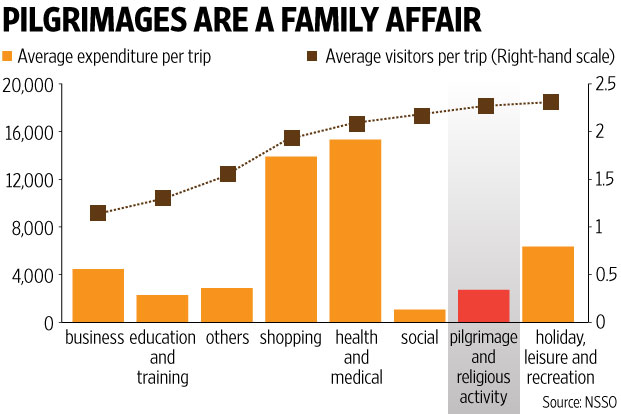
(NSSO) report on domestic tourism for 2008-09. The report found that
social purposes accounted for almost three-fourth of all overnight
trips, while pilgrimages and religious trips accounted for only around
one in 10 such trips in the year preceding the survey. Although the NSSO
released a similar report in 2014-15, it can’t be compared with the
Lokniti findings as NSSO figures are based on response for the last 30
days, against Lokniti’s period of past two years.
Nonetheless,
the NSSO report does show that average expenditure on religious trips
has more than doubled during this period, and it is ranked second in
terms of average number of persons per household who go on such trips.
The broad trends seem to suggest that religious tourism should be accorded priority in India’s tourism policy. This story is based on survey data shared exclusively with Mint. Pranav Gupta is a researcher with Lokniti CSDS and Sanjay Kumar is professor and currently director of CSDS
Give us your religion, caste, Aadhaar: HRD to all college teachers
. . . the Ministry of Human Resource Development has, over the last four months, profiled at least 60 per cent of more than 15 lakh university and college teachers, complete with individual details such as religion, caste, Aadhaar and phone numbers.
Teachers who are yet to furnish personal details have another month to comply. Moves are also afoot to create a similar students’ database next year.
Communalising Population Growth: Understanding Demographic Data
Ram Puniyani
The biases and misconceptions about
conversions and population growth have been used by communal forces to
divide the society. This became apparent once again when Minister of
state of Home, Kiren Rijuju tweeted that that Hindu population is
decreasing in the country as Hindus don’t convert and that minorities in
India are flourishing unlike in the neighbouring countries.
Threat of decline in Hindu population
and increase in population of minorities is being propagated time and
over again. As per the data of 2011 census figures, Hindu population now
stands at 79.8 % and Muslim population at 14.23%. “The data on
Population by Religious Communities of Census 2011 show that between
2001 and 2011, Hindu population grew by 16.76 per cent, while that of
Muslims by 24.6 per cent. The population of both communities grew faster
during the previous decade, at 19.92 per cent and 29.52 per cent,
respectively. As a long-term trend, say demographers, the communities’
growth ratesare
converging.” This means that the decadal rates of growth of both
communities is declining and converging closer to each other.
This is pointer to the fact that while
charting out the future projections it is important to keep in mind that
the rate of growth of Muslim population will be falling and will
stabilise closer to that of rate of rise Hindu population. In the total
population Muslims will remain a religious minority for the times to
come. Interestingly the population increase of Hindus during the period
of 2001 to 2011 has been 133 millions, which is close to the total
population of Muslims in 2001.The scare being spread through word of
mouth campaign and through social media about Muslim population taking
over the Hindu population holds no water, as there are clear trends of
decline in the decadal rate of growth of Muslim population as well.
The demographers point out that the
higher rates of fertility are due to lack of education and poor health
facilities. Muslims in Kerala have a lower fertility rate than many
Hindu communities in North India and even in Kerala. The economic
profile of Kerala Muslims is much different than the Muslims in Assam,
West Bengal, UP and Maharashtra for example. If we broaden this point we
will see that the rise in population among Dalits (Schedule castes) and
Adivasis (Scheduled Tribes) is much higher as such . As per the 2011
census STs are 8.6% while they were 6.23 % according to 1951 census. SCs
now are 16.6%, while as per 1951 they were around 15%.
As such the whole truth will show us
that the propaganda of communal forces has nothing to do with reality of
society and deeper causes of the same. It is in this background that
the likes of Praveen Toagadia said that two child norm should be
imposed, while the likes of Sakshi Maharaj and Sadhvi Prachi have been
extolling the Hindus to produce more children.
BJP President has called for the ‘Look
North East’ to raise the scare about the Christian population in the
North East. This primarily Tribal area saw the increase in percentage of
Christians in the decades of 1931-1951. The rise in percentage of
Christian population has a lot to do with the spread of Civil
Administration with Independence and also with the spread of education
in the region. Country wide we can see that the percentage of Christians
is static from last few decades. If at all it has declined and
stabilised. If we see from 1971, we see that Christian population was
2.60% (1971), 2.44 (1981), 2.34 (1991), 2.30 (2001) and 2.30 (2011). In
the meanwhile the propaganda of Missionary activities and increase in
the number of Christians has dominated the scene. The anti Christian
violence came to the public attention with the ghastly murder of Graham
Stewarts Stains (1999). Dara Singh of Bajrang Dal, which is affiliated
to RSS, incited the local people that the Pastor is doing conversions
which is against Hindus. Wadhwa Commission, which investigated Pastor
Stains murder, concluded that he was not involved in the work of
conversion and that in Keonjhar, Manoharpur Orrisa where the Pastor was
working, there was no increase in the percentage of Christian
population. Similarly Kandhmal anti-Christian violence was unleashed on
the pretext of murder of Swami Laxmananand. Gujarat also saw anti
Christian activities again due to propaganda that the Missionaries are
converting. At the same time we see that the national population of
Christians remains static. Some people do allege that conversions to
Christianity are there but the converts are hiding their religion, this
is again a matter of conjuncture and nothing definite can be said. Any
way it cannot be a large number in any case.
As such conversions have been a part of
the agenda of Hindu nationalism times and over again. During freedom
movement two parallel processes of conversions were going on. One was
Tanzeem, which was to convert the people to Islam, the other was Shuddhi
which was aimed at those who were supposed to have left their
‘religion-home’ and were converted toalienreligions.
The premise was that conversion to other religions has made them impure
so they need to be brought back through a process of purification. Last
several decades RSS-VHP-Vanvasi Kalyan Ashram have been active in what
is called Ghar Wapasi (return Home) to bring back the Dalits and
Adivasis who it is alleged have been converted through force (to Islam)
and allurement or fraud (to Christianity). This Ghar Wapasi campaign has
been undertaken through many newly devised rituals like bath in hot
spring or rituals around fire. This has been rampant inAdivasi areasand in slums-villages.
Adivasis are animists, while RSS claims
they are Hindus. To Hinduize them Vanvasi Kalyan Ashram, now runs a
growing network of schools and hostels in large numbers in North East.
Such assertions and accompanying activities have more to with politics
rather than social welfare as such. The attempt of RSS combine is to
link religion with Nationalism.
“A good world needs knowledge, kindness, and courage; it does not need a regretful hankering after the past or a fettering of the free intelligence by the words uttered long ago by ignorant men’
- Bertrand Russell
The consternation witnessed around release of religious figures in Census 2011 has rather overshadowed an interesting fact which has emerged through this mammoth exercise. It tells us that India has 2.87 million people who have no faith in any religion, which is around 0.24 per cent of our population. Definitely it includes not only atheists, rationalists but all those people who do not believe in any faith but some ‘unknown’ force.
Definitely it is a welcome development that the state has finally acknowledged their existence and what Dravid Kazhagam leader K Veeramani said ‘recorded their voice for the first time in the census’. but a cursory glance at earlier surveys and studies makes it amply clear that the figures are on the lower end.
Take the case of a survey done by the Times of India people with TNS, a leading market research agency to know ‘how Indians view God and their faith’.(10 city TOI-TNS poll ( TOI, 26 th Nov 2006) ) It was done across ten cities – Delhi, Mumbai, Kolkata, Chennai, Bangalore, Hyderabad, Ahmedabad, Patna, Lucknow and Nagpur- with 1,007 respondents, and which was restricted to people falling in socio-economic categories A,B and C.
According to the survey three fourths of Indians were strong believers; 72 per cent of those in their twenties strongly believe in god ; mere 11 per cent of respondents saw god as explicitly male ; number of people who said they are more religious today than they used to be was considerably larger than those who felt they had become less religious. The survey also brought to the fore the unwritten divide existing between the south and the north. While according to the survey 92 % of the respondents in the north had expressed their belief in God, the figure slipped to 86% in South. The scepticism of the south was also evident in things like belief in spiritual gurus or on questions less directly connected to religiosity.
Or, refer to the ‘Global Index of Religiosity and Atheism’ (More Indians have stopped believing in God: Survey, Kounteya Sinha,TNN | May 27, 2013, 05.09 AM IST) which found that ‘the number of non-religious people in India has risen.’ While in the same survey in 2005, 87% participants declared themselves to be religious, the percentage fell to 81 % in 2013, a drop by 6 % in seven years. Interestingly the survey found 1% dip in the number of people calling themselves as an atheist. If 4% people declared themselves to be atheist in 2005, in 2012, it had dipped to 3%.
They also found that the trend is similar globally, while religiosity has dropped by 9 %, atheism has risen by 3 % and they witnessed a ‘notable decline across the globe in self-description of being religious.’ If one goes into the details one discovers that they talked to 51,297 persons from 57 countries in five continents. And in each country they interviewed around 1,000 men and women.
Interestingly a writeup in a leading newspaper ( In God We Don’t Believe, The Telegraph, January 11, 2015) talked about emergence of a ‘silently unfolding counter-movement’ and ‘Atheism gathering followers among Indian youth’. It also said
‘A random dipstick survey of the metros shows that nearly 30 per cent of the people do not believe in God. Of them, 17 per cent are avowed atheists. Among those who do believe in the existence of God, nearly half approach God as an indefinable superpower rather than a religious concept.
Acknowledging the fact that the above mentioned surveys have used a small sample, and have been randomly picked to convey a point it is difficult to comprehend that India which has a long history of atheism and agnosticism and Indian religions like Buddhism, Jainism and some schools of Hinduism consider atheism to be acceptable and India having produced many atheist politicians and social reformers, the no of people under ‘nonfaith category’ is so less. Another important factor which we should bear in mind relates to the trajectory of modern secular democracies where one discovers that people are turning away from religion. E.g. In Netherlands the figure is 40 per cent whereas in Check republic more than 60 per cent people have expressed no commitment towards any religion etc.
The only possible reason behind the meagre number of people under ‘non faith category’ seems to be absence of clarity in the census form itself which had resulted in the lumping together of minor or tribal religions as well as atheists and agnostics in an unclassifiable category of ‘Others’. One can recall how many atheists and agnostics had expressed their dissent then over the fact that question 7 in the 2011 census form had asked respondents to disclose their religion and if it fell in the list of six major religions, a corresponding code was given. They had found it to be ‘closed question which compelled a religious response.’ Although the concerned ministry had instructed enumerators to record ‘no religion’ for such respondents, yet ‘technically, only the coded answers in the Indian census form were tabulated as classifiable data.’ (http://timesofindia.indiatimes.com/home/science/Indian-atheists-seek-recognition-in-the-land-of-a-million-gods/articleshow/14527853.cms?referral=PM)
The small number of people under ‘non faith’ category because of the ambiguity maintained by the state here reminds one of a campaign undertaken by secular groups in Britain in the year 2011 to urge members of the public who are not religious to say so explicitly in the national census. They had felt that the question on the 2001 census form ‘What is your religion?’ was a closed question (which was repeated in the 2011 census as well) which compelled people to give a religious response which had resulted in 72% of people being classed as Christians – a figure which was much higher than other surveys. The British Humanist Association (BHA) had then even unveiled a series of posters on buses and billboards across the country which had used the slogan “Not religious? In this year’s census, say so”.
Perhaps as we contemplate on the issue there is an urgent need to look at similar experiences elsewhere and strategise accordingly so that in the forthcoming census in 2021 at least atheists can be easily marked out and we get the actual figures and are not condemned to the ‘others’ category.
Communal Incidents Have Gone Up in First Six Months of 2015
New Delhi | Aug 02, 2015
Incidents of communal violence in the country have gone up in the first six months of 2015 compared to the corresponding period last year, with 330 riots reported till June this year in which 51 people lost their lives.
According to Home Ministry data, there were 330 incidents of communal violence between January and June, 2015 in comparison to 252 in the first six months of 2014.
Altogether 51 people have lost their lives and 1,092 others injured in communal violence so far this year.
As many as 33 people had lost their lives in first six months of last year. There were 644 riots in the entire 2014 in which 95 people were killed and 1,921 injured.
Samajwadi Party-ruled Uttar Pradesh recorded the highest number of 68 such incidents in which 10 people were killed and 224 injured. There were 133 riots in UP in 2014 in which 26 people lost their lives and 374 wounded.
JD(U)-ruled Bihar has witnessed 41 incidents till June 2015 in which 14 people lost their lives and 169 others were injured. There were 61 riots in Bihar in 2014 in which 5 people were killed and 294 others injured.
BJP-ruled Gujarat has reported 25 incidents of communal violence between January and June 2015 in which 7 people were killed and 79 others wounded. In 2014, there were 74 incidents of riots in Gujarat in which 7 people lost their lives and 215 others were injured.
Maharashtra, another BJP-ruled state, has witnessed 59 incidents of communal violence till June this year in which 4 people were killed and 196 injured. There were 97 riots in Maharashtra in 2014 in which 12 people were killed and 198 injured.
Congress-ruled Karnataka saw 36 such incidents in which two people were killed and 123 others injured. In 2014, there were 73 cases of riots in Karnataka in which 6 people lost their lives while 177 were injured.
By Rakesh Dubbudu*
According to the Ministry of Home Affairs, a total of 2715 communal
incidents occurred in the country from 2011 to 2014. This is an average
of 57 incidents a month. Eight states Bihar, Gujarat, Karnataka, Kerala,
Madhya Pradesh, Maharashtra, Rajasthan and Uttar Pradesh account for
close to 85% of all the incidents. These states were ruled by various
different parties and not a single party. Eight states did not report a
single such incident in these four years. Seven of the Eight North
Eastern states did not report a single communal incident.
The issue of communalism has attracted the center stage in Indian
Politics for quite some time now. Fringe groups of all hues make
statements to incite people and the result being small incidents lead to
large communal disturbances. Data about communal incidents in the
country provides very interesting insights into the spread of these
incidents and the states where they mostly happen. How many incidents from 2011 to 2014? According
to the data available with the Home Ministry, a total of 2715 communal
incidents occurred in the country from 2011 to 2014. About 680 incidents
occurred on an average per year. The lowest number of incidents
occurred in 2011 (580) and the highest in 2013 (823). The number of such
incidents in 2012 and 2014 are 668 & 644 respectively. The number
of people killed in these incidents was more or less proportional to the
number of incidents with the highest number of people getting killed in
2013 and the lowest in 2011. The same is true for the number of people
injured. The increase in the number of incidents in 2013 could be
attributed to the unusual rise in the number of such incidents in Bihar
& Uttar Pradesh. While the number of incidents in Bihar tripled in
2013, it rose by more than twice in Uttar Pradesh in 2013 compared to
2012. Does this rise have anything to do with the end of the BJP- JD(U)
alliance in Bihar is something that needs a deeper investigation. Uttar
Pradesh contributed for 30% of the communal incidents in 2013, which is
very high for a single state. This unusual rise just before the 2014
general election could be because of the communal politics of various
political parties. The Eight States are evenly spread across the country Of
the 35 States/UTs of India, only eight (8) states accounted for close
to 85% of all the communal incidents in the country. Bihar, Gujarat,
Karnataka, Kerala, Madhya Pradesh, Maharashtra, Rajasthan & Uttar
Pradesh are part of this group. It is also interesting to note that
these states are from all the regions of country. Karnataka & Kerala
are from the South, Gujarat & Maharashtra are from the West,
Rajasthan & Uttar Pradesh from the North, Bihar from the East &
Madhya Pradesh from Central India. What is interesting is that, these
eight states were ruled by different parties during this period. The
Congress, BJP, NCP, SP, BSP ruled these states at various points in
time. The trend within these states The
trend within these states is vastly different. In Bihar, the number of
incidents was in the 20s after which it suddenly tripled in 2013. Even
in 2014, this number stood at 61. In Gujarat, the number of incidents
has been continuously increasing. This increasing trend was observed
from 2011 to 2014. In Kerala, the number of incidents almost doubled in
2012 compared to 2011. Since then, there has been a gradual reduction in
the number of incidents. In 2014, there were just 4 such incidents in
Kerala. In Rajasthan, the number of incidents came down on 2012, but,
has been on the rise since then.
In Karnataka, the number of incidents more or less was close to 70 in
each of these years. In Madhya Pradesh, the number of incidents
increased in 2012, but, has decreased since then. In Maharashtra, the
number of incidents has increased in alternate years (2012 & 2014).
In Uttar Pradesh, the number of incidents more than doubled in 2013
compared to 2012, but, came down substantially in 2014. What about the other states? Among
the other states, only Andhra Pradesh, Jharkhand, Tamil Nadu and West
Bengal reported incidents in double digit in one or all of these four
years. Eight of the states did not report a single communal incident in
these four years. These states include Arunachal Pradesh, Himachal
Pradesh, Manipur, Meghalaya, Mizoram, Nagaland, Sikkim & Tripura. 7
of these states are from the North East. What are the Governments Doing? Law
& Order (including Police) is a state subject. Hence the
responsibility of dealing with communal incidents rests primarily with
the respective State Governments. The Central Government assists the
State Governments in a variety of ways like sharing of intelligence,
sending alert messages, sending Central Armed Police Forces, including
the composite Rapid Action Force created specially to deal with communal
situations. The Central Government has also circulated revised
Guidelines to promote communal harmony to the States and Union
Territories in 2008, which laid down standing operating procedures to be
put in place to deal with situation arising out of the communal
violence. The activities of all organizations having a bearing on
communal harmony in the country are under constant watch of the law
enforcement agencies and requisite legal action is taken, wherever
necessary.
— * Data/Information enthusiast & passionate about
governance/policy issues, working on issues related to Right to
Information (RTI) for a decade. Courtesy: https://factly.in/. Source: Unstarred Question No. 2251 Answered on March 10, 2015 in the Lok Sabha, Ministry of Home Affairs.
Muslim population grows 24%, slower than previous decade
Bharti Jain, TNN | Jan 22, 2015
NEW DELHI: The latest census data on the population of religious groups,
set to be released shortly, shows a 24% rise in the Muslim population
between 2001 and 2011, with the community's share of total population
rising from 13.4% to 14.2% over the 10-year period.
The data accessed by TOI showed that
the most rapid rise in the share of Muslims in the total population was
witnessed in Assam. Muslims constituted 30.9% of the state's population
in 2001, but accounted for a 34.2% share a decade later. The state has
had a persisting problem of the illegal influx of Bangladeshi
immigrants.
West Bengal, another state where illegal immigration from Bangladesh
has been an old phenomenon, has also registered a rise in the share of
Muslims in total population from 25.2% in 2001 to 27% in 2011, a growth
of 1.9 percentage points over the 10 years, more than double the
national average.
Uttarakhand, significantly, has also reported
a sharp rise in the share of Muslim population from 11.9% to 13.9%, a
growth of 2 percentage points against the countrywide growth of 0.8
percentage points between 2001 and 2011.
Other states with a
significant rise in the share of Muslims in the total population as per
the 2011 census were Kerala (from 24.7% to 26.6%), Goa (6.8% to 8.4%),
Jammu & Kashmir (67% to 68.3%), Haryana (5.8% to 7%) and Delhi
(11.7% to 12.9%).
The census office had compiled this data by March last year, but the
UPA government held back the release, perhaps fearing political
repercussions of the findings on the eve of Lok Sabha elections. Union
home minister Rajnath Singh last week gave his go-ahead when Registrar
General of India and Census Commissioner C Chandramouli asked whether
the "sensitiive' figures should be released.
Singh on Wednesday confirmed that the data would be made public soon.
Interestingly, Manipur was the only state to show a fall in Muslim
population as a percentage of its total population (a fall of 0.4
percentage points).
The high growth of Muslim population in
Assam has been intensely debated and has been a source of political
confrontation. In fact, a report prepared on the issue in 1998 by the
then governor of Assam, Lt Gen (Retd) S K Sinha, had warned that illegal
immigration was slowly changing the demographic profile in several
districts. The Supreme Court has on more than one occasion expressed
concern over the change in demography and chided the government for not
stopping infiltration from Bangladesh.
source: http://timesofindia.indiatimes.com/india/Muslim-population-grows-24-slower-than-previous-decade/articleshow/45972687.cms
India’s Disturbing Communal Incidents Data; 61 A Month
Sourjya Bhowmick, August 20, 2013
Highlights*Uttar Pradesh had the highest number of communal incidents in the last 4 years
*Manipur, Mizoram and Nagaland reported no communal incidents, Jammu and Kashmir reported only two incidents in 4 years
A communal flare-up (clashes between communities) occurred in Kishtwar district in Jammu and Kashmir around the Eid festival on August 9, 2013.
There were four casualties and around 80 people were injured. Kishtwar town continues to be under curfew at the time of writing this report, which the Government is easing, but intermittently.
The Kishtwar incident triggered a hailstorm of media coverage and political heave-ho. So much so that Omar Abdullah, J&K’s Chief Minister complained in a public function last week that J&K got attention for communal incidents while such incidents also occur elsewhere in the country.
This is not to defend the state of J&K or its young Chief Minister. But the fact is he is right. IndiaSpend used his plea to examine the overall numbers for such incidents (or riots though we are using the term descriptively) across the country. And came up with some disturbing findings.
Sample this. In the last four years, there have been 61 communal incidents or riots, 9 deaths/killings and 192 injuries every month, on an average.
IndiaSpend looked at this data sourced from questions raised in Parliament (as opposed to individual states) and found that from 2009 to 2013 (up to March), there have been 2,969 incidents of communal riots in the country where 9,228 people have been injured and 442 were killed. It is possible the data could vary if there are differences in the interpretation of communal incident or riot in specific states.
Uttar Pradesh had the highest number of communal riots with 482 incidents during 2009-2013, followed closely by Maharashtra with 454 incidents. The highest number of injuries due to riots was reported from U.P. and Maharashtra with 1,866 and 1,497, respectively. Riots killed 105 people in U.P while 76 people were killed in Maharashtra.
The data IndiaSpend looked at does not throw light on the causes behind the deaths, for instance, whether it was due to police firing or the clashes themselves.
Bihar, which recently witnessed communal tension, had 137 incidents between 2009 and 2013 with 19 killings. Incidentally, Jammu and Kashmir had only 2 incidents of communal tensions with no injuries or killings in this period.
Figure 1
The number of communal clashes declined from 2009 till 2011 but escalated again in 2012. The same is true for the number of people injured and killed due to riots. The trend shows that the number of incidents is reducing again this year.
The table below lists the top 10 states with the highest number of communal clashes between 2009 and 2013.
Figure 2
U.P. leads the rankings with 482 incidents and 105 killings followed by Maharashtra with 454 incidents and 76 deaths. Gujarat, which witnessed one of the biggest riots in recent history, finds a place in the top 5 states with 246 incidents 23 persons killed and 804 injuries. Rajasthan, with 175 incidents and 44 killings had lesser communal clashes than these states.
If you look at the persons affected (persons killed + persons injured) per capita in each of the above states we find that Karnataka moves up the table with 16 people affected per million in the state followed by MP and Maharashtra with 14 per million people affected by communal riots. Bihar serves as an exception with 6 per million people affected even though, they have the third largest population in the country.
Kerala and Andhra Pradesh witnessed more clashes but lower deaths when compared with Tamil Nadu.
Interestingly, Goa and Jammu and Kashmir are the states with the lowest number of communal clashes with only 7 and 2 incidents reported with no casualties reported. The North-Eastern states, except Assam, have reported zero incidences. Assam reported 39 clashes in four years.
To return to J&K, Chief Minister Abdullah had said that during the last four years he had been in power, the Kishtwar incident was the first of its nature. Our viewing of the data seems to suggest he was right.
GROUP CLASHES
Riot after riot: The Manmohan years were the most peaceful, data shows
Election years usually show an increase in rioting, but the most violent period of internal strife may be behind us.
Shivam Vij · Today · 08:02 am
Going by incidents of rioting, the Manmohan years were the most peaceful, according to National Crime Records Bureau data, analysed by Scroll.in. By contrast, Indira Gandhi's record on riots was the worst for India.
Looking at this data, it is clear that periods of transition at the Centre see increased rioting in the country, even though law and order is a state subject.
Reassuringly, the most violent phase in terms of mass violent agitations and mass inter-community violence may be behind us. Until 1995, every year from 1969 had recorded 10 or more incidents of rioting per one lakh population.
These riots are not only Hindu-Muslim riots, but any violence that may have attracted sections 143-145, 147-151, 153, 153A, 153B, 157, 158, or 160 of the Indian Penal Code. Rioting is defined in section 146 of the Code: "Whenever force or violence is used by an unlawful assembly, or by any member thereof, in prosecution of the common object of such assembly, every member of such assembly is guilty of the offence of rioting."
Data for years before 1953 and after 2011 was not immediately available, but we know that 2013 and 2014 saw an increase in at least the number of Hindu-Muslim riots. Political scientists have long theorised that riots in India are an effect of elections. That is borne out by the charts below.
The period from the late 1989 looks very violent if measured by the number of incidents. Yet, if normalised by population, the period looks less violent, and the early '80s stand out even more starkly. The '70s and '80s were a period of great upheaval in India: the Jayaprakash Narayan movement that was followed by the Emergency, Indira Gandhi's return to power followed by insurgencies in Punjab and the North East.
A sharp increase of 16% in the total number of incidents in 1964 took the riot rate to near seven per one lakh population. This was the year Nehru died and Lal Bahadur Shastri took over as prime minister.
In 1967, which marked the fourth Lok Sabha election and the first time the Congress was contesting under Indira Gandhi's leadership, there was a steep rise of 22%. In 1969, there was a 24% increase over the previous year. This was the year Gujarat saw large-scale riots, and the Congress party split into two, one faction led by Indira Gandhi and another by Morarji Desai.
Another 22% rise came in 1970. So great was this violence – taking the riot rate above 10 for the first time –that the election year 1971 saw a drop of 6%, taking the riot rate to 11.7. Another 12% increase in 1973 took the riot rate to 12.7.
Indira Gandhi said the Emergency was needed to curtail the worsening law and order situation in the country. As protests and demonstrations were banned in the Emergency years (1974-'76) it is not surprising that these years saw a fall (-7% in 1974, -2% in 1975 and -5% in 1976).
Morarji Desai became the first non-Congress prime minister as the Janata Party came to power in 1977, after the Emergency was lifted. That year saw by far the largest percentage increase in a single year: 26%. The following year saw another 20% increase, taking the riot rate above 15 for the first time.
The riot rate peaked at 16.07 in 1981, a year after Indira Gandhi returned to power.
The year 1984, when Indira Gandhi's death was followed by a pogrom against Sikhs in Delhi and other cities, actually saw a 1% decrease in the over-all number of incidents. The following year saw a significant 7% decline. As the Rajiv Gandhi years seem to have begun seeing relative stability, the riot rate reduced to 12.6 in 1989, despite a 5% overall increase in that election year.
The Mandal agitation and the Babri Masjid demolition resulted in violent upheaval, but the overall number of incidents increased only marginally with VP Singh, Chandra Shekhar and PV Narasimha Rao at the helm.
Just after the Babri Masjid fell, 1993 actually saw a 10% decline in the number of incidents. The riot rate came down to 10.63. Thereafter, there was minor increase or decrease until 1999, when it again fell a substantial 11%. This was the period of the unstable coalition era. In the year 1999, Atal Behari Vajpayee returned to power in the elections held just after the Kargil war.
Despite the pogrom in Gujarat, 2002 saw a 10% decline in violence, and 2003 saw another 17% reduction. By this time the riot rate returned to the level it had reached around same as early 1950s, that is below six. Yet the election year 2004 saw a 5% increase. The most peaceful year was 2006, when the riot rate was 5.06. In 2008, just before the 2009 general elections, there was a 10% increase. The election year saw a 5% decline.
Communal riots rose by 25 per cent in 2013, says MHA data
The southern states of Tamil Nadu and Kerala also figure prominently in the list. Tweet This
Written by Rahul Tripathi | New Delhi | April 27, 2014 9:06 am
The SIT found 22 persons involved in the case. Only two accused Vedpal and Roki alias Don have been arrested while others are still at large, police said. The SIT found 22 persons involved in the case. Only two accused Vedpal and Roki alias Don have been arrested while others are still at large, police said.
The year before the Lok Sabha elections, 2013, saw communal rioting incidents in the country jumping by nearly 25 per cent, with Uttar Pradesh, which witnessed major religious clashes in Muzaffarnagar, being the worst affected with 247 incidents compared to 118 in 2012.
Data from the Union home ministry (MHA) shows that states such as UP, Madhya Pradesh, Karnataka, Rajasthan, Gujarat and Bihar saw a steady rise in communal violence during the rule of UPA-2.
Gujarat recorded 68 cases of communal tension in 2013 in which 10 people died and 57 incidents in 2012 in which five people died. Karnataka recorded 73 cases in 2013 and 69 in 2012.
MHA sources said communities were being polarised to vitiate the atmosphere for political gain. Alarmed by the statistics, the ministry has asked states to keep a check on politicians making provocative speeches to polarise voters.
The Centre has also asked states to compile a list of all those who may try to stoke communal passions and have been involved in such acts in the past.
The data shows Bihar, which saw violence in Nawada, registered 63 incidents of communal violence in 2013 in which seven people were killed and 283 injured. The state recorded 21 incidents in 2012 in which three people were killed and 172 injured.
Maharashtra recorded 128 incidents in 2009 in which 22 people were killed and 389 injured. In 2010, the state saw 117 incidents in which 16 people were killed and 290 injured. In 2013, Maharashtra registered 88 incidents in which 12 people were killed and 352 injured.
Rajasthan recorded 52 incidents in 2009 in which 10 people were killed and 140 injured. The number of incidents was the same in 2013 but only two persons were killed and 194 injured.
The southern states of Tamil Nadu and Kerala also figure prominently in the list.
In 2013, there were 36 incidents in Tamil Nadu in which three people were killed and 85 injured. In 2012, there were 14 incidents in which two persons were killed and 37 injured.
Kerala registered 41 incidents in 2013 compared to 56 in the previous year. Andhra Pradesh too saw a decline in 2013 with 15 incidents compared to 60 in 2012.