|
Showing posts with label Relief. Show all posts

June 12, 2023

India - Manipur: Across Relief Camps, Divided Survivors Are United by the Same Anger Towards the Govt | The Wire

Manipur: Across Relief Camps, Divided Survivors Are United by the Same Anger Towards the Govt

Across nine relief camps of both affected communities scattered across various villages of Bishnupur, Churachandpur, Imphal East, Kangpopki and Kakching districts in Manipur, there was similar grief even though accounts of violence differed.


 https://t.co/SZrU5pZHj8

June 04, 2015

India: Thousands of Bru tribals fled Mizoram in 1997 following ethnic violence, and lived in camps in Trupura, they are to be repatrated now

The Indian Express

Bru repatriation: Cloud over process intensifies as none turn
No Bru has turned up for the verification process even on the third day of the ongoing last and final repatriation process for the community, a senior official said Thursday.

The repatriation process of Bru tibals is likely to be completed by September.
Aizawl | Published on:June 4, 2015 4:04 pm

No Bru has turned up for the verification process even on the third day of the ongoing last and final repatriation process for the community, a senior official said Thursday.

Mamit Deputy Commissioner Vanlalngaihsaka said over phone there has been “nil” verification because inmates of the Kaskau relief camp in North Tripura did not turn up at the government set-up counters over the past three days.

Inmates at Kaskau has meanwhile submitted a memorandum to the government saying they will not return to Mizoram unless their demands of being resettled in the same villages they once lived in within Mizoram and enhanced compensation packages are given. They also complained that the timing of the repatriation is not conducive for their farming season.

The officials deputed for the verification process at the camp are scheduled to move towards Khakchangpara relief camp next, but authorities are not hopeful that results will be any different there or in the four other camps they will go to afterwards.

If anyone who passes the verification process is willing to return to Mizoram, the state government would privide transportation for them to return to the state from Tripura and resettle them in selected villages where they will be allotted land and given compensation packages.

Tens of thousands of Bru tribals fled Mizoram in 1997 following ethnic violence between them and the majority Mizos following the murder of a Mizo official by Bru militants.

They made their way to Tripura where the neighbouring state put them in designated relief camps where they have been lodged ever since. Tripura has repeatedly said Mizoram should take back the tribals.

Six phases of the repatriation process has been organised since 2010 but these have met with limited success, partly because relief camp leaders have rejected the compensation package saying it is too less.

The Ministry of Home Affairs and the Mizoram and Tripura governments have agreed and told the Supreme Court, which is monitoring the repatrartion process, that this would be the last time an effort is made to repatriate the tribals.

Anyone who does not take part would be removed from Mizoram’s electoral rolls (where they have continued to remain after a generation in absentia) and the relief camps disbanded, the sides had agreed.

Kaskau camp has 1100-odd people registered in Mizoram’s electoral rolls, while more than ten times that number are spread over all the six camps taken as a whole. In all, about 30,000 people remain in the camps.

- See more at: http://indianexpress.com/article/india/india-others/bru-repatriation-cloud-over-process-intensifies-as-none-turn/

May 02, 2015

Nepal 2015 Earthquake: RSS relief work facing some problems

RSS relief efforts in Nepal face policy hurdle

Written by Shyamlal Yadav | New Delhi | Published on:May 1, 2015 3:53 am

Rashtriya Swayamsevak Sangh (RSS), which has launched relief work in quake-hit Nepal, is facing several obstacles in ensuring that help reaches those in need.

Nepal government’s provision that all relief money and material must be routed through Nepal government agencies has turned out to be a major hurdle.

While RSS is collecting donations for the relief work, the flow of this fund to their workers in Nepal is going to be affected by Nepal government’s policy.

Shyam Parande, one of those co-ordinating the relief work from Delhi, told The Indian Express: “Yes we are facing some problem. But we are in constant touch with Nepal authorities and our government to sort things out.”

RSS sah-sarkaryawah (joint general Secretary) Dattatreya Hosabale, who is in Nepal to monitor the relief work, on Tuesday met Nepal Prime Minister in this regard.

RSS leaders are also pursuing the matter through Minister of External Affairs Sushma Swaraj.

“Nepal government machinery is yet to reach several affected areas in interior of the country. Our work is getting affected because of their single window policy,” said an RSS functionary.

One of the dozen RSS pracharaks working in Nepal said, “We have to sort out the issue because Nepal government agencies require sufficient support to handle relief and rehabilitation work.”

Also, Nepal authorities did not allow blankets and tarpaulin to be sent by cargo. The RSS sent this material by the land route where authorities, they said, are “co-operative”. Most of its 15-truck material was sent to Nepal through its base camp at Raxaul in Bihar’s East Champaran district.

Senior RSS pracharak Subedar Singh, working in Dharm Jagran Samiti, is co-ordinating relief work from the Bihar. Singh, who was among the first to reach Nepal after the earthquake, told The Indian Express, “Government agencies are focusing on Kathmandu, but we have moved our swayamsevaks to rural areas where we have good access.”

Initially, there was a demand of doctors so RSS mobilised a team of around 20 doctors from Varanasi and an equal number from Haryana.

Later, they were informed of a need for medicines and other medical equipment. On Wednesday, medicines of around Rs 3 lakh were sent from Delhi.

The RSS has also asked pharmaceutical firms in Gujarat and Madhya Pradesh to donate medicines for the cause.

RSS operates in Nepal by the name of Hindu Swayamsevak Sangh which, it claims, has over 150 shakhas across the country. Its other affiliates working in Nepal are Vishwa Hindu Parishad, Jan Kalyan Pratisthan and ABVP branch Pragyik Vidyarthi Parishad.

Sources from the organisation said while around 400 local workers have joined relief operations, around 200 have reached Nepal from India, particularly from Uttar Pradesh, Bihar and Uttarakhand. RSS is also planning to launch yearlong rehabilitation work in the quake-hit country.

source URL: http://indianexpress.com/article/india/india-others/rss-relief-efforts-in-nepal-face-policy-hurdle/

February 09, 2014

India - Kokrajhar or Muzaffarnagar: Camps shut, wounds open | Padmaparna Ghosh

http://timesofindia.indiatimes.com/home/stoi/deep-focus/Camps-shut-wounds-open/articleshow/30083664.cms

The Times of India

Camps shut, wounds open

Padmaparna Ghosh, TNN | Feb 9, 2014, 06.25 AM IST

Whether it's Muzaffarnagar in UP or Kokrajhar district in Assam, those displaced by riots have to eventually leave the shelters and return home. But the road back is full of anxieties and insecurities, reports Padmaparna Ghosh from the northeast

Everyone remembers two details distinctly — when they left home and what they left with. For Hamer Ali, 30, it was July 19, 2012. His most vivid memory is of the calm river that runs alongside his village Kanibhur. "The mobs set everything on fire. When I looked back, even the River Aie looked like it was on fire," he recalls. Samati Brahma, 45, from Aloorbui village, left at 9.30 am on July 23. "I still have the sandals I walked out in," she says.

Ali and Brahma are among over four lakh people displaced by Bodo-Muslim riots of 2012, where ethnic tensions over land and livelihood between indigenous Bodos and Bengali-speaking Muslims escalated after members of both communities were killed. Over the next two months, hundreds of villagers from Kokrajhar, Dhubri and Chirang districts scurried to camps for safety.

Over the past year, most of the riot-affected have trickled back home, some as recently as last month. But no one remembers the exact date of return, symbolizing the aching finality of displacement and the hesitance of homecoming.

The road back is not merely retracing steps — there are insecurities about safety, anxiety about livelihoods, and a sinking realization that lives will have to be restarted . While the closure of relief camps means the evacuees are no longer the district administration's headache, does it mean a seamless return to the past? It's a question being asked about Muzaffarnagar, after the abrupt closure of relief camps barely three months after the September 2013 riots. Harsh Mander, founder of Aman Biradari, an organization working towards inter-communal solidarity, believes this 'invisibility' suits the district administration . "After they disappear from the camp, the government thinks its problem is over," says Mander, whose team will be tracking Muzaffarnagar camp evacuees.

The outsiders

What is the afterlife of camp evacuees? A crucial answer lies in the geographical reorganization of these Assamese villages post the riots. Before July 2012, 456 Muslim family homes in Kanibhur village, Chirang district, were set apart by vast swathes of fields. But when the Muslim families returned, they re-built their tiny, fragile bamboo shacks, really close to each other, seeking security in tight clusters. It was as if the Muslim houses had curled up into a protective, foetal position. Thirty-seven Muslim families of Chakrashila-2 village, Kokrajhar district returned, but didn't enter the village. Their huts stand inches from the highway on the village border, as if asking to be let in. Makram Ali, 46, and his parents moved to the village 40 years ago. "Historically, my family was always moving. Now we are back to the same life." The village, with its mixed population of Bodos, adivasis, Nepalis, Rajbonshis and Muslims, was looted and burned down. Without pucca houses or small businesses and their cattle — the major livelihood for Muslims — lost, Muslims like Ali's have been reduced to daily labour and NGO handouts. (Bodos are majority landowners and received the most compensation from state as well as central governments.) "Everyone used to be employed here. It was quite a nice village ," says Ali. The brand new bicycles, shiny water drums and liquid soap bottles which NGOs have distributed are incongruous in this backdrop. Bodiod Jamal, 40, of Chakrashila-1 did not receive compensation because he didn't have a land deed (for the land his house stood on) for rebuilding his house. "I made the walls stand with whatever I could find. We got some cycles though," he says.

Nirmala Brahma, 44, a Bodo woman in Muslim-dominated Aloorbui village in Kokrajhar, was a regular at the big weekly marketplace. After her return seven months ago, she doesn't venture out after dark. "It isn't that there is zero trust; we talk but there are small hesitations. Like I won't tie my cow far away," she says. Her village has sent about 30 Bodo children to an ashram 35 kms away which takes care of their education and food now. Muslim families in Bodo-majority villages have also sent their children to relatives elsewhere.

Rahul Dey, team leader with Indo-Global Social Service Society, one of the NGOs working in these villages, says these anxieties need to be addressed. "After one of the mixed-community peace meetings, a woman told me, 'I don't know why you are holding these meetings but I like the space I get' ," says Dey.

Livelihoods lost

Bodo or Muslim, loss of homes, granaries and property has set villagers back years. Kathiram Basumathary, a farmer in Chakrashila-1 village, used to own two cows. Now he rents a tractor to plough his four-bigha plot at Rs 300 per bigha. "They return but resources are gone — cattle, water, land. The biggest loss is that of bargaining power," says Dey. "No one wants to live in a relief camp but when they leave, they are completely on their own."
Kanibhur, a Bodo-majority village was a major supplier of vegetables to the local market. Even today, a variety of vegetables are grown here. But after the return, there was a diktat against buying from or selling to local Muslims or hiring them for field work, punishable by heavy fines. Hamer Ali, 30, whose 10-member family owns 16 bighas of land, no longer goes to the market to sell the vegetables he grows. Down to a tenth of his income now, Hamer took his teenage brothers out of school and sent them to cities to find work.
Access to borewells for irrigation has been reduced and Muslim families are also hesitant to work in fields far from home or very close to Bodo areas. Whether Assam or Muzaffarnagar, economic and social boycotts are being used to sustain hatred between communities, says Mander. "Boycotts work effectively in rural areas than urban because the bitterness of estrangement is also greater because social bonds are stronger," he says.

Rebuilding trust

In 1971 there were just seven Muslim families in the three Chakrashila villages; now there are about 800. "The two communities managed quite well. Bodos and Muslims even did nightly guard duty together," says Prasanto Kumar Narjary, 70, former head of Bodo village Chakrashila-1 . He had witnessed the earlier riots of 1950. "I never thought it would happen again."
NGO workers believe that the toughest task of reconciliation is getting communities to trust the process. Shanti Gazun Manch, a team from Aman Biradari in association with Tata Institute of Social Sciences, Guwahati, has been working towards this. Team leader Srinivas recounts the first time he went to a village right after the riots, "The villagers yelled at me for even thinking about peace. I left in tears." Today, they have mixed teams of Bodo and Muslims in 30 villages that have built peace committees and have made them talk to each other. His teams broke the ice in the villages by helping with children's education , health. They get some backing from student's unions and NGOs but not the government as an official in Kokrajhar says, "People have gone back. Peace has been announced. Why do you have to ask questions now?"

Neither friends nor foes

In Muzaffarnagar, Muslim organizations engaged in relief work have suggested Rs 5 lakh compensation for the riot-affected to move to new areas and not return, a measure Mander calls "incentivizing ethnic cleansing" . Landless Muslims in Assam's riot-hit areas have a similar offer — the state will give them Rs 50,000 to buy land elsewhere and sign an affidavit to not return. "We didn't take the offer. This is where I was born. Where will we go?" says Makram Ali.

It is this very land, and inter-dependency , that is bridging the distance between the two communities. In Aloorbui, a Bodo and Muslim woman pat rice cakes together to make 'Jogran' , a local liquor. Lokhiram Musahari, 40, in the neighbouring Tintilla, goes to the fields with his Muslim neighbour every morning. Musahari, a Bodo landowner, owned cattle while his landless but cattle-owning neighbour worked others' fields. After their cattle were looted, they forged a 50-50 sharecropping arrangement . "We are not friends. We don't joke around but it is okay," says Musahari. Seated in his hut, near the ruins of his concrete house, Musahari says that rioters removed his wooden doors and windows before burning down the house. They hang in the same village in another house, a sight that pains him. Yet, he is a regular participant in peace-committee meetings because he believes they can help. Local leaders and village elders are thankful for the interreliance between land and labour. Raju Kr Narzary, executive director, North East Research & Social Work Networking, an NGO, says: "It is a good thing that they need each other. It gives us a beginning."

January 13, 2014

India: How ghettos get made: It’s dangerous that Akhilesh’s government has outsourced riot relief work to religious outfits

[by] Rakhi Chakrabarty | Jan 13, 2014, 12.06 AM IST (The Times of India)

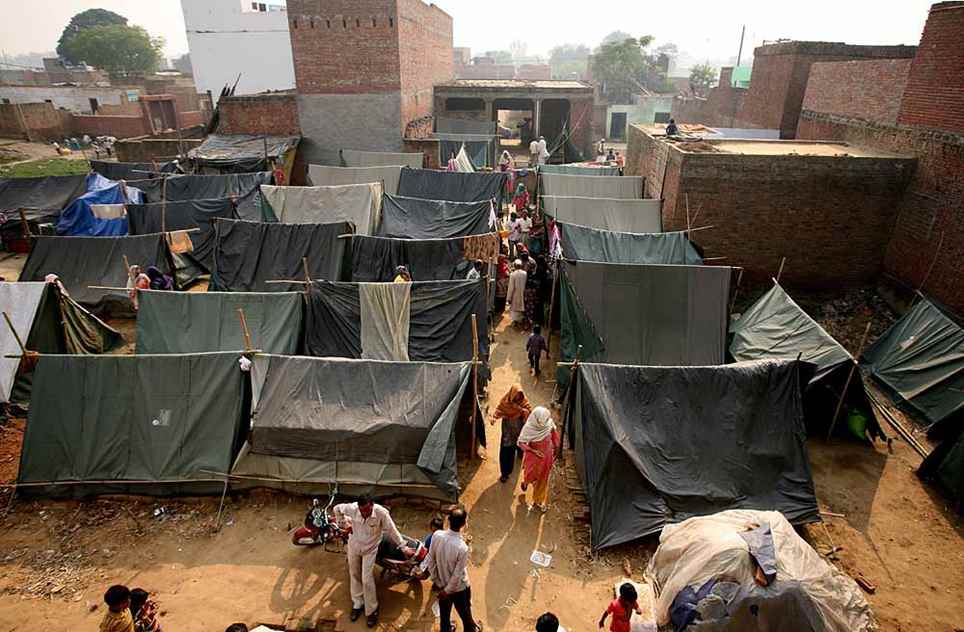
As fog and dusk enveloped Muzaffarnagar's Loi village, riot victims huddled in their cramped tents - a fragile refuge after rioters destroyed their ancestral homes in September. Mothers clung to their babies, striving to protect them from the bitter winter chill. Hungry children cried for food as women struggled to make rotis on a chullah fired by dry sugarcane leaves.

About 50 yards away, stood a couple of monstrous excavators - the most visible sign of the state in riot-ravaged Muzaffarnagar. While the world celebrated New Year, these excavators had rolled into Loi and demolished shelters of about 3,600 riot victims.

While tracking the communal riots that singed Muzaffarnagar and neighbouring Shamli, it has increasingly become clear that the Uttar Pradesh government has abdicated its responsibility and let wounds fester. First it failed to save lives and property in one of the most vicious riots in recent times. Then, it failed to assuage the pain of riot victims by not providing adequate relief and compensation. The government's supply of ration, medicines and doctors, milk for babies, clothes and blankets for riot victims has been intermittent and hugely inadequate. And when the Sup-reme Court rapped it for suffering and deaths in the relief camps, the UP government responded with a drive to dismantle most of the 58 camps.

By Muzaffarnagar district magistrate Kaushal Raj Sharma's estimate, the riots displaced 51,000 people - 27,198 from Muzaffarnagar and the rest from Shamli - from 150 villages. Four months after the riots, only 950 families from nine ''severely affected'' villages have received Rs 5 lakh compensation from the state government. Yardstick for picking only nine villages is not clear. Fate of the other homeless riot victims is uncertain.

The government has also failed to remove fear - many riot accused still roam freely - and restore confidence so that victims return home. Instead, Samajwadi Party's government forced many of them to sign affidavits pledging never to return to their ancestral villages if they accepted the Rs 5 lakh compensation. This move deliberately or otherwise has heightened a sense of hurt and injustice. It could deepen the communal divide.

Other mainstream political parties too have been scarce in their solidarity with or relief for riot victims. There is scant investment in confidence building between the warring communities. The vacuum left by political parties and civil society groups in this rural belt of western UP has been filled in by religious outfits. A slew of Muslim religious organizations have been helping with a steady supply of relief and even mass marriage of daughters of riot victims. They are also building houses and helping riot victims, who lost their livelihood, earn.

A fact-finding team of intellectuals from Delhi University and JNU found that the UP government has outsourced relief work to religious outfits. A reality check at ground zero lends credence to this finding and bares an insidious design as old as the idea of India, but not yet rusty. Politics perilously continues to stir the religious-emotional cauldron, either to consolidate electoral power in our ballot box democracy or to save an eroding political base.
Muzaffarnagar has a notorious crime record, but its communal amity stood out in UP.

In the Jatland, Muslims and Hindus have lived in harmony for centuries. It remained mostly unscathed in the communal frenzy over Partition or Babri masjid demolition.

Village communities built over the ages included people from all backgrounds contributing to the rural economy. Muslim farm labourers worked on land owned by Jats, artisans - blacksmiths, carpenters - were settled by landlords regardless of their religious identity to make the village self-sufficient.

Economy and not religion was the overriding factor. Every member preserved his religious or social identity while being part of a cohesive whole. The September 2013 riots changed that, rupturing social relations cemented over centuries. This is bound to tell on the economy of the country's sugar bowl.

Demography of the region is poised for a change too. Villages here had a largely mixed population. The riots drove out mostly Muslims. A large section of them refuse to return ever. The pattern of settlement of riot victims, mostly with help from religious outfits, portends ghettoisation. Communal homogeneity is inimical to a secular democracy like India. But this could be the future for post-riot villages, churned by a blend of religious segregation and political opportunism.

Help in adversity strengthens bonds and extracts loyalty. During the riots, community leaders and village pradhans - both Hindus and Muslims - emerged as saviours and guardians. If Muslim riot victims are beholden to their community leaders for standing by in crisis, Hindu villagers commend theirs for pandering to the majority's victimhood - lurking in their collective subconscious.

These pradhans and community leaders are potential ghetto overlords. After all amidst UP's political ferment, ghettos could well become the newest captive vote banks controlled by ghetto overlords. They would be open to exploitation by political parties - at a price - for gains in elections.

History, as Stephen Chan says, shows that reconciliation is difficult in a polarized society till each pole lives out its subjectivity. Without reconciliation, the future does not augur peace. Muzaffarnagar's communal frisson spells the end of certainty, at least for now.

Source: http://timesofindia.indiatimes.com/home/opinion/edit-page/How-ghettos-get-made-Its-dangerous-that-Akhileshs-government-has-outsourced-riot-relief-work-to-religious-outfits/articleshow/28713529.cms

January 06, 2014

India: Status Report on Condition of Persons living in Riot Relief Camps in Muzaffarnagar and Shamli Districts of Uttar Pradesh by PUDR

Peoples Union for Democratic Rights

PRESS RELEASE

6 January 2014

Status Report on Condition of Persons living in Riot Relief Camps in Muzaffarnagar and Shamli Districts of Uttar Pradesh

Following the unprecedented outbreak of riots in the rural areas of Muzaffarnagar, Shamli, Baghpat, Meerut and Saharanpur districts of Uttar Pradesh in the first week of September, tens of thousands of Muslim families have been living in relief camps for the last four months. However, over the past week, the Uttar Pradesh Government has been following a policy of forced closure and eviction of people from such camps. As a consequence, the situation created has resulted in increasing the vulnerabilities and insecurities of persons affected by the riots.

A five member fact finding team of Peoples Union for Democratic Rights (PUDR) visited the relief camps last week, between 28th and 30th December 2013, to get a firsthand account of the condition and problems faced by people living in these camps. The team visited a total of 8 camps in the districts of Shamli and Muzaffarnagar and met people from over 60 villages. In Shamli District, the team visited the camps at Malakpur, Barnavi, Kandhla, and Madarsa camp in Shamli town. In Muzaffarnagar district, the team visited the camps at Loyi, Shahpur, Jogiya-kheda and Jaula. In addition, the team also met people from 5 other camps. In all PUDR interacted with people of 13 camps. The team also met the DM Shamli, ADM Muzaffarnagar, SHO of P.S. Phugana, Village Pradhans of Loyi and Jogiya-kheda, health workers, teachers, journalists, members of religious communities, relief camp committee members and relief workers associated with various non-governmental organizations.

The following is a summary of the main findings of the team.

1. Forcible eviction of the riot affected from the relief camps

The hearing of the matter by the Supreme Court and the increased media reporting of the plight of the victims in the camps has had a paradoxical impact. The administration is determined to close down the camps. Various methods are being deployed towards this end. These include the filing of cases against the victims residing in these camps for trespassing on government property; pressurising relief committee members; large-scale police and official presence to browbeat people into leaving the premises; and breaking up the large settlements of victims to facilitate in this pressurising.

In the case of Loyi camp, over a hundred families from Kharad village still awaiting rehabilitation payment were being moved to a government barrack temporary accomodation, on 29th-30th December, ostensibly to provide them with better care and facilities. Other families were being told to clear out of the camp even when they were insecure about returning to their village. This insecurity is worse when those responsible for conducting attacks are not charged for the crimes or even when accused continue to be free to intimidate the victims.

2. Apathy in Provision of Relief by Government Agencies

Our team found that none of the relief camps were initiated or managed by the government. Relief camps came up in Muslim majority villages to which the victims fled during the rioting.

In every camp visited, we were repeatedly told about the apathy on the part of the State administration to supply relief material and services. It was only a fortnight after the start of these camps that the administration started providing relief materials. After 1 October the administration even stopped providing food in most of these camps, which we confirmed at the Jaula and Jogiya-kheda camps. With winter approaching and a Supreme court order of 21 November explicitly calling upon the administration to resume supply of relief material, the Administration did not make any attempts to distribute woollen clothes and blankets for people residing in the camps. It was only in December, when the petitioners drew attention to 39 deaths in the relief camps, that the administration resumed supply of medicines and 200ml of milk per family in 5 camps.

The camps also house a large number of school-going children. While in some places, services of a primary school have been provided, students from higher classes have nowhere to go. Schools in the close vicinity have refused admission to the riot affected. Girl students face this in a more aggravated form. Those having to take the board exams this year have already missed some examinations. Such students face the imminent loss of a year that may effectively deny them futher education.

Medical facilities are primitive. A meagre stock of pills are being distributed at most camps. The DM Shamli expressed inability to provide any better services lamenting the sorry state of the district health-care system. Many pregnant women have given birth and many are in late stages of pregnancy. No services of a gynaecologist are available anywhere in the district and there has been no attempt to provide nutritious food for these mothers. A Committee set up under the directions of the Supreme Court to look into the deaths in relief camps reported 34 deaths of children.

3. The Current number of Relief Camps is under-reported by the State Government

In an affidavit filed before the Supreme Court in December, the State government had stated that out of the 58 camps in operation in September, 53 had been discontinued and only 5 camps were in existence (4 in Shamli and 1 in Muzaffarnagar districts). Our team found this assertion to be wholly false.

We were told by informed residents that relief camps were in operation at 25 villages, some of them housing more than one camp. Our team was able to visit 13 of these locations and found camps in operation. The number of people receiving relief from these camps far exceeds the number of people present in the camps, since many victims have been moved to private houses in the villages in the light of the extreme weather conditions.

The assertion by the ADM Muzaffarnagar to our team on 30 December at the Loyi camp was most shocking. He claimed that there was no relief camp at Shahpur village. An hour later our team found three functioning relief camps at the village!

The exclusion of a large number of camps from the official list merely highlights the callous attitude of the administration by denying all relief to these victims and leaving such people wholly at the mercy of private charity. It is a blatant attempt to misinform the public at large.

4. Misleading Estimates of People Affected by the Riots

The lack of supervision of the relief camps by the district administration has meant that figures of the riot affected are arbitrary. In a report dated 4 October 2013, filed by the Harmony Committee constituted by the Uttar Pradesh government, the total number of internally displaced was estimated to be 33,696 persons. Of this the largest segment of displaced people approximately 74 percent were reported to be living in relief camps located in Muzaffanagar district, followed by 22 percent in Kairana, 3.3 percent in Shamli and 0.7 percent in Bagpat. By December, the number stated in the government affidavit to the Supreme Court is 5,024.

The falsity of the above claim is apparent from the records of residents available at the relief camps. The relief committees running the camps provide the only proper record of victims based on the distribution of material relief at each camp. According to additional affidavit filed on behalf of the petitioners in the case of Citizen for Justice & Peace and others v. State of Uttar Pradesh (petition no. 170 of 2013) the total number of persons living in camps as of the 6 December was 27, 882. Our estimate of the displaced persons from our visit to 13 camps more or less confirms this figure.

5. Flawed Categorization of ‘Riot Affected’ Villages and Persons

We were told by relief committees that families from 162 villages had abandoned their homes and sought refuge in the relief camps. Our team was able to speak to riot victims displaced from over 60 villages. Officially however only 9 villages have been declared as being riot affected, and therefore eligible for Government rehabilitation package. Based on a criteria of worst affected in terms of murders, the 9 villages identified are: Lak, Lisaad, Bahawdi, Kutba, Kutbi, Phugana, Mohammadpur Raisingh, Kakra and Mundbhar. As per the Government package, approximately 1800 families have been identified as riot affected and eligible for a one time rehabilitation package of Rs. 5,00,000 from these villages.

But there exist a large number of persons, beyond the nine government recognised villages, who are in no situation to return to their homes. They have faced serious intimidation and humiliation from their Hindu neighbours. They have suffered their houses being broken into and women humiliated by armed mobs. They have found their homes ransacked when they visited the village with police escort. And in some cases their family members who were unable to flee are still missing, three months after the incident. These villages and their Muslim residents are not being categorized as the riot affected and thus rendered ineligible for rehabilitation. Many of these persons that our team interviewed, recounted having fled empty-handed from their homes on the night of 7 and 8 September.

6. Problematic Rehabilitation Package and its Terms

The State Government’s one-time rehabilitation package of Rs. 5 lakhs for each riot affected family is extremely problematic. This package is based neither on the size of the house in the village, nor is it based on the number of families residing in the house. Hence every resident riot affected family of the 9 villages has not been provided the amount of Rs. 5 lakhs. Multiple families residing in the same house face this problem most acutely where the head of one family has been paid while others have been denied.

The terms of this rehabilitation require beneficiaries to return the Rs. 5 lakh if they were ever to move back into their original homes. Given the present situation of the victims living in tents under the open sky, with little hope of returning to their homes, acceptance of this rehabilitation is a fait accompli. Once the money is brought into use, the labouring households that comprise an overwhelming majority of the victims shall never be in a position to return it. In this manner the government policy effectively ensures that the victims are forbidden to return. The rehabilitation package is therefore in essence a compensation package that fails in every respect to compensate for the losses suffered by the victims.

On the reverse side, the government has made no commitments to protect the houses and community properties of the victims that comprise masjids, idgahs, madrassas and graveyards. Therefore these properties would over time willy nilly fall into the hands of those who perpetrated the violence against the Muslim victims, thereby creating an economic incentive for future communal violence.

What is lost sight of in this process is the culpability of the state. The overwhelming reason for the inability of the victims to return to their lives is the government’s failure to protect them from communal violence; to apprehend and punish the perpetrators; and refusal to provide effective security to them. The rehabilitation package therefore becomes a ploy to hide this abysmal failure.

7. Slow progress of Police investigation of complaints related to Murder, Rape, Arson and Looting

It has come to the knowledge of the fact finding team that the police is deliberately trying to distort evidence and delay investigations in a number of cases. As a result, the maximum of 90 days period allowed for investigation under section 167(2) of the Cr.P.C. is passing by and persons accused of heinous crimes get a right to be freed on bail. As per the additional affidavit filed on behalf of the petitioners in the case of Citizen for Justice & Peace and others v. State of Uttar Pradesh (petition no. 170 of 2013), atleast 5 persons arrested for heinous crimes are already out on bail and those named as accused in FIRs cannot be arrested without a court warrant due to the delay. The following cases indicate towards a dubious role of the police in conducting the investigation.

Killing of Meherudeen (father of Rafeeq) from Dunger village, Phugana Thana, Muzaffarnagar district is a case in point. Meherudeen's body was found hung by the neck, naked in the house of co-villager Pawan Jat on 8 September 2013. Under pressure from village head Ramchandra and other powerful Jats of the village, the body was buried in the graveyard near the village. Today, the family members say that Meherudeen died because of illness. The family has now left the camp and is residing in Kandhla. But three people from the same village have been witness to the entire episode and they find mention in the FIR. They are also being threatened to death in case they testify. Their testimonies have been video-recorded and submitted along with the FIR. An application has also been written to the police authorities requesting post-mortem of the body, but in vain. According to law, the police is required to record a Panchnama upon reaching the incident site, and to record the cause of death as stated by the family. However, in this case, the Panchnama was not created. Even after the FIR was filed, the body has not been exhumed and sent for post-mortem.

Another case in point is that of Aamir Khan s/o Raisuddin from Anchhad village, Thana Binauli, District Baghpat. On 8 September 2013, Aamir and his family including his father, mother, wife and younger brother left the village out of fear and moved to their relative's house in Shieikhpura. On the morning of 12 September 2013, after consulting with family members, Aamir cycled back to his village to see if things had normalised. When Aamir did not return till late evening, his father, mother and wife decided to go and check. They reached their house around 6pm, and found Aamir's body hung by his neck from the ceiling. On hearing their screams many villagers gathered and the village head was also called. Two villagers, Sanjeev and his father Jagbeera, started abusing the family and demanded the return of a loan of Rs. 80,000 that Aamir had allegedly taken. The village head Samarpal got Aamir's body buried and announced that in case anyone made enquires it should be stated that Aamir died of illness. The police was called by the Jat residents and told the same, and ignored repeated requests by the family for post-mortem. Their thumb impressions were forcibly taken from them and the police left. The three people were then held captive in their own house by the village head Samarpal, Sanjeev and Jagbeera to force them to return the loan mentioned above. It was only several days later, on 30 September, that they were released after depositing the money with the help of their relatives. The family then moved to Jaula village camp, Thana Budhana, Muzaffarnagar district and reported the incident on 1 October 2013. The family has again requested the police for a post-mortem but it has not yet been done.

PUDR demands:

1. That the forcible eviction of the displaced people from relief camps be stopped forthwith and victims be provided relief till a permanent secure arrangement is worked out.

2. That a Commission be set up to record all the people displaced from their villages, the reason thereof and their properties in the village so as to ensure proper and sufficient provision of relief and rehabilitation measures.

3. That the rehabilitation package should not be discriminatory and every married couple and every unmarried adult be treated as a separate family for the purpose.

4. That the perverse conditions attached with the rehabilitation package be removed. The properties left behind by the victims in the villages including community properties such as graveyards, masjids, etc. be recorded and protected against encroachment by other village residents.

5. That measures be taken to ensure protection to eye-witnesses and complainants against threats and intimidation.

6. That unbiased investigation and prosecution be ensured by handing the same to a central agency.

D Manjit and Asish Gupta,

Secretaries, PUDR

Ph-9868471143, 9873315447

January 05, 2014

India: Next Target: Muzaffarnagar Relief Camps (अगला निशाना: मुज़फ्फरनगर राहत शिविर ) | A reportage by NewsClic


Newsclick Production, December 29, 2013

On the 27th of December, 2013 the riot victims in Loi relief camp in Muzaffarnagar district once again witnessed the heavy- handedness and insensitivity of the U.P government yet again. In the peak of the winter cold, the government is trying to evacuate the refugees in the camp. Around 10 tents in the camp were destroyed by a bulldozer early morning on 27th December. Ironically, most of the people being targeted are those who still haven't received any compensation from the state for the losses they suffered during the riots. Along with this the feature also looks at the fear among the riot victims in other relief camps.

२७ दिसंबर, २०१३ को मुज़फ्फरनगर के लोई राहत शिविर में दंगा पीड़ितों को एक बार फिर उ.प्र. सरकार की संवेदनहीनता और क्रूरता का सामना करना पड़ा। सर्दियों की चरम पर सरकार शरणार्थियों को शिविरों से हटाने पर अमादा है। २७ दिसंबर की सुबह को सरकार द्वारा १० झुग्गियों को बलपूर्वक तोड़ दिया गया। दुर्भागयवश, अधिकतर लोगों को मुआवज़ा दिए बिना ही वहाँ से खदेड़ा जा रहा है। इस के साथ इसमें अन्य राहत शिवरों में पीड़ितों के भय को भी दिखाया जा रहा है।

January 02, 2014

India: Photos of Protest in Defence of Muzaffarnagar Riot Affected at UP Bhavan on 2 Jan 2014

Several organisations came together to protest, outside the U.P. Bhavan in Delhi on 2 January 2014
, the closure of the camps in Muzaffarnagar and Shamli which were the only protection that thousands had from the bitter cold. The photos posted below were taken by Mukul Dube.

December 15, 2013

India: With the closing of relief camps in Muzaffarnagar, even the meagre food support has disappeared

The Hindu, December 14, 2013


BAREFOOT

Winter in exile

by HARSH MANDER

With the closing of relief camps in Muzaffarnagar, even the meagre food support has disappeared.

As the winter cold descends this year on Muzaffarnagar and Shamli districts in Western U.P., some 20,000 people will camp in makeshift unofficial camps amidst squalor and official neglect, or survive in small rented tenements or with relatives — exiles from the villages of their birth. Three months after one of the grimmest communal outbreaks in more than a decade, the dominant mood among the survivors is still of fear and despair, amid a persisting climate of orchestrated hatred.

A hate campaign — falsely claiming that Muslim boys were enticing Jat Hindu girls in a “love jihad” — led to violent murderous attacks in September on Muslim settlements mainly of poor agricultural workers in the two districts. Some 50,000 people fled in fear, and took refuge in Muslim majority villages mostly in the grounds of madrassas and mosques; belatedly, the State commenced food supplies to these camps. A week later, I joined a fact-finding committee to enquire into the condition of the survivors. Almost the same team — Seema Mustafa, Sukumar Muralidharan, Kamal and Anuradha Chenoy, and Rammohan — decided to revisit the area nearly three months after the mass violence to evaluate the aftermath of the carnage.

We now found that all relief camps had been officially terminated, even though several displaced persons were still unwilling to return home because they continued to feel unsafe. Whereas displaced persons in camps should be officially assisted and supported to return to their original homes, to force them to do so by premature closure of camps can result only in thousands being left without even the meagre food and health support which the government had extended in the camps.

Rural riots are very different from urban ones, because people usually know their attackers intimately, unlike the relative anonymity of cities. The sense of betrayal and loss, and the associated anger, pain and bitterness therefore generally runs much deeper in rural riots. As one survivor who continues to live in a makeshift unofficial camp remarked to us, “When faith is broken, it is very hard for it to be rebuilt.”

The sense of fear and alienation of the survivors is enhanced by distressing reports of organised social and economic boycott of Muslims after the mass violence. Many men testify that if they go back to their villages, they are told they should shave their beards off if they wished to live in their village. People also report similar hate exchanges in buses and public spaces. Three young men were killed when they went to work in their fields. Sporadic incidents of sexual assault are also reported. Survivors recount intimidation and boycott in employment as farm labour, or economic activities like pheris¸ or selling cloth and other goods from house to house.

The confidence of survivors to return to homes is further shaken because of the very low number of arrests. For around 540 FIRs registered in connection with the violence, involving more than 6,000 accused persons, as few as 208 arrests have been made so far. Even the Sadhvi who instigated violence with her hate speeches in the September 7 mahapanchayat was arrested only on the day of our visit, on December 2. This reflects regrettably low political and administrative will to ensure legal action against those who indulged in mass hate violence in September 2013.

One reason given for low number of arrests is that large numbers of women block the entrance to the village whenever police vehicles drive there for arrests, or that tractors are parked to thwart police passage. Survivors on the other hand believe that police themselves informally tip off the villagers before arriving to make arrests, otherwise how would so many assemble at short notice to blockade village roads? This allegation is difficult to independently verify, but no self-respecting police administration can accept this kind of public blockade to persist when it comes in the way of fulfilling their official duties. The SSP of Muzaffarnagar also said that it was necessary to verify independently if the complaints were authentic and plausible or malicious and false, before undertaking the arrests. It is as though the police have shifted the burden to prove the crime to the shoulders of the battered and displaced survivors. It has been our experience of many riots that it is unusual for survivors as a rule to lodge false and malicious complaints after communal carnages, therefore it is unreasonable for police to presume that many complaints may have been filed to settle personal enmity.

There are also distressing signs of judicial bias, because most arrested persons have been granted bail almost the next day or soon after their arrests. This ignores the gravity of hate crimes, and the susceptibility of the survivors to intimidation because of their vulnerable situation after mass targeted violence has spurred large-scale fear, destruction of livelihoods and habitats and migration.

It appears that these refugees from hate have little to look forward to, except a long and lonely winter of continued exile.

December 05, 2013

India: 40 children dead in UP riot relief camps

At least 40 children dead as UP riot relief camps brace for a long winter
Pritha Chatterjee : Muzaffarnagar, Shamli, Thu Dec 05 2013
http://www.indianexpress.com/news/at-least-40-children-dead-as-up-riot-relief-camps-brace-for-a-long-winter/1203511/

November 11, 2013

India: Nowhere People After Muzaffarnagar Riots

web feature at outlookindia.com


All photos: Sanjay Rawat/ Outlook
Muzaffarnagar: Riots
Nowhere People
They have been driven away from their homes. And now the Akhilesh government wants them out of relief camps as well, but only once they sign away their right to return home for Rs5 Lakhs


Uttar Pradesh chief minister Akhilesh Yadav boldly declared in September that his state will “never become another Gujarat”, but the affidavits that victims of Jat-Muslim riots in Muzaffarnagar: are being made to sign tell another story altogether.
Under the guise of providing a “financial assistance” of Rs5 lakh to these victims, the state seems to be running a scheme to empty refugee camps as soon as possible, whatever the human cost.
“I and my family members left our village from fear due to the violent events that took place there, leaving our house and village. Under no circumstances will we ever return to our village and home again,” reads one of the three prominent conditions those availing the UP government’s financial aid have to sign off on.
The Samajwadi Party government’s apprehensions seem to be about the continued presence Muslims in camps, not the terrible conditions prevailing in them, or even the reasons for this present crisis. It also seems to be ignorant of the identity crisis that has taken root among the Jats, (around 14 per cent of western UP’s population), and a key reason why the area has become engulfed in violence.
That the government is unmindful of the crisis is clear from another condition it has placed in these affidavits: Those who avail of the state’s aid will not be allowed to live in any refugee camp thereafter. Nor will they be able to live “illegally” on houses constructed in the village lands, or government-owned lands. This begs the question—where in this area will a Muslim find land and housing worth Rs5 lakh?
The money, the state has made clear in the affidavits, is meant to be used to construct a house. But here too, a condition has been imposed: “After my family or any member of my family avails this one-time financial assistance, we will not try to recoup any loss of immovable property in our village or in any other place.”
In effect, these conditions ensure that those who were forced out of their homes will forego all their properties for Rs5 lakh, regardless of what they owned, or lost in the riots. This sum is to be paid in only one instalment, into their bank accounts, after which the state intends to wash its hands off the matter. For many people, this will be a far lower compensation than the rich agricultural land of this part of the state is worth.
It is confirmed that such affidavits have been signed by many residents who have taken shelter in the camps at Shahpur Bassi. The entire camp consists of Muslims who fled for fear of their lives after the violence that broke out on September 8.

Muslims in a relief camp in Shahpur, Muzzafarnagar
Villagers in Shahpur and around say they are not sure what the government intends to do with the properties that Muslims have left behind in their villages. Many report that their properties have been burnt down, broken into, and appropriated by other villagers. Haroon and his son Ilyas picked up their meagre belongings, next to tears, at Kakada on Tuesday: “Look at this, they have taken away everything of value that I owned,” he sobbed. Going by the affidavits they are now expected to sign, they will lose any right to claim damages against those who trespass into their homes or occupy their land.
These affidavits do not specify the religion of the beneficiaries, however, the composition of  camps makes it clear that only Muslims have sought shelter in them. No camps are known to have come up housing Jat victims or any other community.

Muslims in a relief camp in Shahpur, Muzzafarnagar.
Around 50,000 people fled from villages around Muzaffarnagar in the immediate aftermath of riots that broke out two months ago. The numbers of refugees has now come down, as per unofficial estimates, to around 20,000. Those who remain consist mainly of people who faced the worst of the violence. Many of them are steadfast against returning to villages they fled from.
“The homeless victims have left everything behind in their villages. They are eking out a miserable existence in these camps, and say they are doing so with no assistance from the state after the first couple of weeks,” says Mohd Shaukat, a member of the town committee at Shahpur, who is also managing affairs at the Bassi camp, housing about a 1,000 people in two locations.
Mohd. Salim, who was working as a mistry at Kawal village, says he owned several buffaloes and a plot of land too, but the livestock has been taken by the neighbours by now. “People have taken over everything I left behind at my village,” he says. He is too terrified to return for now. Like several other residents, he hopes to return for a short trip in a while, just to pick up his movable belongings. As for the  land: He just hasn’t thought that far. “All my days at the camp go in looking for work,” he says.
While the state government is imposing tough conditions on these hapless victims, it appears to be ineffectual against sporadic bouts of violence, and seems to have run out of ideas to refresh the dwindling farm economy of the region.
On Wednesday fresh violence broke out in Shahpur after Irfan, from the Bassi camp, identified a man, Yogendra, he had seen participating in the violence at Kutba and Kutbi villages. Yogendra was beaten up by a crowd on the spot. A while later, Irfan, too, was shot dead at nearby Rasulpur village. In the melee, a shop belonging to a local, Dr Harveer Arya, was burnt down. It is not clear by whom.
In a strange twist to this latest violent episode, farm leader Naresh Tikait, a leading figure among the Jats, son of late Mahendra Singh Tikait, and now chairman of  Bharatiya Kisan Union (BKU), announced on November 8 that Muslims involved in the latest round of violence must be arrested within 24 hours—he said the government is being “ek-tarfa”—one-sided. His brother Rakesh Tikait told Outlook earlier that the ongoing violence is not just between Jats and Muslims. Though no community other than Muslims and Jats has taken any part in the violence since September, he says, “It is a Hindu-Muslim fight.”
While leaders of various hues try to add fresh communal touches to the clashes, the panchayats are being accused of having failed to restore confidence among Muslims refugees to return to their villages.
“The panchayat leadership at present has failed. It will take years before a new leadership that is convincing and vigilant of farmer’s needs will arrive on the scene here,” says Harinder Singh Malik, a former Congress Member of Parliament and prominent figure in the local Jat politics. He, too, attended the earliest ‘mahapanchayat’ of Jats, in the events following which all hell broke loose. He denied having addressed that meeting. Both Malik and Rakesh Tikait insisted that the panchayat was a “shok sabha”, held to mourn the deaths of two Jats at Kawal village.
The absence of a viable Jat leadership makes the role of Akhilesh Yadav’s government even more critical at this juncture. More than 80 per cent of Jats are farmers, who find that the size of their holdings is shrinking. Their main crop is sugarcane but their payments are delayed by mills, sometimes by over two years.
Diesel and fertilizer subsidies are being withdrawn, putting immense pressure on farmers’ costs. Besides, most Jats only study up to school and the community has not taken to technical education. Most of the youth joins the Army or police force. In fact, despite the ongoing fighting, the highways are lined with row after row of boys jogging: They are preparing for the physical fitness tests compulsory before joining the forces.
Due to the Arya Samaj influence, Jats have not diversified from farming into poultry-keeping or piggeries: They are mostly vegetarian, and against killing. Meanwhile the veterinary hospitals in the area are largely without doctors, making it next to impossible to maintain livestock.
Member of Parliament from Bijnor and Muzaffarnagar resident Sanjay Singh Chauhan told Outlook that both Muslims and the Jats are “disappointed” with the ongoing events, and want to live side-by-side again, but the Panchayats may be in no position to find the appropriate solution this time. “There is a reason for this. The Panchayats are only attended by leaders who agree that the village should be restored to its original composition. Those who disagree—the lumpen elements who caused the rift, who spark off the violence, are not even present at the panchayat meets,” he says. He says the law and order problem needs to be solved by the state machinery—the Jat-dominated police and constabulary.
Indeed, this is one reason why the state has failed to prevent khap meeting after meeting. At Mohammadpur Raisingh, the Gathwala khap has announced a Khap gathering on the 10th of November. This has been put off until the next day—November 11, once the SP government agreed to fulfil its demands to arrest Muslims accused of rioting. One wonders why the same SP government is taking away the right of evicted Muslims to recoup their only real asset: their land and buildings.


October 07, 2013

Life in A Refugee Camp Near Muzaffarnagar | India Ink - NY Times Blog

by PAMPOSH RAINA [7 Oct 2013]

A month after the riots broke out, about 24,000 people continue to live in refugee camps in the districts of Shamli and Muzaffarnagar, according to the state administration officials.

READ MORE HERE

September 23, 2013

India: Report by fact-finding team of independent social activists, which visited relief camps of the survivors of the communal riots in Muzaffarnagar and Shamli districts

The Hindu,
NEW DELHI, September 23, 2013
“Cry for justice in Muzaffarnagar relief camps ”

Mohammad Ali

A fact-finding team of independent social activists, which visited relief camps of the survivors of the communal riots in Muzaffarnagar and Shamli districts, has indicted the Uttar Pradesh Government for “abdicating its responsibility for relief and rehabilitation in the aftermath of the communal riots, the way it abandoned its duty to provide security and protection to people during the communal carnage.”

The riot, which went on for a week, took around 50 lives and resulted in the displacement of more than 50,000 people, mostly those belonging to the minority community.

While the team has demanded immediate arrest of all those named in the FIRs, it has also appealed to the Union Government to table and pass the Communal Violence (Prevention, Control and Rehabilitation of Victims) Bill which has been languishing in Parliament.

The report was released by writer, activist and National Advisory Council member Farah Naqvi; Pushpa and Maheshwari from Vanangana (Chitrakoot); Askari Naqvi, Puneet, Meena and Azra from Rehnuma Adhikar Manch/ Sanatkada Samajik Pehel (Lucknow); Rehana Adeeb, Usman and Shadab from Astitva (Muzaffarnagar); Archana Dwivedi from Nirantar (Delhi); and Disha Mullick, from The Women, Media and News Trust (Delhi).

Describing some of the most heartrending stories by the survivors who left their homes and villages after being attacked, the report highlighted the denial of the State administration in recognising the urgency to act. The standard response of the local officials was that “things are getting back to normalcy”.

“There are simply thousands of terrified, trembling, desperate people sitting in relief camps, with the bare minimum facilities, with the overwhelming cry for justice, relief and rehabilitation, while the government remains mute spectator to the unfolding tragedy,” said the report, while arguing that ‘official’ numbers of those dead and internally displaced persons (IDPs) are a “gross underestimation.”

The report pointed out that a vast majority of displaced persons, whose fate remains uncertain, are poor Pasmanda (backward) Muslims like those belonging to D hobi, Ansari Teli, Lohar, Julahe, Faqir, Jogi and Lilgar castes.

The fact-finding team has demanded immediate relief and setting up of a rehabilitation commission, headed by a sitting High Court Judge, to oversee a comprehensive reparation plan for all the affected districts, including Muzaffarnagar, Shamli, Baghpat, Saharanpur and Meerut.

The State administration has not even considered preparing village-wise lists of missing persons and has neither initiated processes for lodging of FIRs and complaints, assessing compensation for death, injury, destruction of property and planning rehabilitation, alleged the fact-finding team.

The team visited six relief camps in the two districts. In spite of reports of cases of hurried burial without any post-mortem, the State administration has no clue on how to deal with the cases, the team charged.

The report also highlights the need for providing help to survivors in pursuing legal justice, police desks in camps, lawyers on the ground in camps, medical check-ups and medico-legal intervention for sexual assault.

Another important need of the hour, said the report, was State security for people to visit their villages to assess damage, and a long-term plan of providing safety and security for survivors who want to go back to their villages.

September 17, 2013

India - Muzaffarnagar communal violence: 'We have been reduced to strangers in our own land’ | 50000 riot victims in relief camps

From: The Hindu
Bassi/Tavli/Kutba, September 16, 2013

'We have been reduced to strangers in our own land’
Prashant Jha

On the Muzaffarnagar-Shahpur road is the Tavli madrasa. Now home to over 300 Muslims who have fled from their villages after the outbreak of recent communal violence, it is one among the many makeshift relief camps that dot the district’s landscape.

It is here Shamshad Chaudhary piercingly asked Congress vice-president, Rahul Gandhi, accompanying Prime Minister Manmohan Singh and UPA chairperson Sonia Gandhi, on a visit to the riot-affected areas on Monday morning, “Why did you — the Congress party and Jawaharlal Nehru — stop us from going away in 1947? We have been reduced to strangers in our own land.” As Mr. Chaudhary recounted to The Hindu, Mr. Gandhi told him what had happened was ‘very wrong’. “You are not strangers … The first responsibility is with the State government, but we will do whatever we can to help.”

Through their quick three-hour run through Muzaffarnagar — stopping over at relief camps for displaced Muslims, meeting Jat villagers, and visiting the family of the slain IBN7 journalist, Rajesh Verma — India’s top political leadership got a sense of the deep chasms that have developed among communities in western Uttar Pradesh.

‘New partition’

Over 40,000 Muslims have got displaced in the past 10 days in western U.P. They are living in camps, at homes of relatives, in private farms of well-wishers, at police stations. As one of them put it, ‘The country was partitioned once. Now, our villages are getting partitioned.” None of them are willing to return home.

At the Bassi camp, Asiya, originally from the nearby Kutba village, told Ms. Gandhi they needed a place to stay. “We cannot go back. Winter is approaching. We need a house, and we need compensation to start our lives.” When asked if she would return if her old Hindu neighbours assured her of security, she told The Hindu, “They are the ones who killed, looted, and burnt our homes. How can we trust their word?”

Her words were echoed by Mehmood Hassan, also from Kutba, who demanded punishment for culprits, houses for victims, commensurate compensation for the land they would lose, jobs to family members of the dead, and a CBI enquiry into the riots.

No security guarantee

There is sound logic for not returning.

Kutba village — Asiya’s and Mehmood’s home — resembles a ghost town. Eight Muslims were killed here. And all Muslim residents, 3,000 of them according to one count, have fled. Shutters are down in the middle of the day. Kids are locked inside. Few are seen walking on the streets.

Inside Jat homes, the mood of belligerence is starkly different from the despondency among Muslims.

When asked if they would assure Muslims of security, “We did not tell them to go. Why should we beg them to return?” says an angry, and loud, middle-aged Hindu woman at the house of the village leader. “They have all gone to get compensation. There was no threat from us.”

Another Jat elder put things even more bluntly. “If they see us, they will take revenge. If we see them, we will vent out our anger. There will be no peace until the balance of power is sorted out. One community in each village will remain dominant.” Both asked not to be named.

A local teacher, Ram Kishore, said that after the incidents, over a 100 young Jat men of the village were booked for indulging in violence. ‘These FIRs can ruin their lives. People blame Muslims for trapping their children.” Mr. Kishore suggested that the complex web of interdependence between Jats and Muslims was crumbling. “We need Muslim labourers for our fields, Muslim carpenters, iron-smiths. They need us for income.” In a school run by his son, 150 children were Muslims, and it looked like their academic year — if not their lives — would go waste, living in camps. But despite knowing this, he said they could not provide any ‘security guarantee’.

Gordhan, a relative of the local Pradhan, and a member of the Bharatiya Kisan Union, which has given a call for peace, nodded. Admitting that Muslims were killed in the village, he said, “The onus lies on us to convince Muslims to return. But we can’t control how people will react.” He added, poignantly, sitting in front of a picture of BKU leader Mahendra Singh Tikait on the wall, the era of ‘Jat-Muslim unity’ was over.

A little before the PM and the Gandhis arrived, a security drill was under way in the Tavli camp. Mr. Shamshad Chaudhary — the man who later questioned Mr. Gandhi — told a local police official he was a refugee and asked to be let in. He was told, sneeringly, “What refugee? We all know what games you people are up to.” The SHO-level officer was a local Jat. Shamshad said, “It reminded me of the local thanedar’s reaction when I called to say they have attacked the mosque in my village, Kharda. He had told me — ‘what can I do? Go, put out the fire.’ This is the mindset.”

Dr. Singh promised ‘strictest punishment’ for the riot perpetrators, pledged that the priority was to provide a sense of ‘security’, would ensure people return home, and till they do so, provide adequate care. But even as India’s most powerful leaders came, saw and left, the wounds show no signs of healing; the story of violence has not yet ended; and erstwhile neighbours and friends continue to look at each other with hatred.

o o o

SEE ALSO:

Riots damaged places of worship of Hindus and Muslims: UP (Times of India)
http://timesofindia.indiatimes.com/india/42000-forced-to-flee-religious-sites-damaged-in-UP-riots/articleshow/22644866.cms?

Over 50000 riot victims move to relief camps (Times of India)
http://timesofindia.indiatimes.com/india/Over-50000-riot-victims-move-to-relief-camps/articleshow/22644319.cms

June 30, 2013

Jawed Naqvi on how Communalism also thrives in natural calamities such as earthquakes, floods and cyclones

Fascism’s natural ally
by Jawed Naqvi
[. . .]
The current rain-induced havoc in Uttarakhand, host to several Hindu pilgrimages in India’s Himalayan foothills, spurred Narendra Modi to hog the limelight. The human tragedy was thus deftly converted into a political windfall with an eye on the bilious politician’s religio-fascist agenda. The aim is to win the 2014 Indian elections by whatever means.
http://www.sacw.net/article4856.html

India: Hindu Right VHP and Associates Cashing in on Relief Rehab Activity After Mountain Calamity in Uttrakhand - News reports

The Times of India

VHP volunteers rush to help Uttarakhand pilgrims
Kapil Dave, TNN Jun 20, 2013, 01.32PM IST


AHMEDABAD: While expressing shock and sorrow at the horrific events that are unfolding in Uttarakhand, VHP international working president Dr Pravin Togadia said, "VHP expresses sympathy toward relatives of those who are no more. Those who are injured and are taking treatment are being helped by local VHP and Hindu helpline workers. Soon, to help relatives and the affected, VHP and Hindu helpline will send teams from neighbouring states so transportation and treatment will be taken care of. Since the calamity is beyond normal human comprehension, all should work together to help the army and ITBP who are putting own lives at risk in rescue and relief operations. We had noticed and raised an opposition to a lot of tree burning, breaking of mountain ranges with dynamites for power projects etc. All this has contributed to the damage caused by rain."

VHP has appealed to put the affected devotees' care as the only goal at this time of tragedy and not get into political blame game. All should come together to help.

[. . .
http://articles.timesofindia.indiatimes.com/2013-06-20/india/40092453_1_vhp-cloud-burst-uttarakhand

o o o

The Economic Times

VHP asks all to offer help to flood victims in Uttarakhand
PTI Jun 21, 2013, 03.35PM IST

DEHRADUN: Assuring all help to people in the calamity-hit Uttarakhand, the Vishwa Hindu Parishad (VHP) today appealed to different organisations to come forward to provide succour to flash flood victims in the hill state.

"What has happened in Uttarakhand has the proportions of a national tragedy. I appeal to all organisations to offer whatever help they can to the affected people," VHP's international working president Pravin Togadia, who was here to review steps being taken by the organisation workers to provide relief to the victims, told reporters here.

He said he will soon launch a countrywide campaign to seek the help of different organisations in rehabilitating people, who have lost everything they had in the tragedy.

The VHP will provide a list of people really in need of help to the organisations willing to assist in the relief and rehabilitation of disaster victims in the state, he said.
[. . .]
http://articles.economictimes.indiatimes.com/2013-06-21/news/40119401_1_flood-victims-the-vhp-vishwa-hindu-parishad

o o o

The Times of India

Unsung groups emerge heroes of relief operations
Surojit Gupta & Diwakar, TNN Jun 27, 2013, 06.23AM IST

DEHRADUN: They use Hanuman Chalisa or old patriotic songs from Hindi movies as their caller tunes. They are the power behind swamis and bapus and the popularity of religious channels; also the reason for the stupendous success of Hindi pulp-fi ction brands such as Jasoosi Duniya.

They are mocked for their dress sense, with heavy gold chains around their necks and for carrying "puri bhaji" abroad. They don't come to mind when the "civil society" is valorized as the alternative to the "system". When the state was represented only by the forces and the paramilitary, it's these much-derided groups that swung into action.

Members of the Tata 407 Owners' Association from Moga and Guru Ramdas Welfare Club looked disappointed when the authorities at Dehradun's Jolly Grant Airport refused to accept their truckloads of mineral water, biscuits, bread, soft drinks and roasted gram. They had no room for the mounds of relief material being supplied by associations of transporters, chemists, welfare associations and youth clubs from Punjab, Haryana, Uttarakhand and UP.

It was only after repeated announcements that there was no space to store the relief supplies and that they be taken to the nearby Sports College Raipur, that dera and trust representatives reluctantly reversed their trucks. On their way, they handed out cartons of mineral water, biscuits to relatives of survivors.

The change from the days when the government issued appeals for relief material — noble souls like JP Narayan marched on streets to collect donations — reflects not just the higher economic growth, but the energy that resides in "rurban India" (rural-urban).

At the relief camps, volunteers of the Durga Seva Dal, Bharat Mata Nyas, Bharat Swabhiman Nyas, Bhai Baljeet Singh's Viswa Manav Ruhani Kendra, Shri Krishnayan Desi Goraksha Golakdham, Digambar Jain Sabha vie with each other to offer assistance. There are also Manav Seva Kendras and Samitis serving hot tea with biscuits and snacks. Vegetarian chowmein comes from the All Uttarakhand Budhist Math (Tibet), cold drinks and sherbet. Puri bhaji, kadhi chawal and rajma chawal are available round the clock.

There are other groups too: From the Nehru Yuvak Kendra, ABVP, NSUI, RSS, AAI Engineers' Association and the VHP. So are large hearted souls such as Adnan Qureshi, a meat seller who uses his own funds to distribute mineral water, biscuits and snacks.

October 21, 2012

Violence in Assam has subsided, but anxieties of land and identity are still haunting the people

From: The Times of India, Oct 18, 2012


by HARSH MANDER


Although Assam has disappeared from the front pages of national newspapers, large populations still live in makeshift, underserved camps, racked by memory, fear and uncertainty, with little prospect of an early return to their homelands. Legitimate anxieties of land and identity have acquired an urgent grammar of violence and hate, and irreconcilable divisions have grown further between estranged communities.

During my journey to relief camps in Dhubri, Chirang and Kokrajhar, housed in the classrooms and courtyards of schools, i found that government had ensured basic food rations and primary healthcare services. For the rest, people mainly had to fend for themselves. There was no bedding, no mosquito nets, toilets were scant and choked, and there was little water for drinking and bathing. People who had fled their burning villages or rampaging mobs had few clothes or utensils. Children were the worst hit. There were no child care services, or temporary schooling. Everywhere i found a longing to return home.

The stories we heard in both Bodo and Bengali Muslim camps were disturbingly similar, of neighbours turning into murderous mobs, of torched and ransacked homes, of looted livestock, and of fearful flight. Many escaped only in fear, even though their settlements were not attacked, and in these villages, men return to guard their homes and fields, leaving the women and children in camps.

There are legitimate anxieties and grievances on both sides of the dispute. Udoyon Misra writes eloquently of the 'ever so heavy' burdens of history of indigenous Assamese peoples like the Bodos, of 'land, immigration, demographic change and identity'. He describes massive land alienation of the Bodo plains tribal people who were shifting cultivators with few land records, by industrious and aggressive Bengali Muslim immigrant cultivators.

Successive governments in both the state and the Centre have failed to effectively seal borders, and to identify and repatriate illegal immigrants. The Bodos worry also about being culturally swamped in their traditional homelands, not just by Bengali Muslims but also other communities such as the caste Hindu Assamese, Koch-rajbanshis, Santhals and Bengali Hindus.

The Bodo accord of 1993, which belatedly gave administrative autonomy to the Bodo people in their traditional homelands in which they already were reduced to a minority, unfortunately also created an incentive for driving out people of other communities and ethnicities. The first attacks by armed Bodo militants on Bengali Muslims occurred in 1993 itself, and these have recurred sporadically against also Santhal adivasis, who are descendants of tea garden workers who migrated centuries back. Clashes occurred in 1994, 1996, 1998 and 1999. Around one and a half lakh people displaced by these clashes - both Bengali Muslim and Santhal - continue to live in camps up to the present day, an entire generation of forgotten internal refugees with no home. The government took no decisive steps to help these refugees return to their homelands.

This remains a festering wound on the psyche of the Bengali Muslim, as also the fact that not a single person has been persecuted for the gruesome slaughter mounted in Nellie in 1983. They complain that all Bengali Muslims are tainted as Bangladeshi illegal immigrants, whereas demographers confirm that only a small fraction of the immigrants are actually illegal settlers who slipped into the state after the agreed cut-off date of 1973. Many have learnt Assamese, and wish to be accepted as legitimate Assamese citizens.

This already fraught environment, of legitimate competing anxieties and grievances of diverse communities, has deteriorated sharply because of the implicit legitimisation of violence as a means to resolve these competing claims. People sympathetic to the concern of Bodos and other indigenous tribal communities suggest that the violence to which they have resorted in recent decades is unfortunate but understandable. This is rendered more dangerous because of the easy availability of sophisticated arms among the surrendered Bodo militants, who were never effectively disarmed.

On the other hand, apologists for the Bengali Muslim violence justify it as being 'only retaliatory'. This is slippery ethical territory, because the same argument was used to justify the post-Godhra massacre, as well as the slaughter of Sikhs after Indira Gandhi's assassination. There is disturbing evidence of growing radicalisation of a small section of the Assamese Bengali Muslim, of a kind which was remarkably absent among the victims of the Gujarat violence. The latter have remained unshakably committed to the democratic, legal and non-violent resolution of their grievances, despite the brutal slaughter and systematic subversion of justice and reconciliation by the leadership thereafter.

There are wide demands today that only those Bengali Muslims in relief camps should be allowed to return home who can first prove their legal status. The acceptance of this demand would further incentivise the mass violence which resulted in their displacement in the first place. There is no doubt that the rights of indigenous communities to their land, forests and culture need to be defended, and illegal immigration effectively blocked.

But there should be no compromise, even by implication, with violence as a means to achieve these demands. People in both new and old camps must first be res-tored to their homelands unconditionally, and assisted in rebuilding their houses and livelihoods. Only then should a just and caring state intervene to ensure that the legitimate concerns of both indigenous people and settlers are met, by processes which are lawful, humane and non-violent.

The writer is a social activist.

October 20, 2012

Doing relief and rehab after riots Hindu and Muslim right-wing outfits spreading in Assam

From: Hindustan Times

Post-riots, right-wingers gain foothold in Assam
Sanjib Kr Baruah, Hindustan Times
New Delhi, October 18, 2012

After one of the worst ethnic clashes in the recent memory that saw lakhs displaced in western Assam, Hindu and Muslim right-wing outfits are spreading their tentacles in the state through fundamentalist ideology in the name of relief, rehabilitation and social work. “We are really concerned as close to 12 Muslim and three Hindu right-wing outfits are working at a feverish pace to build up and expand their support base by taking advantage of the increasing polarization between ethnic communities,” government sources said.

“The scale at which these groups are operating is an eye-opener. Unless such activities are curbed, fear of bad times for Assam and the entire nation looms large.”

In August, the violent clashes between indigenous Bodos and settlers of suspected Bangladeshi origin in west Assam resulted in the loss of close to 90 lives while lakhs were displaced. Most of the displaced are housed in cramped relief camps in Kokrajhar and Dhubri.

Till date except in isolated cases, no Assam youth had been found to be involved in pan-India terror modules outside the state.

“The situation may change in the near future as we suspect talent hunting for anti-national activities,” the source added.

Most of the right-wing Islamic outfits are from south India while Hindu outfits are mobilising in places like Guwahati, Silchar and Cachar.

In west Assam, the ‘work’ at the moment comprises rehabilitation and relief for the riot-affected, cash donations, and house-building activities.

Interestingly, among the people belonging to fundamentalist outfits who have visited the relief camps include well-heeled private sector professionals.

In the aftermath of the violence, reminiscent of the anti-foreigner Assam agitation (1979-1985), the state’s indigenous people have stepped up demand for deportation of foreigners, which was promised in the Assam Accord of 1985 but till date has not been delivered.

April 14, 2012

CFP: Salvage and Salvation: Religion, Disaster Relief, and Reconstruction in Asia

H-ASIA
April 13, 2012

CFP - Salvage and Salvation: Religion, Disaster Relief, and Reconstruction
in Asia
******************************************************************
From: "Levi McLaughlin"


CALL FOR PAPERS – Salvage and Salvation: Religion, Disaster Relief,
and Reconstruction in Asia.

Dates: 22 (Thursday) and 23 (Friday) November 2012
Venue: Asia Research Institute
Seminar Room
Tower Block Level 10, 469A Bukit Timah Road
National University of Singapore
Bukit Timah Campus
Organisers: Dr. Philip Fountain
Dr. Levi McLaughlin


What does it mean to offer salvation in the midst of catastrophe? What
dynamics are in play at the intersection of religion and disaster
relief in Asia? Over the past few years, Asia has witnessed frequent
massive and high profile disasters, notably the Indian Ocean tsunami
(2004), the Kashmir earthquake (2005), Cyclone Nargis in Myanmar
(2008), the Pakistan floods of 2010, and most recently the 2011
earthquake, tsunami, and nuclear disasters in northeast Japan. In the
wake of these tragedies – and the numerous smaller-scale disasters
that also afflict the region – religious organizations have played
pivotal roles in disaster response initiatives. Millions of relief
workers and billions of dollars in aid have been mobilized through
their networks. However, despite having a profound impact on the lives
of disaster victims, these initiatives have gone largely
under-reported, and there has been no comprehensive attempt to present
research on religion and relief in contemporary Asia. ‘Salvage and
Salvation’ will be the first interdisciplinary conference to bring
together researchers, humanitarian workers, and policy makers to
address this theme.

Analysis of religion and disaster relief introduces practical and
theoretical concerns. Understanding the full ramifications of disaster
requires attention to specific religions involved in recovery and the
different positions they assume. Additionally, it cannot be presumed
that Asian states are religiously neutral. Disasters and relief
efforts open new forms of communality among affected populations,
thereby altering religion and politics and inspiring novel social and
spiritual trajectories. Humanitarian actors and grassroots
mobilizations are also deeply implicated in these shifts. Even
self-consciously secular humanitarian organizations inevitably engage
with the religious realities they encounter in their disaster
responses through varying strategies of collaboration, accommodation,
or exclusion of different religious activities. A region-wide
comparative approach to disaster and recovery should be concerned with
the broadest possible spectrum of what ‘salvation’ may comprise,
whether associated with the state or non-governmental actors or
whether designated ‘religious’ or ‘secular.’

We are seeking paper presentation proposals that will address the
following topics (and related themes) as they relate to the Asian
region:
• Analysis of the types of humanitarian work undertaken by Buddhist,
Christian, Hindu, Muslim, and other religious groups in response to
disasters, including rescue operations, medical and post-traumatic
care, fundraising, reconstruction, mitigation, proselytizing,
spiritual counseling, and other interventions
• Doctrinal, ritual, clerical, and/or institutional innovations
occasioned by religious disaster responses
• Imaginations and perceptions of religion by state actors and
humanitarian organizations
• Collaborations between religious organizations, state actors,
humanitarian organizations, and community groups in disaster response
initiatives
• Emerging transnational networks forged between religious groups,
non-governmental organizations (NGOs), donor organizations, and other
actors engaged in disaster responses
• Reconfigurations of local communities following religious and/or
secular disaster relief initiatives
• Contrasting visions of ‘salvation’ offered in response to disasters
and the ramifications of these visions

Papers from any field in the humanities or social sciences that employ
any type of methodology are welcome. We are particularly interested in
submissions that employ data from fieldwork. Analytical papers by
development practitioners or representatives of religious
institutions/groups drawing on field experience relevant to this topic
are also encouraged.

SUBMISSION OF PROPOSALS

Paper proposals must be for original, previously unpublished work.
Selected papers from the conference proceedings will be compiled for
an edited volume. Proposals should include a title, abstract (250-300
words), and a brief personal biography (150 words). For more detailed
guidelines or questions regarding specific paper proposals, and for
obtaining a Paper Proposal Form, please contact the conference
organizers.

Please submit all applications to Dr Philip Fountain
(aripmf@nus.edu.sg) by 15 May 2012. Successful applicants will be
notified by 15 June 2012 and will be required to send a draft paper
(5,000-8,000 words) by 15 October 2012. Travel and accommodation
support is available from the Asia Research Institute, depending on
need and availability of funds.

CONTACT DETAILS

Conference Convenors
Dr Philip FOUNTAIN aripmf@nus.edu.sg
Asia Research Institute, National University of Singapore
Dr Levi MCLAUGHLIN lmclaug2@ncsu.edu
North Carolina State University
SECRETARIAT
Ms. Valerie Yeo
Asia Research Institute, National University of Singapore
Email: valerie.yeo@nus.edu.sg