Resources for all concerned with culture of authoritarianism in society, banalisation of communalism, (also chauvinism, parochialism and identity politics) rise of the far right in India (and with occasional information on other countries of South Asia and beyond)
In
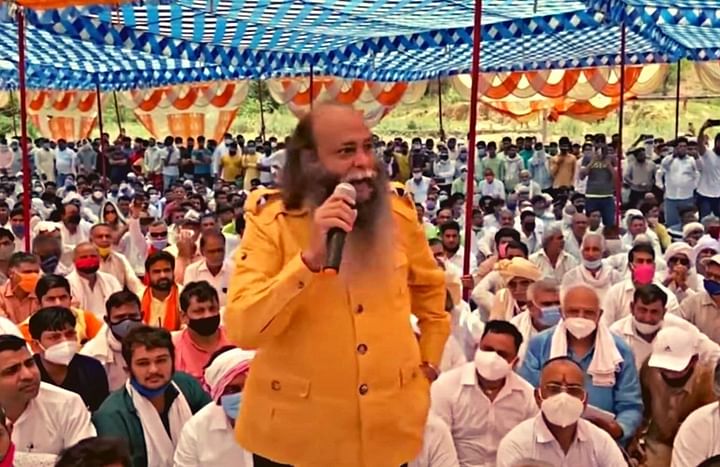
May 2021, a Hindutva mahapanchayat was held in Mewat’s Indri village.
It witnessed several anti-Muslim hate speeches made by Hindutva leaders
who had assembled in support of the accused in the case of the mob
lynching of gym trainer Asif Khan.
Among
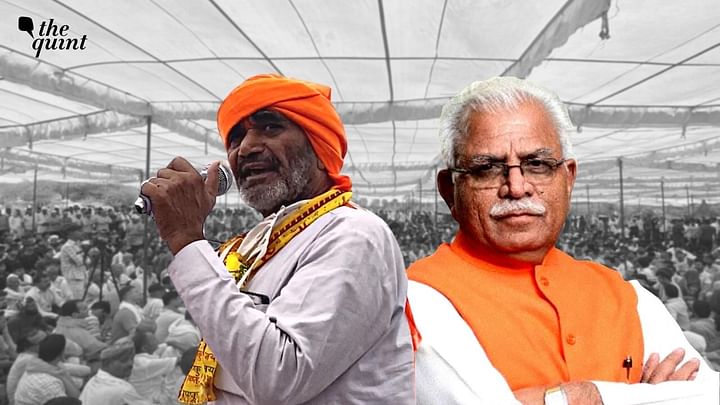
the speakers was BJP leader and Karni Sena chief Surajpal Amu.
Referring to Muslims, Amu provoked the attendees at the mahapanchayat,
“They make pornographic pictures of our sisters and daughters, and we
shouldn’t even murder them?”
BJP leader Surajpal Amu addressing the Hindutva Mahapanchayat in Mewat's Indri village in May 2021.
(Photo: Screenshot/YouTube)
A year later, in May 2022, there was yet another Hindutva Mahapanchayat
in Haryana. Once again, it was held in Mewat - in the village of
Sangel. The cause this time was different. It was being held in
retaliation against the Haryana Police filing an FIR regarding videos of
anti-Muslim violence which had gone viral. The mahapanchayat was held
to threaten the police and the administration to revoke the FIR, even
though the FIR itself was against unidentified persons. There were hate
speeches and calls for violence aplenty here as well.
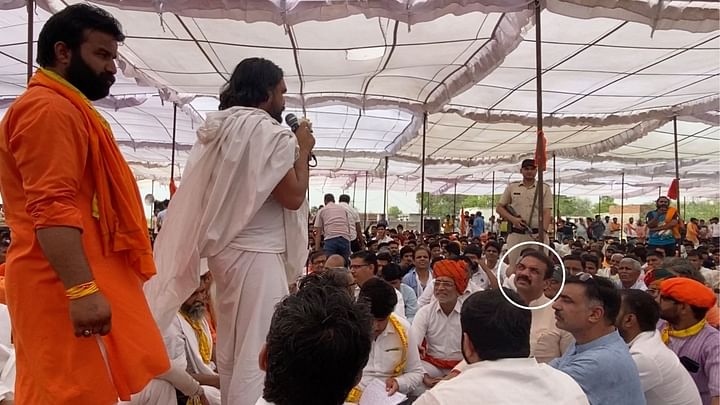
Acharya
Yogendra Arya of the Gau Raksha Dal, Haryana addressing the
Mahapanchayat in Mewat on 8 May 2022, with BJP MLA Sanjay Singh
(circled) in attendance.
(Photo: The Quint)
And
these mahapanchayats, attended by hundreds and thousands of vigilantes
and members of Haryana’s Hindutva outfits aren’t the only events which
are acting as communal flashpoints in Mewat.
In recent months, there has been ample evidence to show that Mewat is witnessing a significant amount of vigilante violence,
at the hands of self-professed ‘gau rakshaks’ or cow vigilantes. More
on that in a bit. The region has also been a particular target area for
online anti-Muslim narratives peddled by Hindutva groups and their foot
soldiers.
But why do Hindutva outfits have this disproportionate focus on Mewat? The answer lies in its demography.
The
Mewat region is loosely defined as stretching from Alwar and Bharatpur
in Rajasthan to parts of Haryana and certain parts of western Uttar
Pradesh. It is a region broader than the district in Haryana that it
lent its name to, till 2016.
Yet, the demographics of the district
formerly known as Mewat (renamed Nuh six years ago), do serve to
explain the Hindutva focus on it.
According to the 2011 Census, around 79.2% of Nuh’s total population of 10.89 lakh people are Muslims.
(Photo: The Quint)
The
district of Nuh (known as Mewat till 2016) has a majority Muslim
population. According to the 2011 Census, around 79.2% of Nuh’s total
population of 10.89 lakh people are Muslims, while Hindus comprise 20.4%
of the population.
In April 2018, NITI Aayog identified the district of Nuh as India’s most backward district.
Alishan
Jafri, an independent journalist who focuses on tracking hate crimes
and vigilante violence, remarks, “Such a large district, with more than
75% of the population being Muslim, is a thorn in the eyes of Hindutva
groups and organisations. In the last one year, Mewat has been an object
of special focus and attention for Hindutva groups. If you see the two
mahapanchayats organised in 2021 (the one in Indri village in May and
then the one in Pataudi in July), people specifically spoke about
teaching the Muslims of Mewat a lesson.”
Jafri
continued, “Because, according to the narrative and rhetoric of the
Hindutva groups there, Hindus are being oppressed in Mewat, and Hindus
elsewhere in Haryana need to unite and teach Mewat a lesson.”
From Your Phones to the Floor of the House, Branding Mewat as ‘Mini Pakistan’
In
September 2021, BJP MLA and Leader of Opposition in the Rajasthan
Assembly, Madan Dilawar stated on the floor of the House that the Mewat
region had turned into "mini Pakistan".
Dilawar’s remark might
have prompted an uproar in the Rajasthan Assembly, but his comments are
par for the course among the Hindutva discourse in the region.
And
it’s not just BJP leaders or members of local Hindutva outfits who
routinely use the phrase “mini Pakistan” while referring to Mewat.
During the filming of the documentary ‘The Making of Lynchistan: Inside
India’s Deadly Gau Raksha Network’ in 2018, even police officials in the
region whom The Quint had interacted with had expressed a similar sentiment.
A
couple of cops in Alwar had told us, “The Mewat region is full of Meo
Muslims. Consider them to be a small country of their own. The business
of the Meos is to steal, slaughter cows, etc.”
The
policemen added, “Only Muslims do this. Not just any Muslims, it is Meo
Muslims who do this. When Aurangzeb and Babur were here, they forcibly
converted Hindus to Islam. They eat off India, and cheer for Pakistan.
These Meo Muslims are such people.”
The
“mini Pakistan” discourse is not a very recent phenomenon, but one that
has been built up over the years by Hindutva groups on the ground, BJP
leaders like Madan Dilawar and even certain media outlets.
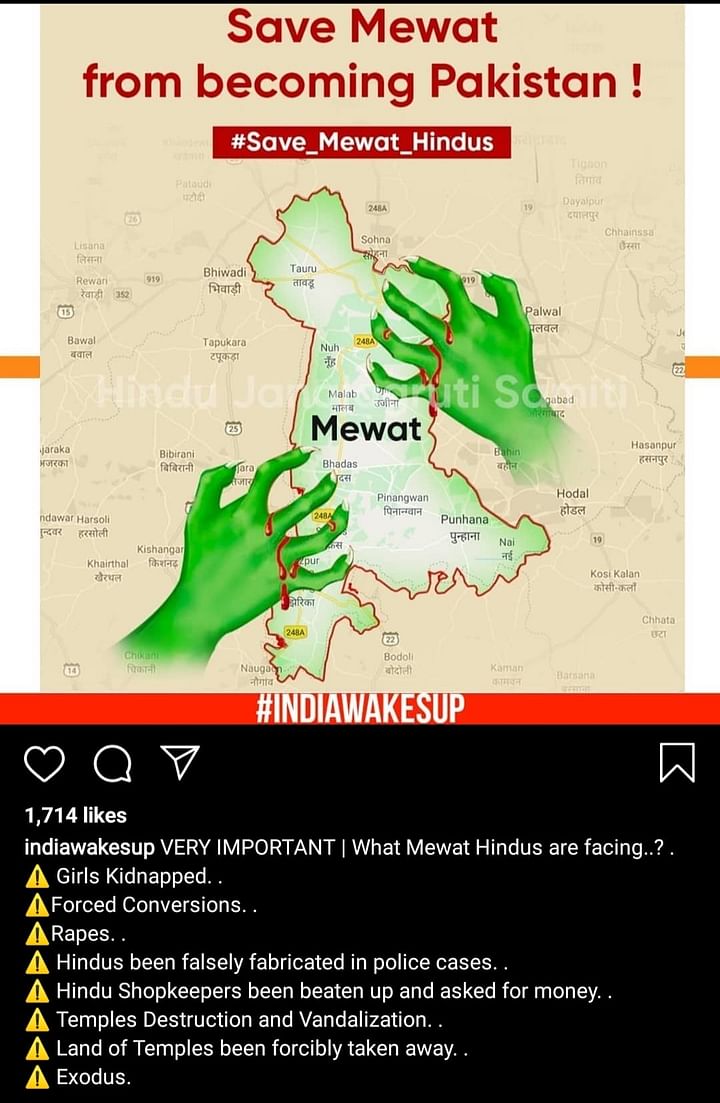
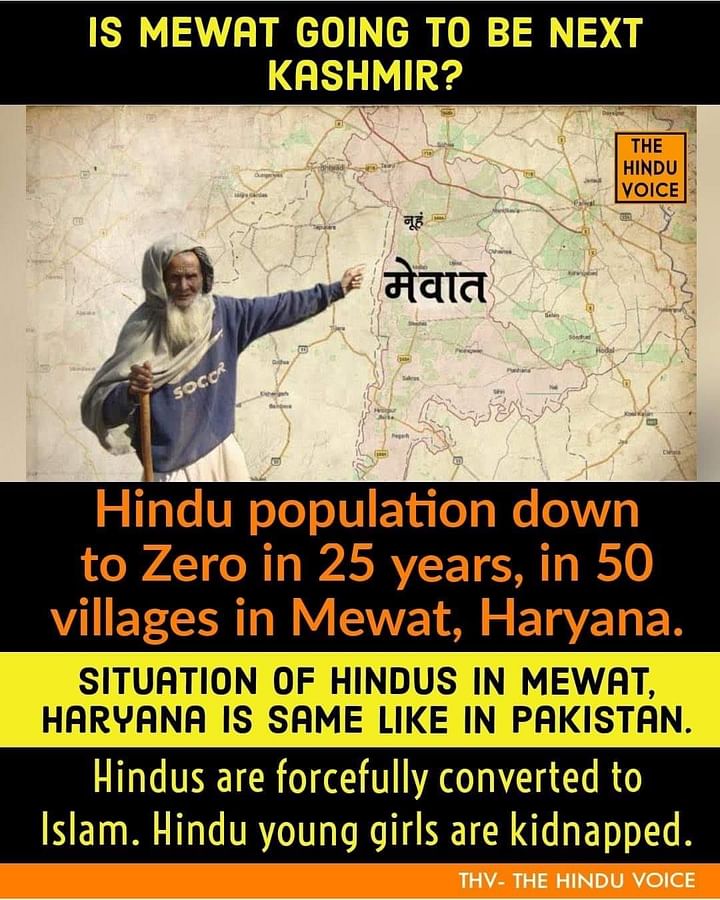
Social media posts and forwards such as the ones shown below have helped in making this narrative reach the masses.
A social media post exhorting people to "save Mewat from becoming Pakistan" and to "#Save_Mewat_Hindus."
(Photo: Angel Photographey/Facebook)
A communally provocative social media post asking if Mewat is going to become the "next Kashmir."
(Photo: Ungli Master/Facebook)
ADVERTISEMENT
The Rise of the Vigilantes, and the Role of the Administration
It
is in this backdrop that one must view the recent videos of vigilante
violence against Muslims which had gone viral. In the videos, proudly
uploaded and shared on social media by the vigilantes themselves, they
can be seen harassing and assaulting Muslim men from the region.
Independent
journalist Alishan Jafri had helped flag these videos online and tagged
the Haryana Police demanding they take action. Jafri says, “There has
been an escalation (in recent months). At least four videos (of
anti-Muslim violence by vigilantes in the region) went viral recently.”
Following
the videos going viral and outrage on social media against the seeming
inaction of the concerned authorities, the Haryana Police eventually
registered an FIR in the matter, against 3-4 unidentified persons. The
police are yet to announce any arrests in the case.
However,
some of the victims of the violence in the viral videos have instead
been promptly arrested by the police for alleged cow smuggling.
Despite
the FIR on the viral videos not naming or identifying any of the
vigilantes as the accused, the Hindutva vigilante outfits held a massive
mahapanchayat in Mewat’s Sangel village on 8 May, aggressively
demanding the revocation of the FIR.
Hindutva leader Kulbhushan Bhardwaj addressing the Mahapanchayat in Mewat on 8 May.
(Photo: The Quint)
The
event was organised by the Vishwa Hindu Parishad, the Bajrang Dal and
the Gau Raksha Dal Haryana. The two Hindutva mahapanchayats that had
been held in Indri and Pataudi in 2021 involving these same outfits had
seen a torrent of hate speech and calls for violence against Muslims.
Additionally, the promotional messaging for the event on 8 May had
distinct and provocative communal overtones, such as being a show of
strength to "those with jihadi mentality", and this too had been brought
to the notice of the district administration.
Yet, despite all of this, the district administration decided to grant them permission to go ahead with the event.
ADVERTISEMENT
Further
hate speeches were made at the Mahapanchayat, including calls for
anti-Muslim violence. There were also public threats made to attack
Congress MLA Mamman Khan and to burn down his house for speaking up
against vigilantes taking the law into their hands.
The communal tensions in Mewat were allowed yet another flashpoint.
Prior
to the event, the Deputy Commissioner of Nuh, Ajay Kumar had told The
Quint, “The organisers have been contacted and called, and it was
clearly communicated to them that the event should, under no conditions,
be like that (communally charged). And that even the speeches should
not be in hyperbole, in the sense of breaking the law."
The event
was both extremely communally polarising, and the speeches calling for
violence and threatening assault did definitely break the law.
No action is known to have been taken against the speakers or organisers of the Mahapanchayat for the same.
The
past few years themselves have shown that if allowed to escalate
relatively unchecked in this manner, hate speech, mob violence and
lawless vigilantism in a politically sensitive region like Mewat can
have disastrous consequences.
Between
2017 and 2018 for example, in Alwar alone, Rakbar Khan, a resident of
Nuh, was lynched in July 2018, Ummar Khan shot dead allegedly by cow
vigilantes in November 2017 and Pehlu Khan lynched in full public view
in April 2017.
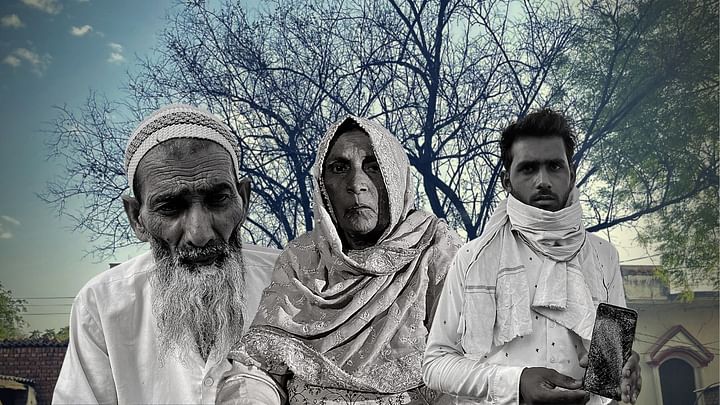
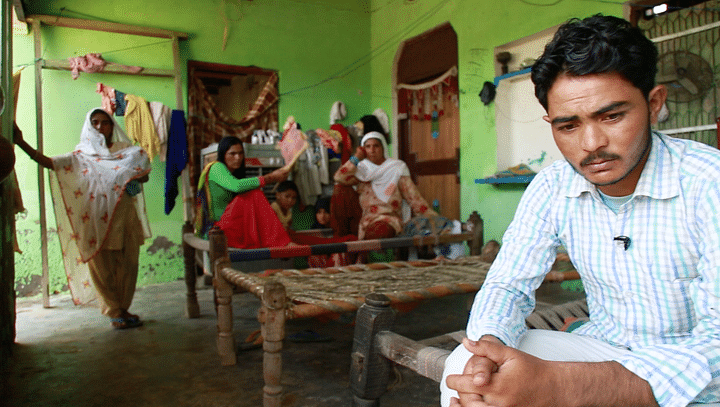
Pehlu Khan’s son Irshad and his family.
(Photo: The Quint)
At
mahapanchayats like the ones in Indri in May 2021 and Sangel in May
2022, hundreds and thousands of members of Hindutva vigilante groups are
incited and spurred on towards conducting similar acts.
Mewat’s
Muslim-majority tag, “mini Pakistan” as the Hindutva leaders call it,
gives the vigilantes operating in an around the region that additional
sense of being exalted in their circles. Jafri says that the work of
such vigilantes provides for a very brave spectacle for the larger
Hindutva audience. He explains, "Going into a Muslim-majority area,
everybody there is a Muslim, and then they are assaulting people with
the kind of impunity these guys enjoy. It makes you a hero if you are
going into Mewat and beating Muslims there.”
He
adds, “So, it’s not surprising that people are not just being attacked,
but their videos are being recorded and uploaded online. It’s a message
to Muslims that you’re not even safe in your ghettos, in a place like
Mewat, where you’re the majority, where thousands and lakhs of Muslims
live. It sends a chilling message to Muslims.”
(At The Quint, we are answerable only to our audience. Play an active role in shaping our journalism by becoming a member. Because the truth is worth it.)
Nuh clashes: Once 'religious', Jalabhishek yatra turns into power show
Updated At: Aug 03, 2023 10:13 AM (IST)
Nuh clashes: Once 'religious', Jalabhishek yatra turns into power show Charred remains of vehicles set on fire by miscreants. PTI file
Tribune News Service Gurugram, August 2 The attack on the Brajmandal Jalabhishek Yatra in Nuh, which left six dead and around 60 injured, has caught national attention, with people wanting to know the relevance and origin of this ‘pilgrimage’. The yatra was introduced three years ago by the Vishwa Hindu Parishad (VHP) to “revive holy Hindu sites and Hindu religious tourism” in Meo Muslim-dominated Nuh. Inhabited by 80 per cent Muslims, the district is home to three Mahabharata-period Shiva temples. The Aravallis are popularised as grazing grounds of Lord Krishna’s cows. The temples have long existed undisturbed — even conserved — but aiming to save them from “potential threat of being encroached by mosques”, like it happened with Kashi Vishwanath or Krishan Janambhoomi, the VHP started the yatra, insisting that pilgrims would keep the temples relevant.
What started with just members of the VHP from Nuh, Gurugram, Faridabad and Palwal soon started getting more and more participants from across Haryana to reclaim the power of “Hindutva” in Mewat. All right-wing outfits from the state are now part of the yatra, which enters Mewat from Sohna. The yatra begins from Nalhar Mahadev Temple at Nuh, proceeds to Jhirakeshwar Mahadev and Radha Krishna Temple at Shrangar village in Punhana block of the district, before culminating at Shringeshwar Mahadev Temple. However, the yatra, which was started as pilgrimage, has been converted into a “power show”, where not just the VHP or Bajrang Dal, but even cow vigilantes brandish arms. Over the last two years, the yatra has been preceded by online war of challenges between participants and local men. There is always tension surrounding the yatra, which escalated this year. “What is wrong in this? Our temples are there and Hindu community also lives there. We can take out processions. Think of Mewat seven years ago, when people were wary of entering villages. As Hindus, we are reclaiming our fundamental right to travel and pray everywhere,” said a senior VHP leader. MLA Aftab Ahmed, talking to The Tribune, stated that both communities had for long coexisted peacefully in Mewat and temples had been given due regard, but rowdyism and instigation by rival groups was increasing.
State’s role in rising Violence against
Minorities
Ram Puniyani
Junaid and Nasir set out on 16th
February 2023 to meet some relatives. They were subjected to brutal violence at
the hands of ‘cow protection’ groups. These groups are operating in Haryana and
nearby areas with great impunity. The tragic episode also reveals the degree of
absolute impunity which these groups enjoy and part collusion with the police.
On their return these two Muslim youth were stopped by the gang operating in
the name of Cow protection, beaten and taken to police station. Police neither sent
the injured men to hospital nor apprehend the criminals. The gang took Nasir
and Junaid to a remote place, tied them to the back seats of the car and put
the car on fire. The car which was used in this crime and other actions in the
name of preventing Cow trafficking was earlier registered as the police
vehicle!
Harsh Mander, the founder of
Caravan-E-Mohabbat, trying to sooth the families of ‘victims of Hate crimes’,
visited the area and wrote in Indian Express “I am profoundly chilled as I scan
social media pages of Monu Manesar. He and members of his gang live stream as
they openly brandish sophisticated firearms, sound sirens mimicking police jeeps, shoot
at vehicles, and brutally thrash the men they catch.”
While protests are going on
against this horrific crime, two Mahapanchayts have taken place. The victims
were from Rajasthan and crime was committed in Haryana. The Mahapanchayats,
duly supported by RSS affiliates Bajarang Dal, VHP and another organization
called Hindu Sena further came out with Hate speeches. In the first one it was
said that if Rajasthan police comes to arrest Monu Manesar, the chief of the
vigilante group, they will not be able to go back on their feet. In the second one
on 22nd February one Aastha Maa talked on the issue of love jihad
and incited the audience not to spare those Muslims who are eying Hindu Girls.
Meanwhile three culprits have
been arrested and it turns out that they were informers (Mukhbirs) of
police. While the menace of Cow vigilantes has gone up in last few years, it
particularly picked up after 2019. In 2015 the Harayana state passed a bill “Govansh
Sanrakshan and Gosamvarshan” (Cow Progeny protection and promotion
Act). In 2019 it brought an amendment that those trafficking cows will be
punished. Since then many groups have sprung up who stop the vehicles carrying
animals, make deals with them and in case of failures of the deals use
violence. This treatment is meted out even to those transporters who have valid
papers. Surely the police must be knowing this all. Muslims of Mevat region are
the ones, who inherit a syncretic Islam with many Hindu rituals. Milk is one of
their main business and they are victims of such regular attacks from the Monu
Manesar type groups while the police is watching.
It is not too long ago when the
issue of Cow beef was brought to the fore as an essential part of divisive
communal politics. While we are talking of one Junaid here; there was another
Junaid, a Madrassa student who was lynched while travelling in a train on the
suspicion that he had beef in his Tiffin. We recall Mohammad Akhlaq and fate of
Pehlu Khan. Lynching was politically-socially introduced as a peak of communal
violence directed against Muslim community. One recalls that it was the murder
of Akhlaq which precipitated the ‘Award Wapasi’ (returning national honors) trend
among our foremost writers, scientists, social workers and what have you.
IndianSpend reports “Muslims were the target of 51%
of violence centered on bovine issues over nearly eight years (2010 to 2017)
and comprised 86% of 28 Indians killed in 63 incidents. As many of 97 per cent
of these attacks were reported after Prime Minister Narendra Modi’s government
came to power in May 2014, and about
half the cow-related violence — 32 of 63 cases
–were from states governed by the Bharatiya Janata Party (BJP) when the attacks
were reported, revealed our analysis of violence recorded until June 25, 2017.”
The
hate spread against Muslims (and also Christians) has gone to horrific limits.
In addition to those who are RSS affiliates, other Hindu Sena type of organizations
have sprung up, dime a dozen. They merrily take the law in their hands, while
some bigwigs keep formally saying that they should not take law in their hands.
The crimes which are committed against this minority are highlighted with
aplomb and many a times these crimes are live streamed on face book (Monu
Manesar face book shows that) or videos are circulated as Shambhulal Regar who
killed Afrazul and videotaped the killing.
Many
of these culprits are honored publically. The murder accused of Kalimuddin
Ansari were greeted by Jayant Sinha, the then union Minster. Processions were
taken out in support of the culprits of Asifa, the eight year old, who was
subjected to rape and murder in Kashmir. One also recalls the murder of IT
engineer Mohsin Shaikh who was murdered in Pune and now all the accused have
been exonerated. They took out a victory march! There was also the incidence of a police officer Subodh Kumar Singh’s
murder. The crime of this upright police officer was that he was trying to take
proper action in the case of a dead cow thrown in the field of village Syana in
UP.
In a
way the ‘Cow-Beef’ issue was flagged off by none other than our Prime Minster
who in a public speech said that Maharana Pratap dedicated his life
for cow protection. New issues are regularly
being added to the ‘Hate other’. Yesterday (26th February 2023) Vashi
(New Bombay) area saw a big rally ‘Hindu Jan Akrsoh Rally’ (Hindu Mass
resentment) shouting slogans against Muslims for Love Jihad and Land Jihad. One
of the top Godi media (pro sectarianism media) anchor had presented a detailed
chart of types of Jihad which have been unleashed in India! Goebbels dominates
the media ecosystem of India!
As we
are witnessing a downward spiral of increasing Hate, Violence and consequent polarization,
the fraternity inherent in our Constitution is showing a downslide. The freedom
movement saw an upward going spiral of communal amity, now is the time to
revive those principles to lay the foundation of harmony, amity and peace.
These surely are the prerequisites of progress of the country.
Waris Khan and his friends are in their vehicle while cow vigilantes
question them, on January 28 near Nuh in Haryana. From a video grab.
A special cow protection task force empowers cow vigilantes to target alleged cow smugglers with impunity.
Haryana’s
Mewat region has seen a number of incidents of mob violence and
lynching in recent years. The victims of the attacks have been mostly
Muslim men who were thought to be involved in cow smuggling and
slaughter. The most recent incident involves Waris Khan, a car dealer
and mechanic, whose family claims that he was killed by Hindutva goons
posing as cow protectors.
On January 28, a video of three Muslim
youths allegedly being harassed by Bajrang Dal members in Tauru near Nuh
in Haryana went viral on social media. The video shows Waris and his
friends Shaukeen and Nafis in the backseat of a car being questioned
about where they hail from and so on. The interviewer’s tone is hostile
while the three young men are barely able to speak. Hours after this
video was shot, Waris, 22, father of a three-month-old girl, died.
Citing the video as proof, his cousin Shahid Hussain said, “They killed
him. They tortured them for hours before he died.”
Even as Waris’ family maintained that “it is a hate crime in the name of gauraksha”
(cow protection) and named a local Bajrang Dal member, Monu Manesar,
for his involvement in it, Nuh Superintendent of Police (SP) Varun
Singla called it an unfortunate road accident.
Waris was on his
way back from Rajasthan’s Bhiwandi with Shaukeen and Nafis when their
car allegedly met with an accident. The police arrested Shaukeen and
Nafis after a mini-truck driver involved in the collision filed a
report. Waris died before he could be presented in court. A cow was
found in the trunk of Waris’ car, the police said.
A country for the cow: The chronicle of a visit to cow vigilante victim Pehlu Khan’s village
The Mewat farmer lynched by cow vigilantes in Alwar has left
behind a broken family, and a fearful community questioning its place in
the Indian republic.
An impoverished dairy farmer, white-bearded, visibly
Muslim, only a few years younger than me, was lynched on a national
highway by a mob of young men with stones and sticks who claimed that he
was a cattle smuggler. He died later in a private hospital. Compelled
and haunted by images of his attack – captured for history on a couple
of mobile phone cameras – a few colleagues and I went to meet his
bereaved family in their village Jaisinghpur in Mewat, Haryana. When we
sat with them, our eyes lowered, we found it hard to find the words to
convey to the bereaved, distraught and terrified family our sadness, our
shame, and our rage.
And yet before I proceed to tell you their
story, in the strange, fraught times we live in, even I feel obliged to
start by underlining that the murdered man and his sons were innocent,
that they were not cattle-smugglers but legitimate dairy farmers. As
though the crime of their brutal mob killing would be any less monstrous
if they had in some way broken the law. Rajasthan’s Home Minister Gulab
Chand Kataria, while criticising the attack, blamed the victims saying,
“The problem is from both the sides. People know cow trafficking is
illegal but they do it. Gau Bhakts try to stop those who indulge in such
crimes.”
His description of the marauders as Gau Bhakts, or
worshippers of the cow, brought back memories from my years as a
district collector in Madhya Pradesh during the Ayodhya Ramjanam Bhoomi
movement, when rioters who terrorised, burnt and murdered their Muslim
neighbours in town after town of communal frenzy were described benignly
in the press and political speeches as Ram Bhakts, or worshippers of
Ram. The felling of Pehlu Khan on April 1, 2017 on NH8 near Behror,
Alwar, by self-styled cow vigilantes, had as little to do with the love
of the cow as the annihilation of the Babri Masjid had to do with the
love of Ram.
This rationalisation for the hate crime echoed in
many television debates. The studied refusal of the chief ministers of
Rajasthan, where the crime occurred, and Haryana, which is home to the
dead man, as well as the otherwise voluble prime minister to express any
outrage or public regret for the killing reflects the same implied
validation. No one from the Haryana state administration has visited
Pehlu Khan’s home. Alwar’s Superintendent of Police Rahul Prakash
categorically told Rediff.com’s
Prasanna D Zore that the 15 men from Mewat, including Pehlu Khan, who
were beaten up by a mob in Alwar on suspicion of smuggling cows had no
verified documents to prove they were in the dairy business and not cow
smugglers, and therefore, “hundred per cent they were cow smugglers;
there is no doubt about that”. But he was reluctantly prepared to admit:
“I don’t know if they [the attackers] knew for sure if they [the
victims] were cow smugglers or not, but according to the police version
they were cow smugglers.”
Before any criminal cases were filed
against the lynch mob, the Rajasthan police first registered a First
Information Report against Pehlu Khan and the young men with him under
the Rajasthan Bovine Animal (Prohibition of Slaughter and Regulation of
Temporary Migration or Export) Act, 1995. I have a copy of the FIR. It
mentions that they are charged under Section 5 of the Act. According to
this section, “No person shall export and cause to be exported any
bovine animal himself or through his agent, servant or other person
acting in his behalf from any place within the State to any place
outside the State for the purposes of slaughter or with the knowledge
that it may be or is likely to be slaughtered.” The men were
transporting five milch cows that had only recently delivered and
carried papers to prove their purchase from the cattle market on Ramgarh
Road in Jaipur. The only cattle that are taken to slaughter are too old
or diseased to yield milk. Why would any person transport expensive
high-milk yielding cows for a slaughterhouse that would pay them a small
fraction of what they would earn if they were sold as productive milch
cows? And to transport milch cows for dairying no papers or permission
are required by the law.
A videograb of the attack on Pehlu Khan and others in Alwar. Therefore,
there was no ground for any presumption by the police (nor by the
vigilante mob) that the men were cattle smugglers. Even so, criminal
cases were registered against them for crimes that could confine them
behind prison walls for 10 years. They were also charged under Section 9
of the Rajasthan Bovine Animal (Prohibition of Slaughter and Regulation
of Temporary Migration or Export) Act, 1995, which makes it illegal to
cause bodily pain, disease or infirmity to a bovine animal. The claim
was that the cows were being treated cruelly because two or three were
packed with their claves in the back of a pick-up van. I wondered if the
policepersons had ever travelled in an unreserved train compartment, a
state transport bus, or seen casual workers transported in the back of
trucks.
By contrast, the police registered cases against the six
men named in the FIR, and 200 others, only after the men who had been
assaulted were charged. Their attackers were charged under relatively
mild sections of the Indian Penal Code – Sections 147 (rioting), 143
(unlawful assembly), 323 (voluntarily causing hurt), 341 (wrongful
restraint), 308 (culpable homicide), and 379 (theft). On April 3,
Section 308 was changed to that of murder (Section 302) after Pehlu Khan
died in hospital around 7.30 pm. Until the time of writing, none of the
men mentioned in the FIR and in Pehlu Khan’s dying declaration have
been arrested. Saddam Hussain, president of Mewat Yuva Sanghtan, alleged
to the Hindustan Times that the police were unwilling to
arrest the named accused because of their affiliation with right-wing
Hindu organisations, the Rashtriya Swayamsevak Sangh, the Hindu Dharma
Jagran and the Akhil Bharatiya Vidyarthi Parishad. “Either there is
pressure from the government to not arrest them or police are not trying
hard enough,” he said.
There are echoes here from the earlier
case of lynching of Mohammad Akhlaq in Dadri by his neighbours over the
rumour that he stored beef in his refrigerator, which also stirred
public conscience. Despite country-wide outrage, criminal cases were
registered against Akhlaq’s family whereas a man charged with his murder
who died of an illness in prison was cremated with his body wrapped in
the national flag, in the presence of a Union minister. Any Muslim or
Dalit victim of mob lynching is somehow criminally guilty, and the
killers are nationalist Hindus understandably outraged because the
sacred cow has been threatened or killed.
The lynching of Mohammad Akhlaq in Dadri, Uttar Pradesh, in 2015 triggered country-wide outrage. Image credit: AFPI
return to our visit to Pehlu Khan’s village Jaisinghpur, with my
friends Farah Naqvi, Mohsin Khan, Zafar Eqbal and Rubina Akhtar, on
April 18, 2017. The village is indistinguishable from many others in the
district Nuh, earlier known as Mewat or the home of the Meo Muslim, who
constitute 80% of this arid and water-scarce, impoverished district. We
approached their home with trepidation. We had made the journey because
we felt compelled to offer solidarity in a small personal way, in the
times that we live in, which I can only describe as times of command
bigotry, hate led and spurred from the top.
But we did not want
to intrude in their time of grief, which was already far too public.
However Ramzan Chaudhary, the large-hearted and courageous lawyer (and a
self-appointed spokesperson of the Meo people) who accompanied us,
assured us that our visit would be welcomed by Pehlu Khan’s family
because he felt we were “not the same” as many of those who had
descended on their home in the past two weeks. But we still arrived
there with unease.
Theirs was a small modest village brick home. A
green cloth canopy had been erected outside the house as the family
could not accommodate the visitors who streamed into their nondescript
village every day after Pehlu Khan’s lynching hit the headlines. There
had been before us some journalists, many local politicians, some
religious leaders, and members of the Kisaan Sabha affiliated with the
communist parties. Farah and Rubina were led into the inner rooms and
came back to us an hour later, harrowed. Pehlu Khan’s mother, a wizened
old woman now completely blind, and his widow and daughters were
inconsolable. Pehlu Khan was an only son. He in turn had eight children.
Some were married, including Irshad, who is in his twenties. The
teenaged Arif was also beaten up with him at Alwar. His daughters and
daughters-in-law cannot make sense of why he was killed. His other sons
and grandchildren are too young to understand what has happened.
Outside,
where I sat with the men, the mood was sombre. More and more men
gathered in the hours that we spent there. The elders sat on benches,
the young men squatted on the ground, deferential to age. I opened the
discussion by saying, “We hesitated to come but at the same time we
could not stay away. Because we want you to know that we share in your
grief and in your anger against the injustice that has been done to
you.” They accepted our awkward words with grace, and insisted that we
must first accept their hospitality and only then talk further. We
protested but to no avail. “We have been taught by our ancestors about
how we should treat our guests, even at times like this.” After much
persuasion, we still had to accept some sweetened soda before we began
to talk.
The story of what transpired with them is well known but
as Pehlu Khan’s older son Irshad and others who were part of this
traumatic journey – nephews, neighbours – spoke, the horror for us
became even more palpable. The family owns barely an acre of land, which
yields little for the family. So, they have always raised milch cattle –
cows or buffaloes – and they sell the milk in the village or to richer
landowners in the surrounding villages. They also buy milch cows from
the cattle markets of Rajasthan, sell their milk for a while and resell
them at a slight profit of a couple of thousand rupees. This helps feed
the family. The sons helped out the father and when they could, drive a
pick-up van or a jeep taxi. Pehlu Khan took even his younger son Arif
with him because he wanted him to learn the cattle trade early.
Members of Mewat Yuva Sangthan take out a silent march in Alwar to demand the arrest of Pehlu Khan's killers. Credit: HT PhotoThe month of Ramzan is a good one for milk sales, the best time of the year. People buy milk and curds for the pre-dawn Sehrior the evening Iftar. Pehlu
Khan took a loan as he always did from richer neighbours, many of them
Hindu Thakurs, at an interest rate of 5% per month. They hired a pick-up
van from a neighbour, loaded on it their buffalo that had stop giving
milk to sell, and with Irshad at the wheel, and Arif, a nephew and some
neighbours in the back, they set off for the weekly cattle market on
Ramgarh Road near Jaipur.
This was a market they visited
frequently. The cattle traders knew Pehlu Khan well. He had initially
set his heart on buying a buffalo to replace the one that he sold. But
he was offered a cow that had recently delivered a calf at a lower
price. The cattle seller milked her in his presence and she gave 12
litres of milk. It was a deal. Other villagers also made their
purchases. Together, they hired one more pick-up truck from the market.
Pehlu Khan sat in the hired truck, with two cows and two calves. Irshad
carried three cows in his pick-up van and drove with his neighbour and
friend Asmat. All the cows were beautiful, healthy, with young calves
and bountiful milk yields. In their villages, they describe pregnant and
milk-giving cows as biyahi, or married.
At the Jaguwas
crossing in Behror, Alwar, the pick-up trucks were stopped by an ugly
crowd of about 50 men. They dragged them out, slapped and heckled them,
claiming they were cow smugglers. Irshad says he showed them the
receipts of the cows from the cattle market but they tore those up.
(Fortunately, he was able to get copies from the cattle market later. He
showed us these copies.) They asked the driver of the truck Pehlu Khan
had hired from the cattle market his name. It was a Hindu name. They
slapped him and told him to run away. The other terrified men tried to
run away as well but the crowd caught them easily. Pehlu Khan was the
oldest among them and received the harshest blows. He tried to pick
himself up weakly but the men rained blows on him again. Asmat was
beaten on his back and spine, Arif was injured in his eye. The mob
vandalised the trucks, twisted the bonnet, and threw rocks on the
windscreen and the engine. They snatched their wallets, watches, mobile
phones and all their money. Irshad had Rs 75,000 left from the loan.
They snatched this as well.
The crowd swelled. More men joined in
the lynching; some vandalised the trucks as though for sport, some
watched, a few took videos on their mobile phone cameras, some walked
past looking at the screens of their mobile phones as though nothing was
amiss around them. No one came to their aid.
They lost track of
time as the beating continued – with sticks, stones and belts – and one
by one all the men fell, lying on the road or pavements in twisted inert
heaps, almost unconscious. They guess some 20 minutes had passed when
the police arrived. “They would have set us all on fire had the police
not come.”
The police confiscated their cows and had sent them to a
private gaushala. They took Phelu Khan and orders to a nearby private
hospital, Kailash Hospital, in Behror. It is there that Pehlu Khan died
on April 3. The doctor who did the post-mortem on him told The Indian Express,
“Injuries were the main cause of death. As said in our post-mortem
report, the (thoracoabdominal) injuries were ‘sufficient cause of
death’. The heart attack was secondary.”
Irshad spoke to us
haltingly, in a low monotone. He was still visibly traumatised, and in
mourning. Besides, young people do not talk loudly in the presence of
their elders. The older men spoke of how the families were ruined. How
will they repay their loans? Will they ever get back the cows they had
bought? Even if they ultimately did, would they still be the beautiful
milch cows that they had bought? They would get back some useless scrub
cattle, if any at all. The remaining cash they had taken on loan at 5%
interest, compound per month, had been stolen from them. They would also
have to pay for the vandalised pick-up truck they had borrowed. Their
father had taken all the decisions but he is not there to guide them
anymore.
We also visited Pehlu Khan’s neighbour Azmat Khan. The
young man, father of an infant girl, lay on a cot, wrapped in an old
nylon sari converted into a sheet. He was still in pain, not yet
recovered from his spine injury. He held my hand for a long time as I
sat by his bedside. We looked at his medical papers from the private
hospital where he was being treated. They did not look good. “I hope he
will be able to walk again,” I whispered in English to my colleagues. He
too had taken a loan to buy a cow for selling milk in the Ramzan month
of fasting and prayers.
Outside virtually every house in the
village is tied a cow or two, or a buffalo. “Our children rarely drink
milk. We have to sell every drop to repay our loans and bring home food.
But now they are terrified about what the future would hold for them.
Anyone can come into our houses and claim that we are raising the cows
for slaughter.” They have few other options. The land is dry and
infertile, and the rains fickle. Education levels are low. Thousands of
young men are drivers but getting a driving licence for heavy vehicles
from the notoriously corrupt district transport office is difficult.
Young men over the years got licences from far corners of the country,
probably because they had to pay smaller bribes. But over the last two
years, these licences have been suddenly derecognised by the district
transport authorities. Ramzan Chaudhary alleges this was done out of
spite in this overwhelmingly Muslim district, rendering an estimated
75,000 drivers out of work.
Gau Raksha Dal members out to inspect trucks on a highway in Taranagar, Rajasthan. Image credit: AFPA
few thousand men opened biryani stalls on the highways but in 2016
raids by police checking if the meat they used was of cows or buffaloes
caused them to shut shop. Today, you see a small number of such shops,
and they hasten to tell you that their biryani has chicken and not beef.
And now even dairy farming has become a dangerous vocation. They
do not know what the future holds, how they will feed their children.
We asked how they will manage. “Bardashth karenge, aur kya?”some of them replied, dully. “We will bear it, what else?” “Bhuke marenge”,said a few others even more dismally. “We will die of hunger.”
Some
of them, though, are planning an unusual if heart-breaking act of civic
resistance. They plan to take their cows to the district collector’s
office and tie them to the gate, leaving it to the government to do what
it will with them. “You do not trust us with the cow, and we are no
longer safe in tending them. Let the government then take them over!”
As
we sat with a large group of men under the makeshift canopy outside
Pehlu Khan’s house, the talk returned over and over to their anguish
about the new climate of hate and suspicion against Muslims that they
found surrounded them. It was never like this, they said. Hindus and
Muslims have always lived together like brothers and sisters. But in the
last two or three years, everything has changed. “We are watanparasth, true
nationalists. Our ancestors made so many sacrifices for our country.
They fought against Babur’s army on the side of Rana Sangha.” We wanted
to stop them: please, you don’t have to do this. Why must you feel you
have to prove your love for your country? But the words got stuck in our
throats as they went on insistently. And they would also ask, “Who
loves the cow more than us Meo Muslims?” Go to any Meo village home and
see how much they love their cows, like they are members of the family.
Any evening, see how lovingly they bathe their cows. And yet we are
being called cow-killers”.
By strange coincidence, the driver of
the taxi we had hired from Delhi to travel to Nuh, a young Dalit Sikh,
turned out to be a man who loved cows. He stopped the taxi on the way
and took out rotis from the car and fed them to stray cows. He said he
had worked as a driver for the owner of a gaushala, and in that time had
come to adore cows. When he is off duty even today, he volunteers to
tend stray cows in a gaushala. Returning from Jaisinghpur, our souls
weighed down by all we had seen and heard, we gave him our leftover
sandwiches to feed the cows. I joined him in feeding them, and as the
cows nuzzled on my fingers, I realised afresh that what had transpired
on the highway at Behror had nothing at all to do with the love of this
gentle animal. Nothing at all.
The words of the villagers in
Nuh echoed in our ears. What is our place in this country, they asked us
over and over again. A country where our life values less than a cow’s?
Five men arrested last week in Patiala on charges of planning a dacoity have confessed to carrying out at least four bombings targeted at Muslims in Haryana in 2009 and 2010, police in Haryana and Punjab said today. The men allegedly belong to a Hindu extremist group called Azad Sangathan, headed by a Jind resident called Azad, also known as Sagar and Kala. Azad was arrested along with his comrades Praveen Sharma, Ram Niwas, Gurnam Singh and Rakesh Kumar at Shambhu barrier in Patiala. All are in Haryana Police custody.
"They have told interrogators that they wanted to spread terror among Muslims and chose Muslim targets for their attacks," Inspector Rohtash Singh, station house officer of Jind city police station, who is investigating the attacks, said. "They chose a madrasa and a meat factory in Jind district, and a mosque in Mehlab village of Mewat district. They wanted to target Muslim buildings." Jind superintendent of police Ashok Kumar said, "So far they have confessed to carrying out blasts at four places. It is a sensitive matter. We are not in a position to divulge many details."
The Jind-Mewat area was rocked by a series of apparently unexplained blasts in 2009-10. Apart from a madrasa and meat factory, bombs went off in Nuh in Mewat and Safidon in Jind. All were low intensity explosions in which no one was killed, police said. Haryana Police have been treating the madrasa blast, which took place in October 2009, as triggered by a leaking septic tank. "All the accused are school dropouts and between ages of 22 and 28. Azad is the head who roped in the others. We have so far not found evidence that they were in touch with any other Hindu extremist group," Inspector Singh said.
He said one of the accused, Rakesh, had come to know of potassium sulphate as an explosive while working as a tractor driver at a mine in Tosham in Haryana's Bhiwani district. "He (Rakesh) stole a bag of potash, and the explosive was used by the members of Azad Sangathan to carry out the blasts," Singh said.
[See two reports below on what could be covert Hindutva operation?. While these cowboys were blowing up places in Harayana, a recently arrested RSS nut (who has a role in the Samjhauta train bombing) was also playing with cow dung for cover see the third news item below about Kamal Chauhan ]
Probe into Haryana bombings reveals role of cow shelters VARINDER BHATIA
Posted: Wednesday, Feb 22, 2012 at 0106 hrs IST
Jind: Investigations into the bombings of several Muslim sites in Haryana’s Jind and Mewat districts in 2009-10 have led the police to a network of gaushalas or cow shelters dotting the region, some of which appear to have played a part in indoctrinating and inspiring the alleged bombers.
The five alleged bombers arrested in Patiala last week on the initial charge of planning a dacoity were produced in a Jind court today. The five men — members of a cow protection group called Azad Sangathan — have given police names of six accomplices, all of whom are on the run.
The arrested men are learnt to have told interrogators that they were “instigated and motivated” to carry out attacks on a mosque, madrasa and slaughterhouse by a man called Swami Dayanand, allegedly the head of a gaushala in Mewat district’s Nuh tehsil.
Dayanand is under the scanner, as are the heads of two other gaushalas in the region, sources in the state police said. None of the three has been questioned yet. Police sources said the gaushalas might have paid the five men a few thousand rupees each to carry out the attacks.
The men — leader Sagar alias Azad alias Kala and his associates Rajesh Kumar, Sham Niwas, Praveen Sharma and Gurnam Singh — were produced before chief judicial magistrate Basruddin who remanded Sagar and Rajesh in the custody of Safidon police in connection with a blast in the town in 2009, and sent the others to jail.
“It has been revealed during interrogation that six more persons — Kismat, Surender, Ajay, Pawan, Sonu and an unidentified man — helped Sagar and his associates in executing the serial blasts. Most of them belong to Jind district and are members of Sagar’s group. The role played by gaushalas and their heads is under investigation too,” investigating officer Inspector Rohtash Singh said.
Besides Dayanand, under the scanner are Swami Gorakshanand and Swami Ganeshanand, both gaushala heads based in Uchana village in Jind. Police sources said they were investigating information that Sagar and his associates were regular visitors to both gaushalas, and might have used them as bases to plan their attacks.
Gorakshanand denied knowing anything about the Azad Sangathan. “I am not aware of any such activity by Sagar or his friends. I have been based in this gaushala for the last 40-50 years. We run ashrams in Haridwar and Kurukshetra, and gaushalas in Jind,” he told The Indian Express.
Villagers in Uchana claimed Ganeshanand had passed away recently.
VijaitaSingh : Punhana, Mewat, Wed Feb 22 2012, 01:07 hrs Fifteen days before a 50-year-old migrant labourer from Bihar was killed in a mysterious explosion at a slaughterhouse in Haryana’s Mewat district, police had recovered explosives and detonators from a ditch in a nearby village.
Three years after these incidents, police have begun to join the dots — after five alleged dacoits arrested by Punjab Police confessed to have carried out four bombings targeted at Muslims in Haryana’s Jind district.
The death of the labourer — identified as Mohammad Medi Hassan, a resident of Madhubani in Bihar — has lain in police records since February 14, 2009, when the blast took place. No progress was made in tracing the planters of the bomb, or the people who hid the explosives in the ditch.
Hassan was killed at Al-Nafees Proteins Limited, a sprawling slaughterhouse owned by a Delhi-based businessman at Satakpuri village in Mewat, after someone rolled a crude bomb into the godown where he was sleeping with two others.
“It was 4 in the morning, and I was asleep. I was woken up by the noise of someone rolling up the shutter of the godown. Something wrapped in a newspaper was rolled towards us,” Rehmatullah, a labourer who survived the explosion said in his complaint to police.
“Two of us ran towards the window, and Hassan ran towards the shutter. Just then, the bomb exploded and he started bleeding from his stomach. We rushed him to hospital but he was dead by then,” Rehmatullah said.
The slaughterhouse complex also has a mosque, which faces the godown where the incident took place.
Barely two weeks before this incident, on January 31, police had recovered a countrymade revolver, red wires, six small pipes, a box of detonators and a bundle of cordex wire from a ditch some six kilometres from the slaughterhouse. From a file that was also found, police had identified three men from Bhilwara in Rajasthan who they suspected might have hidden the bomb-making equipment there. The three — Brij Raj Singh Shekhawat, Kanhaiyya Lal and Bairu Lal — have been declared proclaimed offenders.
“We have sent our teams to Jind and they are interrogating the five accused (arrested in Patiala last week). It is not yet established why they decided to attack this particular slaughterhouse,” Brishbhan, in-charge of Punhana police station in Mewat where both cases are registered, said.
Post-Samjhauta bombing, Kamal Chouhan was saving cows
Venugopal Pillai, TNN Feb 16, 2012, 06.28AM IST
INDORE: RSS man Kamal Chouhan, who is alleged to have bombed the Samjhauta Express killing 68 people, was busy saving cows till last year, say people who knew him in his village near here.
Chauhan, who used to run an RSS shakha in his village Moorkhedi, was associated with Shree Ganga Goshala in Gangajalkhedi. He used to save cows from slaughter and rehabilitate them till last year. "About a year ago, he rescued some ten cows and brought them to the goshala," said Mohanlal, keeper of Shree Ganga Goshala.
According to Ashok Jain, state RSS head, Kamal may have been associated with the RSS at some time, but he did not hold any official position. Jain, however, did not clarify if Chouhan was still an RSS member. "There is nothing like admission or sacking in the RSS," he maintained. Incidentally, Chouhan was quoted saying in reports yesterday that he broke away from the RSS because he could not stand its "new ideology".
Kailash Chauhan, his uncle, said Kamal was an eighth standard dropout from a local government school, and owned 30 bighas of farm land and a tractor. Kailash said his nephew had stopped going to the RSS shakha sometime in 2008. The shakha was held opposite Kamal's home and an RSS worker Rajesh Dhakad had encouraged him to join. Dhakad soon disappeared from the scene and Kamal took over the shakha. "Kamal ran the shakha, attended by many small children," said his uncle, adding the shakha was later "discontinued".
Some, however, believe Kamal could not have been the Samjhauta bomber. A fellow-villager, Rameshwar, claimed that on February 19, 2007 the day the train was bombed, Kamal was in Badoli about 2 kms from Moorkhedi attending a marriage and that his presence has been video recorded.
Released in the Press Conference on 19th Sept, 2011
This preliminary report of the PUCL team pertains to the incident of the police firing in Gopalgarh, district Bharatpur, Rajasthan. As per the media reports, the police resorted to firing to quell rioting mobs. The government has acknowledged eight deaths and 23 injured in this incident. Following this, the PUCL, Rajasthan constituted a Fact Finding Team to conduct independent inquiry into this incident. The team comprised Kavita Srivastava, National Secretary, PUCL, Professor Shail Mayaram (Delhi), Professor Yogendra Yadav(Delhi), Ms. Nishat Hussain (Vice President, PUCL, Rajasthan) Mr. Sawai Singh (Organising Secretary PUCL, Rajasthan), Mr. Noor Mohammed (PUCL, Alwar), Mr Virendra Vidrohi (PUCL, Alwar), Adv. Ramjan Chowdhary (PUCL, Mewat district, Haryana), Mr Gaurav Srivastava(PUCL intern). Mr. Neelabh Mishra, Editor, Outlook (Hindi) and a section of progressive members of the Gurjar and Meo community also accompanied and assisted the fact finding team.
The team visited Gopalgarh and nearby villages on the 16th and 17th of September and, spoke to victims and their families, eyewitnesses and locally informed persons. The team also spoke to the District Magistrate, SP on duty (before they were transferred), the SHO of the Gopalgarh Police Station and senior police and administrative officials.
The government version, widely reported in the media, is that this was an outcome of rioting between two communities. It is said that since the mobs had turned violent, the police was left with no option except to open fire.
Our preliminary inquiry, however, raises many serious questions about this official account:
1. All the eight dead bodies identified are of Meo Muslims. Of the 23 persons officially acknowledged to be injured, 19 are Meo Muslims. This preponderance of Muslims among the dead and injured is intriguing, if the police was, as is claimed, acting neutrally and firing on both sides to control rioting mobs. .
2. Every eye-witness we spoke to said that there was no death before the police force intervened. According to senior police authorities as many as 219 rounds were fired by the police, which appears prima facie an excessive use of this measure of the last resort. Other than the use of tear gas shell, we did not hear about other precautionary steps to disperse the crowds such as lathi charge, use of rubber bullets. Since most of the deaths took place inside the Mosque, there is compelling reason to think that the firing targeted one community.
3. Local persons reported that to several dead bodies were burnt. In addition, three dead bodies were discovered from a nearby well. This aspect requires thorough investigation, since it is reasonable to presume that the police was in-charge of the site after firing had taken place and the mobs dispersed.
4. There are many aspects that point to a collusion between the local police, an aggressive section of the Gujjar community and some local RSS, Bajrang Dal and VHP leaders. The composition of the Police Station (eight police personnel were from the Gujjars community, while none was Muslim) and its conduct in the recent past gives rise to the impression that the police was not neutral.
5. The Mosque bore evidence of extensive vandalism, which lends credence to the allegation that after the firing the Mosque was ‘captured’ by a section of the Gujjar community in complicity with the police.
6. The burning and mutilation of at least three or more dead bodies and of those who were alive (some of the patients in the SMS bear witness to this) again gives rise to the suspicion that the local police and a section of the Gujjar community may have colluded in the aftermath of police action. There is a serious apprehension that this could have been done in order to destroy all evidence of bullet and other injuries.
7. The conduct of the administration in handiling the original dispute concerning the graveyard land and during the crisis of 14 September leaves many questions unanswered. There were confirmed reports about violent confrontation between the two communities (thousands from each side) around 11 a.m. But once the initial clash was put down by noon, the crowds were allowed to remain and rearm for five hours, even though the District Magistrate and SP were at the site. There is a strong belief among the Meos that that the District Magistrate was pressured into ordering firing by self-styled Hindu leaders. There are widespread allegations that firearms from the police station’s armory were taken and used by some elements from the Gujjar community. This needs to be investigated.
The state government has announced several steps following this incident. The District Magistrate and SP have been transferred, a judicial inquiry has been announced, the investigation has been handed over to the CBI and compensation announced for the victims. These are steps in the right direction. But these are not sufficient. We suggest the following steps on an urgent basis to restore peace and public confidence.
There are still many reports of missing persons which need to be verified immediately. There is a need for credible post-mortem of the dead to be done by a high level and independent panel of doctors. The official list of injured needs to be revised so as to include those who did not report out of fear or those who went over to Haryana to get private treatment. There is a need for a fresh MLC for all the injured. Arrangements should be made to bring back the Muslim families of Gopalgarh who have fled in order to save their lives. The entire local police should be transferred and be replaced by a multi-community police force with adequate representation of minority community. The local community needs to be taken into confidence in carrying out repairs and restoration of the Mosque. The case files should be handed over to the CBI within the next seven days. Confidence building measures in this region to reduce the possibility of communities coming to a flashpoint and to restore trust among the minority community need to be undertaken. As a longterm measure all disputes pertaining to community spaces such as temples, mosques, graveyards, cremation grounds, etc should immediately be identified and special courts set up to resolve the legal disputes. Simultaneously, steps should be taken to amicably settle such disputes by bringing the communities in question together through proactive measures.
The terms of reference of the Judicial Enquiry must specifically include
The conduct of the District Collector and SP of Bharatpur, the Additional SP on the site, the SHO of Gopal Garh police station, The Circle Officer of the area and the Tehsildar who issued notices under sec 91 of LRA, which precipitated the situation. The role of outsiders on the 14th of September during the inconclusive mediation meeting between the leaders of both communities held to further intercommunal resolution at the police station, which compelled the Collector to give written orders for firing. The persons responsible for vandalising the Mosque, scorching the dead, putting the dead bodies in the well and those who allowed these persons to enter the mosque when it was in complete control of the police Conduct of police and administration in the five hours from noon to 5 pm so as to find out why the weapons were not seized from both the communities during the course of day and why section 144 CrPC was not imposed when several thousand people had gathered The handling of the original revenue dispute to find out why the concerned Tehsildar issue notices of eviction under section 91 of the Land Revenue Act when the SDM Pahari was already dealing with the Kabristan Land issue underr section 136 of the Land Revenue Act The fire in the stacks of cowdung cakes (the Baterwas-hut shaped structures made for the storage and safety of cow dung cakes) around the site of firing that raged for two days and why were the fires not doused despite the local availability of the fire engine. The exact circumstances in which the orders of firing were issued and the possibility that some police arms were used by private persons.