|
Showing posts with label Homophobia. Show all posts

March 19, 2023

India: IMSD deplores the demonisation of sexual minorities by Kerala’s rightwing Muslims

 Indian Muslims for Secular Democracy (IMSD)

March 17, 2023

PRESS STATEMENT

IMSD deplores the demonisation of sexual minorities by Kerala’s rightwing Muslims

Indian Muslims for Secular Democracy (IMSD) strongly condemns the concerted effort by the Muslim rightwing in Kerala -- including leaders of the Jamaat-e-Islami and the Indian Union Muslim League (IUML), and some Muslim-run websites -- to ridicule, vilify, denigrate and demonise Muslims who are part of the LGBTQIA+ community.

It is a tragic irony that while the minority Muslim community in India is itself the target of rampant Islamophobia, the conservatives among them are hurling hate speech at the sexual minorities (minority within the minority). What logic or ethics makes Islamophobia wrong but homophobia, queerphobia or transphobia right? Not surprisingly, the Muslim right has much in common with the Hindu right.

The latest trigger for the fulminations is the news last month of a transgender couple from Kerala -- Zahad Fazil, a trans man and Ziya Payal, a trans woman – having decided to be biological parents of a baby. The couple reportedly took this decision because adoption is not an option for transgender persons.

What perhaps added to the fervour of the self-appointed custodians of morality is the fact that Kerala’s health minister Veena George promptly congratulated the couple on the phone and directed the Kozhikode Medical College to provide all treatment for free. She also arranged for breast milk to be provided to the baby from the human milk bank.

Being targets of hate politics themselves, Muslims should know the difference between free speech and hate speech. Comparing homosexuality to paedophilia, targeting members of the LGBTQIA+ community with words and expressions such as “a shame”, “mentally ill”, “worst kind of people”, “people in need of treatment” etc. are hate speech, not free speech.

The very Constitution which guarantees to Muslims the right to freely profess, practice and propagate their faith cannot but also guarantee to sexual minorities their right to publicly proclaim their presence, hold a Pride Parade.

The United Nation’s Universal Declaration of Human Rights (1948) begins with the recognition “of the inherent dignity and of the equal and inalienable rights of all members of the human family…” So says the Constitution of Indian too.

Even as the humiliated, bruised and battered Indian Muslim community struggles for its own right to a dignified life, it must learn to respect and uphold the “right to dignity” of all citizens. 

Signatories:

1.      A. J. Jawad, Co-convener IMSD, Lawyer, Chennai

2.      Aarif Kapadia, IMSD, businessman, Mumbra

3.      Aftab Ahmed Khan, Journalist, Nasik

4.      Feroze Mithiborwala, Co-convener IMSD, Mumbai

5.      Gauhar Raza, ANHAD, Poet, Scientist, Delhi

6.      Ghulam Rasool Dehlvi, Islamic Scholar, Writer, Translator, New Delhi

7.      Irfan Engineer, Co-convener IMSD, SSSC, Mumbai

8.      Javed Akhtar, IMSD, Poet, Lyricist, former MP, Mumbai

9.      Kasim Sait, IMSD, Businessman, Chennai

10. Khadija Farouqui, IMSD, Delhi

11. Lara Jesani, Lawyer, PUCL, Mumbai

12. Masooma Ranalvi, IMSD, We Speak Out, Delhi

13. Mohammed Imran, PIO, USA

14. Muniza Khan, IMSD, CJP. Varanasi

15. Najid Hussain, Water Scientist, PIO, USA

16. Naseeruddin Shah, Actor, Mumbai

17.  Nasreen Contractor, Co-convener IMSD, Mumbai

18.  Nasreen Fazelbhoy, IMSD, Mumbai 

19.  Neelima Sharma, Theatre person, Delhi

20.  (Dr) Ram Puniyani, IMSD, Author, Social Activist, Mumbai

21.  Rashida Tapadar, Academic, Activist, Nagaland

22.  Ratna Pathak, Actor, Mumbai

23.  Taizoon Khorakiwala, Businessman, Philanthropist, NRI

24.  Sabah Khan, IMSD, Parcham, Mumbai

25.  Saif Mahmood, IMSD, Supreme Court Lawyer, Delhi

26.  Saleem Saboowala, Activist, Mumbai

27.  Shabnam Hashmi, ANHAD, Delhi

28.  Shafaat Khan, Writer, Mumbai

29.  (Dr) Shahnawaz Alam, Associate Professor, UP

30.  Shama Zaidi, IMSD, Documentary Film Maker, Mumbai

31.  Shamsul Islam, Author, Delhi

32.  Simantini Dhuru, Documentary Film Maker, Mumbai

33.  Sohail Hashmi, SAHMAT, Delhi

34.  Sultan Shahin, Editor-in-chief & Publisher, New Age Islam, Delhi  

35.  Teesta Setalvad, IMSD, CJP, Mumbai

36.  Yash Paranjpe, Activist, Mumbai

37.  Zakia Soman, BMMA, Delhi/Gujarat

38.  Zeenat Shaukatali, IMSD, Islamic Scholar, Wisdom Foundation


September 07, 2018

India: Cartoons on the supreme court of India decriminalising same sex relations and the diapproving homophobic clerics

 1.
 @CartoonistSan


2. Cartoon by Manjul for @mid_day


India: Homophobia of the clerics - Hindu, Muslim, Christian - upset with supreme court order of 6 sept 2018


Gay sex decriminalised: Clerics protest order, hint at moving court

"I want to make it very clear that homosexuality is against Islam and there is a whole chapter on Quran on this. If this becomes the norm, then 100 years later, humanity will be wiped out. It is against the very essence of nature,” Kamal Farooqui, a lawyer and a member of the All India Muslim Personal Law Board said

Written by Abantika Ghosh | New Delhi | Published: September 7, 2018
https://indianexpress.com/article/india/gay-sex-decriminalised-clerics-protest-order-hint-at-moving-court-5344015/

o o o

See also:

Reactions of the Apostolic Churches Alliance, a member of the All India Muslim Personal Law Board and the Imam council are reported in India Today ->
"Homosexuality is an abomination as per the Bible. The act of sodomy, as per the Christian philosophy, faith, belief and sentiments of Christian religion as a whole is a most contemptuous sinful act," said Manoj V George, lawyer for Apostolic Churches Alliance set to file a petition opposing the demand to scrap section 377.
AIMPLB member Sayyed Qasim Rasool Ilyasi, told Mail Today: "We will become a party in the case and oppose the plea. Homosexuality is unethical and is against all religious faiths. If it is legalised, it will create problems in society."
Echoing the same sentiments, Maqsood Ul Hasan Qasmi, President of Imam Council of India "After some years we may find some people who want to do animal sex. Do we think it is their right to choose what they want? Will it be correct if some people demand to legalise it?
source: https://www.indiatoday.in/mail-today/story/sects-unite-to-save-section-377-1282317-2018-07-11

Here is a tweet from the official twitter handle of All India Muslim Personal Law Board which says" Legalizing homosexuality is against Indian values and culture. No religion allows immorality. The government must pass a bill to protect the rights of women as they are the major victims of legalised homosexuality" https://twitter.com/AIMPLB_Official/status/1038083943629824002

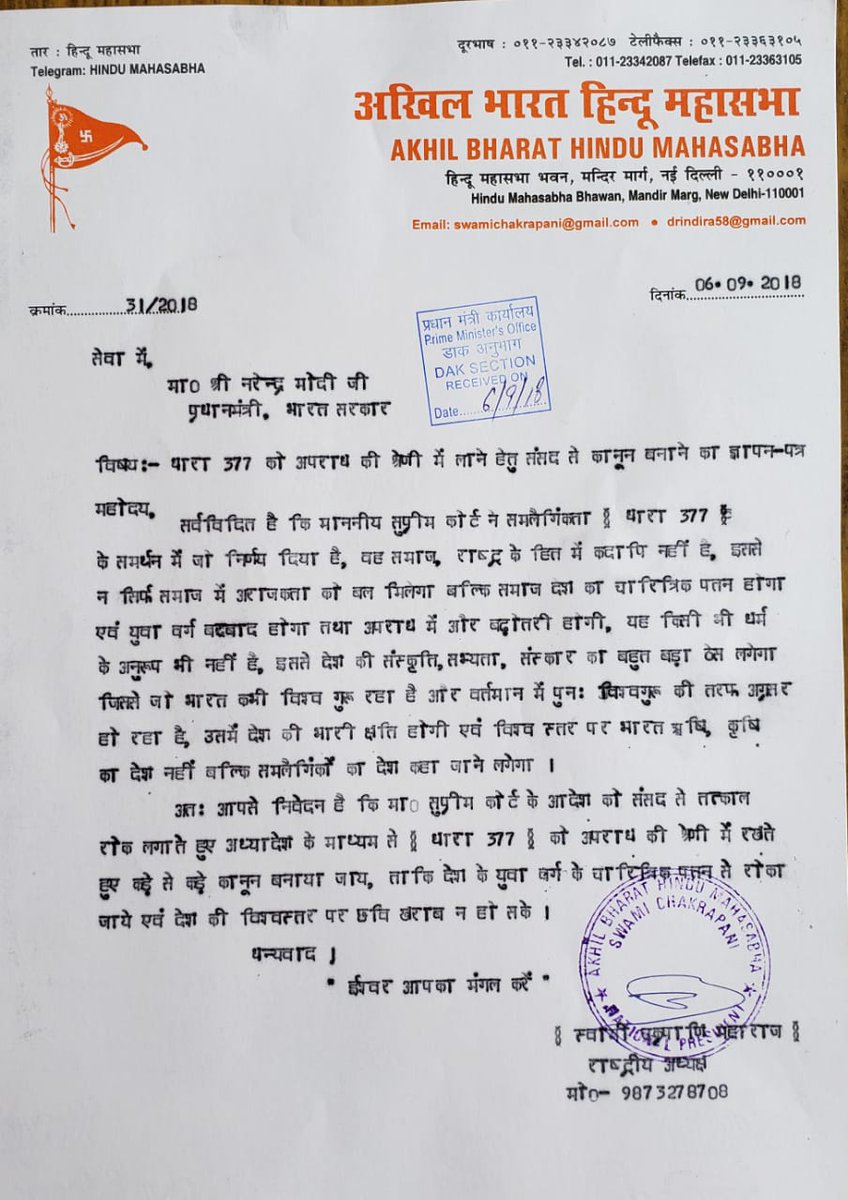
The Hindu Mahasabha has also reacted adversely: https://timesofindia.indiatimes.com/city/meerut/ulemas-hindu-mahasabha-fume-at-sc-verdict-on-section-377/articleshow/65710964.cms

September 12, 2017

IK: on Oxford vice-chancellor’s call to challenge homophobia | Kerrie Thornhill

Times Higher Education - September 12, 2017

Oxford vice-chancellor’s call to challenge homophobia ‘no more than a platitude’

Freedom of speech is not the same as accepting ‘petulant’ professors’ views, says Kerrie Thornhill

This spring, I had the honour to attend an LGBT+ Formal Hall at one of Oxford’s oldest colleges. In some 800 years of hosting these traditional dinners, this was the college’s first in support of LGBT+ rights. It followed a seminar on the history of gender and sexuality, so I sat next to senior co-panellists as well as undergraduate student leaders.
The hall was packed, but everyone listened in silence as one of the college staff told us about growing up gay in the 1970s. Family rejection. Electroshock “therapy” intended to “cure” him. Homelessness, abuse. The undergrads said that he had never told his story so openly. Yet he was willing to share his most heartbreaking memories at this college event, to people gaining the education that he was denied, in order to support a charity that gives teens the help he never had.
His speech resonated with many staff, faculty and students with similar experiences of homophobia. At my table, it inspired a candid intergenerational conversation about fighting bigotry of all kinds, especially within elite (and elitist) settings such as the University of Oxford. We ate rainbow trout with rainbow chard.
I wish the Oxford vice-chancellor had been there. At last week’s Times Higher Education World Academic Summit, she told delegates that she had had “many conversations with students who say they don’t feel comfortable because their professor has expressed views against homosexuality”. She added that her job “isn’t to make you feel comfortable” and that if students do not like these views they should “challenge them, engage with them, and figure how a smart person can have views like that”. “Work out how you can persuade him to change his mind,” she said.
I would like to ask her: would the event that I attended have been more educational if homophobic speakers had been invited? Would such an unbridled exchange of views have taken place in a more hostile space? I suggest that maintaining academic integrity in universities does not require opposing positions so much as it requires deep honesty: reckless, vulnerable honesty.
Here’s a reckless truth: homophobia kills. In my four years as junior dean for Hertford College, the well-evidenced link between homophobia and teen suicide was painfully apparent. I saw brilliant young minds tormented by depression and suicidal urges, made worse by the exhaustion of pretending to be “normal”. But with strong support from the welfare team and other students, many were able to seek help. Those who did, flourished, and became peer supporters in turn.
At Hertford, the LGBT+ support came from the top: the dean, the chaplain and devoted student leaders worked together to make the whole college a better place. Anti-hate work is not about making universities too “comfortable”, as Richardson stated. It is about keeping our future thinkers alive and well.
Does that mean that progressive views should not be contested? Far from it. I taught a queer theory tutorial for a visiting student who identified as non-binary but, over the course of the tutorial, shifted from “they/them” to “she/her”. Using her preferred pronouns was a simple courtesy that did not require that we think alike about queer theory. In fact, respecting her evolving gender identity made room for more interesting debates on the social construction of gender. She did not find our tutorials easy.
I challenged her to read more widely, to organise her thinking and to confront the underlying assumptions of her arguments. Ultimately, she wrote that these confrontations “helped shape my writing, my thinking and my existing”. The effort I put into challenging the student came out of my respect for her talent and potential, not a belief in my inherent superiority as her tutor.
In larger classes, I inform new students that our tutorials are a place for “dangerous thinking”, within certain ground rules for respectful dialogue. That permission to disrupt cuts both ways. It enables me to challenge the students, and the students to challenge me in turn and, inevitably, to rubbish the canon and to reject views they deem to be “pale and stale”.
Student rebellion can come across as arrogant or unqualified to the long-suffering tutor. But students can be experts, too. One of my most anti-canonical former students, Billy-Ray Belcourt, has a forthcoming book of poetry on queer Indigenous grief, This Wound Is a World. No Oxford professor, currently, can write more authoritatively on the condition of being Cree and queer.
The vice-chancellor does not seem like someone with homophobic personal views. Her comments emphasise our shared goal to promote rigorous debate at Oxford. However, the call to “engage with” and “challenge” homophobia is no more than a platitude if queer students are killing themselves, smothering their identities in a closet, or being told that their right to dignity in the classroom hinges on whether or not they can win over “smart” bigots in positions of authority.
Rigorous debate cannot thrive within stark power imbalances, a point that deserves more attention at a university whose professoriate is 85 per cent male and 94 per cent white.
Oxford must generate the freedoms required for free speech, rather than defending petulant profs who, after all, were not “smart” enough to read the university’s anti-harassment code. I therefore call on the vice-chancellor to work with the LGBT+ Staff Network and its student leaders to heal the rift that her comments have created.
Kerrie Thornhill is deputy director, international gender studies, at Lady Margaret Hall, University of Oxford.

February 25, 2016

India: Millat Bedari Muhim Committee protests title of movie on AMU gay professor

The Times of India

Muslim outfit protests title of movie on AMU gay professor

| TNN |
Aligarh: Ahead of the release of 'Aligarh', a movie based on the life of a gay professor of Aligarh Muslim University, a Muslim outfit has written to Union minister Ravi Shankar Prasad and to the Censor Board seeking a change in the film's title, which it alleges will "lower" the prestige of the city.

Millat Bedari Muhim Committee has written to Union Minister of Communications and Information Technology Prasad and Censor Board chief Pahlaj Nihlani over the title of the movie.
The outfit claims that the film will paint the whole city as a place where "gay practice is common, thus lowering its prestige in the eyes of the world."

The film, being directed by Hansal Mehta, is based on the life of Shrinivas Ramchandra Siras, a gay professor of the university who was found dead in 2010.

However, the screenwriter of the film, Apurva Asrani, has described the outfit's fear as "homophobia". "In the past a film was made on Mumbai riots called Bombay, does that mean everyone in Mumbai is communal? There was a film called Delhi Belly where the actors used profane language, so does that mean everyone in Delhi uses profanity?" he said.

Condemning the choice of the title, the members wrote in the letter: "Aligarh is famous for education, lock and hardware industries, culture and tradition. Now with the title of the film, which is based on the life of a gay professor, all of its assets mentioned above will suffer from a negative impact."

Siras was found dead in his apartment at Durga Wadi, in Aligarh on 7 April 2010.

February 08, 2016

India: Sagarika Ghose on Religious leaders united against homosexuality

The Times of India

Feeling gay about love
February 8, 2016, 12:04 am IST Sagarika Ghose in Bloody Mary | 3rd Edit, India, Lifestyle | TOI


Section 377 and pyaar kiya to darna kya

In the beginning there was Article 370, now there’s Section 377. 370 divides Kashmir from the rest of India with Hindu sangh and Muslim jamaat raising slogans against each other. On 377 religious warriors are united as never before, implacably opposed to the possibility of feeling gay about life. Forget the Babri masjid Ram mandir dispute, when it comes to homosexuality, Muslim clergy and Hindu sadhu samaj, not to mention the Christian priesthood, are queering the pitch in unison.

They preach we should love our fellow men but disbelieve the friendship of man. They speak about the love of God but hate the right to love. They say religion teaches humanity but divide the human race between normal and unnatural. They say God loves everyone but in fact preach God loves everyone except the LGBTQ. When it comes to alternate sexuality, religious leaders are sounding positively deviant. While more men and women come out of the closet, religious leaders have locked themselves up in the closet.

You don’t need to watch saas bhi kabhi bahu thi to figure out that marriages are no longer made in heaven. These days it’s best to sing pyaar ko pyaar hi rehne do, koi naam na do. The course of true love never did run smooth but those who declare war on love may find that young people today are raining on their parade. If you’re offended by drag queens, chances are you’re a drag on the system and if the third sex worries you, then perhaps you need to be a permanent third man who will never be able to catch the new ball.

When Krishna himself was once Mohini, when Arjuna once dressed as Brihannala, it’s manners that maketh man not the diktat of churches and temples. In these days of Hindu versus Muslim should we not instead celebrate the 17th century poem Haqiqat-al-Fuqara about the love story of a Muslim and a Hindu man, Hussainand Madho? But as far as religious leaders are concerned, hate-rosexuality is preferable to male bonding because they only want fighting men at war.

So when men hold hands, religious leaders put their hands up first, and when men kiss publicly, to the clergy this is the kiss of death. Suicide bombers can hope for paradise but the gay lover can’t hope for anything but hell. However in the age of same sex dostana, its best to sing pyaar kiya to darna kya.

February 01, 2016

India - Homophobia: Pro-gay Canadian leader runs into an ethical wall with SGPC in Punjab

Hindustan Times

Pro-gay Canadian leader runs into an ethical wall in Punjab

Vivek Gupta and Aseem Bassi, Hindustan Times, Amritsar/Patiala | Updated: Jan 30, 2016 20:32 IST

Ontario premier Kathleen Wynne’s scheduled visit to Amritsar as part of her 10-day business trip to India has landed in controversy even before her arrival. The Shiromani Gurdwara Parbandhak Committee (SGPC) has decided not to honour the Canadian leader with a siropa (robe of honour) during her visit to the Golden Temple on Sunday. Reason: Wynne, a lesbian, is a supporter of same-sex marriages, a practice opposed by the Akal Takht, the highest temporal seat of the Sikhs.

The SGPC’s stand also mirrors the recent anguish of Canadian Sikhs against Wynne’s pro-gay policies. Even since joining the premier’s office in 2013, her relations with minority ethnic communities, especially Sikhs and Muslims, in Ontario have been strained. Her visit to the Golden Temple is being viewed as an attempt to gain acceptability among the Sikh community back home.

Last year, a large section of Sikhs staged a protest against her move to introduce sex education curriculum which, according to them, was not age-appropriate and promoted same-sex relationships among school students. Muslims and other communities of South-east Asian countries also criticised her for endorsing homosexuality as an acceptable way of life.

Wynne has reached Amritsar. (Gurpreet Singh/HT )

Despite numerous car-flag parades, protests at the provincial council’s doorstep and petitions handed over to her government, the curriculum was finally implemented in September. Her government also passed a law to exclude the names of mother and father from all government forms to accommodate same-sex couples.

In 2014, she did not allow turban-wearing Sikhs to ride a motorcycle without wearing a helmet, a decision the Canadian Sikhs called “deeply” disappointing.

Talking to HT, SGPC president Avtar Singh Makkar said, “Offering her (Wynne) a ‘siropa’ would be against Sikh ethics.”

Akal Takht jathedar Giani Gurbachan Singh said, “The SGPC’s decision is correct. Coming to the shrine and paying obeisance is everyone’s right, but while honouring dignitaries, Sikh ethics need to be taken into account.”

The Sikhs and other minority communities in Canada are opposed to same-sex marriages. Akal Takht jathedar Giani Joginder Singh Vedanti had issued an edict in 2005 against such marriages and condemned the Canadian government’s move to legalise same-sex marriages, adding that this concept had no place in the Sikh religion.

Giani Gurbachan Singh had directed gurdwaras worldwide not to solemnise same-sex marriages.

Sources said Wynne would fly to Amritsar from Delhi on Saturday evening. She will visit the Golden Temple on Sunday morning.

April 08, 2014

India: AAP's refusal to declare support for gay rights in its manifesto

http://scroll.in/article/660845

AAP's refusal to declare support for gay rights in its manifesto shows it can confuse populism for democracy
What does this say about AAP's claim to represent a politics of principles?

by Shivam Vij

So it turns out that it wasn't an oversight that the Aam Aadmi Party failed to say anything about decriminalising sexual minorities in its manifesto. A party member explained to some lesbian, gay, bisexual and transgender activists in a private email, "There is a larger strategic perspective with regard to the numbers here... We need the numbers in Parliament, if we are to tangibly do something about it [decriminalising gay sex]... If we do not get the numbers and neither does the Congress...the BJP will manage to defeat it on the floor of the house."

This is strange, not least because the Congress and the Communist Party of India (Marxist) have both said in their manifestos they would support legislative reading down of Section 377 of the Indian Penal Code, the law that makes consensual sex between same-sex adults a criminal offence, punishable with life imprisonment. In 2010 the Delhi High Court had declared the law ultra vires of the Constitution but in December 2013 the Supreme Court had reversed the decision. Thereafter, AAP along with the Congress and the CPM publicly opposed the Supreme Court judgement. The one major political party to support the Supreme Court judgement was the Bhartiya Janata Party.

Having once publicly come out against Section 377, what are the votes AAP fears it could lose by stating its position in its manifesto, especially given that the Congress and the CPM don't think that would lose them votes? AAP leaders are taking to Twitter to clarify that they stick by their position, so why not say as much in the manifesto? In the unlikely event that AAP forms the government, how is anyone to hold them to their promise if they don't give the voter that promise in writing? To say that not writing it in their manifesto doesn't matter because everything is not written in the manifesto is to indicate that this wasn't important enough. But it is very important at a time when the Supreme Court has agreed to hear the government's curative petition against its December judgement.

Perhaps the party, like the Supreme Court, felt that the queer community is too small in number to take such a risk. The fact is that no one really knows the real size of the queer community as it is largely silent. But it does have a vote. A survey of the queer community by Pallav Patankar of the Mumbai-based Humsafar Trust, conducted presumably before the AAP manifesto was out, found that 45% of those surveyed planned to vote for the Congress, and 41% for AAP.

These supporters were then asked how confident they were of their favourite party doing something for their rights. AAP had the highest number of voters who were "highly confident" of the party's stance on queer rights. That confidence is now broken, and AAP is sure to lose a few votes. It is not clear which votes it would gain by its careful calculation to not upset conservatives who would read its manifesto. It is not as if there has been large-scale public outrage in India over the existence of homosexuality.

Another reason why this is strange is because AAP has taken positions in its manifesto that could make it lose the votes of one section of society or another: it talks about speedy justice for Muslims accused in terror cases, it talks about demilitarising Kashmir and amending the Armed Forces Special Powers Act, it supports caste-based reservations by making them preferential to those whose families have never benefited from reservations.

The Aam Aadmi Party seems to often confuse populism for democracy. It advocates power to the people, but often comes up against the hurdle of having to answer: which section of the people? Does it want speedy justice for Muslims because it genuinely thinks Muslims are being falsely implicated in terrorism cases, or is it only to woo Muslim votes? If the commitment is genuine, why not promise to amend the Unlawful Activities Prevention Act, the draconian law used to put the terror-accused in jail for long periods with thin evidence?

Ditto with their policies in Delhi. The law minister of their 49-day state government goofed up so badly that the furor forced him to express regret for leading a raid against an African resident in the city's Khirki village. He wasn't sacked from his post, because the party felt his mistake was minor. But even where the party thinks it did a great job, it was confusing populism for democracy. It won over Delhi's autodrivers, the real rulers of the city, by promising them everything they demanded, and then some. It distributed 15,000 new auto licenses to members of the scheduled castes. What it did not do was to end the license-quota raj in the auto-rickshaw economy. That would have been opposed by the powerful auto unions. But ending the license-quota raj could have been a win-win solution for the woes of both passengers and those who want to run autos to earn a livelihood.

There are also other issues on which AAP may seem progressive when it is being conveniently populist: its opposition to foreign direct investment in big retail, for instance, is a clear attempt to woo small traders, the bedrock of the Bhartiya Janata Party.

There's a point at which tactical compromises don't remain tactical, only compromises. AAP will have to decide, sooner than later, if it really wants to shape a new politics as it claims to, or be shaped by the easy path of populism just like everybody else. This is not the only party that is trying to be everything to everyone, offering one inducement or another to every section of society. But as the Congress party found out in the 1990s, you can't please everyone all the time – and you can't fool all the people all the time. Someday, the contradictions hit home.


--------

[SEE ALSO:
AAP skirts LGBT issues for ‘strategic’ reasons http://www.thehindu.com/news/cities/Delhi/aap-skirts-lgbt-issues-for-strategic-reasons/article5880844.ece ]

March 08, 2014

India:: No compromise with live-ins or gay rights, moral values supreme: RSS

India Express

The meeting attacked the UPA government for playing politics with the minority communities and state borders. Tweet This
Written by Johnson T A | Bangalore | March 8, 2014

The report said the RSS was gaining in popularity among younger people through the Internet. (PTI) The report said the RSS was gaining in popularity among younger people through the Internet. (PTI)

The Rashtriya Swayamsevak Sangh, ideological fount of the BJP, has emphasized that it will not compromise on “moral values, social system and traditions in the name of individual freedom” when it comes to issues like “live-in relationships” and “homosexuality”.

The RSS made its point during the presentation of the annual report of its activities for 2013-14 at a meeting that began on Friday at the Rashtrothana Vidya Kendra here.

Senior RSS leaders expressed hope that the political atmosphere in the country would change after the general elections, and took pride in the fact that the BJP’s prime ministerial candidate Narendra Modi, who is being seen as the harbinger of change, was a swayamsevak.

“In the near future, Lok Sabha elections will be held. This is a good opportunity for our countrymen. The credibility, honesty and commitment to the nation of the present government have become questionable. Today, the nation expects a change”, RSS general secretary Suresh Bhaiyyaji Joshi said during the presentation of the report.

“It is for us to play our role in assessing its implication correctly, so as to bring about the change that will reflect the will and aspirations of the common people,” he told delegates.

Joshi said that “in the past year, two issues had come up for discussion before society — live-in relationships and homosexuality — which led to arguments, both in favour and against, on according legal sanction to such relationships”.

“Before extending legality to such things, we have to keep in mind the long-time deleterious effect it will have on our social life. Law accords security to the individual. However, a society that goes by its traditions, conventions, culture and life-values, cannot be secured through law. Only guidance based on dharmic and social thought can ensure security to social life,” the general secretary said.

The report said the RSS was gaining in popularity among younger people through the Internet.

“More and more young and educated people are coming to Sangh using ‘Join RSS’ feature on RSS website. An effort is going on to appoint karyakartas at every level in the follow up of ‘Join RSS’ feature. 12,118 people came to Sangh via ‘Join RSS’ feature in 2012. In 2013, this number has reached to 31,102,” the report said.

Among other issues that the RSS dwelt upon on the opening day of the meeting was the necessity of “reinforcing security at our borders by developing all needed infrastructure”.

“Presently, there are no proper roads on our borders. The border villages in Ladakh and Arunachal Pradesh happen to be the most neglected and quite backward. In fact, the manpower in such villages should be properly streamlined and utilized from the point of view of security,” Joshi said.

“Our neighbouring countries are trying to create an impression that the borders are disputed. So, we should not only counter their arguments in definite and unequivocal terms, but also think of measures to get them vacated from our areas…

“Migration of youths from border regions for want of work, livelihood and education is a matter of grave concern. The central government has to give serious thought to this problem and prepare and execute necessary plans to address it,” he said.

The meeting attacked the UPA government for playing politics with the minority communities and state borders.

“In recent years, to serve some temporary, selfish political interests, attempts are being made to divide our society in the name of majority and minority. It is the reflection of the same mindset that we see in the proclamation according minority status to the Jain community.

“Discussions on bifurcating big states are being held from time to time. Reorganization of states, if required, is necessary and proper.

However, it is unfortunate that even in such matters, considerations of political gains and losses influence the decision-making process,” the annual report said.

January 18, 2014

India: BJP says Forget 370 but Retain 377 Cartoon by unknown


read the above along with below:

No objection to Article 370 if it helps J&K develop: Rajnath Singh
http://www.thehindu.com/news/national/no-objection-to-article-370-if-it-helps-jk-develop-rajnath/article5590097.ece

December 19, 2013

India: Joint Statement of Religious Leaders in support of “Supreme Court order on Section 377”

http://jamaateislamihind.org/eng/joint-statement-of-religious-leaders-on-supreme-court-order-on-article-377

Joint Statement of Religious Leaders On “Supreme Court order on Section 377”

19 December 2013

New Delhi, 19 Dec 2013: The decision of the Supreme Court on Section 377 of the Indian Penal Code is not only in line with the eastern traditions of this country, moral values and religious teachings but it also removes apprehensions about invasion of western culture and disintegration of family system and fabric of social life – the inevitable fallouts of the Delhi High Court order of 2009 wherein it decriminalized homosexuality.

Our India is a religious country whose overwhelming majority believes in religion and upholds traditions of the east. All religions emphasize on construction of a family through marital relation between men and women, on which depend not only the existence of human race and lasting peace and tranquillity in the society but it also establishes the respected and central position of woman in the society.

The Constitution of the country has rightly described homosexuality as a punishable offence. It is because homosexuality not only prevents evolution and progress of human race but also destroys family system and social relations. Moreover, it is a great danger to public health. Medical research has also found it as a basic reason for the spread of AIDS.

As representatives of different religious organizations, we welcome the decision of the Supreme Court (delivered on 11 Dec 2013). With this historic decision, the apex court has kept the country from going on to the path of destruction. We are concerned that lovers of western culture, in the name of individual freedom, minority rights and other lame excuses, are putting pressure on political parties and governments for amendment in the law so that this shameless and criminal offence could be legalized.

We warn the government and political parties that we will never accept it if they do it ignoring religious teachings, eastern culture and opinion of the overwhelming majority of the people. Such filthy experiments have destroyed human society and violated the rights of women at a large scale in the west. We should learn from it.

We, therefore appeal to the government and all political parties to accept this revolutionary and wise decision of the Supreme Court with open heart. We urge the supporters of western culture to take homosexuality as a crime and come forward to save the society of the country from this heinous act.

Signatories:

Maulana Syed Jalaluddin Umari – (Ameer (National President), Jamaat-e-Islami Hind

Maulana Mufti Mukarram Ahmed – Shahi Imam, Fatehpuri Masjid

Jagat Guru Swami Omkar Anand- Sanatan Dharm

Gyani Ranjit Singh-Chief Priest, Bangla Saheb

Fr. Dominic Emmanuel

Lokesh Muni- Jain Dharm

December 14, 2013

India: BJP unambiguously homophobic

The Telehraph, 14 December 2013

BJP comes out, vows to oppose homosexuality
RADHIKA RAMASESHAN

New Delhi, Dec. 13: BJP president Rajnath Singh today said his party “unambiguously” endorsed the re-criminalisation of gay sex — the first conclusive statement from the party that makes the legislative option difficult for the UPA.

“We will state (at an all-party meeting if it is called) that we support Section 377 because we believe that homosexuality is an unnatural act and cannot be supported,” Rajnath Singh told The Telegraph tonight.

The BJP has been fighting shy of articulating its position since the Supreme Court ruled on Wednesday that Section 377 did not suffer from any constitutional infirmity.

The BJP has now dropped its circumspection, probably on the assessment that the gay community is not electorally significant and the party stands to suffer a dent in its traditional base if it is seen to be supporting “unnatural acts”.

The Congress is the only party that has so far come out unequivocally against Section 377. It is now up to the UPA to decide if it will float an ordinance and let the next government deal with the issue after six months.

BJP sources said Rajnath’s statement was a “carefully considered” view, influenced by political “realities” prevailing on the “ground” and not by “simulated discussions in TV studios”.

First, they said, the opinion of the RSS and its affiliates could not be ignored even if a section of the BJP wished to project a “liberal worldview”.

Second, the BJP had factored in the prospect of facing “brickbats” from the “secular-liberals”. “It is a flawed assumption that ratifying homosexuality is equal to being progressive and broad-minded. The present discourse has been largely generated by a niche of the elite, which reflects the Bharat-India divide,” a source said, ignoring questions on the harassment homosexuals go through in many towns and villages.

Another BJP leader said provincial India would not be persuaded by the argument that same sex was rooted in Hindu culture and mythology. “India is largely status-quoist. Fiction is fiction, the reality is different,” he said.

Given the opposition from not just Hindu clerics but those from Islam and Christianity, BJP sources said Sonia Gandhi and Rahul might have “erred” in feeling the “popular pulse” by openly speaking out against the Supreme Court judgment. “Maybe the Congress wished to deflect attention from its in-house problems but we wonder if religious leaders from other faiths would shower kudos on Sonia and Rahul,” a source said.

Privately, a section of the BJP did not concur with Rajnath. This section felt that there was nothing unnatural about homosexuality, and Section 377 should deal only with bestiality and forced acts. But nobody would go on record.

December 13, 2013

India: BJP refuses to spell stand on Section 377; Lekhi supports SC order / Samajwadi Party supports supreme court ruling

1.)


http://timesofindia.indiatimes.com/india/BJP-refuses-to-spell-stand-on-Section-377-Lekhi-supports-SC-order/articleshow/27261418.cms


BJP refuses to spell stand on Section 377; Lekhi supports SC order
TNN | Dec 13, 2013, 06.02 AM IST

NEW DELHI: While opposition BJP stuck to its non-committal official line on the Supreme Court's verdict on homosexuality, party spokesperson Meenakshi Lekhi came out in support of SC's controversial order for restoration of Section 377.

"I welcome the decision of the court because it is important that Section 377 remains. It is not only women who can be exploited and harassed but men also get exploited so there is a need for a law to protect men too," Lekhi said minutes after her senior colleagues, leaders of opposition Sushma Swaraj and Arun Jaitley, had refrained from declaring their stand on the issue.

BJP sources sought to distance the party from Lekhi's comments saying she had articulated her personal viewpoint on the matter. The spokesperson, who is also an SC lawyer, emphasized that she had spoken in her individual capacity, but her statement trained the spotlight on the unpreparedness of the party to take up cudgels publicly for the LGBT community.

Its PM candidate Narendra Modi has kept quiet on the issue, refusing to be baited by opponents like Congress spokesperson Sanjay Jha who taunted him for staying silent.

The reticence contrasts starkly with Congress's vocal stand against the SC order, as well as that of AAP which overcame its initial diffidence to criticize the revival of Section 377.

Speaking against the backdrop of the support of fellow saffron outfits like the VHP for the SC order on restoration of Section 377, Swaraj said, "Supreme Court has also said Parliament can legislate on this issue. Government can call an all-party meeting and we will tell our view there on the issue after seeing the government proposal."

She also said it was not enough for the UPA chairperson to express disappointment over the verdict, and expressed hope that the matter will be brought to Parliament shortly.

Meanwhile, speaking to TOI, Lekhi said she saw the outrage over the SC order as a perfect case of "much ado about nothing". People are little informed about the criminal law process and how it gets activated, she said, adding, "You need a complainant or victim for that. Unless someone lodges a complaint, the police cannot do anything about it."

As for soliciting for sex in a public space, it is punishable by law in any case, whether it is between men and women or between same sex people, she elaborated.

2.)

http://timesofindia.indiatimes.com/india/SP-against-any-move-to-amend-Section-377/articleshow/27267050.cms?intenttarget=no

NEW DELHI: The Samajwadi Party on Thursday said it would oppose any amendments to Section 377 if it came to Parliament for discussion.

Party leader Ram Gopal Yadav said, "Homosexuality is unethical and immoral, it is against the culture of the country and we will fight it."

December 12, 2013

Modi's silence on 377 - cartoon by Satish Acharya


Modi's closet no. 377

Cartoon: Satish Acharya

Copyright: Sify.com

http://www.sify.com/news/modi-s-secret-hideout-imagegallery-national-nk0mS5hfhce.html

India: Jamaat e Islami (The Muslim Right Wing ) Opposes Legalisation of Live-in Relationships, not to speak of Homosexuality

In a recent judgement, the Apex Court asked Parliament to framed guidelines and make a law to address the ‘concerns’ of those already in the outside-marriage relationship. More unfortunately, the judgement said that live-in relationship is neither a crime nor a sin. A court of law is indeed within its jurisdiction to ascertain whether or not a particular act is crime. But it is beyond its jurisdiction to say whether or not an act is sin. It is religion and scriptures alone that determine what is sin and what not. The verdict also undermines the sanctity of family system and the institution of marriage.

Therefore, Jamaat-e-Islami Hind demands that the court review its judgement, and call upon Parliament not to legalise live-in relationship but instead to make law to curb all promiscuous acts including homosexuality and live-in relationship that lead to moral turpitude.

Read More at: http://jamaateislamihind.org/eng/press-meed-on-babari-masjid-scs-verdict-on-live-in-relationship-violence-against-women/

December 11, 2013

Poster : Homophobes Unite - All Those Who Favour Crimilarising Gay Sex and are for section 377 raise your Hands

from sacw.net

India: BJP's Rajasthan MP Arjun Ram Meghwal planning to raise anti-homosexuality bill in Parliament

The Hindu - December 11, 2013

Bikaner MP to raise anti-homosexuality bill in Lok Sabha

by Mahim Pratap Singh

While Wednesday's Supreme Court judgment on re-criminalising homosexuality has upset the LGBT community, Bikaner MP Arjun Ram Meghwal has welcomed the decision.

Last year, Mr. Meghwal had presented a private member bill in the Lok Sabha against the Delhi High Court judgment of 2009 which termed section 377 of the Indian Penal Code unconstitutional and decriminalised gay sex.

The bill, titled Indian Penal Code (amendment) bill 2012, however is yet to be discussed by the lower house.

With the apex court's Wednesday order overruling the Delhi HC judgment, Mr. Meghwal is all set to call the Lok Sabha's attention to his proposed legislation.

“The winter session of the parliament is on and Friday is the day reserved for discussions on private member bills. I will raise this issue in the Lok Sabha on Friday by way of a point of order,” Mr. Meghwal told The Hindu.

A point of order is an extraordinary process which, when raised, has the effect of suspending the proceedings before the House (and) must relate to the business before the House at the moment.

Mr. Meghwal held discussions across his constituency over the issue and claims people were unanimously opposed to de-criminalising gay sex.

“The main point of my bill is that the honourable Delhi High Court's decision is not in accordance with Indian culture,” said Mr. Meghwal.

India: Religious Homophobes win Gay sex declared illegal by the Suprme Court

NDTV


Gay sex illegal, says Supreme Court, sets aside high court order

All India | Written by Neha Khanna , Edited by Deepshikha Ghosh | Updated: December 11, 2013 10:40 IST

Gay sex illegal, says Supreme Court, sets aside high court order
New Delhi: The Supreme Court today said gay sex between consenting adults remains a criminal offence, in a major setback for the largely closeted homosexual community in India.

The top court today said that the Delhi High court's 2009 order decriminalising homosexuality is constitutionally unsustainable.

The Delhi High Court had decriminalised homosexuality while reading down Section 377 of the Indian Penal Code and ruled that sex between two consenting adults in private would not be an offence.

The high court order had been challenged by anti-gay rights activists, social and religious organisations .

Senior BJP leader BP Singhal, who died last year, had challenged the verdict calling it illegal, immoral and against the ethos of Indian culture.

Religious organisations such as the All India Muslim Personal Law Board, Utkal Christian Council and Apostolic Churches Alliance also filed appeals against that verdict.

The Supreme Court had reserved its order in March last year, after day-to-day hearing in the case lasted an entire month. While hearing the appeal, the top court had pulled up the Centre for its "casual" approach in dealing with homosexuality and expressed concern over Parliament not discussing such issues and instead blaming the judiciary for its alleged overreach.

During the arguments, the Centre told the top court that the anti-gay law in the country was a result of the British colonialism and that the Indian society was more tolerant towards homosexuality.

It was a complete U-turn by the Centre which had strongly opposed the decriminalisation of homosexuality before the High Court, calling it "unnatural, immoral and reflection of a perverse mind."