On
28 May, the Maharashtra government—a coalition of the Shiv Sena and the
Bharatiya Janata Party—will celebrate the birth anniversary of the
Hindu nationalist demagogue VD Savarkar as Swatantraveer Gaurav Din,
perpetuating a tradition among the Hindu Right of lionising him as a
freedom fighter despite his marginal role in the anticolonial struggle.
This month also includes the birthday of Nathuram Godse, who
assassinated MK Gandhi in 1948. Hindutva groups have sought to
rehabilitate Godse’s reputation, with the Hindu Mahasabha commemorating
his birth anniversary in recent years.
| |
As the Hindu Right celebrates its most controversial figures, read a selection of longform essays and reportage from The Caravan’s archives on a few doyens of Hindutva.
| |
| |
Abhay
Regi argues that “the deification of Savarkar has been an outcome of
the constant writing and rewriting of his life.” This project is active
today also, as evident in two recent biographies by Vikram Sampath and
Vaibhav Purandare. Regi turns to a 1926 book, The Life of Barrister Savarkar,
to understand Savarkar’s political legacy, “including his urge towards
primal violence and the anti-intellectualism that undergirds his
thinking.”
| |
.
| |
Dhirendra
K Jha examines archival documents that prove Godse never gave up his
RSS membership, contrary to the Sangh’s disavowal of Gandhi’s assassin.
“The story of Godse’s life reveals a constant and inextricable link with
the RSS,” Jha writes. “Radicalised at an early age by Savarkar himself,
Godse inhabited an environment constantly pushed him towards a certain
kind of politics.”
| |
.
| |
Hartosh Singh Bal’s 2017 profile of Golwalkar—the second sarsanghchalak,
or supreme leader of the RSS—and his continuing influence on India,
with Modi being a staunch admirer of the Sangh ideologue. Bal notes
that, in We or Our Nationhood Defined, Golwalkar unambiguously compares the project of promoting a Hindu culture with German antisemitism.
| |
.
| |
Jha
delves deeper into the Sangh’s imitation of the Nazis, noting how many
RSS members were enamoured with European fascists in the late 1930s and
1940s. “Contemporary accounts suggest that, during this period,
Golwalkar sought to turn the RSS into a Nazi-style militia, with the
goal of eventually installing himself as führer.”
| |
.
| |
Dinesh Narayanan’s May 2014 profile of Bhagwat, the current sarsanghchalak,
whom he defined at the time as “perhaps the only person who has
publicly checked Modi without experiencing any political fallout.”
Narayanan writes that Bhagwat “is immensely influential, but he does not
unilaterally impose his will on the BJP or on his own organisation.”
| |
.
| |
Eight
years after Narayanan’s profile, Jha explains, in the November 2022
issue, how Modi has tilted the balance of power within the Sangh Parivar
in the BJP’s favour, leaving Bhagwat, and the RSS, in a position where
they are obeying instructions instead of issuing them. Ramesh Shiledar
told Jha that Bhagwat was “a man of mediocre qualities and would succumb
to any and every pressure that would be exerted on him.”
| |
.
| |
Sujatha
Sivagnanam’s April 2023 profile of S Gurumurthy, who often shies away
from the limelight despite his oversized impact on India in the past
fifty years. “The vision he has shaped through these institutions,”
Sivagnanam writes, “is central to the RSS’s core tenets and his own
upbringing: the establishment of Brahmin influence over political and
economic life.” |
|

Showing posts with label Golwalkar. Show all posts
Showing posts with label Golwalkar. Show all posts
May 14, 2023
India: Doyens of Hindutva - Collections of essays on Savarkar, Godse, Golwalkar, Mohan Bhagwat, S Gurumurthy | The Caravan


November 12, 2021
India - Karnataka: Savarkar naming bug . . .
Busy intersection in Mangalore to be renamed after V.D. Savarkar
Opposition criticises BJP agenda of naming everything after Savarkar and Golwalkar
[ . . . ]
https://www.telegraphindia.com/india/savarkar-naming-bug-is-spreading/cid/1838488
September 01, 2021

February 20, 2021
India: Culture ministry tweets praises for Gowalkar on his birthday
'Remembering a great thinker'
Culture ministry tweets praises for Gowalkar oh his birthday
Parallels have been drawn between some of the
former RSS chief's views and those of Hitler’s Nazis; a modern-day drive
had been launched to airbrush such a past
[ . . . ]
December 05, 2020
March 15, 2019
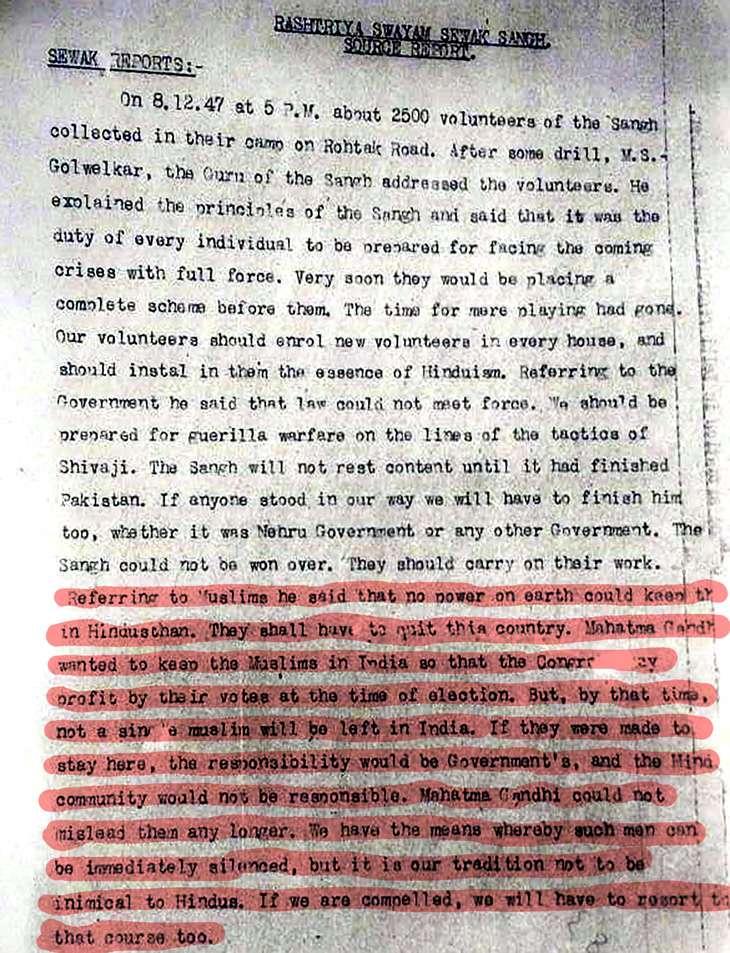
India: RSS chief Golwalkar threatened to Silence Gandhi - 1947 CID report
RSS chief Golwalkar threatened to kill Gandhi - 1947 CID report: "Mahatma Gandhi could not mislead them any longer. We have the means whereby such men can be immediately silenced" - Golwalkar, 8.12.47 ( Extracts from the verbatim copy of a police report ) via : https://twitter.com/QuitMovement/status/1106431948765818882
June 05, 2018
India: How RSS icon MS Golwalkar misrepresented Nehru’s words to justify the Hindutva ...
How RSS icon MS Golwalkar misrepresented Nehru’s words to justify the Hindutva project of ghar wapsi
The second chief of the RSS, who died on this day 45 years ago, believed that Muslims and Christians are not truly Indian.

https://scroll.in/article/881409/how-the-rss-guru-ms-golwalkar-twisted-nehrus-writings-to-justify-the-hindutva-project-of-ghar-wapsi
July 07, 2017
India: Move to glorify M.S. Golwalkar, former RSS chief and "ideological mentor" of PM Narendra Modi - Institute of Public Administration to organise seminar on him
The Telegraph
Push to idolise Modi 'mentor' Golwalkar |
| Basant Kumar Mohanty |

MS Golwalkar
So far confined to RSS shakhas (camps) as a tall ideologue, Golwalkar's views on nation, dharma and "Hindu Rashtra" will be soon discussed on an official platform at a seminar sponsored by the Centre-run Indian Council of Philosophical Research (ICPR). The Indian Institute of Public Administration, another central institute, will organise the seminar titled "Nation and Nationalism in the thoughts of Shri M.S. Golwalkar".
The government has so far projected Jana Sangh
leaders Syama Prasad Mookerjee and Deendayal Upadhyaya as icons,
renaming a number of schemes after them.
Modi has not only hailed Golwalkar - known as Guruji - as his ideological mentor, he has also written an adulatory book, Jyoti Punj,
in Gujarati on 16 eminent persons who had inspired him. One of the
essays, 'Pujniya Shri Guruji (Revered Shri Guruji)', is on Golwalkar and
is the longest in the book.An ICPR concept note seeking papers from scholars for the seminar describes Golwalkar - who headed the RSS for over 30 years till 1973 - as a champion of "robust nationalism" and says the event aims to put his views in proper perspective since he has been much misunderstood and maligned by adversaries. His views on "nation and nationalism are to be understood in a holistic way and in the light of the present-day scenario", the note adds. The deadline for submission of papers, initially June 27, has been extended to July 27. The seminar date will be decided after getting seven to eight papers, a faculty member said. ICPR member-secretary Rajneesh Kumar Shukla said this was the first seminar on Golwalkar to be sponsored by the institute. Shukla contended that Golwalkar's adversaries have "wrongly" tried to judge him on the basis of the book We or Our Nationhood Defined. "Golwalkar has written the forward of the book only. People always refer to that book when talking about him." Shukla saw nothing wrong in debating Golwalkar when academic institutions were freely discussing other philosophers like Mahatma Gandhi and Karl Marx. "We can discuss Hitler. We can discuss Marx. We can discuss Mao. Why not Golwalkar?" Prasanjit Biswas, who teaches philosophy at the North Eastern Hill University in Shillong, also found nothing amiss with the topic. "There is an ideological block that has come to power. They want to bring their ideology for public discussion. Politically, Golwalkar's ideology may be about Hindu rights. But it has a strong philosophical reasoning, making it a critical discussion," said Biswas. Golwalkar had also touched on cow slaughter - the cause of much violence in recent months. In his book India After Gandhi historian Ramachandra Guha quoted from a Golwalkar article of October 1952 that said: "To stop forthwith any onslaught on this particular point of our national honour, and to foster the spirit of devotion to the motherland, ban on cow slaughter should find topmost priority in our programme of national renaissance." |
July 05, 2017
How MS Golwalkar’s virulent ideology underpins Modi’s India (Hartosh Singh Bal)
The Caravan
The Instigator: How MS Golwalkar’s virulent ideology underpins Modi’s India
By HARTOSH SINGH BAL | 1 July 2017
EVERY CULT OR ORGANISATION typically carries forward the legacy of its founder, and it is rare for those who build upon that legacy to exercise the same influence—let alone exceed it. But the Rashtriya Swayamsevak Sangh, or RSS, has never been a typical organisation, and, in this regard too, it stands out. It was founded in 1925 by Dr Keshav Baliram Hedgewar, but it bears the far more emphatic stamp of his successor, Madhav Sadashiv Golwalkar. While Hedgewar is referred to as Doctorji within the RSS, Golwalkar is known as Guruji.
Golwalkar took over as the RSS’s sarsanghchalak, or chief, after Hedgewar’s death, in 1940, and held the post till his own death, in 1973. When he assumed charge, the RSS—also known as the Sangh—was still establishing itself, and did not have a major presence outside Maharashtra’s Vidarbha region. Under him, the organisation passed through great turbulence: it played an incendiary role in the Partition violence, and was banned after the assassination of Mohandas Gandhi. But under Golwalkar’s leadership, the RSS also set down its written constitution and began to expand beyond its shakhas, or local branches, and into front organisations such as the Jan Sangh in politics, the Akhil Bharatiya Vidyarthi Parishad among students, the Vishva Hindu Parishad in religion, and the Bharatiya Mazdoor Sangh among industrial workers.
By the time Golwalkar died, the RSS had extended across the entire country, and its network of allied organisations—the Sangh Parivar—had penetrated almost every aspect of Indian society. His ideological influence did not end with his death: Bunch of Thoughts, a text that distils the vast spread of Golwalkar’s writings and speeches, remains the Sangh’s bible to date.
In 2004, MG Vaidya, currently the RSS’s leading ideologue, articulated what amounts to the organisation’s official view on Golwalkar. Vaidya, according to the RSS mouthpiece, Organiser, “described Shri Guruji as the biggest gift to Hindu society in the 20th century. He said that the credit for today’s importance of the Sangh in national politics should be given to Shri Guruji, who worked tirelessly for spreading the Sangh work in every nook and corner of the country.”
I met Vaidya early in June at his home in Nagpur. In his living room, which is lined with bookshelves, he spoke to me for nearly an hour, often getting up to pull out a book and make me read a particular paragraph to emphasise a point he was making. His energy belied the fact that he was 94 years old; at the end of our interaction, he hopped onto a motorcycle and rode pillion to see a colleague admitted in hospital. “When I joined the RSS in 1941,” Vaidya told me during our conversation, “I took a pledge to make India independent.” After this goal was attained in 1947, he added, “a conceptual storm hit us: what should we do?” Golwalkar, Vaidya said, “inspired the Sangh with a fresh purpose. He said that we have to consider the organisation of the whole society, not just one aspect of it. Life has many fields, like education, industry, agriculture, religion. We have to inspire and organise people in all these areas.”
(Subscribe to The Caravan to read the full story. Click here for a digital subscription or email subscription@delhipress.in for a print subscription.)
Hartosh Singh Bal is the political editor at The Caravan, and is the author of Waters Close Over Us: A Journey Along the Narmada. He was formerly the political editor at Open magazine.
The Instigator: How MS Golwalkar’s virulent ideology underpins Modi’s India
By HARTOSH SINGH BAL | 1 July 2017
EVERY CULT OR ORGANISATION typically carries forward the legacy of its founder, and it is rare for those who build upon that legacy to exercise the same influence—let alone exceed it. But the Rashtriya Swayamsevak Sangh, or RSS, has never been a typical organisation, and, in this regard too, it stands out. It was founded in 1925 by Dr Keshav Baliram Hedgewar, but it bears the far more emphatic stamp of his successor, Madhav Sadashiv Golwalkar. While Hedgewar is referred to as Doctorji within the RSS, Golwalkar is known as Guruji.
Golwalkar took over as the RSS’s sarsanghchalak, or chief, after Hedgewar’s death, in 1940, and held the post till his own death, in 1973. When he assumed charge, the RSS—also known as the Sangh—was still establishing itself, and did not have a major presence outside Maharashtra’s Vidarbha region. Under him, the organisation passed through great turbulence: it played an incendiary role in the Partition violence, and was banned after the assassination of Mohandas Gandhi. But under Golwalkar’s leadership, the RSS also set down its written constitution and began to expand beyond its shakhas, or local branches, and into front organisations such as the Jan Sangh in politics, the Akhil Bharatiya Vidyarthi Parishad among students, the Vishva Hindu Parishad in religion, and the Bharatiya Mazdoor Sangh among industrial workers.
By the time Golwalkar died, the RSS had extended across the entire country, and its network of allied organisations—the Sangh Parivar—had penetrated almost every aspect of Indian society. His ideological influence did not end with his death: Bunch of Thoughts, a text that distils the vast spread of Golwalkar’s writings and speeches, remains the Sangh’s bible to date.
In 2004, MG Vaidya, currently the RSS’s leading ideologue, articulated what amounts to the organisation’s official view on Golwalkar. Vaidya, according to the RSS mouthpiece, Organiser, “described Shri Guruji as the biggest gift to Hindu society in the 20th century. He said that the credit for today’s importance of the Sangh in national politics should be given to Shri Guruji, who worked tirelessly for spreading the Sangh work in every nook and corner of the country.”
I met Vaidya early in June at his home in Nagpur. In his living room, which is lined with bookshelves, he spoke to me for nearly an hour, often getting up to pull out a book and make me read a particular paragraph to emphasise a point he was making. His energy belied the fact that he was 94 years old; at the end of our interaction, he hopped onto a motorcycle and rode pillion to see a colleague admitted in hospital. “When I joined the RSS in 1941,” Vaidya told me during our conversation, “I took a pledge to make India independent.” After this goal was attained in 1947, he added, “a conceptual storm hit us: what should we do?” Golwalkar, Vaidya said, “inspired the Sangh with a fresh purpose. He said that we have to consider the organisation of the whole society, not just one aspect of it. Life has many fields, like education, industry, agriculture, religion. We have to inspire and organise people in all these areas.”
(Subscribe to The Caravan to read the full story. Click here for a digital subscription or email subscription@delhipress.in for a print subscription.)
Hartosh Singh Bal is the political editor at The Caravan, and is the author of Waters Close Over Us: A Journey Along the Narmada. He was formerly the political editor at Open magazine.
February 09, 2017
India: RSS chief Mohan Bhagwat visits Betul jail to pay tributes to Golwalkar
The Times of India
BETUL: Amid objections raised by opposition parties, RSS Sarsanghchalak Mohan Bhagwat visited Betul district jail on Wednesday to pay tributes to Sangh ideologue Madhav Sadashiv Golwalkar.
Golwalkar, who was second Sarsanghchalak (chief) of RSS, was incarcerated during a ban on Sangh in 1949. He was detained in Betul jail for five months and was released on July 13, 1949 after the ban was lifted.
The Madhya Pradesh government had announced to name Betul jail after Golwalkar in 2007 to mark his birth centenary and placed his photo in the cell he was confined.
Bhagwat, accompanied by 15 other members including Sah Sarkaryavah Suresh Soni and local MLA Hemant Khandelwal, visited barrack number 1 at 11 am and paid floral tributes to Golwalkar by garlanding his picture mounted on the wall.
The RSS chief was in the barrack for about 10 minutes. A portrait of Golwalkar with a garland on it was put up in the barrack. Pictures of some Hindu deities were also there along with Golwalkar's portrait. A lamp was also lighted in front of the portrait.
A shloka 'Rashtraya swaha, Rashtraya idam na mam' (I offer everything of mine to this nation. Now everything is the nation's, not mine) was also written above the portrait.
Before leaving, RSS chief also sipped tea at the jail premises. During his jail visit, a delegation of Bohra Muslim community tried to meet Bhagwat to greet him and extend their support, but were not allowed due to security reasons.
Bhagwat's visit to Betul jail raked up controversy after Congress objected to his entering jail premises without any authority. This also violates the jail manual, they alleged.
Congress also alleged that the saffron party and Sangh Parivar are glorifying Golwalkar who was detained after the assassination of Mahatma Gandhi.
However, jail authorities had clarified that jail superintendent can authorise anybody to enter jail premises as per jail manual rule 820.
RSS chief Mohan Bhagwat visits Betul jail to pay tributes to Golwalkar
Rajendra Sharma | TNN | Updated: Feb 9, 2017BETUL: Amid objections raised by opposition parties, RSS Sarsanghchalak Mohan Bhagwat visited Betul district jail on Wednesday to pay tributes to Sangh ideologue Madhav Sadashiv Golwalkar.
Golwalkar, who was second Sarsanghchalak (chief) of RSS, was incarcerated during a ban on Sangh in 1949. He was detained in Betul jail for five months and was released on July 13, 1949 after the ban was lifted.
The Madhya Pradesh government had announced to name Betul jail after Golwalkar in 2007 to mark his birth centenary and placed his photo in the cell he was confined.
Bhagwat, accompanied by 15 other members including Sah Sarkaryavah Suresh Soni and local MLA Hemant Khandelwal, visited barrack number 1 at 11 am and paid floral tributes to Golwalkar by garlanding his picture mounted on the wall.
The RSS chief was in the barrack for about 10 minutes. A portrait of Golwalkar with a garland on it was put up in the barrack. Pictures of some Hindu deities were also there along with Golwalkar's portrait. A lamp was also lighted in front of the portrait.
A shloka 'Rashtraya swaha, Rashtraya idam na mam' (I offer everything of mine to this nation. Now everything is the nation's, not mine) was also written above the portrait.
Before leaving, RSS chief also sipped tea at the jail premises. During his jail visit, a delegation of Bohra Muslim community tried to meet Bhagwat to greet him and extend their support, but were not allowed due to security reasons.
Bhagwat's visit to Betul jail raked up controversy after Congress objected to his entering jail premises without any authority. This also violates the jail manual, they alleged.
Congress also alleged that the saffron party and Sangh Parivar are glorifying Golwalkar who was detained after the assassination of Mahatma Gandhi.
However, jail authorities had clarified that jail superintendent can authorise anybody to enter jail premises as per jail manual rule 820.
April 23, 2016
India: Prof. Shamsul Islam on RSS's False love for Ambedkar
The Indian Express - April 23, 2016
No love for Ambedkar
Ram Madhav’s assertions do not match the ideological discourse of the RSS.
Written by Shamsul Islam
It is heartening to see Ram Madhav, a seasoned RSS/ BJP leader committed to Hindutva politics, praising Indian democracy, begotten by the “architect of our Constitution”, Bhimrao Ambedkar (‘What Dalits want’, The Indian Express, April 14). Madhav also demands that today’s caste system “go lock, stock and barrel” because it is a “stumbling block in achieving fraternity in society”. It’s indeed very pious, coming from an important functionary of the present government led by RSS pracharaks.
The only problem is that Madhav’s wisdom does not match the internal ideological discourse of the RSS. The most prominent RSS ideologue, M.S. Golwalkar declared: “The Hindu People is the virat purusha, the almighty manifesting himself. Though they did not use the word ‘Hindu’, it is clear from the following description of the almighty in Purusha Sukta wherein it is stated that sun and moon are his eyes, the stars and the skies are created from his nabhi (navel) and Brahmin is the head, Kshatriya the hands, Vaishya the thighs and Shudra the feet. This means that the people who have this fourfold arrangement, that is, the Hindu people, is our god. This supreme vision of godhead is the very core of our concept of ‘nation’ and has permeated our thinking and given rise to various unique concepts of our cultural heritage.” (From Bunch of Thoughts). Golwalkar must have been familiar with the fact that the Manusmriti, in Chapter One, Verse 91, decreed that the only job for Shudras was to serve “meekly” the other three high castes.
Madhav needs to be reminded about what the Organiser wrote about the democratic-secular Constitution framed under the guidance of Ambedkar. When the Constituent Assembly had finalised the Constitution (November 26, 1949), the RSS was not happy. It demanded the Manusmriti as the constitution of India. The Organiser, in an editorial on November 30, 1949, complained: “But in our constitution there is no mention of the unique constitutional development in ancient Bharat. Manu’s laws were written long before Lycurgus of Sparta or Solon of Persia. To this day, his laws as enunciated in the Manusmriti excite the admiration of the world and elicit spontaneous obedience and conformity. But to our constitutional pundits, that means nothing”.
Madhav, as an apologist for casteism, tries to confuse the issue by writing that “the present-day caste system defies its own great scriptural wisdom and knowledge”. According to him, casteism in the past was fine, but not today. But Golwalkar made no such difference. In Bunch of Thoughts, he was forthright in his belief — “look at the times of Mahabharata, of Harshwardhan, of Pulakeshi, all the so-called evils of caste etc were there no less marked than today and yet we were a victorious glorious nation then.” Golwalkar always believed that casteism “served a great purpose in critical times”. (From Spotlight).
How much the RSS/ BJP loves Dalits
can be known from the announcement of the Haryana government, led by a senior RSS pracharak, about the change in the name of Gurgaon. Gurgaon will be “Gurugram” because this area was the abode of Guru Dronacharya. This decision was taken two days prior to the 125th birth anniversary of Ambedkar, a Dalit icon. Dronacharya was the guru who deceitfully deprived a lower caste fine archer, Ekalavya, of his thumb by asking for it as “gurudakshina” so that he could not compete with the guru’s high-caste Kaurava and Pandava students. It shows the brazen insensitivity of Madhav’s Hindutva clan — the RSS/ BJP — towards Dalit sentiments and their persecution in the past.
The writer taught political science at the University of Delhi
- See more at: http://indianexpress.com/article/opinion/columns/ram-madhav-b-r-ambedkar-indian-constitution-no-love-for-ambedkar-2766152/#sthash.G3OpwSjq.dpuf
No love for Ambedkar
Ram Madhav’s assertions do not match the ideological discourse of the RSS.
Written by Shamsul Islam
It is heartening to see Ram Madhav, a seasoned RSS/ BJP leader committed to Hindutva politics, praising Indian democracy, begotten by the “architect of our Constitution”, Bhimrao Ambedkar (‘What Dalits want’, The Indian Express, April 14). Madhav also demands that today’s caste system “go lock, stock and barrel” because it is a “stumbling block in achieving fraternity in society”. It’s indeed very pious, coming from an important functionary of the present government led by RSS pracharaks.
The only problem is that Madhav’s wisdom does not match the internal ideological discourse of the RSS. The most prominent RSS ideologue, M.S. Golwalkar declared: “The Hindu People is the virat purusha, the almighty manifesting himself. Though they did not use the word ‘Hindu’, it is clear from the following description of the almighty in Purusha Sukta wherein it is stated that sun and moon are his eyes, the stars and the skies are created from his nabhi (navel) and Brahmin is the head, Kshatriya the hands, Vaishya the thighs and Shudra the feet. This means that the people who have this fourfold arrangement, that is, the Hindu people, is our god. This supreme vision of godhead is the very core of our concept of ‘nation’ and has permeated our thinking and given rise to various unique concepts of our cultural heritage.” (From Bunch of Thoughts). Golwalkar must have been familiar with the fact that the Manusmriti, in Chapter One, Verse 91, decreed that the only job for Shudras was to serve “meekly” the other three high castes.
Madhav needs to be reminded about what the Organiser wrote about the democratic-secular Constitution framed under the guidance of Ambedkar. When the Constituent Assembly had finalised the Constitution (November 26, 1949), the RSS was not happy. It demanded the Manusmriti as the constitution of India. The Organiser, in an editorial on November 30, 1949, complained: “But in our constitution there is no mention of the unique constitutional development in ancient Bharat. Manu’s laws were written long before Lycurgus of Sparta or Solon of Persia. To this day, his laws as enunciated in the Manusmriti excite the admiration of the world and elicit spontaneous obedience and conformity. But to our constitutional pundits, that means nothing”.
Madhav, as an apologist for casteism, tries to confuse the issue by writing that “the present-day caste system defies its own great scriptural wisdom and knowledge”. According to him, casteism in the past was fine, but not today. But Golwalkar made no such difference. In Bunch of Thoughts, he was forthright in his belief — “look at the times of Mahabharata, of Harshwardhan, of Pulakeshi, all the so-called evils of caste etc were there no less marked than today and yet we were a victorious glorious nation then.” Golwalkar always believed that casteism “served a great purpose in critical times”. (From Spotlight).
How much the RSS/ BJP loves Dalits
can be known from the announcement of the Haryana government, led by a senior RSS pracharak, about the change in the name of Gurgaon. Gurgaon will be “Gurugram” because this area was the abode of Guru Dronacharya. This decision was taken two days prior to the 125th birth anniversary of Ambedkar, a Dalit icon. Dronacharya was the guru who deceitfully deprived a lower caste fine archer, Ekalavya, of his thumb by asking for it as “gurudakshina” so that he could not compete with the guru’s high-caste Kaurava and Pandava students. It shows the brazen insensitivity of Madhav’s Hindutva clan — the RSS/ BJP — towards Dalit sentiments and their persecution in the past.
The writer taught political science at the University of Delhi
- See more at: http://indianexpress.com/article/opinion/columns/ram-madhav-b-r-ambedkar-indian-constitution-no-love-for-ambedkar-2766152/#sthash.G3OpwSjq.dpuf
August 18, 2014
The gospels of Maududi and Golwalkar
The gospels of Maududi and Golwalkar
Modi has popularized Golwalkar’s ideas through democracy, just as Maududi’s ideology is dominant in Pakistan’s constitution and its civil society
by Aakar Patel
Read more at: http://www.livemint.com/Leisure/1vjiUyWzBmP15GfFKow9CI/The-gospels-of-Maududi-and-Golwalkar.html
Modi has popularized Golwalkar’s ideas through democracy, just as Maududi’s ideology is dominant in Pakistan’s constitution and its civil society
by Aakar Patel
Read more at: http://www.livemint.com/Leisure/1vjiUyWzBmP15GfFKow9CI/The-gospels-of-Maududi-and-Golwalkar.html
November 29, 2010
Militarised Yoga by Hindu Swayamsevak Sangh USA
Surya Namaskar - Youtube video by HSS USA begins by salutations to Ganesh, saraswati and to Golwalkar the founder of Hindutva
http://www.youtube.com/watch?v=VXTpTRuPiPQ
[... Yoga was adopted by the Hindu right at the beginning of the 20th century -- RSS camps still often begin with an odd militaristic version of Surya Namaskar, e.g.(for a particularly ugly militaristic example, see http://www.youtube.com/watch?v=VXTpTRuPiPQ)
On the militarization of yoga by the Hindu right See e.g. Joseph Alter, "Yoga Shivir: Performativity and the Study of Modern Yoga," in Singleton and Byrne, _Yoga in the Modern World_ (2008).
http://www.youtube.com/watch?v=VXTpTRuPiPQ
[... Yoga was adopted by the Hindu right at the beginning of the 20th century -- RSS camps still often begin with an odd militaristic version of Surya Namaskar, e.g.(for a particularly ugly militaristic example, see http://www.youtube.com/watch?v=VXTpTRuPiPQ)
On the militarization of yoga by the Hindu right See e.g. Joseph Alter, "Yoga Shivir: Performativity and the Study of Modern Yoga," in Singleton and Byrne, _Yoga in the Modern World_ (2008).
June 18, 2008
Nepal's former King, and India's RSS
(Hindustan Times, June 17, 2008)
The original Hindu Rashtra
by Ramachandra Guha
Many years ago, I picked up a 31-page pamphlet with the intriguing title, King Mahendra and the RSS. I cannot remember now where I found it — whether on the pavement in Daryaganj, or in Mumbai’s New and Secondhand Bookshop, or at the superb Prabhu Book Service in Gurgaon, or even in Bangalore’s own Select Bookshop. The last seems most likely, since the pamphlet was published by the Karnataka branch of the Rashtriya Swayamsevak Sangh, and was printed in February 1965 in Bangalore.
Anyhow, years after I discovered this pamphlet, it has acquired an unexpected topicality. For in the last week of May 2008, Nepal became a republic, and its 240-year-old monarchy entered the ash-heap of history. The last ruler of Nepal, once God in the Flesh, the Representative of Vishnu on Earth, now became plain old Mister Gyanendra.
The pamphlet I found was connected principally with Gyanendra’s father, King Mahendra, also known as God in the Flesh, the Representative of Vishnu… etc. It told the story of an aborted visit of the Nepali monarch to the neighbouring Republic of India. Apparently, “a couple of years” before the pamphlet was printed, that is to say in 1962 or 1963, the Sarsanghchalak of the RSS, M.S. Golwalkar, had visited the temple of Pashupatinath in Kathmandu. Before or after he paid tribute to the shrine, the RSS chief had called upon the King of Nepal.
Golwalkar recounted the details of his meeting with King Mahendra in Organiser, the house journal of the RSS. He first acquainted the Nepali monarch with the work of the Sangh. Then, speaking of “the unbreakable relations of Nepal and Bharat, owing to their unity of religion and culture,” he invited the king to preside over the annual Makar Sankranti celebrations held at the RSS headquarters in Nagpur. Unfortunately, Mahendra was not free in January 1964. So Golwalkar invited him again the next year. This time the king agreed.
On Christmas eve, 1964, Golwalkar released a press statement confirming that the visit was on. Two weeks later, on January 8, 1965, the royal palace in Kathmandu said that the trip to Nagpur has been cancelled. This was deeply embarrassing for his hosts, since the visit had been widely publicised in RSS shakhas across the land. There were only a few days left for Sankranti. Where, now, would they find an equally distinguished chief guest?
Although he could not come, King Mahendra sent a message to be read out at the RSS meeting held in Nagpur on Makar Sankranti, January 14, 1965. Nepal, said the king, “has always acted as a sentinel of India. Both have almost the same culture and both are animated by the same ideal of life… This is a matter of glory for the entire Hindu world”.
The king continued: “It is our desire to build up Nepal as an ideal Hindu Kingdom in the eyes of the world from every point of view... Even in days when some Hindus were victims of an artificial atmosphere and were ashamed of calling themselves Hindus, Nepal securely maintained herself as a Hindu Kingdom. All Hindus should take special pride in this fact.”
The reading of the king’s message was followed by the speech of the Sarsanghchalak. This was even more effusive in its praise of the Hindu essence of the Himalayan State. Nepal, said Golwalkar, “is the only State that proudly proclaims itself a Hindu Nation. Nepal, treading the path of her own genius, has rejected Western and other types of democracy and has adopted the time-honoured panchayat system of Hindu Democracy... Surely, Nepal finds a pride of place in the hearts of Hindus all over the world”.
The RSS chief’s rejection of ‘Western’ style democracy is noteworthy. So, too, is his praise of the ‘Hindu’ system of democracy allegedly in force in Nepal. In the late 1950s, Nepal briefly had a proper democracy. Then, the king dismissed the lawfully elected government and threw the Prime Minister, the great patriot and democrat B.P. Koirala, into jail. He further imposed, manifestly against the will of the people, a political system where there were no parties and no elected national government, thus further consolidating his own (and undeniably autocratic) rule.
The king’s proposed visit to the RSS headquarters was promoted by a man called Tulsi Giri, who was then Chairman of Nepal’s (unelected) Council of Ministers and an active proponent of the partyless Panchayat scheme. The pamphlet quotes Giri as saying: “Our King is a Hindu King of a Hindu Kingdom. Why shouldn’t Hinduism be a basis of unity [between Nepal and India]?” Giri also claimed that “Nepal would never go red as she was a Hindu kingdom”. After the trip was cancelled, Giri told the Hindustan Times that “it would have been the fulfilment of one of my dreams if the King had been able to visit Nagpur for I wanted to project him as a world leader of Hindus. He was the only King of the only Hindu Kingdom in the world who could lead the Hindus of the world”.
Now, 43 years down the line, Nepal has in fact gone ‘red’ (a change of colour commendably achieved via the ballot box). Meanwhile, the monarchy has been abolished, and the former king made to vacate his palace. Perhaps, in the spirit of the contents of the pamphlet King Mahendra and the RSS, the now homeless, jobless, commoner carrying the name of Gyanendra can be invited to Nagpur to assume a honoured place among the men who presume to lead the Hindus of the world.
Ramachandra Guha is a historian and the author of India After Gandhi.
The original Hindu Rashtra
by Ramachandra Guha
Many years ago, I picked up a 31-page pamphlet with the intriguing title, King Mahendra and the RSS. I cannot remember now where I found it — whether on the pavement in Daryaganj, or in Mumbai’s New and Secondhand Bookshop, or at the superb Prabhu Book Service in Gurgaon, or even in Bangalore’s own Select Bookshop. The last seems most likely, since the pamphlet was published by the Karnataka branch of the Rashtriya Swayamsevak Sangh, and was printed in February 1965 in Bangalore.
Anyhow, years after I discovered this pamphlet, it has acquired an unexpected topicality. For in the last week of May 2008, Nepal became a republic, and its 240-year-old monarchy entered the ash-heap of history. The last ruler of Nepal, once God in the Flesh, the Representative of Vishnu on Earth, now became plain old Mister Gyanendra.
The pamphlet I found was connected principally with Gyanendra’s father, King Mahendra, also known as God in the Flesh, the Representative of Vishnu… etc. It told the story of an aborted visit of the Nepali monarch to the neighbouring Republic of India. Apparently, “a couple of years” before the pamphlet was printed, that is to say in 1962 or 1963, the Sarsanghchalak of the RSS, M.S. Golwalkar, had visited the temple of Pashupatinath in Kathmandu. Before or after he paid tribute to the shrine, the RSS chief had called upon the King of Nepal.
Golwalkar recounted the details of his meeting with King Mahendra in Organiser, the house journal of the RSS. He first acquainted the Nepali monarch with the work of the Sangh. Then, speaking of “the unbreakable relations of Nepal and Bharat, owing to their unity of religion and culture,” he invited the king to preside over the annual Makar Sankranti celebrations held at the RSS headquarters in Nagpur. Unfortunately, Mahendra was not free in January 1964. So Golwalkar invited him again the next year. This time the king agreed.
On Christmas eve, 1964, Golwalkar released a press statement confirming that the visit was on. Two weeks later, on January 8, 1965, the royal palace in Kathmandu said that the trip to Nagpur has been cancelled. This was deeply embarrassing for his hosts, since the visit had been widely publicised in RSS shakhas across the land. There were only a few days left for Sankranti. Where, now, would they find an equally distinguished chief guest?
Although he could not come, King Mahendra sent a message to be read out at the RSS meeting held in Nagpur on Makar Sankranti, January 14, 1965. Nepal, said the king, “has always acted as a sentinel of India. Both have almost the same culture and both are animated by the same ideal of life… This is a matter of glory for the entire Hindu world”.
The king continued: “It is our desire to build up Nepal as an ideal Hindu Kingdom in the eyes of the world from every point of view... Even in days when some Hindus were victims of an artificial atmosphere and were ashamed of calling themselves Hindus, Nepal securely maintained herself as a Hindu Kingdom. All Hindus should take special pride in this fact.”
The reading of the king’s message was followed by the speech of the Sarsanghchalak. This was even more effusive in its praise of the Hindu essence of the Himalayan State. Nepal, said Golwalkar, “is the only State that proudly proclaims itself a Hindu Nation. Nepal, treading the path of her own genius, has rejected Western and other types of democracy and has adopted the time-honoured panchayat system of Hindu Democracy... Surely, Nepal finds a pride of place in the hearts of Hindus all over the world”.
The RSS chief’s rejection of ‘Western’ style democracy is noteworthy. So, too, is his praise of the ‘Hindu’ system of democracy allegedly in force in Nepal. In the late 1950s, Nepal briefly had a proper democracy. Then, the king dismissed the lawfully elected government and threw the Prime Minister, the great patriot and democrat B.P. Koirala, into jail. He further imposed, manifestly against the will of the people, a political system where there were no parties and no elected national government, thus further consolidating his own (and undeniably autocratic) rule.
The king’s proposed visit to the RSS headquarters was promoted by a man called Tulsi Giri, who was then Chairman of Nepal’s (unelected) Council of Ministers and an active proponent of the partyless Panchayat scheme. The pamphlet quotes Giri as saying: “Our King is a Hindu King of a Hindu Kingdom. Why shouldn’t Hinduism be a basis of unity [between Nepal and India]?” Giri also claimed that “Nepal would never go red as she was a Hindu kingdom”. After the trip was cancelled, Giri told the Hindustan Times that “it would have been the fulfilment of one of my dreams if the King had been able to visit Nagpur for I wanted to project him as a world leader of Hindus. He was the only King of the only Hindu Kingdom in the world who could lead the Hindus of the world”.
Now, 43 years down the line, Nepal has in fact gone ‘red’ (a change of colour commendably achieved via the ballot box). Meanwhile, the monarchy has been abolished, and the former king made to vacate his palace. Perhaps, in the spirit of the contents of the pamphlet King Mahendra and the RSS, the now homeless, jobless, commoner carrying the name of Gyanendra can be invited to Nagpur to assume a honoured place among the men who presume to lead the Hindus of the world.
Ramachandra Guha is a historian and the author of India After Gandhi.
March 06, 2007
Terrifying Vision - a new book on Golwalkar
Terrifying Vision
Category: Biography
Author: Jyotirmaya Sharma
Publisher: Penguin Books India
Price: Rs 295
Madhav Sadashiv Golwalkar (1906-73) was the second sarsanghachalak or supreme guide of the Hindu nationalist Rashtriya Swayamsevak Sangh (RSS), a position he held for thirty-three years.
Though he was not its founder, he cast the organization in his own image, and remains to this day the most influential ideologue not only of the RSS but also of all the organizations 'inspired' by it�including the Bharatiya Janata Party (BJP), which led the country�s ruling coalition from 1999 to 2004.
This unprecedented and extremely important book is perhaps the first to examine Golwalkar�s thought and his legacy closely and critically.
Focusing on the arguments delineated in the writings and speeches of Golwalkar, Jyotirmaya Sharma questions the assumptions upon which the ideologues and champions of Hindutva seek to establish a Hindu nation in India.
As it highlights how much these arguments derive from eighteenth-and nineteenth-century Indologists, and how closely they parallel Fascist ideology, the book unravels the confusion, intolerance and intellectual deficit that has gone into Hindu nationalist thinking.
It comes to the conclusion that the politics of Hindu nationalism feeds on a dangerous concept of the nation state and a misunderstanding of the very idea of what Hinduism is and who is a Hindu.
In doing so, the book also provides an opportunity to engage with the politics of Hindutva and its various manifestations in the contemporary political scenario.
About the Author
Jyotirmaya Sharma lectured in political philosophy at the universities of Delhi, Hull and Oxford.
He was a Fellow at the Centre for the Study of Developing Societies, Delhi, and the Indian Institute of Advanced Study, Shimla.
He has also worked with the Times of India and The Hindu. His book Hindutva: Exploring the Idea of Hindu Nationalism was published by Penguin in 2003.
Category: Biography
Author: Jyotirmaya Sharma
Publisher: Penguin Books India
Price: Rs 295
Madhav Sadashiv Golwalkar (1906-73) was the second sarsanghachalak or supreme guide of the Hindu nationalist Rashtriya Swayamsevak Sangh (RSS), a position he held for thirty-three years.
Though he was not its founder, he cast the organization in his own image, and remains to this day the most influential ideologue not only of the RSS but also of all the organizations 'inspired' by it�including the Bharatiya Janata Party (BJP), which led the country�s ruling coalition from 1999 to 2004.
This unprecedented and extremely important book is perhaps the first to examine Golwalkar�s thought and his legacy closely and critically.
Focusing on the arguments delineated in the writings and speeches of Golwalkar, Jyotirmaya Sharma questions the assumptions upon which the ideologues and champions of Hindutva seek to establish a Hindu nation in India.
As it highlights how much these arguments derive from eighteenth-and nineteenth-century Indologists, and how closely they parallel Fascist ideology, the book unravels the confusion, intolerance and intellectual deficit that has gone into Hindu nationalist thinking.
It comes to the conclusion that the politics of Hindu nationalism feeds on a dangerous concept of the nation state and a misunderstanding of the very idea of what Hinduism is and who is a Hindu.
In doing so, the book also provides an opportunity to engage with the politics of Hindutva and its various manifestations in the contemporary political scenario.
About the Author
Jyotirmaya Sharma lectured in political philosophy at the universities of Delhi, Hull and Oxford.
He was a Fellow at the Centre for the Study of Developing Societies, Delhi, and the Indian Institute of Advanced Study, Shimla.
He has also worked with the Times of India and The Hindu. His book Hindutva: Exploring the Idea of Hindu Nationalism was published by Penguin in 2003.
February 21, 2007
RSS project Contorting Bharat [India]
(HindustanTimes.com » Editorial » The Big Idea)
Contorting Bharat
Sitaram Yechury
February 21, 2007
The culmination of the RSS’s countrywide celebrations marking the birth centenary of its longest serving Sarsanghchalak, MS Golwalkar, comes ominously close on the eve of the 5th anniversary of the 2002 genocide in Gujarat. These observations triggered the eruption of communal violence in a number of places in recent weeks. In Karnataka, the whipping up of communal polarisation is being systematically undertaken. Reports of clashes have come in from places like Mangalore, Bangalore and Chikmangalore. In various cities in Madhya Pradesh, also a BJP-ruled state, similar reports are coming from Indore, Jabalpur and Mandsaur. The latest are the reports of widespread communal disturbances coming from eastern Uttar Pradesh with violence rocking Gorakhpur, Maharajganj, Kushinagar, Basti and Azamgarh.
These centenary observations need to be seen in the context of the recent Lucknow session of the BJP where it adopted a strident communal pitch calling for the propagation of prakhar (aggressive) Hindutva. With the UP elections on the cards and polls in Gujarat, Madhya Pradesh, Chhattisgarh and Delhi to follow soon, the strategy of the RSS-BJP appears to be clear and equally dangerous — to regain its lost political base by sharpening communal polarisation.
This campaign has been hailed by the RSS as the biggest ever national campaign for the establishment of the Hindu Rashtra. It is necessary to evaluate Golwalkar’s contributions — to ascertain the immediate impact this pernicious concept has for our body politic as well as to understand the long-term direction for the consolidation of the secular, democratic, modern Indian republic. Heading the RSS from 1940 to 1973 was not Golwalkar’s only seminal contribution. He continues to wield an abiding influence on the RSS and not only provided it with an ideological foundation but also established its organisational structure to achieve the aim of a Hindu Rashtra.
The ideological foundations are chillingly detailed in his book, We or Our Nationhood Defined, first published in 1939 and republished in a fourth edition in 1947. Note the organisational initiatives Golwalkar undertook to create and sustain the Sangh parivar as it is known today. Following the ban of the RSS after the assassination of Mahatma Gandhi, Golwalkar entered into an agreement with the government seeking its withdrawal while assuring that the RSS would not play any political role in the future.
A clear strategy evolved: the RSS would, in the public eye, confine itself to ‘cultural activity’ while its affiliates would branch out into various sections spreading the message of Hindu Rashtra. These seemingly independent tentacles were welded together by the RSS. Apart from the various frontal organisations, two important structures must be noted. The Vishwa Hindu Parishad (VHP) was established in the mid-1960s seeking to unite various Hindu sects, “sink their many differences” and establish contacts with Hindus residing abroad. The other was to create a political front under its leadership and control. In 1951, Golwalkar sent cadres to help Shyama Prasad Mukherjee to start the Bharatiya Jan Sangh, whose later incarnate is today’s BJP. Among those sent were Deen Dayal Upadhyaya, Atal Bihari Vajpayee and L.K. Advani.
This entire organisational structure was to achieve the political goal which was unambiguously articulated in Golwalkar’s book. This exercise was an attempt to establish the RSS interpretation of ‘swaraj’ — ‘swa’ meaning ‘we’ and ‘raj’ meaning ‘rule’. Accordingly, Golwalkar proceeds to assert that we means ‘Hindus’ and, hence, swaraj means ‘Hindu Raj’ or ‘Hindu Rashtra’.
Taking recourse to mythology instead of history, theology instead of philosophy, Golwalkar ‘established’ that the Hindus were always, and continue to remain, a nation. He proceeds to assert the intolerant, theocratic content of such a Hindu nation. “... the conclusion is unquestionably forced upon us that... in Hindusthan exists and must need exist the ancient Hindu nation and nought else but the Hindu nation. All those not belonging to the national i.e. Hindu race, religion, culture and language naturally fall out of the pale of real ‘National’ life.”
Consequently, only those movements are truly ‘national’ that aim at rebuilding, revitalising and emancipating the Hindu nation from “its present stupor”. The only nationalist patriots are those who, aspiring to glorify the Hindu race and nation, are prompted into activity and strive to achieve that goal. “All others are either traitors and enemies to the national cause, or, to take a charitable view, idiots” (page 43 and 44).
He continues, “So long... as they maintain their racial, religious and cultural differences, they cannot but be only foreigners”. (page 45). And further: “There are only two courses open to the foreign elements — either to merge themselves in the national race and adopt its culture, or to live at its mercy so long as the national race may allow them to do so and to quit the country at the sweet will of the national race...
From this standpoint, sanctioned by the experience of shrewd old nations, the foreign races in Hindusthan must either adopt the Hindu culture and language, must learn to respect and hold in reverence Hindu religion, must entertain no idea but those of the glorification of the Hindu race and culture, i.e. of the Hindu nation, and must lose their separate existence to merge in the Hindu race, or may stay in the country, wholly subordinated to the Hindu nation, claiming nothing, deserving no privileges, far less any preferential treatment — not even citizen’s rights. There is... no other course for them to adopt. We are an old nation; let us deal, as old nations ought to and do deal with the foreign races who have chosen to live in our country”. (pages 47 and 48)
And how should such “old nations” deal with the “foreign races”? The adulation of fascist Germany could not have been more brazen. “To keep up the purity of the race and its culture, Germany shocked the world by her purging the country of the semitic races — the Jews. Race pride at its highest has been manifested here. Germany has also shown how well nigh impossible it is for races and cultures, having differences going to the root, to be assimilated into one united whole, a good lesson for us in Hindusthan to learn and profit by”. (page 35)
Thus, clearly, this RSS vision of establishing a fascistic Hindu Rashtra and the organisational structure evolved by Golwalkar stand in absolute antagonism to the very conception of a secular, democratic, modern Indian republic enshrined in the Indian Constitution. In a pluralistic democracy, everybody has the right to propagate their views and observe their occasions. While they are welcome to exercise this right, it enjoins upon all Indian patriots to make an impassioned evaluation of what these constitute for the future of our republic.
In the 60th year of our Independence, the effort to consolidate the modern Indian republic based on the foundations of secular democracy, federalism, social justice and economic self-reliance requires the democratic ostracisation of such pernicious political projects.
Sitaram Yechury is a Rajya Sabha MP and member, CPI(M) politburo.
Contorting Bharat
Sitaram Yechury
February 21, 2007
The culmination of the RSS’s countrywide celebrations marking the birth centenary of its longest serving Sarsanghchalak, MS Golwalkar, comes ominously close on the eve of the 5th anniversary of the 2002 genocide in Gujarat. These observations triggered the eruption of communal violence in a number of places in recent weeks. In Karnataka, the whipping up of communal polarisation is being systematically undertaken. Reports of clashes have come in from places like Mangalore, Bangalore and Chikmangalore. In various cities in Madhya Pradesh, also a BJP-ruled state, similar reports are coming from Indore, Jabalpur and Mandsaur. The latest are the reports of widespread communal disturbances coming from eastern Uttar Pradesh with violence rocking Gorakhpur, Maharajganj, Kushinagar, Basti and Azamgarh.
These centenary observations need to be seen in the context of the recent Lucknow session of the BJP where it adopted a strident communal pitch calling for the propagation of prakhar (aggressive) Hindutva. With the UP elections on the cards and polls in Gujarat, Madhya Pradesh, Chhattisgarh and Delhi to follow soon, the strategy of the RSS-BJP appears to be clear and equally dangerous — to regain its lost political base by sharpening communal polarisation.
This campaign has been hailed by the RSS as the biggest ever national campaign for the establishment of the Hindu Rashtra. It is necessary to evaluate Golwalkar’s contributions — to ascertain the immediate impact this pernicious concept has for our body politic as well as to understand the long-term direction for the consolidation of the secular, democratic, modern Indian republic. Heading the RSS from 1940 to 1973 was not Golwalkar’s only seminal contribution. He continues to wield an abiding influence on the RSS and not only provided it with an ideological foundation but also established its organisational structure to achieve the aim of a Hindu Rashtra.
The ideological foundations are chillingly detailed in his book, We or Our Nationhood Defined, first published in 1939 and republished in a fourth edition in 1947. Note the organisational initiatives Golwalkar undertook to create and sustain the Sangh parivar as it is known today. Following the ban of the RSS after the assassination of Mahatma Gandhi, Golwalkar entered into an agreement with the government seeking its withdrawal while assuring that the RSS would not play any political role in the future.
A clear strategy evolved: the RSS would, in the public eye, confine itself to ‘cultural activity’ while its affiliates would branch out into various sections spreading the message of Hindu Rashtra. These seemingly independent tentacles were welded together by the RSS. Apart from the various frontal organisations, two important structures must be noted. The Vishwa Hindu Parishad (VHP) was established in the mid-1960s seeking to unite various Hindu sects, “sink their many differences” and establish contacts with Hindus residing abroad. The other was to create a political front under its leadership and control. In 1951, Golwalkar sent cadres to help Shyama Prasad Mukherjee to start the Bharatiya Jan Sangh, whose later incarnate is today’s BJP. Among those sent were Deen Dayal Upadhyaya, Atal Bihari Vajpayee and L.K. Advani.
This entire organisational structure was to achieve the political goal which was unambiguously articulated in Golwalkar’s book. This exercise was an attempt to establish the RSS interpretation of ‘swaraj’ — ‘swa’ meaning ‘we’ and ‘raj’ meaning ‘rule’. Accordingly, Golwalkar proceeds to assert that we means ‘Hindus’ and, hence, swaraj means ‘Hindu Raj’ or ‘Hindu Rashtra’.
Taking recourse to mythology instead of history, theology instead of philosophy, Golwalkar ‘established’ that the Hindus were always, and continue to remain, a nation. He proceeds to assert the intolerant, theocratic content of such a Hindu nation. “... the conclusion is unquestionably forced upon us that... in Hindusthan exists and must need exist the ancient Hindu nation and nought else but the Hindu nation. All those not belonging to the national i.e. Hindu race, religion, culture and language naturally fall out of the pale of real ‘National’ life.”
Consequently, only those movements are truly ‘national’ that aim at rebuilding, revitalising and emancipating the Hindu nation from “its present stupor”. The only nationalist patriots are those who, aspiring to glorify the Hindu race and nation, are prompted into activity and strive to achieve that goal. “All others are either traitors and enemies to the national cause, or, to take a charitable view, idiots” (page 43 and 44).
He continues, “So long... as they maintain their racial, religious and cultural differences, they cannot but be only foreigners”. (page 45). And further: “There are only two courses open to the foreign elements — either to merge themselves in the national race and adopt its culture, or to live at its mercy so long as the national race may allow them to do so and to quit the country at the sweet will of the national race...
From this standpoint, sanctioned by the experience of shrewd old nations, the foreign races in Hindusthan must either adopt the Hindu culture and language, must learn to respect and hold in reverence Hindu religion, must entertain no idea but those of the glorification of the Hindu race and culture, i.e. of the Hindu nation, and must lose their separate existence to merge in the Hindu race, or may stay in the country, wholly subordinated to the Hindu nation, claiming nothing, deserving no privileges, far less any preferential treatment — not even citizen’s rights. There is... no other course for them to adopt. We are an old nation; let us deal, as old nations ought to and do deal with the foreign races who have chosen to live in our country”. (pages 47 and 48)
And how should such “old nations” deal with the “foreign races”? The adulation of fascist Germany could not have been more brazen. “To keep up the purity of the race and its culture, Germany shocked the world by her purging the country of the semitic races — the Jews. Race pride at its highest has been manifested here. Germany has also shown how well nigh impossible it is for races and cultures, having differences going to the root, to be assimilated into one united whole, a good lesson for us in Hindusthan to learn and profit by”. (page 35)
Thus, clearly, this RSS vision of establishing a fascistic Hindu Rashtra and the organisational structure evolved by Golwalkar stand in absolute antagonism to the very conception of a secular, democratic, modern Indian republic enshrined in the Indian Constitution. In a pluralistic democracy, everybody has the right to propagate their views and observe their occasions. While they are welcome to exercise this right, it enjoins upon all Indian patriots to make an impassioned evaluation of what these constitute for the future of our republic.
In the 60th year of our Independence, the effort to consolidate the modern Indian republic based on the foundations of secular democracy, federalism, social justice and economic self-reliance requires the democratic ostracisation of such pernicious political projects.
Sitaram Yechury is a Rajya Sabha MP and member, CPI(M) politburo.
December 04, 2006
The Hindu Rashtra and its exclusions
(Magazine Section / The Hindu
December 3, 2006)
The Hindu Rashtra and its exclusions
Rejecting secularism: Celebrating Golwalkar's birth centenary in Bhopal. Photo: A.M. Faruqui
MADHAV SADASHIV GOLWALKAR, the chief mentor and ideologue of the Rashtriya Swayamsevak Sangh (RSS) for 33 years, believed that freedom in 1947 had left two significant issues unresolved. The first was the question of the relations between various communities. The resolution of this problem, Golwalkar felt, was closely linked to a second question, namely, that of defining the idea of `pure' nationalism. For him, the idea of nationalism and nationhood had not even been born in this country.
Title of `ownership'
In sharp contrast to what Golwalkar and the RSS regarded as the prevailing misguided notions of the nation, the Sangh's founder, Dr. K.B. Hedgewar, had come to the conclusion that an ancient country like India with a unified past ought to be a nation. He realised, says Golwalkar, that from the very beginning this land was a Hindu nation, not the `patchwork quilt' that the Congress had envisioned. The nation had to be founded on the basis of reviving Hindu culture and forging unity on the basis of culture.
Having rejected the secular foundations of free India and ridiculed the substance of the freedom won in 1947, Golwalkar proceeds to establishing a clear title of `ownership' of the nation for the Hindus. He exhorted the Hindus to emphatically claim that they represented the very roots of this land, that they constituted its primary and only component. The very existence of this nation, he adds, is the responsibility of Hindu society.
Establishing the primacy of the Hindus was relatively simple. Golwalkar's story begins a thousand years ago, when, according to him, there was no one in this country other than Hindus. Of course, there were many sects, denominations, languages, castes and kingdoms, but all of these were Hindu. The Shakas, the Huns and the Greeks came, but they had to become Hindus. They failed to contaminate and corrupt Hindu society. Rather, Hindu society managed to absorb them completely. The situation was very different now. Hindus have had to share their land with other religions and communities.
Defining a `Hindu' was a far more complex task. A Hindu is one, Golwalkar explains, who believes in `our' historical tradition, who reveres `our' great men, and who has faith in `our' principles of life. Here, the possessive adjective `our' stands for Golwalkar's idea of a historically eternal, though momentarily fractured, Hindu society.
Acutely aware that confining the Hindu Rashtra to Hindus alone would invite charges of narrowness and communalism, Golwalkar rejects such charges as a sign of lack of clarity and residual slavishness. For him, there was one truth and this truth had to be announced to the world loudly and clearly: Hindus represent the idea of the national in this country. Whether other communities remained in the country or not was neither his concern nor that of the Sangh.
Clear exposition
In recent years, the Sangh and its affiliates have argued that the term `Hindu' indicates a civilisational sense rather than a religious one. This contradicts Golwalkar's clear exposition of Hindu Rashtra and its composition. He was emphatic that the word `Hindu' was not a generic term.
Savarkar had defined Hindutva in terms of fidelity to Pitrabhu (Fatherland), Matribhu (Motherland) and Punyabhu (Holy Land). Golwalkar incorporates the classification offered by Savarkar, and adds three more elements to it. For him, the Hindu Rashtra was punyabhoomi, matribhoomi, pitrubhoomi, dharmabhoomi or the land of one's pieties, karmabhoomi or the land of one's actions, and mokshabhoomi or the land of one's salvation. The Motherland was Bharatmata, and she was the mother of the Hindus. Anyone who forcibly enters her `house' cannot be a `son' of the Motherland. As such, Golwalkar insisted, it was important for Hindu society to understand that Muslims and Christians were enemies.
No friendship
Golwalkar's ire was usually directed towards the Muslims, but he often included Christians in his construction of a rogues' gallery. The question of treating them as friends did not arise. Only the Hindus, who were the progeny of this land, could be masters of this nation. Muslims and Christians could never be either children or masters of the nation because they were attackers. Those who have converted to Islam and Christianity, he asserts, have not merely altered their form of worship. They had also forsaken their religion, society and national life. The Muslims had even encroached on the territories of Hindustan and had cut the Motherland into pieces. For this reason alone, they could not even be considered `national'.
What if the Muslims and Christians were to reject Golwalkar's vision of the Hindu Rashtra and not call themselves Hindu? Golwalkar was categorical that all those Muslims and Christians, whose ancestors were Hindu, must abandon their newly acquired faiths and return to the Hindu fold. If they failed to comply, Hindus ought to follow the example of Vikramaditya. He avenged his father's murder by organising a formidable strength and drove the aliens out of this land. There were other inspirations to follow in the matter of dealing with desecration of the Motherland. Parashuram avenged his father's humiliation by offering him libations of blood of those who had insulted him. Likewise, the only way to worship the Motherland after she had been defiled, warns Golwalkar, would be to wash it with the blood of those who dared commit such an act.
JYOTIRMAYA SHARMA
December 3, 2006)

The Hindu Rashtra and its exclusions
Rejecting secularism: Celebrating Golwalkar's birth centenary in Bhopal. Photo: A.M. Faruqui
MADHAV SADASHIV GOLWALKAR, the chief mentor and ideologue of the Rashtriya Swayamsevak Sangh (RSS) for 33 years, believed that freedom in 1947 had left two significant issues unresolved. The first was the question of the relations between various communities. The resolution of this problem, Golwalkar felt, was closely linked to a second question, namely, that of defining the idea of `pure' nationalism. For him, the idea of nationalism and nationhood had not even been born in this country.
Title of `ownership'
In sharp contrast to what Golwalkar and the RSS regarded as the prevailing misguided notions of the nation, the Sangh's founder, Dr. K.B. Hedgewar, had come to the conclusion that an ancient country like India with a unified past ought to be a nation. He realised, says Golwalkar, that from the very beginning this land was a Hindu nation, not the `patchwork quilt' that the Congress had envisioned. The nation had to be founded on the basis of reviving Hindu culture and forging unity on the basis of culture.
Having rejected the secular foundations of free India and ridiculed the substance of the freedom won in 1947, Golwalkar proceeds to establishing a clear title of `ownership' of the nation for the Hindus. He exhorted the Hindus to emphatically claim that they represented the very roots of this land, that they constituted its primary and only component. The very existence of this nation, he adds, is the responsibility of Hindu society.
Establishing the primacy of the Hindus was relatively simple. Golwalkar's story begins a thousand years ago, when, according to him, there was no one in this country other than Hindus. Of course, there were many sects, denominations, languages, castes and kingdoms, but all of these were Hindu. The Shakas, the Huns and the Greeks came, but they had to become Hindus. They failed to contaminate and corrupt Hindu society. Rather, Hindu society managed to absorb them completely. The situation was very different now. Hindus have had to share their land with other religions and communities.
Defining a `Hindu' was a far more complex task. A Hindu is one, Golwalkar explains, who believes in `our' historical tradition, who reveres `our' great men, and who has faith in `our' principles of life. Here, the possessive adjective `our' stands for Golwalkar's idea of a historically eternal, though momentarily fractured, Hindu society.
Acutely aware that confining the Hindu Rashtra to Hindus alone would invite charges of narrowness and communalism, Golwalkar rejects such charges as a sign of lack of clarity and residual slavishness. For him, there was one truth and this truth had to be announced to the world loudly and clearly: Hindus represent the idea of the national in this country. Whether other communities remained in the country or not was neither his concern nor that of the Sangh.
Clear exposition
In recent years, the Sangh and its affiliates have argued that the term `Hindu' indicates a civilisational sense rather than a religious one. This contradicts Golwalkar's clear exposition of Hindu Rashtra and its composition. He was emphatic that the word `Hindu' was not a generic term.
Savarkar had defined Hindutva in terms of fidelity to Pitrabhu (Fatherland), Matribhu (Motherland) and Punyabhu (Holy Land). Golwalkar incorporates the classification offered by Savarkar, and adds three more elements to it. For him, the Hindu Rashtra was punyabhoomi, matribhoomi, pitrubhoomi, dharmabhoomi or the land of one's pieties, karmabhoomi or the land of one's actions, and mokshabhoomi or the land of one's salvation. The Motherland was Bharatmata, and she was the mother of the Hindus. Anyone who forcibly enters her `house' cannot be a `son' of the Motherland. As such, Golwalkar insisted, it was important for Hindu society to understand that Muslims and Christians were enemies.
No friendship
Golwalkar's ire was usually directed towards the Muslims, but he often included Christians in his construction of a rogues' gallery. The question of treating them as friends did not arise. Only the Hindus, who were the progeny of this land, could be masters of this nation. Muslims and Christians could never be either children or masters of the nation because they were attackers. Those who have converted to Islam and Christianity, he asserts, have not merely altered their form of worship. They had also forsaken their religion, society and national life. The Muslims had even encroached on the territories of Hindustan and had cut the Motherland into pieces. For this reason alone, they could not even be considered `national'.
What if the Muslims and Christians were to reject Golwalkar's vision of the Hindu Rashtra and not call themselves Hindu? Golwalkar was categorical that all those Muslims and Christians, whose ancestors were Hindu, must abandon their newly acquired faiths and return to the Hindu fold. If they failed to comply, Hindus ought to follow the example of Vikramaditya. He avenged his father's murder by organising a formidable strength and drove the aliens out of this land. There were other inspirations to follow in the matter of dealing with desecration of the Motherland. Parashuram avenged his father's humiliation by offering him libations of blood of those who had insulted him. Likewise, the only way to worship the Motherland after she had been defiled, warns Golwalkar, would be to wash it with the blood of those who dared commit such an act.
JYOTIRMAYA SHARMA
Subscribe to:
Posts (Atom)