Indian Express, 12 Otober, 2003
by Manoj Mitta
Anju Gupta, an IPS officer, was barely two months into her job when she was asked to take charge of L K Advani’s security on December 6, 1992. Her testimony to the police, to the CBI and to the Liberhan Commission, is perhaps the most damning against Advani. So much so that the Centre has named her as the main witness against Advani. And BJP lawyers have, on record, pilloried her—even brought up the issue of her marriage to a Muslim IPS officer.
Certainly then, Gupta should have been the last witness any judge would quote to discharge Advani in the Babri Masjid demolition case. But exactly the opposite has happened.
She is, in fact, the first of the six witnesses Rae Bareli Magistrate V K Singh cites in favour of Advani and calls her testimony ‘‘ati mahatwapoorna’’ (crucially important). The other five were journalists, two of them from The Indian Express. But more of that later.
Consider the allegations Gupta, who is currently on a UN assignment in Thailand, made against Advani:
• Accusing Advani of inciting kar sevaks from the dais, Gupta said: ‘‘Advani ke aate hi, mahaul garam ho gaya. Jaise hi Advani bolte gaye, mahaul garam hota gaya. (No sooner had Advani arrived than the situation became tense. And it worsened as he spoke.)
• Asserting that Advani appealed to kar sevaks to come down from the domes since the mosque was being demolished from inside, Gupta said: ‘‘I did not see any of these leaders making any effort to stop the demolition of the disputed structure. Advani was sad only about the fact that people were falling off the domes and dying.’’
• Alleging that Advani himself took part in the celebrations that went on over the demolition, she said: ‘‘When the first, second and third domes fell, Uma Bharti and Sadhvi Rithambara hugged each other and distributed sweets. They also hugged men. Uma Bharti and Sadhvi Rithambara expressed happiness by hugging Advani, Joshi and S C Dixit. After the domes fell, they congratulated each other.’’
Given all this and the fact that these statements are recorded by Rae Bareli magistrate in his 130-page order, how does he still use the same testimony to clear Advani? And rule that the case against him is based on ‘‘keval sandeh’’ (mere suspicion) and not ‘‘ghor sandeh’’ (grave suspicion)? He does that by selectively quoting three sentences from Gupta’s testimony while analysing the evidence. This is how:
• Anju Gupta said: ‘‘I saw some boys near Kuber Tola carrying different implements and moving towards the structure. Then Advani asked me what was happening inside the mosque...’’
The magistrate uses this to conclude that ‘‘Advani was unaware of the demolition of the disputed structure at the time it started.’’
Far from it. Gupta goes on to say in the same statement that Advani was only trying to find out what was happening ‘‘inside’’ the structure as the demolition from the top was anyway visible from the dais where the leaders were sitting.
• ‘‘I want to go to the site and ask people to come down,’’ Advani said so to Gupta, as recorded in her statement. The magistrate says that this ‘‘gives rise to a second view’’ on Advani’s conduct contrary to the prima facie allegation against him.
To buttress this claim, the magistrate selectively quotes the testimony of six journalists, two of them from this newspaper. Both Rakesh Sinha and Ganesh Swaminath (who has since left the newspaper) said that they heard Advani on the loud-speaker telling the kar sewaks to come down.
• What the magistrate glosses over is Gupta’s version of why Advani was doing that. Unlike the journalists, Gupta was on the dais with Advani. She said that he started appealing to kar sevaks to come down from the domes only after he learnt from her that the mosque was being demolished from below and that those on top were falling down and getting injured.
• ‘‘Advani asked me what was happening elsewhere and I told him I did not know anything.’’ The magistrate inferred from this quote of Gupta that Advani was ‘‘in the dark’’ about the demolition.
But Advani’s question appears in Gupta’s testimony immediately after she says that she could see ‘‘fire and smoke all around Ayodhya.’’ This was because kar sevaks had set fire to Muslim houses and other mosques in the holy town.
Advani was then trying to find out from Gupta, who was the ASP, Faizabad, if the violence had spread elsewhere, besides what they could see happening to Babri Masjid.
|

October 20, 2003
October 18, 2003
Why we can't trust them
The Hindustan Times, New Delhi, October 17, 2003
The BJP's long record of extremism & duplicity sits ill with its feigned moderation
Why we can't trust them
By Praful BidwaI
Whatever happens in Ayodhya today, it is plain that the sangh parivar, including the BJP, has decided to milk the Ram temple issue brazenly for political gains. The way the latest, hysterical, mobilisation was launched, led by Central minister Swami Chinmayanand, no less, and the manner in which the RSS-BJP have misinterpreted the Archaeological Survey report on the Ayodhya excavation as if it vindicated 'revenge against history', and decisively established the case for building only a temple and not a mosque, permit no other conclusion.
The BJP and its associates are playing with fire. The last time they sent karsevaks in significant numbers to Ayodhya was February last year. The result˜via the Ramsevaks‚ roguish behaviour on their return journeys, and repeated minor altercations with Muslim vendors in Godhra˜was the barbaric burning alive of 59 people and the reign of terror that followed, with the butchery of 2,000 Muslims with state complicity.
One can only (anxiously) speculate about the consequences of unleashing the same extremist forces once again. But it's clear that VHP and Shiv Sena fanatics cannot be trusted to behave moderately and peacefully.
Their entire agenda is inflammatory and provocative in the first place. It's to compound a horrible wrong˜the Babri demolition˜by visiting yet more vengeance upon the religious minorities, further humiliating them, and disenfranchising them politically and out of public life.
Yet, we have Prime Minister Vajpayee urging us to 'trust' the VHP. This is so counter-intuitive and so violently contradicted by experience and by the VHP's abusive descriptions of him, that it raises another question: can we trust Vajpayee and other 'moderate' BJP leaders?
The short answer, after the 11 year-long charade of investigation and prosecution in the Babri demolition case, is a resounding no. To start with, the government rigged the chargesheet, illegitimately splitting it and dropping the conspiracy charge from that assigned to the Rae Bareli Œspecial court‚. Thus, those guilty of planning, instigating and supervising a crime against the Constitution, would be tried for minor offences˜akin to booking a murderer for a parking offence.
Now it turns out that the Rae Bareli judge's verdict discharging L.K. Advani was based on flagrant misreading and distortion of a key eyewitness˜Anju Gupta, an IPS officer charged with Advani's security on D-Day. According to an Indian Express story, based on the judge's order, Gupta testified that Advani and other leaders provoked the mob with inflammatory speeches and made no effort to stop the demolition. 'Advani was sad only about the fact that people were falling off the domes and dying'.
According to Gupta, Advani appealed to the karsevaks to descend from the domes, but only because the mosque was being demolished from the inside. He fully participated in the celebrations that followed the fall of three domes. Uma Bharati and Ritambhara hugged him in ecstasy.
Gupta's account is fully corroborated not just by countless other eyewitnesses, including TV crew and print journalists, but above all, by the highly reliable, accurate reports of the Citizens‚ Commission on Ayodhya, comprised of Justices O. Chinappa Reddy, D.A. Desai and D.S. Tewatia, themselves based on the examination of 90 witnesses and cross-checking of numerous accounts.
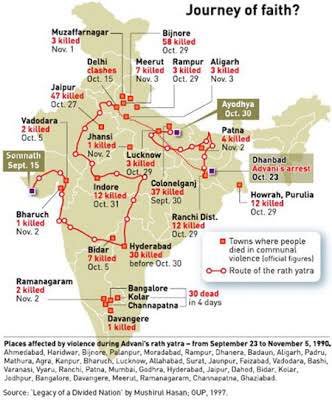
Advani, say the reports, was pivotal to the well-planned conspiracy that led to the Babri demolition˜right through periodic mobilisations of the mid-1980s (he became BJP president in 1986), his Toyota rath-yatra of 1990, which left a bloody trail, to the nuts-and-bolts planning for December 6, which took place at a crucial closed-door meeting at Vinay Katiyar's Faizabad house the previous day, attended by, among others, the RSS's H.V. Seshadri and K.S. Sudarshan, VHP's Ashok Singhal and Vinay Katiyar, Shiv Sena's Moreshwar Save, and BJP's Pramod Mahajan.
Advani was the star speaker on December 6. At 11:45 a.m. he announced: "'We don't need bulldozers to pull down the mosque; [we can do it manually]" The assault on the mosque began. Advani ensured it would be completed without interruption by Central paramilitary forces whose entry he urged the karsevaks to block. (3:15 p.m.)
It's not so much VHP, but BJP leaders, who are being egregiously, disgracefully, duplicitous about the demolition˜to evade fair trial for a grievous crime against Indian democracy, and the wave of violence that followed it in 1993. The same Advani now declares that the Babri demolition, like the Gujarat pogrom, was an 'aberration'.
Even more disingenuously, Advani says there is nothing wrong in VHP and RSS members being appointed public prosecutors to try Gujarat's Hindutva culprits˜as part of a massive plan to shield them and subvert justice.
It is our collective shame that we have a Home Minister who has not heard of conflict of interest and who blithely ignores the appointment of countless VHP office-bearers, including general secretary Dilip Trivedi and Chetan Shah (who was asked to handle the Naroda-Patiya massacre, of a hundred people). He is equally blind to the filing of defective First Information Reports, in which the accused are unnamed, which are calculated to exonerate the guilty. Half the culprits in the Gujarat violence have already been acquitted.
To erase the truth from public memory, Advani resorts to blaming 'the system' and to mystifying the human/social agencies at work, and making them disappear! Thus, says Advani, the Gujarat pogrom 'should not have happened, but at the same time, the government or the ruling party cannot be blamed'. The pogrom could not have happened without Narendra Milosevic Modi's planning, coordination, encouragement and execution!
The psychopathology at work here suggests a huge disconnect from reality, now a Hindutva trademark. Take the series of self-congratulatory half- and full-page advertisements issued daily by the government since September 9 at public expense: 'ringing in the good times‚ about the economy (read, stockmarkets) being 'on a roll', when the 'flowers are blooming', 'expenses are settling', 'our country is prospering', 'our lives are changing', 'our tomorrow is promising', 'India Shining'!
These slogans are outrageously partisan and based on purely elite upper-class perceptions. They have nothing to do with the many problems that plague India: rising joblessness, acute power and drinking water shortages, collapse of public services (especially healthcare and primary education), increasing casualisation of labour, persistent deprivation, growing social discontent, rising personal insecurity, and disempowerment of vast numbers.
Nothing illustrates this better than three recent developments/events: the self-immolation in Mumbai by a long-unemployed former Tata contract employee; starvation deaths in Maharashtra, Karnataka, Bihar and above all in Jharkhand, now being reported and seriously investigated by Jean Dreze, Ramesh Sharan and the PUCL; and the rape of a Swiss diplomat in Delhi. These all reflect the iron in our soul, the rot and the sickness in our disgustingly hierarchical society, with its apathetic elite.
Rather than hysterically call for the death penalty for rape, as our loh-purush Home Minister is prone to do after the third incident, we should reflect soberly on what's going wrong: the coarsening of our public discourse; spread of Rambo-style Mera-Bharat-Mahan hypernationalism and viciously male-supremacist ideas; growing xenophobia, demonisation of 'the Other', and an obsession to 'get even' with them through violence; rampant corruption in the police which makes it complicit in crime; and a culture of impunity for the gravest of human rights violations. This is visible in Ayodhya, Mumbai, Delhi and Gujarat.
After all, was it a mere 'aberration' that Gujarat's Hindu nationalists used horrendous sexual violence and mass rape against Muslim women as instruments of vengeance and genocidal warfare? Was it only a joke that after Pokharan-II, the VHP wanted India declared a Hindu state, which had globally 'arrived'? Can Hindutva's malign, violent content and its contribution to social pathologies vanish merely by calling it 'cultural nationalism'?˜
The BJP's long record of extremism & duplicity sits ill with its feigned moderation
Why we can't trust them
By Praful BidwaI
Whatever happens in Ayodhya today, it is plain that the sangh parivar, including the BJP, has decided to milk the Ram temple issue brazenly for political gains. The way the latest, hysterical, mobilisation was launched, led by Central minister Swami Chinmayanand, no less, and the manner in which the RSS-BJP have misinterpreted the Archaeological Survey report on the Ayodhya excavation as if it vindicated 'revenge against history', and decisively established the case for building only a temple and not a mosque, permit no other conclusion.
The BJP and its associates are playing with fire. The last time they sent karsevaks in significant numbers to Ayodhya was February last year. The result˜via the Ramsevaks‚ roguish behaviour on their return journeys, and repeated minor altercations with Muslim vendors in Godhra˜was the barbaric burning alive of 59 people and the reign of terror that followed, with the butchery of 2,000 Muslims with state complicity.
One can only (anxiously) speculate about the consequences of unleashing the same extremist forces once again. But it's clear that VHP and Shiv Sena fanatics cannot be trusted to behave moderately and peacefully.
Their entire agenda is inflammatory and provocative in the first place. It's to compound a horrible wrong˜the Babri demolition˜by visiting yet more vengeance upon the religious minorities, further humiliating them, and disenfranchising them politically and out of public life.
Yet, we have Prime Minister Vajpayee urging us to 'trust' the VHP. This is so counter-intuitive and so violently contradicted by experience and by the VHP's abusive descriptions of him, that it raises another question: can we trust Vajpayee and other 'moderate' BJP leaders?
The short answer, after the 11 year-long charade of investigation and prosecution in the Babri demolition case, is a resounding no. To start with, the government rigged the chargesheet, illegitimately splitting it and dropping the conspiracy charge from that assigned to the Rae Bareli Œspecial court‚. Thus, those guilty of planning, instigating and supervising a crime against the Constitution, would be tried for minor offences˜akin to booking a murderer for a parking offence.
Now it turns out that the Rae Bareli judge's verdict discharging L.K. Advani was based on flagrant misreading and distortion of a key eyewitness˜Anju Gupta, an IPS officer charged with Advani's security on D-Day. According to an Indian Express story, based on the judge's order, Gupta testified that Advani and other leaders provoked the mob with inflammatory speeches and made no effort to stop the demolition. 'Advani was sad only about the fact that people were falling off the domes and dying'.
According to Gupta, Advani appealed to the karsevaks to descend from the domes, but only because the mosque was being demolished from the inside. He fully participated in the celebrations that followed the fall of three domes. Uma Bharati and Ritambhara hugged him in ecstasy.
Gupta's account is fully corroborated not just by countless other eyewitnesses, including TV crew and print journalists, but above all, by the highly reliable, accurate reports of the Citizens‚ Commission on Ayodhya, comprised of Justices O. Chinappa Reddy, D.A. Desai and D.S. Tewatia, themselves based on the examination of 90 witnesses and cross-checking of numerous accounts.
Advani, say the reports, was pivotal to the well-planned conspiracy that led to the Babri demolition˜right through periodic mobilisations of the mid-1980s (he became BJP president in 1986), his Toyota rath-yatra of 1990, which left a bloody trail, to the nuts-and-bolts planning for December 6, which took place at a crucial closed-door meeting at Vinay Katiyar's Faizabad house the previous day, attended by, among others, the RSS's H.V. Seshadri and K.S. Sudarshan, VHP's Ashok Singhal and Vinay Katiyar, Shiv Sena's Moreshwar Save, and BJP's Pramod Mahajan.
Advani was the star speaker on December 6. At 11:45 a.m. he announced: "'We don't need bulldozers to pull down the mosque; [we can do it manually]" The assault on the mosque began. Advani ensured it would be completed without interruption by Central paramilitary forces whose entry he urged the karsevaks to block. (3:15 p.m.)
It's not so much VHP, but BJP leaders, who are being egregiously, disgracefully, duplicitous about the demolition˜to evade fair trial for a grievous crime against Indian democracy, and the wave of violence that followed it in 1993. The same Advani now declares that the Babri demolition, like the Gujarat pogrom, was an 'aberration'.
Even more disingenuously, Advani says there is nothing wrong in VHP and RSS members being appointed public prosecutors to try Gujarat's Hindutva culprits˜as part of a massive plan to shield them and subvert justice.
It is our collective shame that we have a Home Minister who has not heard of conflict of interest and who blithely ignores the appointment of countless VHP office-bearers, including general secretary Dilip Trivedi and Chetan Shah (who was asked to handle the Naroda-Patiya massacre, of a hundred people). He is equally blind to the filing of defective First Information Reports, in which the accused are unnamed, which are calculated to exonerate the guilty. Half the culprits in the Gujarat violence have already been acquitted.
To erase the truth from public memory, Advani resorts to blaming 'the system' and to mystifying the human/social agencies at work, and making them disappear! Thus, says Advani, the Gujarat pogrom 'should not have happened, but at the same time, the government or the ruling party cannot be blamed'. The pogrom could not have happened without Narendra Milosevic Modi's planning, coordination, encouragement and execution!
The psychopathology at work here suggests a huge disconnect from reality, now a Hindutva trademark. Take the series of self-congratulatory half- and full-page advertisements issued daily by the government since September 9 at public expense: 'ringing in the good times‚ about the economy (read, stockmarkets) being 'on a roll', when the 'flowers are blooming', 'expenses are settling', 'our country is prospering', 'our lives are changing', 'our tomorrow is promising', 'India Shining'!
These slogans are outrageously partisan and based on purely elite upper-class perceptions. They have nothing to do with the many problems that plague India: rising joblessness, acute power and drinking water shortages, collapse of public services (especially healthcare and primary education), increasing casualisation of labour, persistent deprivation, growing social discontent, rising personal insecurity, and disempowerment of vast numbers.
Nothing illustrates this better than three recent developments/events: the self-immolation in Mumbai by a long-unemployed former Tata contract employee; starvation deaths in Maharashtra, Karnataka, Bihar and above all in Jharkhand, now being reported and seriously investigated by Jean Dreze, Ramesh Sharan and the PUCL; and the rape of a Swiss diplomat in Delhi. These all reflect the iron in our soul, the rot and the sickness in our disgustingly hierarchical society, with its apathetic elite.
Rather than hysterically call for the death penalty for rape, as our loh-purush Home Minister is prone to do after the third incident, we should reflect soberly on what's going wrong: the coarsening of our public discourse; spread of Rambo-style Mera-Bharat-Mahan hypernationalism and viciously male-supremacist ideas; growing xenophobia, demonisation of 'the Other', and an obsession to 'get even' with them through violence; rampant corruption in the police which makes it complicit in crime; and a culture of impunity for the gravest of human rights violations. This is visible in Ayodhya, Mumbai, Delhi and Gujarat.
After all, was it a mere 'aberration' that Gujarat's Hindu nationalists used horrendous sexual violence and mass rape against Muslim women as instruments of vengeance and genocidal warfare? Was it only a joke that after Pokharan-II, the VHP wanted India declared a Hindu state, which had globally 'arrived'? Can Hindutva's malign, violent content and its contribution to social pathologies vanish merely by calling it 'cultural nationalism'?˜


Devil’s workshop
The Hindustan Times, October 18, 2003 | Op-Ed.
Devil’s workshop
Jan Breman
In a recent study on the socio-political context of communal violence in India, Ashutosh Varshney has focused on the importance of civic networks for binding Hindus and Muslims together.
He argues that in the case of Ahmedabad, a truly impressive level of civic activity was built up during the national movement, to a large extent initiated by Gandhi.
The main pillars of civil engagement that emerged were the Congress Party, which brought people of all communities together; a wide variety of social and educational agencies, set up by Gandhi and his associates, which later became known as non-governmental organisations; business associations, which had a long tradition of inter-communal interaction in the framework of artisan and mercantile guilds; and the Textile Labour Association (TLA) as a working class organisation which had both Hindu and Muslim mill hands in its fold and a programme that preached unity.
In Varshney’s opinion, these institutions were together crucial for producing a social climate characterised by harmony. Once these pillars started to crumble, and the collapse of the textile industry happened to be a major turning point, communal violence became ferocious. The author himself modifies his thesis of a strong Hindu-Muslim engagement which prevailed until a few decades ago. Congress leaders were never able, nor did they aim to, mobilise a large number of Muslims in the city during the anti-colonial struggle; only few Gandhian institutions reached out to either urban or rural segments of the main religious minority, the business associations in the city had an in-group character and did not promote civic interaction.
As for the TLA, Varshney concedes that a large proportion of Muslim mill workers decided to stay away from this union. I beg to differ from his main argument suggesting that political Hinduism is an altogether new phenomenon in Ahmedabad which has brought to an end the climate of tolerance and harmony built up by Gandhi and his disciples. A.M. Shah, among others, has critically questioned the suggestion that Gandhi’s message of non-violence had penetrated deeply in Gujarati society and culture during his lifetime. Whatever social relevance it then had, it certainly did not survive him.
My own opinion is that the communal divide which already existed in the past was strengthened by the segmentary, though not confrontational, politics adopted by the Congress before and after Independence. This parochial strategy, the KHAM coalition consisting of Kshatriyas, Harijans, Adivasis and Muslims, contained the underclasses in their own and separate identities as convenient vote banks. This electoral design was successful for a short span of time only because it provoked a vigorous and vicious backlash from those higher up in society. Their pent-up resentment was the momentum which the Hindutva forces capitalised to come to power...
...The recurrent riots in Ahmedabad towards the end of the 20th century cannot be understood merely as an upsurge of Hindu nationalism under high-caste leadership, planned and organised from a Hindutva perspective. The high tide of communalism is engineered by the promotion of a political economy which seeks to keep the working classes fragmented and in a state of dependency in order to reduce the price of their labour to the lowest possible level. At the end of February and in early March 2002, violence once again erupted in Ahmedabad — on a scale and intensity that far surpassed that of previous years. It is much too facile to suggest a direct causation between the looting, burning, a kill, which reached its climax in the industrial localities of the city, and massive impoverishment due to the collapse of the textile mills in the preceding quarter of a century.
A major difference with the earlier communal riots was that this time the search and destroy operation was not a spontaneous outburst of discontent and rivalry among people living at the bottom of the urban economy but well planned in advance and carried out with brutal precision...
...The residents of the slum localities were not only the victims of communal rage and hatred, but also responded en masse to the call to eliminate the members of the opposing group. The main targets of the violence were Muslims, many hundred of whom — men, women and children — were killed, often
in the most horrific ways. The pogrom made it clear that the Sangh parivar organisations had succeeded in inciting the lumpen army of unemployed and semi-unemployed youth in the industrial district to murder, looting and arson. In an early report on these events, I made a link between the mass redundancies that accompanied the closure of the mills, the impoverishment and degradation of the industrial neighbourhoods and the pogroms which took place largely in this milieu. The social cohesion that once existed has gone...
...This close-knit community feeling which used to exist, lives on in the narratives about what has been lost. They are memories of visits to one’s neighbour, to take part in the joys and sorrows of family life, to pay their respects or to show each other hospitality on festive occasions, to share the burden of everyday problems. This mesh of social cohesion that transcended the separate identify niches broke down once the mill had closed, the TLA started to fade away, and municipal agencies, due to lack of funding, ceased or drastically curtailed their welfare activities, which were also meeting points.
The climate of Social Darwinism that replaced it not only established the right of the survival of the fittest, but meant that the weakest
at the base of society are forced to compete with each other as hunter and hunted. In the course of my own stay in Ahmedabad during these fateful days in March 2002, I met with the secretary general of the TLA. He told me about his despair when he failed to get through to the police commissioner or to politicians of the ruling party once the pogrom had started. The lack of response to his incessant calls from his office on February 28, 2002, made him realise that the State machinery deliberately refused to end the rampage and that his union now really had become a spent force...
...When I left Ahmedabad at the end of March, order and peace had not yet been restored. The curfew was lifted in some parts of the city, only to be re-imposed the next day in the same or other localities because of few incidents. There has been hardly any discussion of what all this meant for the large number of working class households who fully depend on the erratic and meagre yield of their labour power.
Even under so-called normal circumstances, steady employment is difficult to come by, but for more than three weeks at a stretch they had not able to move around in their cumbersome search for gainful work. For many of them, the regular state of deprivation in which they live has further deteriorated into destitution. Without any food left and bereft of all creditworthiness, they have to survive on whatever private charities are willing to dole out to them. What does deserve attention is that, with a few exceptions, the institutions that represent civil society took no action at all when the communal riots and the horrific violence that accompanied them broke out.
Ahmedabad is proud of the large number of non-governmental agencies located in the city. In the past, commentators have widely praised their role in tackling poverty. This generated a hugely exaggerated picture, which included the glorification of NGO initiatives to which the private sector and the local government also contributed. These efforts have, however, reaped few benefits for the poorer sections of the population, and for the large number of Muslims among them in particular. For collective action, the city’s excluded minority has always been, and remain, dependent on charity from their own community. In the pauperised industrial districts of Ahmedabad ‘the righteous struggle’, which did succeed in generating a certain amount of inter-communal solidarity, lives on only in the memory of a better past.
The writer is Professor of Comparative Sociology, University of Amsterdam.
This is an edited extract from the book, The Making and Unmaking of An Industrial Working Class, Oxford University Press
Devil’s workshop
Jan Breman
In a recent study on the socio-political context of communal violence in India, Ashutosh Varshney has focused on the importance of civic networks for binding Hindus and Muslims together.
He argues that in the case of Ahmedabad, a truly impressive level of civic activity was built up during the national movement, to a large extent initiated by Gandhi.
The main pillars of civil engagement that emerged were the Congress Party, which brought people of all communities together; a wide variety of social and educational agencies, set up by Gandhi and his associates, which later became known as non-governmental organisations; business associations, which had a long tradition of inter-communal interaction in the framework of artisan and mercantile guilds; and the Textile Labour Association (TLA) as a working class organisation which had both Hindu and Muslim mill hands in its fold and a programme that preached unity.
In Varshney’s opinion, these institutions were together crucial for producing a social climate characterised by harmony. Once these pillars started to crumble, and the collapse of the textile industry happened to be a major turning point, communal violence became ferocious. The author himself modifies his thesis of a strong Hindu-Muslim engagement which prevailed until a few decades ago. Congress leaders were never able, nor did they aim to, mobilise a large number of Muslims in the city during the anti-colonial struggle; only few Gandhian institutions reached out to either urban or rural segments of the main religious minority, the business associations in the city had an in-group character and did not promote civic interaction.
As for the TLA, Varshney concedes that a large proportion of Muslim mill workers decided to stay away from this union. I beg to differ from his main argument suggesting that political Hinduism is an altogether new phenomenon in Ahmedabad which has brought to an end the climate of tolerance and harmony built up by Gandhi and his disciples. A.M. Shah, among others, has critically questioned the suggestion that Gandhi’s message of non-violence had penetrated deeply in Gujarati society and culture during his lifetime. Whatever social relevance it then had, it certainly did not survive him.
My own opinion is that the communal divide which already existed in the past was strengthened by the segmentary, though not confrontational, politics adopted by the Congress before and after Independence. This parochial strategy, the KHAM coalition consisting of Kshatriyas, Harijans, Adivasis and Muslims, contained the underclasses in their own and separate identities as convenient vote banks. This electoral design was successful for a short span of time only because it provoked a vigorous and vicious backlash from those higher up in society. Their pent-up resentment was the momentum which the Hindutva forces capitalised to come to power...
...The recurrent riots in Ahmedabad towards the end of the 20th century cannot be understood merely as an upsurge of Hindu nationalism under high-caste leadership, planned and organised from a Hindutva perspective. The high tide of communalism is engineered by the promotion of a political economy which seeks to keep the working classes fragmented and in a state of dependency in order to reduce the price of their labour to the lowest possible level. At the end of February and in early March 2002, violence once again erupted in Ahmedabad — on a scale and intensity that far surpassed that of previous years. It is much too facile to suggest a direct causation between the looting, burning, a kill, which reached its climax in the industrial localities of the city, and massive impoverishment due to the collapse of the textile mills in the preceding quarter of a century.
A major difference with the earlier communal riots was that this time the search and destroy operation was not a spontaneous outburst of discontent and rivalry among people living at the bottom of the urban economy but well planned in advance and carried out with brutal precision...
...The residents of the slum localities were not only the victims of communal rage and hatred, but also responded en masse to the call to eliminate the members of the opposing group. The main targets of the violence were Muslims, many hundred of whom — men, women and children — were killed, often
in the most horrific ways. The pogrom made it clear that the Sangh parivar organisations had succeeded in inciting the lumpen army of unemployed and semi-unemployed youth in the industrial district to murder, looting and arson. In an early report on these events, I made a link between the mass redundancies that accompanied the closure of the mills, the impoverishment and degradation of the industrial neighbourhoods and the pogroms which took place largely in this milieu. The social cohesion that once existed has gone...
...This close-knit community feeling which used to exist, lives on in the narratives about what has been lost. They are memories of visits to one’s neighbour, to take part in the joys and sorrows of family life, to pay their respects or to show each other hospitality on festive occasions, to share the burden of everyday problems. This mesh of social cohesion that transcended the separate identify niches broke down once the mill had closed, the TLA started to fade away, and municipal agencies, due to lack of funding, ceased or drastically curtailed their welfare activities, which were also meeting points.
The climate of Social Darwinism that replaced it not only established the right of the survival of the fittest, but meant that the weakest
at the base of society are forced to compete with each other as hunter and hunted. In the course of my own stay in Ahmedabad during these fateful days in March 2002, I met with the secretary general of the TLA. He told me about his despair when he failed to get through to the police commissioner or to politicians of the ruling party once the pogrom had started. The lack of response to his incessant calls from his office on February 28, 2002, made him realise that the State machinery deliberately refused to end the rampage and that his union now really had become a spent force...
...When I left Ahmedabad at the end of March, order and peace had not yet been restored. The curfew was lifted in some parts of the city, only to be re-imposed the next day in the same or other localities because of few incidents. There has been hardly any discussion of what all this meant for the large number of working class households who fully depend on the erratic and meagre yield of their labour power.
Even under so-called normal circumstances, steady employment is difficult to come by, but for more than three weeks at a stretch they had not able to move around in their cumbersome search for gainful work. For many of them, the regular state of deprivation in which they live has further deteriorated into destitution. Without any food left and bereft of all creditworthiness, they have to survive on whatever private charities are willing to dole out to them. What does deserve attention is that, with a few exceptions, the institutions that represent civil society took no action at all when the communal riots and the horrific violence that accompanied them broke out.
Ahmedabad is proud of the large number of non-governmental agencies located in the city. In the past, commentators have widely praised their role in tackling poverty. This generated a hugely exaggerated picture, which included the glorification of NGO initiatives to which the private sector and the local government also contributed. These efforts have, however, reaped few benefits for the poorer sections of the population, and for the large number of Muslims among them in particular. For collective action, the city’s excluded minority has always been, and remain, dependent on charity from their own community. In the pauperised industrial districts of Ahmedabad ‘the righteous struggle’, which did succeed in generating a certain amount of inter-communal solidarity, lives on only in the memory of a better past.
The writer is Professor of Comparative Sociology, University of Amsterdam.
This is an edited extract from the book, The Making and Unmaking of An Industrial Working Class, Oxford University Press
October 15, 2003
Temple versus terror
The Indian Express
Wednesday, October 15, 2003
Temple versus terror
October 17 is not a climactic point. VHP is in it for the long haul
ASHOK MALIK
As the Vishwa Hindu Parishad’s Ram readies to take on the regime of RAM — Rajput-Ahir-Muslim, the social coalition underpinning Mulayam Singh Yadav’s government in Uttar Pradesh — a sense of deja vu is inescapable.
Once again the VHP is demanding its temple. Once again the BJP is trapped in the silence of ambiguity, unsure of what it thinks the prime minister wants it to say and what its instincts tell it to say. Once again Ayodhya has been converted into a garrison town.
Identifying the villain is facile business. The prevailing intellectual wisdom over the past few years has been straightforward: Vajpayee, good; BJP, tolerable; VHP, terrible. The Ashok Singhal-Pravin Togadia group, by this reckoning, is a bunch of religious crazies, completely at the margins of Indian society. The Ram issue is politically dead.
From the cosy confines of drawing room Delhi, this logic appears perfectly tenable. It doesn’t square up, however, with two niggling bits of reality.
One, why is the VHP attracting substantially larger crowds than it ever has? Admittedly, these are not always huge, revolution-inducing throngs; but they are significantly larger than those in, say, the late 1990s.
To cite stray examples from 2003 itself, Togadia gathered over 100,000 people at a Mangalore rally, another 60,000 in Aurangabad and addressed 11 meetings in Madhya Pradesh, with crowds in even small centres rarely falling below 20,000-25,000. In short, the threshold of VHP mobilisation autonomous of the BJP has gone up.
Two, there is a creeping fear in the BJP that the VHP is rhetorically divorcing it from a certain aggressive positioning in the politics of Hindu nationalism. This will not sink the BJP but, in an election without an overriding emotive issue, could do some damage.
There is a disinclination, born partly of hostility and partly of sheer laziness, to recognise just how — and how much — the VHP has grown, in numbers and in terms of appropriation of ideas. For instance, while focused on the Ram mandir, the VHP has sought to exploit the hard mood against terrorism.
In the VHP’s dream scenario, the Ram mandir issue will become an adjunct to India’s war against jihad. Ram, a sort of Hindu St George, will become what he already is to the faithful, a symbol of national identity and security.
All this may appear far-fetched but the VHP’s thought process is not quite random. It is based, to some degree, on an April 2002 document available to only the Parishad’s upper echelons. A survey of public opinion, the document was, for lack of a better expression, a SWOT analysis for the VHP.
Respondents were asked to identify the number one issue of concern for India from a given universe. Poverty — under which category were subsumed worries about income and subsistence — was right on top with 45 per cent. Terrorism came second with 25 per cent.
What did this mean for the Ram movement?
Economic issues, unfortunately or otherwise, have never dominated Indian public life. Historically, opinion poll after opinion poll, pre-election survey after pre-election survey has shown a sharp differential between the questions ‘‘What is the biggest problem facing the country?’’ and ‘‘Which issues will determine your vote?’’ The answer to the first is usually defined by economic perennials, to the second by prevailing emotions.
As such, terrorism was more likely to work a mob, especially at a time when the Indian government’s policy on Pakistan tended to oscillate between tepid and ambivalent. In their public meetings, VHP leaders now speak of only two issues: temple and terrorism.
The 2002 document was educative in terms of the social base of VHP religio-nationalism. While support was relatively high among lower income groups and the rich, the big city middle class was seen as fickle. Its support was influenced by immediate provocations — such as Godhra — and not consistent. Among caste groups, the VHP found it had not made substantial inroads into the Dalit community.
The geographical spread of the VHP also presents a contrast from the mandir agitation of the early 1990s. Support, insiders admit, has peaked if not declined in Bihar and Uttar Pradesh. The boom areas are Gujarat and Maharashtra, parts of Rajasthan, Tamil Nadu, north Karnataka and odd areas in Andhra Pradesh.
A whole generation of political analysts has come of age convincing itself of secret, election-eve deals between the VHP and the BJP. It is difficult to make them believe that the top leadership of the sangh twins is barely on talking terms.
In part, this is a personality clash. To the VHP, Atal Bihari Vajpayee and, increasingly, L.K. Advani, are snarl words, crypto-secularists if you like, who sought to use the Kanchi Shankaracharya to split the Ram constituency.
To the BJP, Singhal is an irascible character, cussed and unwilling to see reason. The second generation senses it will have to do business with the VHP some day, maybe after the 2004 election, but is unwilling to oppose the party elders right now.
To the VHP, the October 17 gathering in Ayodhya is not a climactic point. It is only the beginning of a long haul, one in which it will have to pressure enough MPs to agree to parliamentary legislation on Ayodhya.
For the moment, that seems a forlorn hope. What is decidedly more real, is the fear that the VHP may just launch a new political party — ‘‘the H Party’’, as some put it — committed to the Hindu cause. An ultimatum to the BJP is expected after the assembly elections in December. The VHP has even identified two possible leaders from the BJP’s second generation, though it is far from obvious that they will jump ship.
What will this new party, if it arrives, achieve? VHP strategists say it could win 30-40 Lok Sabha seats and play a role in a future coalition. A more sober assessment suggests it may win nothing — but still slice away, say, a fifth of the BJP vote in a number of constituences.
In the Ramayan, when Ram sent Sita to the forest, the vitality of his existence vanished too. Is the BJP set to repeat that tragedy?
Wednesday, October 15, 2003
Temple versus terror
October 17 is not a climactic point. VHP is in it for the long haul
ASHOK MALIK
As the Vishwa Hindu Parishad’s Ram readies to take on the regime of RAM — Rajput-Ahir-Muslim, the social coalition underpinning Mulayam Singh Yadav’s government in Uttar Pradesh — a sense of deja vu is inescapable.
Once again the VHP is demanding its temple. Once again the BJP is trapped in the silence of ambiguity, unsure of what it thinks the prime minister wants it to say and what its instincts tell it to say. Once again Ayodhya has been converted into a garrison town.
Identifying the villain is facile business. The prevailing intellectual wisdom over the past few years has been straightforward: Vajpayee, good; BJP, tolerable; VHP, terrible. The Ashok Singhal-Pravin Togadia group, by this reckoning, is a bunch of religious crazies, completely at the margins of Indian society. The Ram issue is politically dead.
From the cosy confines of drawing room Delhi, this logic appears perfectly tenable. It doesn’t square up, however, with two niggling bits of reality.
One, why is the VHP attracting substantially larger crowds than it ever has? Admittedly, these are not always huge, revolution-inducing throngs; but they are significantly larger than those in, say, the late 1990s.
To cite stray examples from 2003 itself, Togadia gathered over 100,000 people at a Mangalore rally, another 60,000 in Aurangabad and addressed 11 meetings in Madhya Pradesh, with crowds in even small centres rarely falling below 20,000-25,000. In short, the threshold of VHP mobilisation autonomous of the BJP has gone up.
Two, there is a creeping fear in the BJP that the VHP is rhetorically divorcing it from a certain aggressive positioning in the politics of Hindu nationalism. This will not sink the BJP but, in an election without an overriding emotive issue, could do some damage.
There is a disinclination, born partly of hostility and partly of sheer laziness, to recognise just how — and how much — the VHP has grown, in numbers and in terms of appropriation of ideas. For instance, while focused on the Ram mandir, the VHP has sought to exploit the hard mood against terrorism.
In the VHP’s dream scenario, the Ram mandir issue will become an adjunct to India’s war against jihad. Ram, a sort of Hindu St George, will become what he already is to the faithful, a symbol of national identity and security.
All this may appear far-fetched but the VHP’s thought process is not quite random. It is based, to some degree, on an April 2002 document available to only the Parishad’s upper echelons. A survey of public opinion, the document was, for lack of a better expression, a SWOT analysis for the VHP.
Respondents were asked to identify the number one issue of concern for India from a given universe. Poverty — under which category were subsumed worries about income and subsistence — was right on top with 45 per cent. Terrorism came second with 25 per cent.
What did this mean for the Ram movement?
Economic issues, unfortunately or otherwise, have never dominated Indian public life. Historically, opinion poll after opinion poll, pre-election survey after pre-election survey has shown a sharp differential between the questions ‘‘What is the biggest problem facing the country?’’ and ‘‘Which issues will determine your vote?’’ The answer to the first is usually defined by economic perennials, to the second by prevailing emotions.
As such, terrorism was more likely to work a mob, especially at a time when the Indian government’s policy on Pakistan tended to oscillate between tepid and ambivalent. In their public meetings, VHP leaders now speak of only two issues: temple and terrorism.
The 2002 document was educative in terms of the social base of VHP religio-nationalism. While support was relatively high among lower income groups and the rich, the big city middle class was seen as fickle. Its support was influenced by immediate provocations — such as Godhra — and not consistent. Among caste groups, the VHP found it had not made substantial inroads into the Dalit community.
The geographical spread of the VHP also presents a contrast from the mandir agitation of the early 1990s. Support, insiders admit, has peaked if not declined in Bihar and Uttar Pradesh. The boom areas are Gujarat and Maharashtra, parts of Rajasthan, Tamil Nadu, north Karnataka and odd areas in Andhra Pradesh.
A whole generation of political analysts has come of age convincing itself of secret, election-eve deals between the VHP and the BJP. It is difficult to make them believe that the top leadership of the sangh twins is barely on talking terms.
In part, this is a personality clash. To the VHP, Atal Bihari Vajpayee and, increasingly, L.K. Advani, are snarl words, crypto-secularists if you like, who sought to use the Kanchi Shankaracharya to split the Ram constituency.
To the BJP, Singhal is an irascible character, cussed and unwilling to see reason. The second generation senses it will have to do business with the VHP some day, maybe after the 2004 election, but is unwilling to oppose the party elders right now.
To the VHP, the October 17 gathering in Ayodhya is not a climactic point. It is only the beginning of a long haul, one in which it will have to pressure enough MPs to agree to parliamentary legislation on Ayodhya.
For the moment, that seems a forlorn hope. What is decidedly more real, is the fear that the VHP may just launch a new political party — ‘‘the H Party’’, as some put it — committed to the Hindu cause. An ultimatum to the BJP is expected after the assembly elections in December. The VHP has even identified two possible leaders from the BJP’s second generation, though it is far from obvious that they will jump ship.
What will this new party, if it arrives, achieve? VHP strategists say it could win 30-40 Lok Sabha seats and play a role in a future coalition. A more sober assessment suggests it may win nothing — but still slice away, say, a fifth of the BJP vote in a number of constituences.
In the Ramayan, when Ram sent Sita to the forest, the vitality of his existence vanished too. Is the BJP set to repeat that tragedy?
Stirring the hornet’s nest | Letters To the Editor - Hindustan Times
Letters To the Editor - Hindustan Times, October 15, 2003
Stirring the hornet’s nest
Atal Bihari Vajpayee implying that the prohibitory orders from Ayodhya and Faizabad should be withdrawn by the Mulayam Singh Yadav government, is arbitrary (We should trust VHP: PM, October 13). There are many instances where VHP leaders have broken their promises. Praveen Togadia never kept the promise he made to the court in Rajasthan in April that he would not give hate speeches anymore. And Ashok Singhal has recently been charge-sheeted for his alleged role in the Babri masjid demolition.
Vishal Arora, Delhi
II
Every time people seem to be settling down to a life free from communal tension and of socio-economic progress, the VHP and its allied organisations whip up communal tension by declaring some puja or darshan at Ayodhya (Treading choppy waters, October 14). And when elections are round the corner, their love for Ram increases even at the cost of national interest. The temple issue has earned India a bad image in the world.
Because of a communal polarisation encouraged by the so-called perpetrators of Hindutva, mutual suspicion and hostility have increased manifold. Silence and inaction on the part of saner elements will encourage animosity, resulting in destabilisation.
Ved Guliani, via e-mail
Stirring the hornet’s nest
Atal Bihari Vajpayee implying that the prohibitory orders from Ayodhya and Faizabad should be withdrawn by the Mulayam Singh Yadav government, is arbitrary (We should trust VHP: PM, October 13). There are many instances where VHP leaders have broken their promises. Praveen Togadia never kept the promise he made to the court in Rajasthan in April that he would not give hate speeches anymore. And Ashok Singhal has recently been charge-sheeted for his alleged role in the Babri masjid demolition.
Vishal Arora, Delhi
II
Every time people seem to be settling down to a life free from communal tension and of socio-economic progress, the VHP and its allied organisations whip up communal tension by declaring some puja or darshan at Ayodhya (Treading choppy waters, October 14). And when elections are round the corner, their love for Ram increases even at the cost of national interest. The temple issue has earned India a bad image in the world.
Because of a communal polarisation encouraged by the so-called perpetrators of Hindutva, mutual suspicion and hostility have increased manifold. Silence and inaction on the part of saner elements will encourage animosity, resulting in destabilisation.
Ved Guliani, via e-mail
October 13, 2003
TV Spirituality: Bhakti Button
Outlook Magazine, October 20, 2003
Bhakti Button
God rides the ether as his angels, in many flavours, reach
for sofa-bound souls
[by] Harsh Kabra
Preaching was never so lucrative. With salvation outsourced,
the boob tube now wants to be your drawing-room deliverer,
promising armchair enlightenment and remote-controlled
emancipation.
What started with good old Doordarshan‚s pioneering daybreak
discourses was fleetly espoused by almost all satellite channels,
culminating in Maharishi Veda Vision, Sanskar, Aastha and,
most recently, Sadhna, all with an overtly Hindu bent, much
like the Christian agenda of God TV, the Syro-Malabar
Church-promoted Jeevan TV, MiracleNet, Eternal World
Television‚s Global Catholic Network and Human Upliftment
Organisation‚s Golden Age Television. And as Muslims
appropriated specks of Pakistan TV and Arabic channels, the
Sikhs have leaned towards Alpha Punjabi, Lashkara and ETC
Punjabi for their feed of telly spirituality˜the latter prized
by expats for Gurbani beamed from Amritsar‚s Golden temple.
And this plethora hasn't kept more players from sallying into
the fray. ATN International's bilingual Ahimsaa TV debuted
on Gandhi Jayanti this year, and Sanskriti and Sudarshan TV
are in the works.
Eyeball dynamics bear out the enthusiasm. At least 50 per
cent of the 40-plus age group, accounting for over 60 per cent
of the estimated 150 million viewers in the 24 million cable
homes in India, are believed to have taken to spirituality on
the tube. A share that's poised to surge with higher cable and
satellite TV penetration in India, which, reports Media Partners,
stood at 53 per cent in 2002 and will scale up to 65 per cent
by 2015 astride a subscriber base of 96 million. The overall
current share of religious channels may be a scrimpy 1 per
cent, but it still translates into an average weekly reach of
15 million (TAM Media Research) for the five major channels
in July ‚03 (see chart).
Spiritual channels, like the rest of their free-to-air clan, survive
on airtime sales and sponsorships (God TV also receives
donations). Their modest tariff cards have steadily drawn
advertisers looking to improve niche exposure and campaign
frequency. "The advertiser finds that our viewer is patient and
doesn‚t surf channels," asserts Dilip Kabra of Sanskar.
On their part, the Hindu channels are just waking up to the
idea of content being the key differentiator. But as Ashish Bhasin,
director, Integrated Marketing Action Group, Lowe India, avers:
"As of now, all channels look the same. The content begs
improvement." Kabra is more realistic: "A lot needs to be done,
but issues of financial viability stifle costly projects...."
Which is where usps atrophy. Like in real-world spirituality,
those who believe in nothing can be seen lapping up virtually
anything. One sees celebrity speakers like Sudhanshuji Maharaj
trailed by a growing breed of self-appointed masters claiming
to interpret ancient esoteric knowledge, chivvying nebulous
notions of inner peace. Souls materialistic are lambasted for
their ever-growing possessions by ever-more expensive gurus.
One wonders if the speakers and audiences are animated as
much by the ideas at hand as by the presence of a TV camera;
or if cant is a natty shortcut to social acclaim.
It‚s the swelling throngs at gala discourses that inspired
channels like Sanskar in the first place. Says Kabra: "The
country is imbued with spirituality...there existed a ready
audience." Rakesh Gupta, MD, Sadhna TV, was spurred by
the tightening tentacles of the soap culture: "Sadhna was
envisaged as a medium to extricate viewers from the
imaginary world of fiction, where vices are shown in the
name of Indian culture and producers play with the
emotions of viewers."
Passion is all right. But it can't offset tentative production
standards, poor execution. How can content like home
videos of devotional songs and congregations ever poach
upon the audiences of chic soaps and film shows? Kabra
insists it‚s a myth that home videos do not amount to quality
content. "Not only would you find high levels of devotion
in them, they also showcase promising singers," he explains.
The channels are also changing tack, to claim the attentions
of diverse age groups. Some like the Kochi-based
Jeevan TV have become entertainment channels with
spirituality confined to daily slots. Others are zooming in on
younger age groups with programmes on yoga, Art of Living.
A flip through Aastha and Sadhna unleashes a slew of
astrologers and Vaastushastra or Feng Shui experts
bombarding you with contact details and rate cards for
various 'services'. Aren't these channels becoming ready
vehicles of promotion for some? Gupta concedes they
are, but adds: "These subjects are closely related to our
culture, scientifically proven and popular. Even the
government is approving full-fledged courses in astrology
and vaastu."
The political abuse of the medium is another apprehension.
Political analyst A.S. Ojha recently told a news agency:
"These channels may not be party to poll pandering but
our right-wing parties will discover ways to use them to
legitimise their ideologies." TV producer Kiran Mittal trod
a step ahead. "They have a political slant," he declared.
"When they talk of promoting Indian heritage, why do
they only promote Hinduism and no other religion?"
Gupta spars: "We are only spreading the message of
peace and harmony enshrined in Hinduism...to talk
about India without Hinduism is like talking about a
person without a conscience." Iqbal Malhotra, director
of Delhi-based aim Television, concurs: "The channels
are not purveying a militant Hindu line. There is no
evidence of a party or ideological line. They are tapping
into a niche, a lucrative market thirsting for a blend of
eastern spiritualism, western precepts."
Which way do you then look at the likes of God TV?
Reveals Thomas Robinson, channel director for Asia
and Middle East: "Our channel is about spreading the
love of God, helping people find God. It‚s not about a
religion but about the person Jesus who brings joy
and peace into our lives." Are such Christian channels
stabs at countering the Hindu movement? Robinson
denies it: "We respect the varied culture and beliefs
of everyone and have nothing to do with the Hindu
movement."
So is all this marking a waypost in the evolution of a
certain genre, undecided about distinctions between
institutional religion and bona fide spirituality. Says
Santosh Kumar Jain, MD, ATN International: "Ahimsaa
believes in a multi-religious platform, a new market in
the area of social TV aimed at all age groups and faiths.
(But) I don‚t think there‚s anything wrong with
channels focusing on one faith, like MTV focuses on the
youth." Says Suresh Chavanke, COO, Sudarshan TV:
"We want to blend socialism and spiritualism and replace
the political bent of social activities with a philosophical
bent."
All in all, the concepts seem worthy, pronounces Bhasin,
but "they‚ll succeed only through a mix of entertainment
and education.And in the long run, only one or two
players will survive in every genre."
So talk of commercialisation of spirituality be damned, is
it time to give in to the spiel? As Sri Sri Ravi Shankar says,
"The mind has become commercial and can only be
captured commercially." Amen.
Bhakti Button
God rides the ether as his angels, in many flavours, reach
for sofa-bound souls
[by] Harsh Kabra
Preaching was never so lucrative. With salvation outsourced,
the boob tube now wants to be your drawing-room deliverer,
promising armchair enlightenment and remote-controlled
emancipation.
What started with good old Doordarshan‚s pioneering daybreak
discourses was fleetly espoused by almost all satellite channels,
culminating in Maharishi Veda Vision, Sanskar, Aastha and,
most recently, Sadhna, all with an overtly Hindu bent, much
like the Christian agenda of God TV, the Syro-Malabar
Church-promoted Jeevan TV, MiracleNet, Eternal World
Television‚s Global Catholic Network and Human Upliftment
Organisation‚s Golden Age Television. And as Muslims
appropriated specks of Pakistan TV and Arabic channels, the
Sikhs have leaned towards Alpha Punjabi, Lashkara and ETC
Punjabi for their feed of telly spirituality˜the latter prized
by expats for Gurbani beamed from Amritsar‚s Golden temple.
And this plethora hasn't kept more players from sallying into
the fray. ATN International's bilingual Ahimsaa TV debuted
on Gandhi Jayanti this year, and Sanskriti and Sudarshan TV
are in the works.
Eyeball dynamics bear out the enthusiasm. At least 50 per
cent of the 40-plus age group, accounting for over 60 per cent
of the estimated 150 million viewers in the 24 million cable
homes in India, are believed to have taken to spirituality on
the tube. A share that's poised to surge with higher cable and
satellite TV penetration in India, which, reports Media Partners,
stood at 53 per cent in 2002 and will scale up to 65 per cent
by 2015 astride a subscriber base of 96 million. The overall
current share of religious channels may be a scrimpy 1 per
cent, but it still translates into an average weekly reach of
15 million (TAM Media Research) for the five major channels
in July ‚03 (see chart).
Spiritual channels, like the rest of their free-to-air clan, survive
on airtime sales and sponsorships (God TV also receives
donations). Their modest tariff cards have steadily drawn
advertisers looking to improve niche exposure and campaign
frequency. "The advertiser finds that our viewer is patient and
doesn‚t surf channels," asserts Dilip Kabra of Sanskar.
On their part, the Hindu channels are just waking up to the
idea of content being the key differentiator. But as Ashish Bhasin,
director, Integrated Marketing Action Group, Lowe India, avers:
"As of now, all channels look the same. The content begs
improvement." Kabra is more realistic: "A lot needs to be done,
but issues of financial viability stifle costly projects...."
Which is where usps atrophy. Like in real-world spirituality,
those who believe in nothing can be seen lapping up virtually
anything. One sees celebrity speakers like Sudhanshuji Maharaj
trailed by a growing breed of self-appointed masters claiming
to interpret ancient esoteric knowledge, chivvying nebulous
notions of inner peace. Souls materialistic are lambasted for
their ever-growing possessions by ever-more expensive gurus.
One wonders if the speakers and audiences are animated as
much by the ideas at hand as by the presence of a TV camera;
or if cant is a natty shortcut to social acclaim.
It‚s the swelling throngs at gala discourses that inspired
channels like Sanskar in the first place. Says Kabra: "The
country is imbued with spirituality...there existed a ready
audience." Rakesh Gupta, MD, Sadhna TV, was spurred by
the tightening tentacles of the soap culture: "Sadhna was
envisaged as a medium to extricate viewers from the
imaginary world of fiction, where vices are shown in the
name of Indian culture and producers play with the
emotions of viewers."
Passion is all right. But it can't offset tentative production
standards, poor execution. How can content like home
videos of devotional songs and congregations ever poach
upon the audiences of chic soaps and film shows? Kabra
insists it‚s a myth that home videos do not amount to quality
content. "Not only would you find high levels of devotion
in them, they also showcase promising singers," he explains.
The channels are also changing tack, to claim the attentions
of diverse age groups. Some like the Kochi-based
Jeevan TV have become entertainment channels with
spirituality confined to daily slots. Others are zooming in on
younger age groups with programmes on yoga, Art of Living.
A flip through Aastha and Sadhna unleashes a slew of
astrologers and Vaastushastra or Feng Shui experts
bombarding you with contact details and rate cards for
various 'services'. Aren't these channels becoming ready
vehicles of promotion for some? Gupta concedes they
are, but adds: "These subjects are closely related to our
culture, scientifically proven and popular. Even the
government is approving full-fledged courses in astrology
and vaastu."
The political abuse of the medium is another apprehension.
Political analyst A.S. Ojha recently told a news agency:
"These channels may not be party to poll pandering but
our right-wing parties will discover ways to use them to
legitimise their ideologies." TV producer Kiran Mittal trod
a step ahead. "They have a political slant," he declared.
"When they talk of promoting Indian heritage, why do
they only promote Hinduism and no other religion?"
Gupta spars: "We are only spreading the message of
peace and harmony enshrined in Hinduism...to talk
about India without Hinduism is like talking about a
person without a conscience." Iqbal Malhotra, director
of Delhi-based aim Television, concurs: "The channels
are not purveying a militant Hindu line. There is no
evidence of a party or ideological line. They are tapping
into a niche, a lucrative market thirsting for a blend of
eastern spiritualism, western precepts."
Which way do you then look at the likes of God TV?
Reveals Thomas Robinson, channel director for Asia
and Middle East: "Our channel is about spreading the
love of God, helping people find God. It‚s not about a
religion but about the person Jesus who brings joy
and peace into our lives." Are such Christian channels
stabs at countering the Hindu movement? Robinson
denies it: "We respect the varied culture and beliefs
of everyone and have nothing to do with the Hindu
movement."
So is all this marking a waypost in the evolution of a
certain genre, undecided about distinctions between
institutional religion and bona fide spirituality. Says
Santosh Kumar Jain, MD, ATN International: "Ahimsaa
believes in a multi-religious platform, a new market in
the area of social TV aimed at all age groups and faiths.
(But) I don‚t think there‚s anything wrong with
channels focusing on one faith, like MTV focuses on the
youth." Says Suresh Chavanke, COO, Sudarshan TV:
"We want to blend socialism and spiritualism and replace
the political bent of social activities with a philosophical
bent."
All in all, the concepts seem worthy, pronounces Bhasin,
but "they‚ll succeed only through a mix of entertainment
and education.And in the long run, only one or two
players will survive in every genre."
So talk of commercialisation of spirituality be damned, is
it time to give in to the spiel? As Sri Sri Ravi Shankar says,
"The mind has become commercial and can only be
captured commercially." Amen.
October 12, 2003
Habib Tanvir: In the eye of a storm
Magazine / The Hindu
Oct 12, 2003
URL: http://www.thehindu.com/thehindu/mag/2003/10/12/stories/2003101200230400.htm
THEATRE
In the eye of a storm
Veteran theatre person Habib Tanvir has been at the receiving end for staging two plays that deal with issues like untouchability, casteism and communal harmony. He speaks to SANGEETA BAROOAH PISHAROTY about the controversy.
IF William Shakespeare had been a 21st Century Indian dramatist, his "Hamlet" would not have had the line, `What's in a name?' And, if the bard had persisted with it, he would have got a sharp retort: "Everything!"
At least, that is what theatre thespian Habib Tanvir would have said.
Suddenly after being on the road for 60 years, the second-generation migrant from Pakistan finds that his name has become a baggage these days. After all, how can a Muslim stage plays that laughs at the tyranny of upper caste Brahmins? So what if he has been showing "Ponga Pandit" for decades in every corner of the country, and abroad.
Tanvir admits he has been wedged in the maelstrom of politics. Touring through Madhya Pradesh with the plays, "Ponga Pandit" and "Jisse Lahore Nahin Dekhya" last month sponsored by MP Sanskriti Parishad, the 80-year-old veteran had to face the fury of militant Sangh Parivar groups for what they called "playing with religious feelings".
"The series of attacks on my plays, particularly `Ponga Pandit', have nothing to do with religious sentiment. With state elections coming, it is mere play of politics between the ruling party and the Opposition. And, I have a name that suits them," says the veteran, somewhat fractious at the way "things are becoming anti-art".
"Theatre, for that matter any art, is not just supposed to entertain but to stimulate thinking. It should ironically laugh at life, question our rituals, lacks, social evils," he says.
Art, to him, is all about asking questions. "Ponga Pandit" too asks questions. "It is a deeply religious play and shows that to reach God you do not need a via media," argues the Padma Shree dramatist.
But who would argue with a band of self-declared custodians of Hinduism swearing to "even take the bullets" to prevent the play from being performed.
Interestingly, this is not the first time Tanvir has been on the right-wingers' hit list. Soon after the Babri Masjid demolition, his plays were targeted too. "There were protests in Gwalior. The Vishwa Hindu Parishad also demonstrated in the United Kingdom when I took my plays there," he says.
This time, what upset the members of Bajrang Dal, Vishwa Hindu Parishad, Rashtriya Swayamsevak Sangh and Bharatiya Janata Party were scenes showing a character entering the village temple with shoes, a sweeper carrying an idol in her basket and a pundit lighting an incense stick with a bidi. But the director of the Naya Theatre argues, "The character shown entering the temple with his slippers is a village simpleton. When the priest tells him to leave his shoes outside because God lives in a temple, he asks, `does that mean God is not everywhere'.
"Also, it shows the sweeper genuinely interested in listening to the Satya Narayan Katha, but with the pandit coming in between with endless rituals, she decides not to have medium to reach God."
While the play pokes fun at upper-caste Hindus, what is not true is the Sangh Parivar's campaign that Tanvir has written the play. It was actually penned by two Dalit writers way back in 1930s, which explains the constant reference to the upper caste oppression.
"I chose `Ponga Pandit' because it speaks for social equality and justice.
"`Jisse Lahore Nahin Dekhya' is a superb play to show people the strength of communal harmony, an issue most important in present-day India, especially after the genocide in Gujarat," says Tanvir.
And therein lies another irony. "Jisse Lahore Nahin Dekhya" is fine with the right-wingers, for it shows a fanatical gang of Muslims trying to chase away Hindus from Lahore. It suits their political agenda but social evils like untouchability, caste-system and hollow rituals are shown in "Ponga Pandit", it angers them.
"It is a pity that politicians are rapidly bringing the country into a situation that do not permit art to flourish," says the Sangeet Natak Akademi awardee.
Responding to the Sangh Parivar observation that he should set his eyes on Muslim religious atrocities too, Tanvir comments, "If someone does come out with a play which criticises oppression of the weak in the name of any religion, I would be the last person to protest".
He says the Valmiki Samaj performed a puja organised by the BJP to protest against his plays. "But interestingly, it was not allowed to be held inside the temple but just outside it. And, this inequality is what `Ponga Pandit' laughs at," he adds.
Though, according to a local newspaper, none of the state BJP office bearers had seen "Ponga Pandit", Tanvir says, "Two BJP MLAs turned up with a big posse of supporters at Baghpat on the Janamastami night. Since the play is basically a comedy, it has dialogues and situations, which can surely tickle your senses.
"The leaders too were seen laughing at the discourse but as they came with a decided plan of action, slogan shouting, pelting of stones and eggs soon started. After much pleading to carry on the play, both by the cast and the genuine theatregoers, we had to leave the stage fearing violence."
But none of all this actually scares Tanvir. After a brief visit to Delhi, he is eager to get back to Bhopal and hit the road with "Ponga Pandit" and "Jisse Lahore Nahin Dekhya" again.
Oct 12, 2003
URL: http://www.thehindu.com/thehindu/mag/2003/10/12/stories/2003101200230400.htm
THEATRE
In the eye of a storm
Veteran theatre person Habib Tanvir has been at the receiving end for staging two plays that deal with issues like untouchability, casteism and communal harmony. He speaks to SANGEETA BAROOAH PISHAROTY about the controversy.
IF William Shakespeare had been a 21st Century Indian dramatist, his "Hamlet" would not have had the line, `What's in a name?' And, if the bard had persisted with it, he would have got a sharp retort: "Everything!"
At least, that is what theatre thespian Habib Tanvir would have said.
Suddenly after being on the road for 60 years, the second-generation migrant from Pakistan finds that his name has become a baggage these days. After all, how can a Muslim stage plays that laughs at the tyranny of upper caste Brahmins? So what if he has been showing "Ponga Pandit" for decades in every corner of the country, and abroad.
Tanvir admits he has been wedged in the maelstrom of politics. Touring through Madhya Pradesh with the plays, "Ponga Pandit" and "Jisse Lahore Nahin Dekhya" last month sponsored by MP Sanskriti Parishad, the 80-year-old veteran had to face the fury of militant Sangh Parivar groups for what they called "playing with religious feelings".
"The series of attacks on my plays, particularly `Ponga Pandit', have nothing to do with religious sentiment. With state elections coming, it is mere play of politics between the ruling party and the Opposition. And, I have a name that suits them," says the veteran, somewhat fractious at the way "things are becoming anti-art".
"Theatre, for that matter any art, is not just supposed to entertain but to stimulate thinking. It should ironically laugh at life, question our rituals, lacks, social evils," he says.
Art, to him, is all about asking questions. "Ponga Pandit" too asks questions. "It is a deeply religious play and shows that to reach God you do not need a via media," argues the Padma Shree dramatist.
But who would argue with a band of self-declared custodians of Hinduism swearing to "even take the bullets" to prevent the play from being performed.
Interestingly, this is not the first time Tanvir has been on the right-wingers' hit list. Soon after the Babri Masjid demolition, his plays were targeted too. "There were protests in Gwalior. The Vishwa Hindu Parishad also demonstrated in the United Kingdom when I took my plays there," he says.
This time, what upset the members of Bajrang Dal, Vishwa Hindu Parishad, Rashtriya Swayamsevak Sangh and Bharatiya Janata Party were scenes showing a character entering the village temple with shoes, a sweeper carrying an idol in her basket and a pundit lighting an incense stick with a bidi. But the director of the Naya Theatre argues, "The character shown entering the temple with his slippers is a village simpleton. When the priest tells him to leave his shoes outside because God lives in a temple, he asks, `does that mean God is not everywhere'.
"Also, it shows the sweeper genuinely interested in listening to the Satya Narayan Katha, but with the pandit coming in between with endless rituals, she decides not to have medium to reach God."
While the play pokes fun at upper-caste Hindus, what is not true is the Sangh Parivar's campaign that Tanvir has written the play. It was actually penned by two Dalit writers way back in 1930s, which explains the constant reference to the upper caste oppression.
"I chose `Ponga Pandit' because it speaks for social equality and justice.
"`Jisse Lahore Nahin Dekhya' is a superb play to show people the strength of communal harmony, an issue most important in present-day India, especially after the genocide in Gujarat," says Tanvir.
And therein lies another irony. "Jisse Lahore Nahin Dekhya" is fine with the right-wingers, for it shows a fanatical gang of Muslims trying to chase away Hindus from Lahore. It suits their political agenda but social evils like untouchability, caste-system and hollow rituals are shown in "Ponga Pandit", it angers them.
"It is a pity that politicians are rapidly bringing the country into a situation that do not permit art to flourish," says the Sangeet Natak Akademi awardee.
Responding to the Sangh Parivar observation that he should set his eyes on Muslim religious atrocities too, Tanvir comments, "If someone does come out with a play which criticises oppression of the weak in the name of any religion, I would be the last person to protest".
He says the Valmiki Samaj performed a puja organised by the BJP to protest against his plays. "But interestingly, it was not allowed to be held inside the temple but just outside it. And, this inequality is what `Ponga Pandit' laughs at," he adds.
Though, according to a local newspaper, none of the state BJP office bearers had seen "Ponga Pandit", Tanvir says, "Two BJP MLAs turned up with a big posse of supporters at Baghpat on the Janamastami night. Since the play is basically a comedy, it has dialogues and situations, which can surely tickle your senses.
"The leaders too were seen laughing at the discourse but as they came with a decided plan of action, slogan shouting, pelting of stones and eggs soon started. After much pleading to carry on the play, both by the cast and the genuine theatregoers, we had to leave the stage fearing violence."
But none of all this actually scares Tanvir. After a brief visit to Delhi, he is eager to get back to Bhopal and hit the road with "Ponga Pandit" and "Jisse Lahore Nahin Dekhya" again.
Subscribe to:
Posts (Atom)