From: expressindia.com
Ganesha in Mother Mary’s arm irks VHP, Bajrang Dal
Express news service
Posted: Sep 20, 2012 at 0330 hrs IST
Surat An attempt at a communally harmonious Ganesha puja pandal met with severe opposition from VHP and Bajrang Dal activists forcing organisers to change the idol soon after its installation here on Wednesday.
The Hira Panna Group of City Light area in Surat, which has been setting up theme-based Ganesh pandals in the city, had installed a statue of Mother Mary with an infant Ganesha in her arms. The plan was to immerse the idol and donate the Mother Mary to a church coming up in Dumas.
On Wednesday, when the idol was unveiled and news spread, activists of VHP, Bajrang Dal and president of Ganesh Utsav Sewa Samiti Anil Biscuitwala came to the pandal along with several priests and forced the organisers to remove the idol.
The objection was to the cross hanging from the right hand while it held a Ganesh in her left hand, in place of infant Jesus.
Under mounting pressure from all sides, the youths of H P Group removed the cross from the hand of the statue in the evening and replaced it with the tricolour, apparently turning it into a replica of ‘Mother India’.
“We are getting pressure from all sides to remove the idol of Mother Mary but we are firm on our decision and we will not remove the idol. The small Ganesha Idol is removable. And after immersion, we have decided to donate the 11-foot statue of Mother Mary to a new church in Dumas area of Surat. We have done nothing wrong,” said one of the organisers.
“We just want to spread message of communal harmony but some people do not seem to like it and they are making big issue of it. To settle the controversy, we have removed the cross and replaced it with Indian flag,” added the organiser.
Ganesh Utsav Samithi president and BJP’s Rander councillor Anil Biscuitwala said, “We went to the spot and tried to convince the organisers that such a concept would spread a wrong message. The two religions should not be mixed as it might lead to controversies... Our motive was to resolve it peacefully, and later, the organisers agreed to remove the cross and replaced it with the national flag, which now looks like Mother India with Lord Ganesha in her arms.”
|

Showing posts with label Surat. Show all posts
Showing posts with label Surat. Show all posts
September 23, 2012
December 20, 2009
Gujarat: The forgotten riots of surat
The Indian Express, Dec 17, 2009
The forgotten riots
by Parimal Dabhi
Ahmedabad/ Surat : While Justice Liberhan may have submitted his report 17 years late, an inquiry commission for the 1992 riots that broke out in Surat in the wake of the Babri Masjid demolition was terminated in 1997 because it sought several extensions. And while a human rights group challenged the decision in court, this attempt failed to revive the commission.
Though the official death toll in the Surat riots stands at 152, many went missing, and property worth crores was damaged, no one has been held accountable. Lawyer-turned-BJP MLA Atmaram Parmar who defended the accused in the riots admits that there has not even been one conviction in cases of arson, rape and murder that are comparable to the 2002 riots in the state.
Incidentally, Shankersinh Vaghela, who as the chief minister in 1997 ordered the termination of the state inquiry commission, is the lone Congress leader to be indicted by the Liberhan Commission for his role in inciting the post-Babri Masjid demolition riots.
The ill-fated inquiry commission was ordered by Chimanbhai Patel’s Congress government two months after the Surat riots. It was initially headed by Justice (retd) I C Bhatt, but when he was appointed as the Lokayukta in 1995-96, Justice P M Chauhan replaced him.
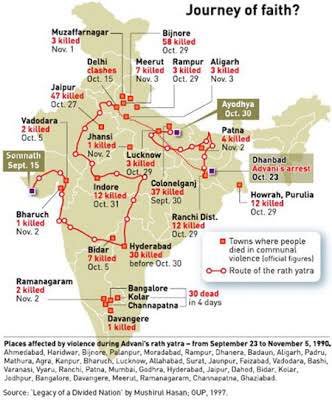
Incidentally, it was on the issue of the Ayodhya rath yatra that Chimanbhai Patel’s support shifted from the BJP to Congress. Patel, heading the Janata Dal-Gujarat, became the chief minister with the BJP’s support in 1990 but the coalition fell apart on the issue of support to L K Advani’s rath yatra which began from Somnath in Gujarat. By 1992, Chimanbhai Patel emerged as a Congress chief minister after merging the Janata Dal-Gujarat with the party.
Further political ironies were to play out. Vaghela was the state BJP president when the riots broke out in 1992-93, but he went on to engineer a split in the party and toppled the Suresh Mehta-led BJP government in 1995. He then formed the government with the support of the Congress in October 1996. It was in 1997 that he ordered the termination of the inquiry commission, just when the final report was being dictated.
“I am strongly against giving extensions to the inquiry commissions as they become an instrument of getting various allowances only. And so, I ordered the termination of the Chauhan Commission when it did not meet the deadline,” says Vaghela.
While Vaghela’s decision to terminate the commission was challenged in the Gujarat High Court by a human rights group, Jan Sangharsh Manch (JSM), the division bench of the HC dismissed the petition saying that the state government has the power to terminate the inquiry commission. Mukul Sinha of JSM said that the HC decision was challenged in the Supreme Court but it “did not entertain the petition at the relevant time.”
The outcome is that the findings of the commission report may never be known. Justice Chauhan refuses to comment on it and the survivors — especially women and children who were raped and lost their entire families — are reluctant to recall the trauma they went through.
The only candid admission comes surprisingly from BJP MLA, Atmaram Parmar, who defended those accused in the riots’ cases “To the best of my knowledge not a single person had been convicted in any case of 1992 riots.”
The forgotten riots
by Parimal Dabhi
Ahmedabad/ Surat : While Justice Liberhan may have submitted his report 17 years late, an inquiry commission for the 1992 riots that broke out in Surat in the wake of the Babri Masjid demolition was terminated in 1997 because it sought several extensions. And while a human rights group challenged the decision in court, this attempt failed to revive the commission.
Though the official death toll in the Surat riots stands at 152, many went missing, and property worth crores was damaged, no one has been held accountable. Lawyer-turned-BJP MLA Atmaram Parmar who defended the accused in the riots admits that there has not even been one conviction in cases of arson, rape and murder that are comparable to the 2002 riots in the state.
Incidentally, Shankersinh Vaghela, who as the chief minister in 1997 ordered the termination of the state inquiry commission, is the lone Congress leader to be indicted by the Liberhan Commission for his role in inciting the post-Babri Masjid demolition riots.
The ill-fated inquiry commission was ordered by Chimanbhai Patel’s Congress government two months after the Surat riots. It was initially headed by Justice (retd) I C Bhatt, but when he was appointed as the Lokayukta in 1995-96, Justice P M Chauhan replaced him.
Incidentally, it was on the issue of the Ayodhya rath yatra that Chimanbhai Patel’s support shifted from the BJP to Congress. Patel, heading the Janata Dal-Gujarat, became the chief minister with the BJP’s support in 1990 but the coalition fell apart on the issue of support to L K Advani’s rath yatra which began from Somnath in Gujarat. By 1992, Chimanbhai Patel emerged as a Congress chief minister after merging the Janata Dal-Gujarat with the party.
Further political ironies were to play out. Vaghela was the state BJP president when the riots broke out in 1992-93, but he went on to engineer a split in the party and toppled the Suresh Mehta-led BJP government in 1995. He then formed the government with the support of the Congress in October 1996. It was in 1997 that he ordered the termination of the inquiry commission, just when the final report was being dictated.
“I am strongly against giving extensions to the inquiry commissions as they become an instrument of getting various allowances only. And so, I ordered the termination of the Chauhan Commission when it did not meet the deadline,” says Vaghela.
While Vaghela’s decision to terminate the commission was challenged in the Gujarat High Court by a human rights group, Jan Sangharsh Manch (JSM), the division bench of the HC dismissed the petition saying that the state government has the power to terminate the inquiry commission. Mukul Sinha of JSM said that the HC decision was challenged in the Supreme Court but it “did not entertain the petition at the relevant time.”
The outcome is that the findings of the commission report may never be known. Justice Chauhan refuses to comment on it and the survivors — especially women and children who were raped and lost their entire families — are reluctant to recall the trauma they went through.
The only candid admission comes surprisingly from BJP MLA, Atmaram Parmar, who defended those accused in the riots’ cases “To the best of my knowledge not a single person had been convicted in any case of 1992 riots.”


December 20, 2008
Denying Muslims housing is shaping the city of Surat into ‘ours’ and ‘theirs’
A Divided Cityscape Denying Muslims housing is shaping the city of Surat into ‘ours’ and ‘theirs’ TRIDIP SUHRUD HOW IS one to understand the decision of the real estate developers and agents of Surat not to sell or rent houses or commercial properties to Muslims of the city? “
We want to control the percentage of Muslims with properties and shops in our areas,” was the official explanation of the association that called the meeting of builders. This, they argued, was a precautionary measure against Mumbai-like terror attacks and the failed bomb strikes against Surat in July. No terror attack could be planned or carried out without local support, they argued. This comes at a time when Muslim groups in the country have assiduously distanced themselves from the Mumbai terror attack. The Babri Masjid Action Committee decided not to observe December 6 as a ‘black day’, Eid was marked by mourning, and a few months ago, the Darul Uloom at Deoband had unequivocally declared terror as being un-Islamic. This could be seen as a public acknowledgement of a process that has been going on for a long time, not just in Surat or Gujarat but also elsewhere in the country. Terror is only the upper layer of many deepseated fears, which include in Gujarat fears of non-vegetarianism. But it is not just an expression of cultural fear or a communal mindset. It is also a sign of a newly-emerging cityscape. It is possible to speak of a city as being divided into ‘our’ areas and ‘their’ areas. It conveys a belief that a city can be conceived as being inhabited by mutually exclusive community groups, with no interdependence, either in terms of trade and commerce or in the sense of a shared daily life. It claims that the new city will have no ‘public spaces’ but only community specific institutions: separate schools, hospitals, commercial establishments and also separate underworlds. In this new city, it is possible to speak in terms of ‘boarders.’ And as Juhapura in Ahmedabad would testify, this boarder is not imaginary or pathological. It is real, in all its brick and mortar materiality. What they hope to create is a city of ‘a permanent underclass.’ But it is not only this imagination that drives Surat. Surat was and is an entrepreneurial city; with diamonds and textiles driving the city’s growth. It is a city that is capable of exemplary civic will, as the post-plague period in the city’s recent past demonstrated. Surat’s economic ambitions are at variance with its desire to create separate enclosures for its Muslims and Hindus. What they do not recognise is that an entrepreneurial city cannot survive with a permanent underbelly. For Surat, it also conveys a deep amnesia about its own history and cultural moorings. Surat, on the banks of the river Tapi, has been a major trading port since medieval times. The Arabs, Mughals, Portuguese, English, Dutch and the French all came to Surat and contributed to its cultural and architectural imagination, which are still in evidence, if recessive in memory. Surat was the most cosmopolitan of urban settlements on the west coast of Gujarat, before the emergence of Mumbai. Surat celebrates its association with Narmad, the poet, lexicographer and historian of the city, who gave us the song “Jay Jay Garvi Gujarat.” Its major university is named after Narmad. But it also violates Narmad’s memory. It was Narmad who asked the question of “Who does Gujarat belong to?” He listed all the cultural and religious symbols, communities and caste groups and said that Gujarat does not belong to anyone of them. He sang that Gujarat belongs to all those who make Gujarat their home. If Surat wants to prosper as an entrepreneurial city, it can do so only by reclaiming its forgotten cosmopolitan character, and not as a city that seeks the erasure of a large part of its citizenry. (Suhrud is an academic living in Ahmedabad) | ||
From Tehelka Magazine, Vol 5, Issue 51, Dated Dec 27, 2008 | ||

December 12, 2008
Communalised Surat: Real estate brokers not to sell or rent houses to Muslims
The Indian Express
Dec 12, 2008
Editorial
House for Mr Ali
In a recent meeting, some 300 real estate brokers in Surat declared that they will not sell or rent houses to Muslim clients. The ostensible reason for this “boycott” is that the terrorists who attacked Mumbai had local supporters. In other words, even if the terrorists are foreign, they rely on the support of India’s Muslims, all of whom, in this thesis, are suspect. Muslims have long found it hard to buy houses in urban India. Tales of discrimination now form a clear pattern of prejudice. Many middle-class Muslims find that otherwise pliant homeowners and building societies suddenly develop cold feet on learning of the buyer’s religion. This is especially true in Gujarat post-2002, with segregation becoming disturbingly visible. But this is unprecedented in its brazenness.
Urbanisation is supposed to mix communities, scrambling neighbourhoods and ridding them of sameness, removing identity as a geographic marker. This is why the Surat-like boycotts are even more alarming. In fact, Islamic terrorists feed on the perceived alienation and ghettoisation of Muslim communities in India — and they often cite the discrimination which they claim people from those communities face when trying to enter the mainstream. One would have thought that by buying and renting houses in urban India, more Muslims would enter the mainstream, further decreasing the power of such justifications. Besides, it is in insular ghettos that prejudices fester, and anger amplifies. And nothing kills stereotypes the way familiarity does.
But for those brokering hate and paranoia, logic is a lost investment. These real estate brokers have shown us what they think about what defines our nationhood and citizenship. They’ve also shown that, in the struggle against terrorism, they expect rationality to take a back seat to their prejudices. It is up to civil society to snub them.
Dec 12, 2008
Editorial
House for Mr Ali
In a recent meeting, some 300 real estate brokers in Surat declared that they will not sell or rent houses to Muslim clients. The ostensible reason for this “boycott” is that the terrorists who attacked Mumbai had local supporters. In other words, even if the terrorists are foreign, they rely on the support of India’s Muslims, all of whom, in this thesis, are suspect. Muslims have long found it hard to buy houses in urban India. Tales of discrimination now form a clear pattern of prejudice. Many middle-class Muslims find that otherwise pliant homeowners and building societies suddenly develop cold feet on learning of the buyer’s religion. This is especially true in Gujarat post-2002, with segregation becoming disturbingly visible. But this is unprecedented in its brazenness.
Urbanisation is supposed to mix communities, scrambling neighbourhoods and ridding them of sameness, removing identity as a geographic marker. This is why the Surat-like boycotts are even more alarming. In fact, Islamic terrorists feed on the perceived alienation and ghettoisation of Muslim communities in India — and they often cite the discrimination which they claim people from those communities face when trying to enter the mainstream. One would have thought that by buying and renting houses in urban India, more Muslims would enter the mainstream, further decreasing the power of such justifications. Besides, it is in insular ghettos that prejudices fester, and anger amplifies. And nothing kills stereotypes the way familiarity does.
But for those brokering hate and paranoia, logic is a lost investment. These real estate brokers have shown us what they think about what defines our nationhood and citizenship. They’ve also shown that, in the struggle against terrorism, they expect rationality to take a back seat to their prejudices. It is up to civil society to snub them.
November 11, 2008
Those 29 unexploded bombs in surat
Times of India, 12 Nov 2008
How did 29 bombs surface in most unlikely spots in Surat?
by Melvyn Thomas , TNN
SURAT: The Gujarat Police has been trying to figure out this puzzle for a while. How did nearly 29 unexploded bombs surface in Surat just after the serial bomb blasts in Ahmedabad on July 26 in most unlikely locations? The bombs were planted atop trees, under fly-overs and behind towering hoardings.
Finally, the Maharashtra anti-terrorist squad (ATS) may have an answer. It's another matter that the 29 bombs bombs did not explode, apparently because of a faulty integrated circuit, and a snorkel was used to reach up to the bomb and defuse it.
But it now appears that on the night of July 25 or 26, the bombers may have driven around in a snorkel to plant bombs. The snorkel is used to fix streetlights and fight fires by Surat Municipal Corporation (SMC).
The Maharashtra ATS officers are here to investigate the Malegaon blasts as well as the two cars stolen from Navi Mumbai found abandoned in Surat laden with explosives. They strongly suspect that terrorists may have used an elevated platform to plant bombs.
TOI checked the logbook of SMC's fire control department, which has six snorkels. However, entries made in the logbook for July suggest that between July 20 and 28, the snorkels did not roll out of the fire station.
On being asked about the line of Maharashtra ATS's investigation, RMS Brar, Commissioner of Police, said, ``This is absurd. The Maharashtra ATS is investigating into the Malegaon blast. There is no connection between Malegaon and Surat. We have already identified the suspects who planted the Surat bombs.''
Chief fire officer of SMC G M Kothwala said, ``There are no private snorkels here. We strictly monitor movement of our snorkels. But, the possibility of street ladders cannot be ruled out.''
How did 29 bombs surface in most unlikely spots in Surat?
by Melvyn Thomas , TNN
SURAT: The Gujarat Police has been trying to figure out this puzzle for a while. How did nearly 29 unexploded bombs surface in Surat just after the serial bomb blasts in Ahmedabad on July 26 in most unlikely locations? The bombs were planted atop trees, under fly-overs and behind towering hoardings.
Finally, the Maharashtra anti-terrorist squad (ATS) may have an answer. It's another matter that the 29 bombs bombs did not explode, apparently because of a faulty integrated circuit, and a snorkel was used to reach up to the bomb and defuse it.
But it now appears that on the night of July 25 or 26, the bombers may have driven around in a snorkel to plant bombs. The snorkel is used to fix streetlights and fight fires by Surat Municipal Corporation (SMC).
The Maharashtra ATS officers are here to investigate the Malegaon blasts as well as the two cars stolen from Navi Mumbai found abandoned in Surat laden with explosives. They strongly suspect that terrorists may have used an elevated platform to plant bombs.
TOI checked the logbook of SMC's fire control department, which has six snorkels. However, entries made in the logbook for July suggest that between July 20 and 28, the snorkels did not roll out of the fire station.
On being asked about the line of Maharashtra ATS's investigation, RMS Brar, Commissioner of Police, said, ``This is absurd. The Maharashtra ATS is investigating into the Malegaon blast. There is no connection between Malegaon and Surat. We have already identified the suspects who planted the Surat bombs.''
Chief fire officer of SMC G M Kothwala said, ``There are no private snorkels here. We strictly monitor movement of our snorkels. But, the possibility of street ladders cannot be ruled out.''
August 04, 2008
stop blaming one section of society for all the terror attacks in India
(The Hindu, 5 August 2008)
Don’t blame a single section for all terror attacks: Secular Forum
Staff Reporter
“No such violence can take place without political failure and injustices”
Demands an inquiry either by CBI or by apex court judges into the recent blasts
NEW DELHI: Calling terrorism a response to politics and not religion, Asghar Ali Engineer of the All India Secular Forum has asked the Centre and the media to stop blaming one section of society for all the terror attacks in the country recently. Addressing a press conference organised by Anhad here on Monday, he appealed to all Indians not to be misled by any religious rhetoric.
“In our country, the Hindutva forces too use such rhetoric for their own political purposes. Terrorism is a political response to a political situation. It would be futile to look for its roots in any religion. As Hindutva is not a product of Hinduism but that of a right-wing Hindu political party, jihadis are not a product of Islam but of politics of right-wing Muslim outfits. In principle, our democracy should keep religion at a distance from governance and politics should be based on secular issues pertaining to people.”
Stating that no such violence would take place without political failure and gross injustices, Dr. Engineer said: “Even after Independence and vivisection of our country, we never shed our communal outlook and politics. Our politicians were hardly made of secular democratic stuff and our administrative machinery was hardly any different. Our politics was never based on soci0-economic justice and the naxal problem is an outcome of gross socio-economic injustices.”
Also present were Shabnam Hashmi of Anhad (Delhi), Jyotsna Shukla of Quami Ekta Samiti and L.S. Hardenia, editor of Secular Democracy.
Seek CBI inquiry
The speakers demanded an inquiry by the CBI or by sitting judges of the Supreme Court into the recent bomb blasts in Ahmedabad and Surat. An inquiry was also demanded into the role of Rashtriya Swayamsevak Sangh, Bajrang Dal and other Sangh Parivar organisations in various attacks.
Ms. Hashmi said: “There are several Muslim families who fought the British during the Indian freedom struggle. We are proud that we belong here but why are we forced to prove our patriotism after every terror attack? We also want to know why very often innocent young men are rounded up and harassed after every bomb blast in the country just because they happen to belong to a particular community.”
Don’t blame a single section for all terror attacks: Secular Forum
Staff Reporter
“No such violence can take place without political failure and injustices”
Demands an inquiry either by CBI or by apex court judges into the recent blasts
NEW DELHI: Calling terrorism a response to politics and not religion, Asghar Ali Engineer of the All India Secular Forum has asked the Centre and the media to stop blaming one section of society for all the terror attacks in the country recently. Addressing a press conference organised by Anhad here on Monday, he appealed to all Indians not to be misled by any religious rhetoric.
“In our country, the Hindutva forces too use such rhetoric for their own political purposes. Terrorism is a political response to a political situation. It would be futile to look for its roots in any religion. As Hindutva is not a product of Hinduism but that of a right-wing Hindu political party, jihadis are not a product of Islam but of politics of right-wing Muslim outfits. In principle, our democracy should keep religion at a distance from governance and politics should be based on secular issues pertaining to people.”
Stating that no such violence would take place without political failure and gross injustices, Dr. Engineer said: “Even after Independence and vivisection of our country, we never shed our communal outlook and politics. Our politicians were hardly made of secular democratic stuff and our administrative machinery was hardly any different. Our politics was never based on soci0-economic justice and the naxal problem is an outcome of gross socio-economic injustices.”
Also present were Shabnam Hashmi of Anhad (Delhi), Jyotsna Shukla of Quami Ekta Samiti and L.S. Hardenia, editor of Secular Democracy.
Seek CBI inquiry
The speakers demanded an inquiry by the CBI or by sitting judges of the Supreme Court into the recent bomb blasts in Ahmedabad and Surat. An inquiry was also demanded into the role of Rashtriya Swayamsevak Sangh, Bajrang Dal and other Sangh Parivar organisations in various attacks.
Ms. Hashmi said: “There are several Muslim families who fought the British during the Indian freedom struggle. We are proud that we belong here but why are we forced to prove our patriotism after every terror attack? We also want to know why very often innocent young men are rounded up and harassed after every bomb blast in the country just because they happen to belong to a particular community.”
Inquiry demanded on Ahmedabad and Surat blasts
Press Release, 4 August 2008
Memorandum
Independent and objective inquiry demanded in Ahmedabad and Surat blasts
- Pray, terror does not touch Gujarat. C.M. Knows state's anti-terror machinery is cracking' warned Times of India on 16th May, 2008.
- Is Ahmedabad safe under new Commissioner of Police O.P. Mathur? Prashant Dayal asked on 27th May, 2008 and onwards in serial articles in Times of India.
Yet instead of reconsidering the appointment of Police Commissioner Gujarat Government allowed SEDITION COMPLAINT being registered against Times of India Resident Editor Bharat Desai and reporter Prashant Dayal on one hand and made several statements after Bangalore blast one was by Minister of States for Home affairs Amit Shah in Dhoraji (Rajkot District) on 25th July, 2008. Second by BJP State President Purshottam Rupala at Virpur (Kheda District) on 26th July, few hours before the first blast in Ahmedabad took place. Over and above Chief Minister himself saying in Jetpur (Rajkot District) making a statement that if the terrorist dare to do what they did in Bangalore I shall hunt them down to death. (Patal Mathi Pan Sodhi Ne Emne Kabrastan Ma Pahochadi Daish, Saaf Kari Nakhis). He earlier had told a public meeting in Mumbai of similar kind and off course Gujarat remembers him boasting during election meetings. Chest as wide as 56", claimed earlier to fight terrorism is now nowhere in the scenario.
- The central agencies, according to Minister of State for Home Affairs in the Union Government, Shakeel Ahmed, had given warnings about high terrorists threat to Gujarat. High alert was advised but Narendra Modi chose to ignore, as if it was weather forecast and decided not to act, Why?
- Is it not too much of coincidence that Surat bomb detonators has been traced to Government factory in Dholpur, in Rajasthan a BJP ruled state and Ammonium Nitrate trail in Nagpur where the RSS headquarter is situated ?
- All the Muslim organisations and leading individuals from the Community have condemned the serial blast in Ahmedabad, they have demonstrated against and asked for independent probe while Hindu organisations have preferred not to do so. Why ?
- A total of 27 live bombs were recovered in Surat in places like Varachha, Kapodara, Mahidharpura and Umbra in four days after the Ahmedabad blasts. The bombs were recovered through the local people and not by Surat police or any crime detection agencies. How this fact is explained?
- Why there are long pending vacancies for five Superintendent of Police, 9 Inspectors and 40 % post of lower level staffers in Intelligence branch resulting in non-availability of intelligence report from bordering districts like Kutch and Banaskantha.
- It is beyond anybody's comprehension that all the live bombs in Surat did not explode while in Ahmedabad most of them did. The bomb disposal squad diffused the explosive without any safety gear and with smiling faces, even they by-standards showed no fear as they watched the bombs being diffused. Did they know that bombs were not to be exploded?
- Surat bombs were planted as high as on hoardings and tree tops which had to be brought down with the help of crane. Are we to believe terrorists were planting the bombs with the help of cranes which Surat police did not know?
- What is the evidence or information available against the survivors of Gujarat carnage 2002, who suffered personal losses six years ago that they are being targeted for the blasts? Or is this the new theory that the Sangh and the administration is selling us?
- Was it true that Pota detainees had called Rasool Party in Pakistan, if so, what action has been taken against the Sabarmati Jail authorities? Are we to believe prisons in Gujarat are the hide outs of terror cells?
- Why the CCTV cameras installed at the state border and in Ahmedabad hospitals failed on 26th July when the blast took place yet no action seems to have taken against them nor anyone is held responsible for the failure?
- Former deputy Prime Minister and leader of the opposition in the Lok Sabha
L.K. Advani downwards in saffron brigade are demanding Pota and Gujco like laws but they do not seems to know that baring two provisions Pota is existing in Gujarat in the form of Prevention of Unlawful Activities Act. Moreover terrorist attacks on Parliament House, Red Fort, Akshardham in Gandhinagar and Jammu Mandir had taken place when POTA law was in operation. Any law can help in penalizing those who are arrested but law by itself does not arrest anybody or prevent any crime.
All the above points are either gross and serious failure by Gujarat Home Department or the State Police or it was a case of criminal complacency in either case an independent inquiry should be held by CBI or by a commission headed by sitting judge of Supreme Court of India.
Is it not true that direct evidence is available against the Sangh Parivar outfits in the following terror attacks/ bomb blasts: Nanded Bomb blast case, Tenkasi terrorist attack, Thane bomb attacks in the theatre, Nagpur attack on the RSS office?
Why the intelligence agencies at the centre ignoring this evidence and why these organizations not banned so far?
Is it not true that Bal Thackrey said that Hindu Suicide squads should be formed and Hindu terror should be unleashed? Also that the bombs planted in Thane should have been stronger? 'It is time to set up Hindu suicide squads to ensure safety of the Hindu society and to protect the nation'.
Why he was not arrested? Why Shiv Sena not banned after this statement?
Why RSS, Bajrang Dal have not been banned?
Is it not true that in 2002 bombs were used to blow up mosques and dargahs and residences? Who made them?
Is it not true that various outfits of the Sangh are giving arms training to their cadre?
We the undersigned demand:
Independent inquiry into the bomb blasts in Ahmedabad and Surat by CBI or by a commission headed by sitting judge of Supreme Court of India.
An inquiry in to the role of RSS, Bajrang Dal and other Sangh Parivar organizations in various terror attacks.
Suspension of Police Commissioner of Ahmedabad.
Dr Asghar Ali Engineer- All India Secular Forum
LS Hardenia- Editor, Secular Democracy
Jyotsna Shukla- Executive Quami Ekta Samiti
Digant Oza- People's Movement of India
Shabnam Hashmi- Anhad, Delhi
to
1. Dr. Manmohan Singh
2. Smt Sonia Gandhi
Memorandum
Independent and objective inquiry demanded in Ahmedabad and Surat blasts
- Pray, terror does not touch Gujarat. C.M. Knows state's anti-terror machinery is cracking' warned Times of India on 16th May, 2008.
- Is Ahmedabad safe under new Commissioner of Police O.P. Mathur? Prashant Dayal asked on 27th May, 2008 and onwards in serial articles in Times of India.
Yet instead of reconsidering the appointment of Police Commissioner Gujarat Government allowed SEDITION COMPLAINT being registered against Times of India Resident Editor Bharat Desai and reporter Prashant Dayal on one hand and made several statements after Bangalore blast one was by Minister of States for Home affairs Amit Shah in Dhoraji (Rajkot District) on 25th July, 2008. Second by BJP State President Purshottam Rupala at Virpur (Kheda District) on 26th July, few hours before the first blast in Ahmedabad took place. Over and above Chief Minister himself saying in Jetpur (Rajkot District) making a statement that if the terrorist dare to do what they did in Bangalore I shall hunt them down to death. (Patal Mathi Pan Sodhi Ne Emne Kabrastan Ma Pahochadi Daish, Saaf Kari Nakhis). He earlier had told a public meeting in Mumbai of similar kind and off course Gujarat remembers him boasting during election meetings. Chest as wide as 56", claimed earlier to fight terrorism is now nowhere in the scenario.
- The central agencies, according to Minister of State for Home Affairs in the Union Government, Shakeel Ahmed, had given warnings about high terrorists threat to Gujarat. High alert was advised but Narendra Modi chose to ignore, as if it was weather forecast and decided not to act, Why?
- Is it not too much of coincidence that Surat bomb detonators has been traced to Government factory in Dholpur, in Rajasthan a BJP ruled state and Ammonium Nitrate trail in Nagpur where the RSS headquarter is situated ?
- All the Muslim organisations and leading individuals from the Community have condemned the serial blast in Ahmedabad, they have demonstrated against and asked for independent probe while Hindu organisations have preferred not to do so. Why ?
- A total of 27 live bombs were recovered in Surat in places like Varachha, Kapodara, Mahidharpura and Umbra in four days after the Ahmedabad blasts. The bombs were recovered through the local people and not by Surat police or any crime detection agencies. How this fact is explained?
- Why there are long pending vacancies for five Superintendent of Police, 9 Inspectors and 40 % post of lower level staffers in Intelligence branch resulting in non-availability of intelligence report from bordering districts like Kutch and Banaskantha.
- It is beyond anybody's comprehension that all the live bombs in Surat did not explode while in Ahmedabad most of them did. The bomb disposal squad diffused the explosive without any safety gear and with smiling faces, even they by-standards showed no fear as they watched the bombs being diffused. Did they know that bombs were not to be exploded?
- Surat bombs were planted as high as on hoardings and tree tops which had to be brought down with the help of crane. Are we to believe terrorists were planting the bombs with the help of cranes which Surat police did not know?
- What is the evidence or information available against the survivors of Gujarat carnage 2002, who suffered personal losses six years ago that they are being targeted for the blasts? Or is this the new theory that the Sangh and the administration is selling us?
- Was it true that Pota detainees had called Rasool Party in Pakistan, if so, what action has been taken against the Sabarmati Jail authorities? Are we to believe prisons in Gujarat are the hide outs of terror cells?
- Why the CCTV cameras installed at the state border and in Ahmedabad hospitals failed on 26th July when the blast took place yet no action seems to have taken against them nor anyone is held responsible for the failure?
- Former deputy Prime Minister and leader of the opposition in the Lok Sabha
L.K. Advani downwards in saffron brigade are demanding Pota and Gujco like laws but they do not seems to know that baring two provisions Pota is existing in Gujarat in the form of Prevention of Unlawful Activities Act. Moreover terrorist attacks on Parliament House, Red Fort, Akshardham in Gandhinagar and Jammu Mandir had taken place when POTA law was in operation. Any law can help in penalizing those who are arrested but law by itself does not arrest anybody or prevent any crime.
All the above points are either gross and serious failure by Gujarat Home Department or the State Police or it was a case of criminal complacency in either case an independent inquiry should be held by CBI or by a commission headed by sitting judge of Supreme Court of India.
Is it not true that direct evidence is available against the Sangh Parivar outfits in the following terror attacks/ bomb blasts: Nanded Bomb blast case, Tenkasi terrorist attack, Thane bomb attacks in the theatre, Nagpur attack on the RSS office?
Why the intelligence agencies at the centre ignoring this evidence and why these organizations not banned so far?
Is it not true that Bal Thackrey said that Hindu Suicide squads should be formed and Hindu terror should be unleashed? Also that the bombs planted in Thane should have been stronger? 'It is time to set up Hindu suicide squads to ensure safety of the Hindu society and to protect the nation'.
Why he was not arrested? Why Shiv Sena not banned after this statement?
Why RSS, Bajrang Dal have not been banned?
Is it not true that in 2002 bombs were used to blow up mosques and dargahs and residences? Who made them?
Is it not true that various outfits of the Sangh are giving arms training to their cadre?
We the undersigned demand:
Independent inquiry into the bomb blasts in Ahmedabad and Surat by CBI or by a commission headed by sitting judge of Supreme Court of India.
An inquiry in to the role of RSS, Bajrang Dal and other Sangh Parivar organizations in various terror attacks.
Suspension of Police Commissioner of Ahmedabad.
Dr Asghar Ali Engineer- All India Secular Forum
LS Hardenia- Editor, Secular Democracy
Jyotsna Shukla- Executive Quami Ekta Samiti
Digant Oza- People's Movement of India
Shabnam Hashmi- Anhad, Delhi
to
1. Dr. Manmohan Singh
2. Smt Sonia Gandhi
Subscribe to:
Posts (Atom)