The Hindu
March 20, 2004
URL: http://www.thehindu.com/2004/03/20/stories/2004032005630500.htm
Rajasthan
Khurana holds Bhoomi Poojan for Asaram Bapu's discourse
By Our Special Correspondent
JAIPUR, MARCH 19 . Undeterred by criticism for dragging his constitutional office into religious activities, the Rajasthan Governor, Madan Lal Khurana, today conducted "Bhoomi Poojan'' (homage to land) at Amroodon Ka Bagh near the State Assembly where the popular saint, Asaram Bapu, will deliver "Pravachan'' (discourses) at the invitation of Raj Bhavan later this month.
Mr. Khurana had recently appointed a committee for organising Asaram Bapu's discourses to raise funds to assist the poor and downtrodden coming to the "Ghareeb Sunwai Kendra'' established by him in Raj Bhavan. The committee's general secretary is the vice-president of the State unit of the ruling Bharatiya Janata Party, Chandraraj Singhvi.
Asaram Bapu will deliver sermons on Geeta Bhagwat during the four-day discourse programme from March 27 to 30 and encourage the donors to render assistance to Mr. Khurana's venture. The final day of discourses will coincide with Ramnavmi festival and the contributions would go to the Chief Minister's Relief Fund for being disbursed to the deserving people.
Mr. Khurana conducted Bhoomi Poojan under the guidance of a priest, Pandit Manohar Chaturvedi, amid chanting of Vedic mantras. He prayed for success of the programme and welfare of the people at large while chanting the hymns and performing the rites of worship. His wife, Raj Khurana, accompanied him in the worship.
The Governor also released a poster of Asaram Bapu prepared for wide publicity of the event and flagged off a "Prachar Rath'' (publicity chariot) carrying a huge picture of the saint after applying `tilak' at his forehead in the photo and offering a garland to it.
Mr. Khurana, speaking on the occasion, called upon the people to extent their support wholeheartedly to serve the poor and needy. "The funds collected during the Pravachan will be utilised for providing medical treatment to those who cannot afford it, financial assistance to the destitute and support to poor children for completing their education,'' he said.
"This programme is like a Yagna. People should make their `Ahuti' (offerings) in this Yagna in the shape of monetary contribution and earn `Punya' (blessings) for themselves,'' Mr. Khurana affirmed. He said the discourses would bring prosperity to the State and motivate the people to serve the suffering humanity.
Even though the Governor has asserted that the event would be "above politics'', the Opposition Congress and Communist Party of India (Marxist) have disapproved of the programme and alleged that it would give political mileage to the ruling BJP. The CPI(M) has accused Mr. Khurana of undermining the secular character of his office and indulging in politics in the name of religion.
A similar initiative taken by the then Governor, Anshuman Singh, by organising the Ram Katha discourses of Murari Bapu in 2002 had led to a controversy about the propriety of the Governor patronising a particular religion. The ostensible objective of the programme at that time was to generate funds for the benefit of drought-affected people.
Mr. Khurana has stated that he was guided by his religious faith and concern for the poor in organising the discourse programme. However, the majority of the members of the committee -- named Ghareeb Sahayatarth Asaram Bapu Pravachan Samiti -- are either the BJP functionaries or have affiliation or sympathy for the party. The committee is headed by the president of the Yoga Vedanta Sewa Samiti and a leading trader, Babulal Gupta.
|

March 14, 2004
India: [HINDUTVA] IN THE NAME OF NATIONALISM
Frontline
March 13 - March 26, 2004
COVER STORY
IN THE NAME OF NATIONALISM
K.N. PANIKKAR
The rise of Hindutva was neither sudden nor spontaneous. It owes much to the slow transformation in social consciousness as a result of sustained interventions in the cultural and religious life of the people.
INDRANIL MUKHERJEE/AFP
RSS members at a training camp in Bangalore.
A NEW identity is being foisted on Hindus. The identity of Hindutva. Are Hindus being coerced to accept that identity, socially and culturally and indeed politically? Apparently, no society can be forced to own an externally induced identity. It has to emerge from within as a part of social dynamics. Yet, when ideas are implanted in social consciousness and nurtured through legitimising interventions, they do succeed in exercising a powerful influence in society. Hindutva is such an idea `invented' about 80 years ago, intellectually elaborated thereafter by several communal ideologues and recently given wide currency through state sponsorship, political support and socio-cultural mobilisation. Although alien to Hindu philosophical tenets and religious practices, Hindutva has gained legitimacy as a commonly shared heritage among a large section of Hindus. The implications of this development has pitch-forked Hindutva to the centre stage of contemporary Indian politics.
Hindutva and Hinduism
But then what is Hindutva? None of its contemporary advocates, including Prime Minister Atal Bihari Vajpayee and his less imaginative colleagues in the Sangh Parivar, have spelt out its character and its constitutive elements. For good reasons. They are seeking to evolve an overarching political ideology to bring together the followers of a highly differentiated religious faith. Hindutva is, therefore, conceived as an undefinable quality inherent in the Hindu `race', which cannot be identified with anything specific in Hinduism. Hindutva, in the opinion of Vinayak Damodar Savarkar, the progenitor of the concept, "is so varied and so rich, so powerful and so subtle, so elusive and yet so vivid" that it defies all attempts at analysis. Therefore, he had stopped short of defining it; instead he only tried to underline its relationship with Hinduism. He had asserted: "Hinduism is only a derivative, a fraction, a part of Hindutva." He, however, argued that this distinction would help to consolidate the Hindu community: "Failure to distinguish between Hindutva and Hinduism has given rise to much misunderstanding and mutual suspicion between some of those sister communities that have inherited this inestimable and common treasure of our Hindu civilisation... It is enough to point out that Hindutva is not identical with what is vaguely indicated by the term Hinduism. By an `ism' it is generally meant a theory or a code more or less based on spiritual or religious dogma or system. But when we attempt to investigate into the essential significance of Hindutva, we do not primarily - and certainly not mainly - concern ourselves with any particular theocratic or religious dogma or creed... Hindutva embraces all the departments of thought and activity of the whole Being of our Hindu race." Despite the above distinction, the relationship between Hindutva and Hinduism is well marked even in Savarkar's scheme. Savarkar had argued that a Muslim or a Christian, even if born in India, could not claim to possess the qualities of Hindutva. The essentials of Hindutva, according to Savarkar, are "a common nation (rashtra), a common race (jati) and a common civilisation (sanskriti)".
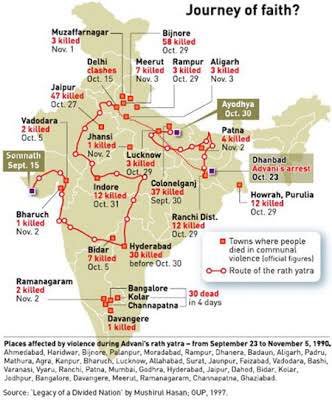
Later Hindu ideologues such as M.S. Golwalkar elaborated this idea to exclude all non-Hindus from the ambit of the nation. Hindutva, therefore, serves as an ideological justification for the construction of India as a Hindu nation. The statement of the Prime Minister that the demolition of the Babri Masjid is an expression of national sentiment and his reluctance to condemn the Gujarat massacre unambiguously demonstrate his commitment to the political ideology of Hindutva. So does the Sangh Parivar's general view that the rath yatra of L.K. Advani, currently enacting a repeat performance, represents the resurgence of India as a nation. In the Hindu communal practice, therefore, the distinction between Hindutva and Hinduism has disappeared, which has helped the militant communal Hindu politics to command the support of unsuspecting Hindu believers. In the last few elections, this strategy has returned high dividends.
V.V. KRISHNAN
The L.K. Advani-led rath yatra leaves for Ayodhya from Somnath in September 1990.
The next election is another test case as to whether Hindus can be coerced in the name of their faith to act against the basic tenets of their own religion. Despite the new slogans of development and statesmanship, Hindutva would continue to be an issue in the forthcoming elections. For the Sangh Parivar cannot ensure the support even of its ardent followers without feeding them with irrational politics. Such politics commands wider support when imbued with cultural content. The Sangh Parivar is fully alive to this mobilising potential of culture, which accounts for the foregrounding of cultural nationalism as central to its politics.
Cultural nationalism
The concept of cultural nationalism conceived and propagated by Hindutva is based on a misrepresentation of the nature of national identity. Nationalism, like democracy, is indivisible, with its constitutive elements - political, economic and cultural - intermeshed with each other. Privileging any one of these attributes tends to undermine the holistic character of nationalism. There is no denying the importance of culture in the make-up of national identity; yet culture alone does not mould the nationalism of any country. This was true of India as well where nationalism emerged and evolved as a part of anti-colonial consciousness. Culture was deeply implicated in this process of national reconstruction, both by trying to develop a national culture, which was distinct from the colonial and the traditional, as well as by invoking culture as a locus of resistance. Yet, the struggle for national culture during the anti-colonial period either remained an epi-phenomenon, or an instrument of political mobilisation. Therefore, the cultural question was not adequately addressed during the anti-colonial struggle and Hindutva has appropriated the space thus left open.
Hindutva's conception of nationalism is rooted in the primacy of culture over politics. The meaning attributed to culture by the ideologues of the Sangh Parivar and their cultural practices further qualifies the character of cultural nationalism. According to their interpretation, culture "is but a product of our all-comprehensive religion, a part of its body and not distinguishable from it". It naturally implies that the national culture is Hindu religious culture. Cultural nationalism is, therefore, a euphemism invoked in order to mask the creation of a state with Hindu religious identity. Such a character of the nation was clearly spelt out by Golwalkar: "In Hindustan, the land of the Hindus lives and should live the Hindu Nation... Consequently, only those movements are truly `National' as aim at rebuilding, revitalising, and emancipating from the present stupor, the Hindu Nation."
The contemporary advocates of cultural nationalism and the movements they lead are engaged in creating a nation in which the Hindu religious identity coincides with the cultural. This is attempted through intervention in culture rather than cultural intervention. The importance of this distinction is realised by the activists of the Hindutva who, as a result, constantly intervene in the actual cultural life of the people in order to transform it in a religious direction. As a part of this endeavour, the Sangh Parivar has set up cultural organisations in almost every conceivable area. They are constantly engaged in imparting a Hindu religious character to the quotidian cultural practices of the people. The secular forces, on the other hand, even at the face of the successful cultural advance of Hindutva, continue to be trapped in an instrumentalist view of culture and persist with their faith in the transformative power of cultural performance.
The BJP's Bharat Uday Rath.
The multi-faceted cultural intervention of Hindutva is primarily intended to appropriate the cultural past as Hindu and to expropriate the `other' as anti-national. As a part of the former, a new Hindu cultural pantheon is being constructed. The icons of this pantheon goes back to the Indus Valley Civilisation, renamed now as Saraswati River civilisation, as a part of the attempt to impart to it a Hindu character. At any rate, the lineage of the Hindu nation is traced to the culture of the Vedic era and, though not yet firmly, to the Indus Valley. Identifying the roots of the Indian civilisational process to the achievements of the Harappan and the Vedic people is indeed unexceptionable. That, however, does not establish either its contemporary relevance or its being the sole source of national culture, as Hindutva seems to advocate. In doing so, the historical process, which has ushered in a fundamental transformation in social and cultural mores, is ignored. Nevertheless, it has admirably served its ends. It has given to the Hindu, culturally and psychologically ravaged by colonial subjugation, the knowledge of a credible and honourable cultural past. In the process, Hindutva has not only succeeded in creating a new, even aggressive, cultural confidence among Hindus, but at the same time cast itself as the defender and preserver of Indian heritage. Thereby Hindutva claims to represent the cultural interest of the Hindu `community' as a whole.
The success of Hindutva was its ability to implant its Hindu representative character in social consciousness. Through a series of social and cultural undertakings, initially at the grassroots level, such an impression was slowly but surely created. An interesting example is the movement for the renovation of village temples, which were in decay. The members of the Sangh Parivar positioning themselves in the forefront of this movement received the general approval and approbation of the Hindus of the locality. It was believed that they were acting not only to maintain a religious place of worship but also to preserve the cultural tradition. At a national plane, the Ram Janmabhoomi issue provided an unprecedented opportunity, which was used by celebrating Ram as a national icon and by undertaking the popularisation of symbols linked with him. The agitation centred around the temple, including the rath yatra of Advani, established Hindutva's claim to represent Hindus. The effort, however, goes on. Bhojshala in Madhya Pradesh and Baba Budangiri in Karnataka are the new sites invented to defend Hindu interests.
In order to realise this claim socially and culturally, the Sangh Parivar has adopted an aggressive policy of homogenising the diverse groups among Hindus. Many were taken by surprise when Dalits participated in the Gujarat pogrom or when Adivasis supported the Bharatiya Janata Party in the recently held elections to the State Assemblies. But it is not altogether surprising as the ideology of Hindutva has been at work among these groups for a long time in order to inculcate a Hindu identity in them. An indication of this change is the transformation in their worship pattern. Their traditional places of worship are being refashioned as Hindu temples and their modes of worship are being replaced by those of the Brahminical order. The Hinduisation thus taking place amounts to cultural denial and oppression. Yet, a large number of Dalits and Adivasis are attracted to the lure of sanskritisation, which is a major achievement of Hindu consolidation.
Appropriation of cultural tradition
SHANKER CHAKRAVARTY
Atal Bihari Vajpayee with RSS Sarsanghchalak K.S. Sudershan (right) and other leaders at a Navaratri pooja function in New Delhi in October 1997.
A selective appropriation of cultural and intellectual traditions and their privileging through the intervention of innumerable organisations have lent credence to Hindutva's claim to represent Hindu interests. It is selective because it excludes those with non-Hindu affiliations. Even in the Hindu past only what is ideologically useful is invoked. The purpose of this appropriation is to inscribe on Hindutva the stamp of the authentic tradition of the nation. As a part of this endeavour, Hindu religious events have been turned into national cultural celebrations, even when they are alien to regional cultures or unknown to different sections of Hindus. Rakshabandhan and Ganapati festivals, for instance. Sponsored by the Sangh Parivar, they have now become public celebrations even in South India where they were earlier unknown.
The appropriation is not limited to cultural tradition alone; even political and intellectual leaders of the past are being turned into Hindu nationalist icons. Ancient and medieval rulers, even if they had followed the principles of secular governance, are claimed as Hindu. So are those who fought against colonial rule. Kerala Varma Pazhassi Raja, Velu Thampi, Nana Saheb and Kattabomman are being made into Hindutva's cult figures. Similarly, Hindu religious reformers of the 19th century, such as Dayananda Saraswati, Vivekananda and Aurobindo, who gave much importance to the universalist spirit in all religions, are celebrated as the progenitors of Hindu nationalism. But their ideas of inclusive nationalism are completely overlooked. Vivekananda, for instance, had argued that the union of Hindu and Islamic civilisations offered an ideal solution for India's regeneration. Aurobindo's concept of nationalism was riven with contradictions and at any rate he did not subscribe to a Hindu denominational nationalism in which the followers of other faiths had no place. Even Mahatma Gandhi and Bhagat Singh are in the process of being co-opted into the Hindutva fold!
At the same time, what is excluded from the nationalist tradition helps to reinforce Hindutva's religion-based concept of nationalism. Liberal and tolerant rulers such as Ashoka, Akbar, Jai Singh, Shahu Maharaj and Wajid Ali Shah do not figure in Hindutva's list of national heroes. Among those who revolted against the British, Bahadur Shah, Zinat Mahal, Maulavi Ahamadullah and General Bhakt Khan, are conspicuous by their absence. Even syncretic traditions such as the Bhakti movement are generally ignored. It is quite interesting that the advocates of religious universalism, including modernisers such as Rammohan Roy and Keshab Chandra Sen, do not figure in the Hindutva pantheon.
The selective appropriation is based on the premise that national regeneration and resurgence would require the recreation of an authentic culture by reclaiming the indigenous and purging the exogenous. Hindutva's cultural project, encoded in the slogan `nationalise and spiritualise', therefore, is twofold: First, to retrieve and disseminate the cultural traditions of the `golden' Hindu past; and second, to eliminate all accretions that had become part of the heritage. The educational policy as adumbrated by the BJP-led government is inspired by the first. The entire exercise of curriculum revision undertaken by government agencies during the last few years was mainly intended to achieve this end.
Deputy Prime Minister L.K. Advani.
The involvement of the government, obsessive and lopsided, with the pursuit of Vedic knowledge is an obvious example. The government, it appears, is spending an enormous amount of money for research in Vedic studies, which in itself is not undesirable. But it is a different matter when undertaken to prove certain preconceived assumptions. It is reported that several science organisations funded by the government are scouting for scholars and institutions who would be willing to testify the golden age thesis. Such efforts are likely to create false notions about India's past.
The authentic cultural tradition Hindutva seeks to construct does not respect either the trajectory of its own historical evolution or the importance of external influences in its make-up. It, therefore, takes a static view of cultural tradition, ignoring its inherent dynamism. One of the consequences of this attitude is the intolerance of different interpretations and conflicting representations for which the Indian cultural tradition is justly famous. The plural cultural traditions, therefore, have been continuously under attack. Well-known examples are the vandalising of M.F. Hussain's paintings of Hindu goddesses, disruption of the shooting of Deepa Mehta's film, the campaign against the Malayalam writer Kamala Suraiya and the destruction of SAHMAT's exhibition on Ayodhya. The instances in which the Hindu cultural police has intervened, often in a violent and intimidatory manner, in defence of Hindu cultural tradition are far too many to cite. The denigration of secular historians, writers and journalists are also done with the same purpose.
These fairly orchestrated assaults are meant to silence any opposition to the communal colonisation of the cultural sphere. The legitimacy Hindutva has managed to garner is the most decisive development in contemporary Indian politics. A marginal force until about 10 years ago, it is now in a position to dictate the political and cultural agenda of the nation. Yet, the rise of Hindutva was neither sudden nor spontaneous. It owes much to the slow transformation in social consciousness as a result of sustained interventions in the cultural and religious life of the people. The decline of the Congress(I) and the inability of the Left to emerge as an alternative provided the space for Hinduva to imbue such interventions with a political content. It was compounded by the willing collaboration and cooperation of secular formations, particularly after the Emergency, which lent to Hindutva the legitimacy it lacked before. Hindutva thus succeeded in integrating politics with culture. Hence cultural nationalism is the real shining motif of Hindutva. Given its exclusivist character, however, cultural nationalism is anti-democratic and anti-national. The existence of India as a nation is possible only with the rejection of cultural nationalism.
K.N. Panikkar is the Vice-Chancellor of the Sri Sankara University of Sanskrit, Kalady, Kerala.
March 13 - March 26, 2004
COVER STORY
IN THE NAME OF NATIONALISM
K.N. PANIKKAR
The rise of Hindutva was neither sudden nor spontaneous. It owes much to the slow transformation in social consciousness as a result of sustained interventions in the cultural and religious life of the people.
INDRANIL MUKHERJEE/AFP
RSS members at a training camp in Bangalore.
A NEW identity is being foisted on Hindus. The identity of Hindutva. Are Hindus being coerced to accept that identity, socially and culturally and indeed politically? Apparently, no society can be forced to own an externally induced identity. It has to emerge from within as a part of social dynamics. Yet, when ideas are implanted in social consciousness and nurtured through legitimising interventions, they do succeed in exercising a powerful influence in society. Hindutva is such an idea `invented' about 80 years ago, intellectually elaborated thereafter by several communal ideologues and recently given wide currency through state sponsorship, political support and socio-cultural mobilisation. Although alien to Hindu philosophical tenets and religious practices, Hindutva has gained legitimacy as a commonly shared heritage among a large section of Hindus. The implications of this development has pitch-forked Hindutva to the centre stage of contemporary Indian politics.
Hindutva and Hinduism
But then what is Hindutva? None of its contemporary advocates, including Prime Minister Atal Bihari Vajpayee and his less imaginative colleagues in the Sangh Parivar, have spelt out its character and its constitutive elements. For good reasons. They are seeking to evolve an overarching political ideology to bring together the followers of a highly differentiated religious faith. Hindutva is, therefore, conceived as an undefinable quality inherent in the Hindu `race', which cannot be identified with anything specific in Hinduism. Hindutva, in the opinion of Vinayak Damodar Savarkar, the progenitor of the concept, "is so varied and so rich, so powerful and so subtle, so elusive and yet so vivid" that it defies all attempts at analysis. Therefore, he had stopped short of defining it; instead he only tried to underline its relationship with Hinduism. He had asserted: "Hinduism is only a derivative, a fraction, a part of Hindutva." He, however, argued that this distinction would help to consolidate the Hindu community: "Failure to distinguish between Hindutva and Hinduism has given rise to much misunderstanding and mutual suspicion between some of those sister communities that have inherited this inestimable and common treasure of our Hindu civilisation... It is enough to point out that Hindutva is not identical with what is vaguely indicated by the term Hinduism. By an `ism' it is generally meant a theory or a code more or less based on spiritual or religious dogma or system. But when we attempt to investigate into the essential significance of Hindutva, we do not primarily - and certainly not mainly - concern ourselves with any particular theocratic or religious dogma or creed... Hindutva embraces all the departments of thought and activity of the whole Being of our Hindu race." Despite the above distinction, the relationship between Hindutva and Hinduism is well marked even in Savarkar's scheme. Savarkar had argued that a Muslim or a Christian, even if born in India, could not claim to possess the qualities of Hindutva. The essentials of Hindutva, according to Savarkar, are "a common nation (rashtra), a common race (jati) and a common civilisation (sanskriti)".
Later Hindu ideologues such as M.S. Golwalkar elaborated this idea to exclude all non-Hindus from the ambit of the nation. Hindutva, therefore, serves as an ideological justification for the construction of India as a Hindu nation. The statement of the Prime Minister that the demolition of the Babri Masjid is an expression of national sentiment and his reluctance to condemn the Gujarat massacre unambiguously demonstrate his commitment to the political ideology of Hindutva. So does the Sangh Parivar's general view that the rath yatra of L.K. Advani, currently enacting a repeat performance, represents the resurgence of India as a nation. In the Hindu communal practice, therefore, the distinction between Hindutva and Hinduism has disappeared, which has helped the militant communal Hindu politics to command the support of unsuspecting Hindu believers. In the last few elections, this strategy has returned high dividends.
V.V. KRISHNAN
The L.K. Advani-led rath yatra leaves for Ayodhya from Somnath in September 1990.
The next election is another test case as to whether Hindus can be coerced in the name of their faith to act against the basic tenets of their own religion. Despite the new slogans of development and statesmanship, Hindutva would continue to be an issue in the forthcoming elections. For the Sangh Parivar cannot ensure the support even of its ardent followers without feeding them with irrational politics. Such politics commands wider support when imbued with cultural content. The Sangh Parivar is fully alive to this mobilising potential of culture, which accounts for the foregrounding of cultural nationalism as central to its politics.
Cultural nationalism
The concept of cultural nationalism conceived and propagated by Hindutva is based on a misrepresentation of the nature of national identity. Nationalism, like democracy, is indivisible, with its constitutive elements - political, economic and cultural - intermeshed with each other. Privileging any one of these attributes tends to undermine the holistic character of nationalism. There is no denying the importance of culture in the make-up of national identity; yet culture alone does not mould the nationalism of any country. This was true of India as well where nationalism emerged and evolved as a part of anti-colonial consciousness. Culture was deeply implicated in this process of national reconstruction, both by trying to develop a national culture, which was distinct from the colonial and the traditional, as well as by invoking culture as a locus of resistance. Yet, the struggle for national culture during the anti-colonial period either remained an epi-phenomenon, or an instrument of political mobilisation. Therefore, the cultural question was not adequately addressed during the anti-colonial struggle and Hindutva has appropriated the space thus left open.
Hindutva's conception of nationalism is rooted in the primacy of culture over politics. The meaning attributed to culture by the ideologues of the Sangh Parivar and their cultural practices further qualifies the character of cultural nationalism. According to their interpretation, culture "is but a product of our all-comprehensive religion, a part of its body and not distinguishable from it". It naturally implies that the national culture is Hindu religious culture. Cultural nationalism is, therefore, a euphemism invoked in order to mask the creation of a state with Hindu religious identity. Such a character of the nation was clearly spelt out by Golwalkar: "In Hindustan, the land of the Hindus lives and should live the Hindu Nation... Consequently, only those movements are truly `National' as aim at rebuilding, revitalising, and emancipating from the present stupor, the Hindu Nation."
The contemporary advocates of cultural nationalism and the movements they lead are engaged in creating a nation in which the Hindu religious identity coincides with the cultural. This is attempted through intervention in culture rather than cultural intervention. The importance of this distinction is realised by the activists of the Hindutva who, as a result, constantly intervene in the actual cultural life of the people in order to transform it in a religious direction. As a part of this endeavour, the Sangh Parivar has set up cultural organisations in almost every conceivable area. They are constantly engaged in imparting a Hindu religious character to the quotidian cultural practices of the people. The secular forces, on the other hand, even at the face of the successful cultural advance of Hindutva, continue to be trapped in an instrumentalist view of culture and persist with their faith in the transformative power of cultural performance.
The BJP's Bharat Uday Rath.
The multi-faceted cultural intervention of Hindutva is primarily intended to appropriate the cultural past as Hindu and to expropriate the `other' as anti-national. As a part of the former, a new Hindu cultural pantheon is being constructed. The icons of this pantheon goes back to the Indus Valley Civilisation, renamed now as Saraswati River civilisation, as a part of the attempt to impart to it a Hindu character. At any rate, the lineage of the Hindu nation is traced to the culture of the Vedic era and, though not yet firmly, to the Indus Valley. Identifying the roots of the Indian civilisational process to the achievements of the Harappan and the Vedic people is indeed unexceptionable. That, however, does not establish either its contemporary relevance or its being the sole source of national culture, as Hindutva seems to advocate. In doing so, the historical process, which has ushered in a fundamental transformation in social and cultural mores, is ignored. Nevertheless, it has admirably served its ends. It has given to the Hindu, culturally and psychologically ravaged by colonial subjugation, the knowledge of a credible and honourable cultural past. In the process, Hindutva has not only succeeded in creating a new, even aggressive, cultural confidence among Hindus, but at the same time cast itself as the defender and preserver of Indian heritage. Thereby Hindutva claims to represent the cultural interest of the Hindu `community' as a whole.
The success of Hindutva was its ability to implant its Hindu representative character in social consciousness. Through a series of social and cultural undertakings, initially at the grassroots level, such an impression was slowly but surely created. An interesting example is the movement for the renovation of village temples, which were in decay. The members of the Sangh Parivar positioning themselves in the forefront of this movement received the general approval and approbation of the Hindus of the locality. It was believed that they were acting not only to maintain a religious place of worship but also to preserve the cultural tradition. At a national plane, the Ram Janmabhoomi issue provided an unprecedented opportunity, which was used by celebrating Ram as a national icon and by undertaking the popularisation of symbols linked with him. The agitation centred around the temple, including the rath yatra of Advani, established Hindutva's claim to represent Hindus. The effort, however, goes on. Bhojshala in Madhya Pradesh and Baba Budangiri in Karnataka are the new sites invented to defend Hindu interests.
In order to realise this claim socially and culturally, the Sangh Parivar has adopted an aggressive policy of homogenising the diverse groups among Hindus. Many were taken by surprise when Dalits participated in the Gujarat pogrom or when Adivasis supported the Bharatiya Janata Party in the recently held elections to the State Assemblies. But it is not altogether surprising as the ideology of Hindutva has been at work among these groups for a long time in order to inculcate a Hindu identity in them. An indication of this change is the transformation in their worship pattern. Their traditional places of worship are being refashioned as Hindu temples and their modes of worship are being replaced by those of the Brahminical order. The Hinduisation thus taking place amounts to cultural denial and oppression. Yet, a large number of Dalits and Adivasis are attracted to the lure of sanskritisation, which is a major achievement of Hindu consolidation.
Appropriation of cultural tradition
SHANKER CHAKRAVARTY
Atal Bihari Vajpayee with RSS Sarsanghchalak K.S. Sudershan (right) and other leaders at a Navaratri pooja function in New Delhi in October 1997.
A selective appropriation of cultural and intellectual traditions and their privileging through the intervention of innumerable organisations have lent credence to Hindutva's claim to represent Hindu interests. It is selective because it excludes those with non-Hindu affiliations. Even in the Hindu past only what is ideologically useful is invoked. The purpose of this appropriation is to inscribe on Hindutva the stamp of the authentic tradition of the nation. As a part of this endeavour, Hindu religious events have been turned into national cultural celebrations, even when they are alien to regional cultures or unknown to different sections of Hindus. Rakshabandhan and Ganapati festivals, for instance. Sponsored by the Sangh Parivar, they have now become public celebrations even in South India where they were earlier unknown.
The appropriation is not limited to cultural tradition alone; even political and intellectual leaders of the past are being turned into Hindu nationalist icons. Ancient and medieval rulers, even if they had followed the principles of secular governance, are claimed as Hindu. So are those who fought against colonial rule. Kerala Varma Pazhassi Raja, Velu Thampi, Nana Saheb and Kattabomman are being made into Hindutva's cult figures. Similarly, Hindu religious reformers of the 19th century, such as Dayananda Saraswati, Vivekananda and Aurobindo, who gave much importance to the universalist spirit in all religions, are celebrated as the progenitors of Hindu nationalism. But their ideas of inclusive nationalism are completely overlooked. Vivekananda, for instance, had argued that the union of Hindu and Islamic civilisations offered an ideal solution for India's regeneration. Aurobindo's concept of nationalism was riven with contradictions and at any rate he did not subscribe to a Hindu denominational nationalism in which the followers of other faiths had no place. Even Mahatma Gandhi and Bhagat Singh are in the process of being co-opted into the Hindutva fold!
At the same time, what is excluded from the nationalist tradition helps to reinforce Hindutva's religion-based concept of nationalism. Liberal and tolerant rulers such as Ashoka, Akbar, Jai Singh, Shahu Maharaj and Wajid Ali Shah do not figure in Hindutva's list of national heroes. Among those who revolted against the British, Bahadur Shah, Zinat Mahal, Maulavi Ahamadullah and General Bhakt Khan, are conspicuous by their absence. Even syncretic traditions such as the Bhakti movement are generally ignored. It is quite interesting that the advocates of religious universalism, including modernisers such as Rammohan Roy and Keshab Chandra Sen, do not figure in the Hindutva pantheon.
The selective appropriation is based on the premise that national regeneration and resurgence would require the recreation of an authentic culture by reclaiming the indigenous and purging the exogenous. Hindutva's cultural project, encoded in the slogan `nationalise and spiritualise', therefore, is twofold: First, to retrieve and disseminate the cultural traditions of the `golden' Hindu past; and second, to eliminate all accretions that had become part of the heritage. The educational policy as adumbrated by the BJP-led government is inspired by the first. The entire exercise of curriculum revision undertaken by government agencies during the last few years was mainly intended to achieve this end.
Deputy Prime Minister L.K. Advani.
The involvement of the government, obsessive and lopsided, with the pursuit of Vedic knowledge is an obvious example. The government, it appears, is spending an enormous amount of money for research in Vedic studies, which in itself is not undesirable. But it is a different matter when undertaken to prove certain preconceived assumptions. It is reported that several science organisations funded by the government are scouting for scholars and institutions who would be willing to testify the golden age thesis. Such efforts are likely to create false notions about India's past.
The authentic cultural tradition Hindutva seeks to construct does not respect either the trajectory of its own historical evolution or the importance of external influences in its make-up. It, therefore, takes a static view of cultural tradition, ignoring its inherent dynamism. One of the consequences of this attitude is the intolerance of different interpretations and conflicting representations for which the Indian cultural tradition is justly famous. The plural cultural traditions, therefore, have been continuously under attack. Well-known examples are the vandalising of M.F. Hussain's paintings of Hindu goddesses, disruption of the shooting of Deepa Mehta's film, the campaign against the Malayalam writer Kamala Suraiya and the destruction of SAHMAT's exhibition on Ayodhya. The instances in which the Hindu cultural police has intervened, often in a violent and intimidatory manner, in defence of Hindu cultural tradition are far too many to cite. The denigration of secular historians, writers and journalists are also done with the same purpose.
These fairly orchestrated assaults are meant to silence any opposition to the communal colonisation of the cultural sphere. The legitimacy Hindutva has managed to garner is the most decisive development in contemporary Indian politics. A marginal force until about 10 years ago, it is now in a position to dictate the political and cultural agenda of the nation. Yet, the rise of Hindutva was neither sudden nor spontaneous. It owes much to the slow transformation in social consciousness as a result of sustained interventions in the cultural and religious life of the people. The decline of the Congress(I) and the inability of the Left to emerge as an alternative provided the space for Hinduva to imbue such interventions with a political content. It was compounded by the willing collaboration and cooperation of secular formations, particularly after the Emergency, which lent to Hindutva the legitimacy it lacked before. Hindutva thus succeeded in integrating politics with culture. Hence cultural nationalism is the real shining motif of Hindutva. Given its exclusivist character, however, cultural nationalism is anti-democratic and anti-national. The existence of India as a nation is possible only with the rejection of cultural nationalism.
K.N. Panikkar is the Vice-Chancellor of the Sri Sankara University of Sanskrit, Kalady, Kerala.


March 04, 2004
India: What would a Hindu state do that the secular state has not done already?
The Telegraph (India)
March 04, 2004
WHY THE BJP IS CALM
- What would a Hindu state do that the secular state has not done already?
Pratap Bhanu Mehta
The author is visiting professor of government, Harvard University
Just as a supposedly socialist constitution does not prevent India, except at the margins, from being configured into a capitalist economy, it could be argued that a secular constitution does not prevent India from being a Hindu state. It has become customary to write the history of the modern Indian state in something like the following terms: India, after Independence, sought to create a secular state. There is some dispute about what this secularism entailed. This project entailed that there would be no state religion, but it left the precise boundaries of state involvement with religion open. Whe- ther such a secular state could thrive in a society not itself fully in the throes of secularization was also an open question. But there was no doubt that this secular state was the quintessential project of modern India, the basis of the state’s legitimacy.
Hindu nationalism was the first powerful ideology to openly challenge this objective, and the extent to which it has managed to compromise the state’s secular credentials is the object of fierce debate. But does the narrative of Hindutva versus secularism adequately capture the ideological trajectory of the Indian state?
Ask yourself a question with graceless frankness. What would a Hindu state do that the secular state has not already done? The Indian state has used state power to consolidate Hindu identity in more ways than one can list. The state, for the first time, created a territorially unified body of Hindu law, transcending numerous regional divisions. Supreme Court judges not only promulgate public purposes; they act as authoritative interpreters of Hindu religion, defining what is essential to it and what is not. The state runs thousands of temples across the country, appropriated in the name of social reform or financial propriety.
Cow protection, an issue which many think is the most symbolically potent of Hindu demands, is allowed in many states. The entire burden of anti-conversion legislation, acquiesced to by all parties and the Supreme Court, is to privilege Hinduism. Anti-conversion legislation privileges Hinduism in its interpretation of the relationship between religion and propagation; it privileges Hinduism in its attempts to protect it from other religions, in the way it seeks to eliminate competition for the allegiances of those who might be the target of conversion: Dalits and Adivasis, and so forth. Rather than eliminating religious identity from law, the state constitutes these identities in legal terms.
Even the so-called reform of Hindu law undertaken during the Fifties can be given another interpretation. It was not so much that a secular state was reforming a religious law, an alien imposition on an otherwise recalcitrant religion. Rather the reform process was an example of Hindus collectively exercising their authority as Hindus, deciding on what the laws should be. It was not so much a secular state reforming religion, as it was Hindus exercising self-determination, in a somewhat progressive direction. That Hindus reformed their laws democratically does not make those laws any less Hindu. The fact that the reform was carried out through a process of democratic representation, was a result of the fact that Hindus chose to resolve their disputes over who exactly had authority over its laws democratically.
Even in terms of public representation, it could be argued that India has been more like a Hindu state. Minority representation in public life has been dwindling, but the curious thing is the asymmetry of legitimacy that religious leaders have in politics. It is quite all right for mahants and pandits, sadhvis and gurus to participate in politics, even contest and win elections, not to mention run governments, without in any sense attenuating their identity. On the other hand maulvis or priests in politics at this juncture would be quite a hazardous affair. Most of them are confined to issuing odd statements here and there, but the idea that they could enter politics qua religious leaders would be quite anathema. We can put the matter this way: it is more legitimate to be a Hindu leader and be in politics than it is to be a religious leader of any other sect and participate in politics. Has not the representative space been defined in Hindu terms?
It is true that the state cannot preach the Hindu religion, but it can do the next best thing. It can write textbooks that give a particular version of Indian history, promulgated by a set of Hindus who have access to power (justified by the canard that the Marxists did the same thing). Or better still, it can not provide any robust state education in Dalit and tribal areas, so that these remain at the mercy of schools inspired by the Rashtriya Swayamsevak Sangh. And if the government of Rajasthan is to be followed, direct preaching in state schools may not be far off. It also has to be admitted that state power is complicit in turning what should have been, at most, a private dispute in property law, into a religious dispute and it is only a matter of time before a temple is built at Ayodhya.
So what would a Hindu state do that the Indian state is not doing already? Given the character of Hinduism, it would be difficult to anoint an official god for this state. If we pick one that has any form, the protagonists of different gods will be fighting one another. Saivites and Vaishnavites can partake of the same ultimate reality when political symbolism is not at stake; if political power comes into the picture, they will be, as they often have been in medieval India, at each others throats. So, for the sake of Hindu unity, we cannot have an official god.
You might protest. I am going too quickly. Has not the Indian state guaranteed freedom of religion? Has it not been solicitous towards minorities, granting them supposedly separate laws, subsidizing their Haj pligrimages, sometimes tolerating their loudspeakers and so forth? This may be true enough, but it is never entirely clear why this is incompatible with the Indian state acting as a Hindu state would. Even in these acts of toleration there is an assertion of majority identity. It is made very clear that the majority, if they can be called as such, grants these privileges; if the minorities get too demanding, we will be within our rights to admonish them.
Of course, Hindus can grant a significant space to minorities; it is to their credit that they often have. But the state makes sure that these grants are on Hindu terms. And besides, anti-minority communalism is, in principle, only contingently related to Hindu nationalism. In principle, you can be secular and think that minorities are traitors to India’s territorial integrity, or you could want a state to be solicitous of Hindu sentiment and grant space to other religions as well.
So we remain stuck at the question. What would a Hindu state do that is not already being done? It is true that the state did not protect the Kashmiri Pandits. But their plight was as much a result of the Centre exercising undue proprietary rights over elections in Kashmir, in the name of the interests of the rest of us Hindus, as it was a failure of the state to take Kashmiri Hindus seriously. Secularism has become to Hindu nationalism what socialism in our Constitution is to capitalism: form without content.
This argument can have its comforts. One might be able to say to the Vishwa Hindu Parishad and the RSS, “Calm down, you don’t need to agitate. India already is close to being a Hindu state. You are fighting to get something you already possess. That is why the Bharatiya Janata Party is so calm these days. What else do you want? Do you want it also to be an extremist Hindu state?” But then we were reminded in the last couple of weeks that there are other big battles to be fought. As Uma Bharti has reminded us, India is pretty close to being a Hindu state. The big question before us now is whether it will be a vegetarian or a non-vegetarian Hindu state.
March 04, 2004
WHY THE BJP IS CALM
- What would a Hindu state do that the secular state has not done already?
Pratap Bhanu Mehta
The author is visiting professor of government, Harvard University
Just as a supposedly socialist constitution does not prevent India, except at the margins, from being configured into a capitalist economy, it could be argued that a secular constitution does not prevent India from being a Hindu state. It has become customary to write the history of the modern Indian state in something like the following terms: India, after Independence, sought to create a secular state. There is some dispute about what this secularism entailed. This project entailed that there would be no state religion, but it left the precise boundaries of state involvement with religion open. Whe- ther such a secular state could thrive in a society not itself fully in the throes of secularization was also an open question. But there was no doubt that this secular state was the quintessential project of modern India, the basis of the state’s legitimacy.
Hindu nationalism was the first powerful ideology to openly challenge this objective, and the extent to which it has managed to compromise the state’s secular credentials is the object of fierce debate. But does the narrative of Hindutva versus secularism adequately capture the ideological trajectory of the Indian state?
Ask yourself a question with graceless frankness. What would a Hindu state do that the secular state has not already done? The Indian state has used state power to consolidate Hindu identity in more ways than one can list. The state, for the first time, created a territorially unified body of Hindu law, transcending numerous regional divisions. Supreme Court judges not only promulgate public purposes; they act as authoritative interpreters of Hindu religion, defining what is essential to it and what is not. The state runs thousands of temples across the country, appropriated in the name of social reform or financial propriety.
Cow protection, an issue which many think is the most symbolically potent of Hindu demands, is allowed in many states. The entire burden of anti-conversion legislation, acquiesced to by all parties and the Supreme Court, is to privilege Hinduism. Anti-conversion legislation privileges Hinduism in its interpretation of the relationship between religion and propagation; it privileges Hinduism in its attempts to protect it from other religions, in the way it seeks to eliminate competition for the allegiances of those who might be the target of conversion: Dalits and Adivasis, and so forth. Rather than eliminating religious identity from law, the state constitutes these identities in legal terms.
Even the so-called reform of Hindu law undertaken during the Fifties can be given another interpretation. It was not so much that a secular state was reforming a religious law, an alien imposition on an otherwise recalcitrant religion. Rather the reform process was an example of Hindus collectively exercising their authority as Hindus, deciding on what the laws should be. It was not so much a secular state reforming religion, as it was Hindus exercising self-determination, in a somewhat progressive direction. That Hindus reformed their laws democratically does not make those laws any less Hindu. The fact that the reform was carried out through a process of democratic representation, was a result of the fact that Hindus chose to resolve their disputes over who exactly had authority over its laws democratically.
Even in terms of public representation, it could be argued that India has been more like a Hindu state. Minority representation in public life has been dwindling, but the curious thing is the asymmetry of legitimacy that religious leaders have in politics. It is quite all right for mahants and pandits, sadhvis and gurus to participate in politics, even contest and win elections, not to mention run governments, without in any sense attenuating their identity. On the other hand maulvis or priests in politics at this juncture would be quite a hazardous affair. Most of them are confined to issuing odd statements here and there, but the idea that they could enter politics qua religious leaders would be quite anathema. We can put the matter this way: it is more legitimate to be a Hindu leader and be in politics than it is to be a religious leader of any other sect and participate in politics. Has not the representative space been defined in Hindu terms?
It is true that the state cannot preach the Hindu religion, but it can do the next best thing. It can write textbooks that give a particular version of Indian history, promulgated by a set of Hindus who have access to power (justified by the canard that the Marxists did the same thing). Or better still, it can not provide any robust state education in Dalit and tribal areas, so that these remain at the mercy of schools inspired by the Rashtriya Swayamsevak Sangh. And if the government of Rajasthan is to be followed, direct preaching in state schools may not be far off. It also has to be admitted that state power is complicit in turning what should have been, at most, a private dispute in property law, into a religious dispute and it is only a matter of time before a temple is built at Ayodhya.
So what would a Hindu state do that the Indian state is not doing already? Given the character of Hinduism, it would be difficult to anoint an official god for this state. If we pick one that has any form, the protagonists of different gods will be fighting one another. Saivites and Vaishnavites can partake of the same ultimate reality when political symbolism is not at stake; if political power comes into the picture, they will be, as they often have been in medieval India, at each others throats. So, for the sake of Hindu unity, we cannot have an official god.
You might protest. I am going too quickly. Has not the Indian state guaranteed freedom of religion? Has it not been solicitous towards minorities, granting them supposedly separate laws, subsidizing their Haj pligrimages, sometimes tolerating their loudspeakers and so forth? This may be true enough, but it is never entirely clear why this is incompatible with the Indian state acting as a Hindu state would. Even in these acts of toleration there is an assertion of majority identity. It is made very clear that the majority, if they can be called as such, grants these privileges; if the minorities get too demanding, we will be within our rights to admonish them.
Of course, Hindus can grant a significant space to minorities; it is to their credit that they often have. But the state makes sure that these grants are on Hindu terms. And besides, anti-minority communalism is, in principle, only contingently related to Hindu nationalism. In principle, you can be secular and think that minorities are traitors to India’s territorial integrity, or you could want a state to be solicitous of Hindu sentiment and grant space to other religions as well.
So we remain stuck at the question. What would a Hindu state do that is not already being done? It is true that the state did not protect the Kashmiri Pandits. But their plight was as much a result of the Centre exercising undue proprietary rights over elections in Kashmir, in the name of the interests of the rest of us Hindus, as it was a failure of the state to take Kashmiri Hindus seriously. Secularism has become to Hindu nationalism what socialism in our Constitution is to capitalism: form without content.
This argument can have its comforts. One might be able to say to the Vishwa Hindu Parishad and the RSS, “Calm down, you don’t need to agitate. India already is close to being a Hindu state. You are fighting to get something you already possess. That is why the Bharatiya Janata Party is so calm these days. What else do you want? Do you want it also to be an extremist Hindu state?” But then we were reminded in the last couple of weeks that there are other big battles to be fought. As Uma Bharti has reminded us, India is pretty close to being a Hindu state. The big question before us now is whether it will be a vegetarian or a non-vegetarian Hindu state.
March 01, 2004
In the name of charity, British public is funding Hindutva extremism
In Bad Faith: British Charity and Hindu Extremism
Published by Awaaz South Asia Watch Limited (London) 2004
ISBN 0 9547174 0 6
In the name of charity, British public is funding Hindutva extremism
A report [...] launched on the second anniversary of the horrific Gujarat carnage in 2002 presents alarming new evidence that under the cloak of humanitarian charity, massive donations from the British public were sent to Fascist-inspired Hindu extremist groups involved or directly implicated in serious, large-scale violence or hatred in India.
Prepared by Awaaz - South Asia Watch Ltd, a London-based secular network, the report In Bad Faith? British Charity and Hindu Extremism, says UK organisations have been raising funds in the name of charity for natural disasters like earthquakes, and giving them to extremist organisations that preach hatred against Muslims and Christians.
The report, which is available now, demonstrates that the UK-based Sewa International sent £2 million for the devastating earthquake in the Indian state of Gujarat in 2001, to its Indian counterpart Sewa Bharati, a front for the secretive, violent Rashtriya Swayamsevak Sangh (RSS). Money from the UK was given to RSS front organisations that are involved or implicated in serious violence or hate politics in India. Much of the money was spent on schools that promote hatred and fanaticism.
“Gandhi’s murderer was an RSS activist. Most British donors would be horrified if they knew the nature, history and ideas of the RSS. Individuals raised funds and donated in good faith to Sewa International’s Gujarat earthquake appeals but would not have done so had they known that the organisation raising the money was closely linked to the Fascist-inspired and secretive Indian RSS”, says Awaaz.
Sewa International is not registered as a British charity, but is the fundraising arm of the registered charity Hindu Swayamsevak Sangh (HSS), the UK branch of the RSS. The report exposes the connections of the HSS, Sewa International and the Kalyan Ashram Trust (another registered charity) to violent and extremist groups in India. The RSS, its closely allied family of organisations and their followers have been involved in the persecution or killing of thousands of Muslims and Christians in India over the past fifteen years. They are known to have planned and executed anti-Muslim pogroms in the Indian state of Gujarat in 2002, in which 2,000 people were killed and 200,000 displaced. An independent investigation headed by a former Chief Justice of India called the Gujarat violence a “genocide”. Victims included British citizens. The RSS family considers religious minorities especially Muslims and Christians to be foreigners, aliens and polluters who have no right be treated as equal citizens of India.
“Sewa International has tried to dupe politicians, donors and the general public. Its main purpose is to fund, expand and glorify hate-driven RSS organisations, several of which have been at the forefront of large scale violence, pogroms or hate campaigns in India. Its claim to be a non-sectarian, non-political, non-religious humanitarian charity is a sham,” said Awaaz spokesperson Suresh Grover.
In the thoroughly documented report, Awaaz clearly establishes the strong ties between British charities and extremist organisations in India. It has called for the Charity Commissioner to withdraw the charity status of three British charities: Hindu Swayamsevak Sangh (HSS) UK, the Vishwa Hindu Parishad (VHP) UK, and the Kalyan Ashram Trust. The Leicester-based Hindu Swayamsevak Sangh and Sewa International are currently being investigated by the UK Charity Commission.
FOR MORE INFORMATION email contact@awaazsaw.org.
The full report is available at
www.awaazsaw.org/ibf/index.htm
www.awaazsaw.org/ibf/ibflores.pdf
Published by Awaaz South Asia Watch Limited (London) 2004
ISBN 0 9547174 0 6
In the name of charity, British public is funding Hindutva extremism
A report [...] launched on the second anniversary of the horrific Gujarat carnage in 2002 presents alarming new evidence that under the cloak of humanitarian charity, massive donations from the British public were sent to Fascist-inspired Hindu extremist groups involved or directly implicated in serious, large-scale violence or hatred in India.
Prepared by Awaaz - South Asia Watch Ltd, a London-based secular network, the report In Bad Faith? British Charity and Hindu Extremism, says UK organisations have been raising funds in the name of charity for natural disasters like earthquakes, and giving them to extremist organisations that preach hatred against Muslims and Christians.
The report, which is available now, demonstrates that the UK-based Sewa International sent £2 million for the devastating earthquake in the Indian state of Gujarat in 2001, to its Indian counterpart Sewa Bharati, a front for the secretive, violent Rashtriya Swayamsevak Sangh (RSS). Money from the UK was given to RSS front organisations that are involved or implicated in serious violence or hate politics in India. Much of the money was spent on schools that promote hatred and fanaticism.
“Gandhi’s murderer was an RSS activist. Most British donors would be horrified if they knew the nature, history and ideas of the RSS. Individuals raised funds and donated in good faith to Sewa International’s Gujarat earthquake appeals but would not have done so had they known that the organisation raising the money was closely linked to the Fascist-inspired and secretive Indian RSS”, says Awaaz.
Sewa International is not registered as a British charity, but is the fundraising arm of the registered charity Hindu Swayamsevak Sangh (HSS), the UK branch of the RSS. The report exposes the connections of the HSS, Sewa International and the Kalyan Ashram Trust (another registered charity) to violent and extremist groups in India. The RSS, its closely allied family of organisations and their followers have been involved in the persecution or killing of thousands of Muslims and Christians in India over the past fifteen years. They are known to have planned and executed anti-Muslim pogroms in the Indian state of Gujarat in 2002, in which 2,000 people were killed and 200,000 displaced. An independent investigation headed by a former Chief Justice of India called the Gujarat violence a “genocide”. Victims included British citizens. The RSS family considers religious minorities especially Muslims and Christians to be foreigners, aliens and polluters who have no right be treated as equal citizens of India.
“Sewa International has tried to dupe politicians, donors and the general public. Its main purpose is to fund, expand and glorify hate-driven RSS organisations, several of which have been at the forefront of large scale violence, pogroms or hate campaigns in India. Its claim to be a non-sectarian, non-political, non-religious humanitarian charity is a sham,” said Awaaz spokesperson Suresh Grover.
In the thoroughly documented report, Awaaz clearly establishes the strong ties between British charities and extremist organisations in India. It has called for the Charity Commissioner to withdraw the charity status of three British charities: Hindu Swayamsevak Sangh (HSS) UK, the Vishwa Hindu Parishad (VHP) UK, and the Kalyan Ashram Trust. The Leicester-based Hindu Swayamsevak Sangh and Sewa International are currently being investigated by the UK Charity Commission.
FOR MORE INFORMATION email contact@awaazsaw.org.
The full report is available at
www.awaazsaw.org/ibf/index.htm
www.awaazsaw.org/ibf/ibflores.pdf
February 28, 2004
Can India 'shine' under Hindutva?
Dawn (Pakistan)
28 February 2004
Can India 'shine' under Hindutva?
By Asghar Ali Engineer
The media campaign launched by the NDA government showing "India is Shining" is immoral as crores of rupees of public money is being spent on it and the purpose is certainly not merely to inform the public about the 'achievements' of the ruling coalition but to win forthcoming elections.
Is India shining? Well, it all depends on how one looks at it. Even from economic perspective such claim is totally untenable. In a country where millions are unemployed, hundreds are committing suicide because of poverty and hunger and millions of children drop out from school before reaching even 5th standard, how can one claim India is shining?
But we are more concerned here with communal situation under the NDA rule than the economic situation. India despite its bewildering diversity has remained united, thanks to our commitment to secular polity.
Secularism in India means that state remains neutral to all religions and see that religious majority does not reduce our democracy to majoritarianism and minorities are protected and are free to follow their religion without any let and hindrance.
However, India has suffered very badly on this score under the NDA. India can politically shine only if its secular polity is not tampered with. Can India shine politically when its main ruling party remains tied to organisations like RSS, VHP and Bajrang Dal, which are avowedly anti-minorities? No less a person than the prime minister of India said in the crowd of RSS and BJP supporters in Straten Island in the USA that 'RSS is my soul'.
Can there be any doubt about BJP's active connection with the RSS? Mr L.K.Advani personally attends the RSS rally in 'Khaki chaddi' and gives salute to RSS flag. And he does so when he is home minister of India. What message will it send to the police force? Will police force then be able to control communal violence impartially?
The Congress regime did not have any brilliant record of communal peace in the 45 years of its rule. No one disputes this. But its leaders did not have allegiance to the likes of the RSS, much less VHP and Bajrang Dal. They did not stuff premier research bodies like the ICHR and ICSSR (Indian Council of Historical Research and Indian Council of Social Science Research) with those who openly deride secularism. These two premier research bodies were controlled during the Congress rule by those academics whose secular credentials were never in doubt.
But soon the NDA came to power, these organisations were captured by the RSS and VHP supporters. It is a great tragedy that such research bodies in social sciences be controlled by those who are avowed opponents of secularism. Even moderate BJP person like the late Prof M.L.Sondhi was not tolerated and the human resources ministry removed him from chairmanship of the ICSSR.
If these organisations are to be controlled by avowed opponents of secularism what direction social sciences would take? Social sciences are the very basis of intellectual life of a country.
These cannot be allowed to be in the hands of those who are opposed to our constitutional values. They are making all efforts to undermine the secular values of the Indian constitution. How India can remain secular under such a dispensation?
The British rulers distorted our history in order to divide us which ultimately resulted in division of our country. The textbooks are now being changed for the worse by the NDA hard-liners.
The so-called secular parties supporting the NDA, and keeping the BJP in power, are also a party to these dangerous attempts to undermine our secular values. The children are growing with a deep sense of hatred towards minority communities.
Thus it is not only hate politics but also hate education and such an environment of hatred and polarisation was never there before during the 56 years of independence.
It was the BJP leadership, which raised the controversy about secularism in early eighties describing it as a western concept unsuitable for Indian culture and Indian society and then dubbed it as 'pseudo-secularism' and based on 'appeasement of minorities'. A high pitched propaganda was carried out on these grounds to build a Hindu vote bank thus seriously damaging inter-community relations.
It was certainly the outcome of this high-pitched hate propaganda that a communal carnage erupted in Gujarat and which put the entire country to shame in the comity of nations.
The Ramjanambhoomi matter was raised by the BJP during the nineties to win elections and the BJP came to power ultimately on the basis of this hate propaganda and now it has worked out a clever strategy to perpetuate the controversy.
While the BJP keeps on saying that construction of Ram temple is not on the NDA agenda, the RSS, VHP and Bajrang Dal keep the issue of temple construction alive and they raise this issue with much more vehemence whenever elections are due in any state or in the Centre.
This time the prime minister has himself initiated his election campaign from Ayodhya and again promising that 'give us five more years and the temple will be constructed.' How can a 'secular' government promise people to construct a temple or a mosque? And when Shankaracharya of Puri tried to intervene and established contacts with the Muslim Personal Law Board to solve the issue through a dialogue and it was about to be resolved the RSS and VHP chiefs stormed the Shakaracharya's place. They forced him to retreat so that the temple issue remains alive and exploitable for votes.
Also, the issue of Uniform Civil Code, which is purely a secular issue and pertaining to gender justice was communalized by the BJP by adopting as 'Hindutva Agenda'.
What an irony? And do the Hindutva leaders believe in gender justice? Are they ready to give equal rights to women? All of us know that a secular issue like UCC was communalized by the BJP leaders only to create anti-minority feelings among the Hindus and to damage harmonious relations between the two communities. Earlier all women organisations were demanding UCC but once it became Hindutva agenda it was given up by all secular women's organisations.
And by the way can any party which feels proud of its 'Hindutva' agenda and proclaims it publicly be trusted to run a secular state? Can the secular constitution be safe in the hands of such a party? Can India politically shine under a Hindutva party? Can there be communal peace under it? The BJP used to claim that when it comes to power there is no communal riot.
What happened in Gujarat under its rule is now a tragic episode of our history. It will make all secularists and humanists shudder forever. The Gujarat came close to atrocities committed by the fascists and Nazis of Germany.
The BJP has been in power since 1999. There was not a single year under it when India did not witness communal violence. According to our research based on newspaper reports and other sources, the number of riots that took place in the year 1999 was 52 in which 43 people were killed and 248 injured.
In the year 2000, 24 riots occurred in which 91 people were killed and 165 injured. In the year 2001, 27 riots erupted in which 56 were killed and 158 injured.
In the year 2002, 28 communal riots were recorded (including Gujarat) in which 1,173 persons lost their lives and 2,272 were injured (unofficially in Gujarat alone more than 2,000 people were killed according to private counts). And in the year 2003, 67 riots took place in which 58 people were killed and 611 were injured.
How truthful is the claim of the BJP that no communal violence occurs when it is in power? It is true that these riots took place in the states where the BJP was not in power but it has an overall responsibility in the country and in most of these riots its family organisations like the RSS/VHP/Bajrang Dal were involved. There was not a single year, which was riot-free under the NDA rule led by the BJP.
Now we have reports from Madhya Pradesh that under the BJP Chief Minister Ms. Uma Bharti an RSS Pracharak has been appointed as her adviser with cabinet rank. She has also set up a Hanuman temple in the courtyard of her chief ministerial bungalow.
Is secularism shining or communal darkness intensifying? Where will all this end? Can anyone ever expect that India can remain secular under the leadership of Sangh Parivar? The BJP is an ideological brainchild of the RSS and has always refused to sever its umbilical chord from its parent.
When dual membership controversy arose in 1978 (and Mr George Fernandese, now with the BJP along with Raj Narayan and Madhu Limaye had raised it) the Jansangh members resigned from the Janata Party bringing down Morarji Desai government rather than resigning from the RSS. And the RSS has consistently refused to give up its Hindu Rashtra concept, which is in direct confrontation with the concept of secular India.
Those who think that India can politically shine only if secularism goes strong can never accept a dispensation in which the BJP is a dominant partner. And the day BJP wins majority of its own one can expect all kinds of steps to convert India into Hindu Rashtra. Then India will never shine again. n
The writer is chairman of the Centre for Study of Society and Secularism, Mumbai.
28 February 2004
Can India 'shine' under Hindutva?
By Asghar Ali Engineer
The media campaign launched by the NDA government showing "India is Shining" is immoral as crores of rupees of public money is being spent on it and the purpose is certainly not merely to inform the public about the 'achievements' of the ruling coalition but to win forthcoming elections.
Is India shining? Well, it all depends on how one looks at it. Even from economic perspective such claim is totally untenable. In a country where millions are unemployed, hundreds are committing suicide because of poverty and hunger and millions of children drop out from school before reaching even 5th standard, how can one claim India is shining?
But we are more concerned here with communal situation under the NDA rule than the economic situation. India despite its bewildering diversity has remained united, thanks to our commitment to secular polity.
Secularism in India means that state remains neutral to all religions and see that religious majority does not reduce our democracy to majoritarianism and minorities are protected and are free to follow their religion without any let and hindrance.
However, India has suffered very badly on this score under the NDA. India can politically shine only if its secular polity is not tampered with. Can India shine politically when its main ruling party remains tied to organisations like RSS, VHP and Bajrang Dal, which are avowedly anti-minorities? No less a person than the prime minister of India said in the crowd of RSS and BJP supporters in Straten Island in the USA that 'RSS is my soul'.
Can there be any doubt about BJP's active connection with the RSS? Mr L.K.Advani personally attends the RSS rally in 'Khaki chaddi' and gives salute to RSS flag. And he does so when he is home minister of India. What message will it send to the police force? Will police force then be able to control communal violence impartially?
The Congress regime did not have any brilliant record of communal peace in the 45 years of its rule. No one disputes this. But its leaders did not have allegiance to the likes of the RSS, much less VHP and Bajrang Dal. They did not stuff premier research bodies like the ICHR and ICSSR (Indian Council of Historical Research and Indian Council of Social Science Research) with those who openly deride secularism. These two premier research bodies were controlled during the Congress rule by those academics whose secular credentials were never in doubt.
But soon the NDA came to power, these organisations were captured by the RSS and VHP supporters. It is a great tragedy that such research bodies in social sciences be controlled by those who are avowed opponents of secularism. Even moderate BJP person like the late Prof M.L.Sondhi was not tolerated and the human resources ministry removed him from chairmanship of the ICSSR.
If these organisations are to be controlled by avowed opponents of secularism what direction social sciences would take? Social sciences are the very basis of intellectual life of a country.
These cannot be allowed to be in the hands of those who are opposed to our constitutional values. They are making all efforts to undermine the secular values of the Indian constitution. How India can remain secular under such a dispensation?
The British rulers distorted our history in order to divide us which ultimately resulted in division of our country. The textbooks are now being changed for the worse by the NDA hard-liners.
The so-called secular parties supporting the NDA, and keeping the BJP in power, are also a party to these dangerous attempts to undermine our secular values. The children are growing with a deep sense of hatred towards minority communities.
Thus it is not only hate politics but also hate education and such an environment of hatred and polarisation was never there before during the 56 years of independence.
It was the BJP leadership, which raised the controversy about secularism in early eighties describing it as a western concept unsuitable for Indian culture and Indian society and then dubbed it as 'pseudo-secularism' and based on 'appeasement of minorities'. A high pitched propaganda was carried out on these grounds to build a Hindu vote bank thus seriously damaging inter-community relations.
It was certainly the outcome of this high-pitched hate propaganda that a communal carnage erupted in Gujarat and which put the entire country to shame in the comity of nations.
The Ramjanambhoomi matter was raised by the BJP during the nineties to win elections and the BJP came to power ultimately on the basis of this hate propaganda and now it has worked out a clever strategy to perpetuate the controversy.
While the BJP keeps on saying that construction of Ram temple is not on the NDA agenda, the RSS, VHP and Bajrang Dal keep the issue of temple construction alive and they raise this issue with much more vehemence whenever elections are due in any state or in the Centre.
This time the prime minister has himself initiated his election campaign from Ayodhya and again promising that 'give us five more years and the temple will be constructed.' How can a 'secular' government promise people to construct a temple or a mosque? And when Shankaracharya of Puri tried to intervene and established contacts with the Muslim Personal Law Board to solve the issue through a dialogue and it was about to be resolved the RSS and VHP chiefs stormed the Shakaracharya's place. They forced him to retreat so that the temple issue remains alive and exploitable for votes.
Also, the issue of Uniform Civil Code, which is purely a secular issue and pertaining to gender justice was communalized by the BJP by adopting as 'Hindutva Agenda'.
What an irony? And do the Hindutva leaders believe in gender justice? Are they ready to give equal rights to women? All of us know that a secular issue like UCC was communalized by the BJP leaders only to create anti-minority feelings among the Hindus and to damage harmonious relations between the two communities. Earlier all women organisations were demanding UCC but once it became Hindutva agenda it was given up by all secular women's organisations.
And by the way can any party which feels proud of its 'Hindutva' agenda and proclaims it publicly be trusted to run a secular state? Can the secular constitution be safe in the hands of such a party? Can India politically shine under a Hindutva party? Can there be communal peace under it? The BJP used to claim that when it comes to power there is no communal riot.
What happened in Gujarat under its rule is now a tragic episode of our history. It will make all secularists and humanists shudder forever. The Gujarat came close to atrocities committed by the fascists and Nazis of Germany.
The BJP has been in power since 1999. There was not a single year under it when India did not witness communal violence. According to our research based on newspaper reports and other sources, the number of riots that took place in the year 1999 was 52 in which 43 people were killed and 248 injured.
In the year 2000, 24 riots occurred in which 91 people were killed and 165 injured. In the year 2001, 27 riots erupted in which 56 were killed and 158 injured.
In the year 2002, 28 communal riots were recorded (including Gujarat) in which 1,173 persons lost their lives and 2,272 were injured (unofficially in Gujarat alone more than 2,000 people were killed according to private counts). And in the year 2003, 67 riots took place in which 58 people were killed and 611 were injured.
How truthful is the claim of the BJP that no communal violence occurs when it is in power? It is true that these riots took place in the states where the BJP was not in power but it has an overall responsibility in the country and in most of these riots its family organisations like the RSS/VHP/Bajrang Dal were involved. There was not a single year, which was riot-free under the NDA rule led by the BJP.
Now we have reports from Madhya Pradesh that under the BJP Chief Minister Ms. Uma Bharti an RSS Pracharak has been appointed as her adviser with cabinet rank. She has also set up a Hanuman temple in the courtyard of her chief ministerial bungalow.
Is secularism shining or communal darkness intensifying? Where will all this end? Can anyone ever expect that India can remain secular under the leadership of Sangh Parivar? The BJP is an ideological brainchild of the RSS and has always refused to sever its umbilical chord from its parent.
When dual membership controversy arose in 1978 (and Mr George Fernandese, now with the BJP along with Raj Narayan and Madhu Limaye had raised it) the Jansangh members resigned from the Janata Party bringing down Morarji Desai government rather than resigning from the RSS. And the RSS has consistently refused to give up its Hindu Rashtra concept, which is in direct confrontation with the concept of secular India.
Those who think that India can politically shine only if secularism goes strong can never accept a dispensation in which the BJP is a dominant partner. And the day BJP wins majority of its own one can expect all kinds of steps to convert India into Hindu Rashtra. Then India will never shine again. n
The writer is chairman of the Centre for Study of Society and Secularism, Mumbai.
Can India 'shine' under Hindutva?
Dawn (Pakistan)
28 February 2004
Can India 'shine' under Hindutva?
By Asghar Ali Engineer
The media campaign launched by the NDA government showing "India is Shining" is immoral as crores of rupees of public money is being spent on it and the purpose is certainly not merely to inform the public about the 'achievements' of the ruling coalition but to win forthcoming elections.
Is India shining? Well, it all depends on how one looks at it. Even from economic perspective such claim is totally untenable. In a country where millions are unemployed, hundreds are committing suicide because of poverty and hunger and millions of children drop out from school before reaching even 5th standard, how can one claim India is shining?
But we are more concerned here with communal situation under the NDA rule than the economic situation. India despite its bewildering diversity has remained united, thanks to our commitment to secular polity.
Secularism in India means that state remains neutral to all religions and see that religious majority does not reduce our democracy to majoritarianism and minorities are protected and are free to follow their religion without any let and hindrance.
However, India has suffered very badly on this score under the NDA. India can politically shine only if its secular polity is not tampered with. Can India shine politically when its main ruling party remains tied to organisations like RSS, VHP and Bajrang Dal, which are avowedly anti-minorities? No less a person than the prime minister of India said in the crowd of RSS and BJP supporters in Straten Island in the USA that 'RSS is my soul'.
Can there be any doubt about BJP's active connection with the RSS? Mr L.K.Advani personally attends the RSS rally in 'Khaki chaddi' and gives salute to RSS flag. And he does so when he is home minister of India. What message will it send to the police force? Will police force then be able to control communal violence impartially?
The Congress regime did not have any brilliant record of communal peace in the 45 years of its rule. No one disputes this. But its leaders did not have allegiance to the likes of the RSS, much less VHP and Bajrang Dal. They did not stuff premier research bodies like the ICHR and ICSSR (Indian Council of Historical Research and Indian Council of Social Science Research) with those who openly deride secularism. These two premier research bodies were controlled during the Congress rule by those academics whose secular credentials were never in doubt.
But soon the NDA came to power, these organisations were captured by the RSS and VHP supporters. It is a great tragedy that such research bodies in social sciences be controlled by those who are avowed opponents of secularism. Even moderate BJP person like the late Prof M.L.Sondhi was not tolerated and the human resources ministry removed him from chairmanship of the ICSSR.
If these organisations are to be controlled by avowed opponents of secularism what direction social sciences would take? Social sciences are the very basis of intellectual life of a country.
These cannot be allowed to be in the hands of those who are opposed to our constitutional values. They are making all efforts to undermine the secular values of the Indian constitution. How India can remain secular under such a dispensation?
The British rulers distorted our history in order to divide us which ultimately resulted in division of our country. The textbooks are now being changed for the worse by the NDA hard-liners.
The so-called secular parties supporting the NDA, and keeping the BJP in power, are also a party to these dangerous attempts to undermine our secular values. The children are growing with a deep sense of hatred towards minority communities.
Thus it is not only hate politics but also hate education and such an environment of hatred and polarisation was never there before during the 56 years of independence.
It was the BJP leadership, which raised the controversy about secularism in early eighties describing it as a western concept unsuitable for Indian culture and Indian society and then dubbed it as 'pseudo-secularism' and based on 'appeasement of minorities'. A high pitched propaganda was carried out on these grounds to build a Hindu vote bank thus seriously damaging inter-community relations.
It was certainly the outcome of this high-pitched hate propaganda that a communal carnage erupted in Gujarat and which put the entire country to shame in the comity of nations.
The Ramjanambhoomi matter was raised by the BJP during the nineties to win elections and the BJP came to power ultimately on the basis of this hate propaganda and now it has worked out a clever strategy to perpetuate the controversy.
While the BJP keeps on saying that construction of Ram temple is not on the NDA agenda, the RSS, VHP and Bajrang Dal keep the issue of temple construction alive and they raise this issue with much more vehemence whenever elections are due in any state or in the Centre.
This time the prime minister has himself initiated his election campaign from Ayodhya and again promising that 'give us five more years and the temple will be constructed.' How can a 'secular' government promise people to construct a temple or a mosque? And when Shankaracharya of Puri tried to intervene and established contacts with the Muslim Personal Law Board to solve the issue through a dialogue and it was about to be resolved the RSS and VHP chiefs stormed the Shakaracharya's place. They forced him to retreat so that the temple issue remains alive and exploitable for votes.
Also, the issue of Uniform Civil Code, which is purely a secular issue and pertaining to gender justice was communalized by the BJP by adopting as 'Hindutva Agenda'.
What an irony? And do the Hindutva leaders believe in gender justice? Are they ready to give equal rights to women? All of us know that a secular issue like UCC was communalized by the BJP leaders only to create anti-minority feelings among the Hindus and to damage harmonious relations between the two communities. Earlier all women organisations were demanding UCC but once it became Hindutva agenda it was given up by all secular women's organisations.
And by the way can any party which feels proud of its 'Hindutva' agenda and proclaims it publicly be trusted to run a secular state? Can the secular constitution be safe in the hands of such a party? Can India politically shine under a Hindutva party? Can there be communal peace under it? The BJP used to claim that when it comes to power there is no communal riot.
What happened in Gujarat under its rule is now a tragic episode of our history. It will make all secularists and humanists shudder forever. The Gujarat came close to atrocities committed by the fascists and Nazis of Germany.
The BJP has been in power since 1999. There was not a single year under it when India did not witness communal violence. According to our research based on newspaper reports and other sources, the number of riots that took place in the year 1999 was 52 in which 43 people were killed and 248 injured.
In the year 2000, 24 riots occurred in which 91 people were killed and 165 injured. In the year 2001, 27 riots erupted in which 56 were killed and 158 injured.
In the year 2002, 28 communal riots were recorded (including Gujarat) in which 1,173 persons lost their lives and 2,272 were injured (unofficially in Gujarat alone more than 2,000 people were killed according to private counts). And in the year 2003, 67 riots took place in which 58 people were killed and 611 were injured.
How truthful is the claim of the BJP that no communal violence occurs when it is in power? It is true that these riots took place in the states where the BJP was not in power but it has an overall responsibility in the country and in most of these riots its family organisations like the RSS/VHP/Bajrang Dal were involved. There was not a single year, which was riot-free under the NDA rule led by the BJP.
Now we have reports from Madhya Pradesh that under the BJP Chief Minister Ms. Uma Bharti an RSS Pracharak has been appointed as her adviser with cabinet rank. She has also set up a Hanuman temple in the courtyard of her chief ministerial bungalow.
Is secularism shining or communal darkness intensifying? Where will all this end? Can anyone ever expect that India can remain secular under the leadership of Sangh Parivar? The BJP is an ideological brainchild of the RSS and has always refused to sever its umbilical chord from its parent.
When dual membership controversy arose in 1978 (and Mr George Fernandese, now with the BJP along with Raj Narayan and Madhu Limaye had raised it) the Jansangh members resigned from the Janata Party bringing down Morarji Desai government rather than resigning from the RSS. And the RSS has consistently refused to give up its Hindu Rashtra concept, which is in direct confrontation with the concept of secular India.
Those who think that India can politically shine only if secularism goes strong can never accept a dispensation in which the BJP is a dominant partner. And the day BJP wins majority of its own one can expect all kinds of steps to convert India into Hindu Rashtra. Then India will never shine again. n
The writer is chairman of the Centre for Study of Society and Secularism, Mumbai.
28 February 2004
Can India 'shine' under Hindutva?
By Asghar Ali Engineer
The media campaign launched by the NDA government showing "India is Shining" is immoral as crores of rupees of public money is being spent on it and the purpose is certainly not merely to inform the public about the 'achievements' of the ruling coalition but to win forthcoming elections.
Is India shining? Well, it all depends on how one looks at it. Even from economic perspective such claim is totally untenable. In a country where millions are unemployed, hundreds are committing suicide because of poverty and hunger and millions of children drop out from school before reaching even 5th standard, how can one claim India is shining?
But we are more concerned here with communal situation under the NDA rule than the economic situation. India despite its bewildering diversity has remained united, thanks to our commitment to secular polity.
Secularism in India means that state remains neutral to all religions and see that religious majority does not reduce our democracy to majoritarianism and minorities are protected and are free to follow their religion without any let and hindrance.
However, India has suffered very badly on this score under the NDA. India can politically shine only if its secular polity is not tampered with. Can India shine politically when its main ruling party remains tied to organisations like RSS, VHP and Bajrang Dal, which are avowedly anti-minorities? No less a person than the prime minister of India said in the crowd of RSS and BJP supporters in Straten Island in the USA that 'RSS is my soul'.
Can there be any doubt about BJP's active connection with the RSS? Mr L.K.Advani personally attends the RSS rally in 'Khaki chaddi' and gives salute to RSS flag. And he does so when he is home minister of India. What message will it send to the police force? Will police force then be able to control communal violence impartially?
The Congress regime did not have any brilliant record of communal peace in the 45 years of its rule. No one disputes this. But its leaders did not have allegiance to the likes of the RSS, much less VHP and Bajrang Dal. They did not stuff premier research bodies like the ICHR and ICSSR (Indian Council of Historical Research and Indian Council of Social Science Research) with those who openly deride secularism. These two premier research bodies were controlled during the Congress rule by those academics whose secular credentials were never in doubt.
But soon the NDA came to power, these organisations were captured by the RSS and VHP supporters. It is a great tragedy that such research bodies in social sciences be controlled by those who are avowed opponents of secularism. Even moderate BJP person like the late Prof M.L.Sondhi was not tolerated and the human resources ministry removed him from chairmanship of the ICSSR.
If these organisations are to be controlled by avowed opponents of secularism what direction social sciences would take? Social sciences are the very basis of intellectual life of a country.
These cannot be allowed to be in the hands of those who are opposed to our constitutional values. They are making all efforts to undermine the secular values of the Indian constitution. How India can remain secular under such a dispensation?
The British rulers distorted our history in order to divide us which ultimately resulted in division of our country. The textbooks are now being changed for the worse by the NDA hard-liners.
The so-called secular parties supporting the NDA, and keeping the BJP in power, are also a party to these dangerous attempts to undermine our secular values. The children are growing with a deep sense of hatred towards minority communities.
Thus it is not only hate politics but also hate education and such an environment of hatred and polarisation was never there before during the 56 years of independence.
It was the BJP leadership, which raised the controversy about secularism in early eighties describing it as a western concept unsuitable for Indian culture and Indian society and then dubbed it as 'pseudo-secularism' and based on 'appeasement of minorities'. A high pitched propaganda was carried out on these grounds to build a Hindu vote bank thus seriously damaging inter-community relations.
It was certainly the outcome of this high-pitched hate propaganda that a communal carnage erupted in Gujarat and which put the entire country to shame in the comity of nations.
The Ramjanambhoomi matter was raised by the BJP during the nineties to win elections and the BJP came to power ultimately on the basis of this hate propaganda and now it has worked out a clever strategy to perpetuate the controversy.
While the BJP keeps on saying that construction of Ram temple is not on the NDA agenda, the RSS, VHP and Bajrang Dal keep the issue of temple construction alive and they raise this issue with much more vehemence whenever elections are due in any state or in the Centre.
This time the prime minister has himself initiated his election campaign from Ayodhya and again promising that 'give us five more years and the temple will be constructed.' How can a 'secular' government promise people to construct a temple or a mosque? And when Shankaracharya of Puri tried to intervene and established contacts with the Muslim Personal Law Board to solve the issue through a dialogue and it was about to be resolved the RSS and VHP chiefs stormed the Shakaracharya's place. They forced him to retreat so that the temple issue remains alive and exploitable for votes.
Also, the issue of Uniform Civil Code, which is purely a secular issue and pertaining to gender justice was communalized by the BJP by adopting as 'Hindutva Agenda'.
What an irony? And do the Hindutva leaders believe in gender justice? Are they ready to give equal rights to women? All of us know that a secular issue like UCC was communalized by the BJP leaders only to create anti-minority feelings among the Hindus and to damage harmonious relations between the two communities. Earlier all women organisations were demanding UCC but once it became Hindutva agenda it was given up by all secular women's organisations.
And by the way can any party which feels proud of its 'Hindutva' agenda and proclaims it publicly be trusted to run a secular state? Can the secular constitution be safe in the hands of such a party? Can India politically shine under a Hindutva party? Can there be communal peace under it? The BJP used to claim that when it comes to power there is no communal riot.
What happened in Gujarat under its rule is now a tragic episode of our history. It will make all secularists and humanists shudder forever. The Gujarat came close to atrocities committed by the fascists and Nazis of Germany.
The BJP has been in power since 1999. There was not a single year under it when India did not witness communal violence. According to our research based on newspaper reports and other sources, the number of riots that took place in the year 1999 was 52 in which 43 people were killed and 248 injured.
In the year 2000, 24 riots occurred in which 91 people were killed and 165 injured. In the year 2001, 27 riots erupted in which 56 were killed and 158 injured.
In the year 2002, 28 communal riots were recorded (including Gujarat) in which 1,173 persons lost their lives and 2,272 were injured (unofficially in Gujarat alone more than 2,000 people were killed according to private counts). And in the year 2003, 67 riots took place in which 58 people were killed and 611 were injured.
How truthful is the claim of the BJP that no communal violence occurs when it is in power? It is true that these riots took place in the states where the BJP was not in power but it has an overall responsibility in the country and in most of these riots its family organisations like the RSS/VHP/Bajrang Dal were involved. There was not a single year, which was riot-free under the NDA rule led by the BJP.
Now we have reports from Madhya Pradesh that under the BJP Chief Minister Ms. Uma Bharti an RSS Pracharak has been appointed as her adviser with cabinet rank. She has also set up a Hanuman temple in the courtyard of her chief ministerial bungalow.
Is secularism shining or communal darkness intensifying? Where will all this end? Can anyone ever expect that India can remain secular under the leadership of Sangh Parivar? The BJP is an ideological brainchild of the RSS and has always refused to sever its umbilical chord from its parent.
When dual membership controversy arose in 1978 (and Mr George Fernandese, now with the BJP along with Raj Narayan and Madhu Limaye had raised it) the Jansangh members resigned from the Janata Party bringing down Morarji Desai government rather than resigning from the RSS. And the RSS has consistently refused to give up its Hindu Rashtra concept, which is in direct confrontation with the concept of secular India.
Those who think that India can politically shine only if secularism goes strong can never accept a dispensation in which the BJP is a dominant partner. And the day BJP wins majority of its own one can expect all kinds of steps to convert India into Hindu Rashtra. Then India will never shine again. n
The writer is chairman of the Centre for Study of Society and Secularism, Mumbai.
February 20, 2004
Cultural Policing by Bajrang Dal and the Rajasthan police
Cultural Policing by Bajrang Dal and the Rajasthan police.
[20 February 2004]
Cultural Artists of Rajasthan stand in solidarity with Bhanu Bharti and Shail Choyal and condemn the attack on Cultural Expression and Artistic Freedom in Rajasthan
A Lower court in Udaipur grants anticipatory bail to Bhanu Bharti and Shail Choyal on 17th February
Several persons related to the field of art and culture in Rajasthan came together on the 15th of February and carried out a day long protest against the attack on freedom of expression that was carried out by the Bajrang Dal and the Rajasthan police in Udaipur.
As you are aware on the 10th of February, '04 cases u/s 295(A) of the IPC was filed against Bhanu Bhanrti, the Director of the Lok Kala Mandal who is also a well known theatre artist and Painter Shail Choyal. At the behest of a group of fifty Bajrang Dal activist who presented certain paintings, claiming that their religious sentiments had been outraged, the police lodged a case and conducted a raid of the Lok Kala Mandal, got into the Director's room in his absence ( He was away for a production to Delhi ) and seized the so called "objectionable" paintings.
While the police was conducting this raid the Bajrang Dal workers were allowed to get into the Building. The paintings had been created as part of a campaign to promote breast feeding for CARE. The paintings had not been released as they had only been recently tested for feedback amongst the tribal community. The Bajrang Dal objected to the use of hindu gods from the hindu pantheon like that of Ganesh, Krishna, Ravana and others.
The day long event at the Safdar Hashmi corner of the Ram Niwas Bagh, consisted of painters painting on canvasses, theatre persons putting up plays, recitation of poems and speeches and songs. The paintings made by Shail Choyal were also displayed. Views on the paintings from ordinary people was also taken. All the activities happened underneath a canopy of trees in a wide area. Being a Sunday a large number of Jaipur citizens participated.
About 20 painters who through the medium of the brush expressed their protest. Painters like Gauri Shanker, Surendra Joshi, former prinicipal of the art college Sh. Somendra, Vidya Sagar Upadhaya, Art critic of Udaipur A.L. Damami, Prof. Suresh Sharma, R. B.Gautam, former secretary of the Lalit Kala Academy Sh.Khangarot, young painters like Shiv Kumar Gandhi and others participated.
Leading the group of theatre persons were IPTA president Ranbir Singh. Stunning perfomances by the MKSS & SWRC group led by Shanker Singh,Ram Lal and others resulted in large numbers of ordinary people participating. Other well known artists like Sabir Khan of Sarthak Theatre Group, Sunil and Lokesh of Theatre Artists Association of Jaipur also contributed
Several Literary persons like Sh.Ved Vyas, Rajendra Bhora, Mohan Shotreya, Manju Sharma, Simantini Raghav, Nirja Mishra, Govind Mathur, Sanjeev Mishra, Anju Dhadda, Neelabh Mishra and members of the Janwadi Lekhak Sangh and others also expressed their views. Other Human rights and political groups also participated.
Painters, writers, poets, theatre persons expressed shock and condemned the manner in which the police conducted itself. It was also brought to our notice that the Rajasthan police made history when they filed sec 295 (A) of the IPC case, of outraging religious sentiments, on these two artists. Nowhere in the State has such a case has been filed on a culture person. It was observed that if the police would be free to enter cultural places, lodge cases against artists, then no cultural artist will be free to create art as he / she wills, within the framework of the constitution. As every piece of art, music, play, poem they create may affect the sentiment of one or the other and require them to run from police stations to courts rather than do their required work.
The participants raised serious questions with the Government, whether it wanted to hand over the control of art and creativity to the police and the judiciary. Will art now be surrendered to the law and order machinery which does not have the competence or will Institutions like the Lok Kala Mandal now surrender to cultural policing of the Bajrang Dal, who will decide what form art should take, it was asked ? It was also reiterated that no society can flourish if art and the right to create will be attacked.
The people demanded from the Government that the cases against these two personalities be closed, Groups like the Bajrang Dal not be allowed to take control of public institutions like the police and the Lok Kala Mandal and that such incidents never be repeated in Rajasthan. The group decided to continue with this struggle and organise an exhibition of protest paitnings and a dialogue on the attack on cultural freedom in Rajasthan.
The two, Bhanu Bharti and Shail Choyal were granted anticipatory bail on the 17th of February, 2004 by a lower Court in Udaipur.
In Udaipur the Bajrang Dal and the Shiv Dal have not given up their attack against Bhanu bharti and Shail Choyal. Everyday in one town on the outskirts of Udaipur a protest is being organised and their effigies are being burnt.On Shivratri, 18th February a pamphlet was also issued against them.
The CM has no yet met us although her office has got in touch with us.
We are,
Ranbir Singh, Surendra Joshi, Prem Krishna Sharma, Dilip Singh, Vidya Sagar Upadhaya, A. L Damami, Prof. Suresh Sharma, Sabir Khan, Rajendra Saiwal, Om Prakash Mathur, Komal Chand Jain, Dr. Narendra Gupta, Mamta Jaitly, Vakar-Ul-Ahad, Nishat Hussein, Mohan Shotreya, Komal Srivastava, Sumitra Chopra, Shri Prakash, Rajaram Bhadu, Sunil Ghildiyal, Ajay Jain, Kapil, Manish, Ishwar, Lokesh, Ashish Maharishi, Kavita Srivastava and many others
[20 February 2004]
Cultural Artists of Rajasthan stand in solidarity with Bhanu Bharti and Shail Choyal and condemn the attack on Cultural Expression and Artistic Freedom in Rajasthan
A Lower court in Udaipur grants anticipatory bail to Bhanu Bharti and Shail Choyal on 17th February
Several persons related to the field of art and culture in Rajasthan came together on the 15th of February and carried out a day long protest against the attack on freedom of expression that was carried out by the Bajrang Dal and the Rajasthan police in Udaipur.
As you are aware on the 10th of February, '04 cases u/s 295(A) of the IPC was filed against Bhanu Bhanrti, the Director of the Lok Kala Mandal who is also a well known theatre artist and Painter Shail Choyal. At the behest of a group of fifty Bajrang Dal activist who presented certain paintings, claiming that their religious sentiments had been outraged, the police lodged a case and conducted a raid of the Lok Kala Mandal, got into the Director's room in his absence ( He was away for a production to Delhi ) and seized the so called "objectionable" paintings.
While the police was conducting this raid the Bajrang Dal workers were allowed to get into the Building. The paintings had been created as part of a campaign to promote breast feeding for CARE. The paintings had not been released as they had only been recently tested for feedback amongst the tribal community. The Bajrang Dal objected to the use of hindu gods from the hindu pantheon like that of Ganesh, Krishna, Ravana and others.
The day long event at the Safdar Hashmi corner of the Ram Niwas Bagh, consisted of painters painting on canvasses, theatre persons putting up plays, recitation of poems and speeches and songs. The paintings made by Shail Choyal were also displayed. Views on the paintings from ordinary people was also taken. All the activities happened underneath a canopy of trees in a wide area. Being a Sunday a large number of Jaipur citizens participated.
About 20 painters who through the medium of the brush expressed their protest. Painters like Gauri Shanker, Surendra Joshi, former prinicipal of the art college Sh. Somendra, Vidya Sagar Upadhaya, Art critic of Udaipur A.L. Damami, Prof. Suresh Sharma, R. B.Gautam, former secretary of the Lalit Kala Academy Sh.Khangarot, young painters like Shiv Kumar Gandhi and others participated.
Leading the group of theatre persons were IPTA president Ranbir Singh. Stunning perfomances by the MKSS & SWRC group led by Shanker Singh,Ram Lal and others resulted in large numbers of ordinary people participating. Other well known artists like Sabir Khan of Sarthak Theatre Group, Sunil and Lokesh of Theatre Artists Association of Jaipur also contributed
Several Literary persons like Sh.Ved Vyas, Rajendra Bhora, Mohan Shotreya, Manju Sharma, Simantini Raghav, Nirja Mishra, Govind Mathur, Sanjeev Mishra, Anju Dhadda, Neelabh Mishra and members of the Janwadi Lekhak Sangh and others also expressed their views. Other Human rights and political groups also participated.
Painters, writers, poets, theatre persons expressed shock and condemned the manner in which the police conducted itself. It was also brought to our notice that the Rajasthan police made history when they filed sec 295 (A) of the IPC case, of outraging religious sentiments, on these two artists. Nowhere in the State has such a case has been filed on a culture person. It was observed that if the police would be free to enter cultural places, lodge cases against artists, then no cultural artist will be free to create art as he / she wills, within the framework of the constitution. As every piece of art, music, play, poem they create may affect the sentiment of one or the other and require them to run from police stations to courts rather than do their required work.
The participants raised serious questions with the Government, whether it wanted to hand over the control of art and creativity to the police and the judiciary. Will art now be surrendered to the law and order machinery which does not have the competence or will Institutions like the Lok Kala Mandal now surrender to cultural policing of the Bajrang Dal, who will decide what form art should take, it was asked ? It was also reiterated that no society can flourish if art and the right to create will be attacked.
The people demanded from the Government that the cases against these two personalities be closed, Groups like the Bajrang Dal not be allowed to take control of public institutions like the police and the Lok Kala Mandal and that such incidents never be repeated in Rajasthan. The group decided to continue with this struggle and organise an exhibition of protest paitnings and a dialogue on the attack on cultural freedom in Rajasthan.
The two, Bhanu Bharti and Shail Choyal were granted anticipatory bail on the 17th of February, 2004 by a lower Court in Udaipur.
In Udaipur the Bajrang Dal and the Shiv Dal have not given up their attack against Bhanu bharti and Shail Choyal. Everyday in one town on the outskirts of Udaipur a protest is being organised and their effigies are being burnt.On Shivratri, 18th February a pamphlet was also issued against them.
The CM has no yet met us although her office has got in touch with us.
We are,
Ranbir Singh, Surendra Joshi, Prem Krishna Sharma, Dilip Singh, Vidya Sagar Upadhaya, A. L Damami, Prof. Suresh Sharma, Sabir Khan, Rajendra Saiwal, Om Prakash Mathur, Komal Chand Jain, Dr. Narendra Gupta, Mamta Jaitly, Vakar-Ul-Ahad, Nishat Hussein, Mohan Shotreya, Komal Srivastava, Sumitra Chopra, Shri Prakash, Rajaram Bhadu, Sunil Ghildiyal, Ajay Jain, Kapil, Manish, Ishwar, Lokesh, Ashish Maharishi, Kavita Srivastava and many others
Subscribe to:
Posts (Atom)