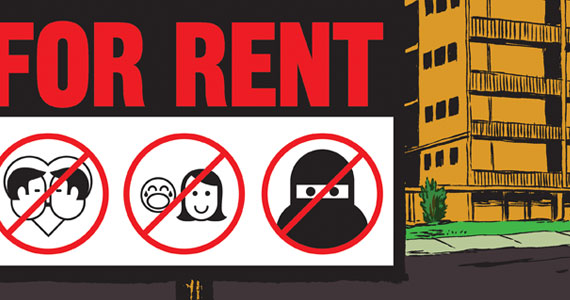
|
Showing posts with label Housing. Show all posts

February 11, 2021

India: How Delhi, Mumbai Keep Muslim Tenants Out | Mohsin Alam Bhat

Bigotry At Home: How Delhi, Mumbai Keep Muslim Tenants Out 

Exclusion, segregation of Muslim tenants are the norm even in India’s most diverse, cosmopolitan cities, reveal findings of a three-year study on discrimination in housing. From owners to brokers, from flat-mates to social media, a web of factors limits Muslims to Muslim-only localities 

MOHSIN ALAM BHAT

https://www.article-14.com/post/bigotry-at-home-how-delhi-mumbai-keep-muslim-tenants-out

March 14, 2020

India: Why Lucknow, Jaipur don’t see communal riots but Delhi and Ahmedaba | Naveen Bharathi and Kashif-ul-Hudad do

the print


Why Lucknow, Jaipur don’t see communal riots but Delhi and Ahmedabad do
If you live in segregated neighbourhoods, it is easy to demonise the 'other’ — which often happens to Muslims in India.
Naveen Bharathi and Kashif-ul-Huda 13 March, 2020 12:10 pm IST

People walk by a sign that says 'hum ek hain' (we are one) in riot-hit Mustafabad in Northeast Delhi | Photo: Praveen Jain | ThePrint


In light of the recent communal riots in Delhi when a few Muslim neighbourhoods were targeted by mobs, it has again become pertinent for policymakers and urban planners to look at urban residential segregation as one of the major factors that precipitates such communal violence in India.

Neighbourhood diversity, for Indian urban planners, mostly meant reserving a few low-income group plots/apartments in new housing projects. The dominant strands in Indian urbanism have not studied caste or religion as a significant factor influencing the politics of space making.

Also read: Left and liberals should stop looking for the perfect victim in Delhi riots
Why neighbourhood diversity is important

Any segregation, as research on race in US cities shows, is detrimental to economic growth, societal equity and economic mobility, and leads to alienation of communities.

A study by Harvard economist Raj Chetty and others has shown that the neighbourhood where one grows up has a major impact on their lifetime earnings and success later in life. The research found that less residential segregation results in upward social and economic mobility. Residential segregation aggravates existing socio-economic inequality. Children growing up in highly segregated and poor neighbourhoods are more susceptible to failure and are emotionally vulnerable.

There is enough empirical evidence to suggest that neighbourhoods with more diversity have lower crime rates, when compared to homogeneous neighbourhoods.

Segregation also results in ghettoisation of minority and poor groups, and this aspect of stratification spills over to next generations. In times of communal violence, it becomes easy to target individuals of a particular group or community — as it happened in Delhi recently.

The Los Angeles riots of 1992, for example, were also a result of highly segregated residential neighbourhoods with “unequal social and political endowments and economic niches”, as shown by a study conducted by the Rand Corporation.

Various studies have shown that people living in heterogeneous neighbourhoods are less discriminatory towards people belonging to other races and ethnic groups. If you live in segregated neighbourhoods, it is easy to demonise the ‘other’ — which often happens to Muslims in India.

Also read: Not a single Dalit in 60% of Kolkata’s neighbourhoods. How caste divides Indian cities
Residential segregation in Delhi

Previous research, by one of us, along with Deepak Malghan and Andaleeb Rahman showed that many Indian cities are segregated along caste lines. Our research found that at least 30 per cent of Delhi’s neighbourhoods (Census enumeration blocks) did not have any Dalits.

Since the Census of India doesn’t make enumeration block-level data of religions public, it becomes difficult to study residential segregation along religious lines.

Researchers like Raphael Susewind have tried to overcome this lack of data by using polling booth-level data to study residential segregation of Muslims in Indian cities.

In his research study titled ‘Muslims in Indian cities: Degrees of segregation and the elusive ghetto’, Susewind uses a probabilistic algorithm to deduce the religion of the person in the voter list. The findings show that Delhi and Ahmedabad are the most segregated cities for Muslims while Jaipur, Kozhikode and Lucknow are the least segregated.

Lucknow and Jaipur have not experienced communal riots in the past many decades. As scholar Ashutosh Varshney notes, Lucknow’s only major communal riot took place in 1924, and there were no communal riots during India’s partition in 1947, or even during heightened tensions after the 1992 Babri Masjid demolition. According to him, the economic integration of Muslims and Hindus in the city is the major reason for the absence of communal riots.

Whether economic integration leads to diverse neighbourhoods or diverse neighbourhoods result in economic integration of communities requires further research.

Another study by Kashif-ul-Huda and Kamrun Nehar looked at the membership records of all housing societies (around 2,000 societies) registered in New Delhi in 2012. They identified Muslim names from the membership records and calculated the percentage of Muslims in each housing society.
Source: Research study by Kashif-ul-Huda and Kamrun Nehar

Almost 70 per cent of housing societies (1,345 out of 2,000) did not have Muslim members at all. Around 96 per cent of societies had less than ten per cent of Muslims. If one looks at the number of Muslim housing society members, then 58.8 per cent of them are associated with societies that have more than 90 per cent Muslims as members.

This means that 31 societies account for 59 per cent of Muslims in housing societies. This data pertains only to registered societies, and the situation is starker in unregistered housing colonies and settlements. While this might not be very surprising to many of us, the extent of segregation this data demonstrates is quite stark.

Also read: Why Jungle Raj Bihar kept out communal riots for 3 decades but Delhi and Gujarat couldn’t
Discrimination against Muslims by real estate agents

There may be many reasons for segregation of Muslims in Indian cities. One major aspect is the discrimination they face in urban real estate markets. A study by Sukhadeo Thorat and others on the rental housing market in five metropolitan areas of the National Capital Region of Delhi recorded the discrimination that Dalits and Muslims face while renting a house.

Almost 60 per cent of the Muslim home seekers received negative responses from landlords compared to 40 per cent for Dalit home seekers and only 3 per cent for upper-caste Hindus.

In 2013, news website TwoCircles.net found out about discriminatory ads posted on real estate website 99acres.com. A search on their website revealed 88 past and active ads with the term “only Muslims” in them. However, search for “no Muslims” resulted in 774 hits. There were 1,470 ads when one searched for “only Hindu” on the same website. The website led a campaign that forced 99acres to commit to removing the discriminatory ads and putting filters for future ads.

Also read: Rumour has it that riots are breaking out in your neighbourhood. What would you do?
Riots and residential segregation

Another major reason for segregation of Muslims in Indian cities is communal riots. Successive communal riots have alienated Muslims and they have been forced to move into Muslim majority neighbourhoods seeking safety.

In early 20th century Europe, Jews lived in ghettos for safety reasons. These ghettoes became easy targets during the Nazi occupation of Europe. In Ahmedabad, successive communal riots have forced Muslims to move into the old city and live in ghettos.

Communal riots drive residential segregation, and residential segregation helps in inciting violence against minority groups. Now, the images of Muslims moving out of riot-hit areas of Delhi to safer neighbourhoods are fresh in our minds.

Also read: Are communal riots a new thing in India? Yes, and it started with the British
The road ahead

Many countries have strict laws that prevent discrimination on the basis of race, religion, national origin, familial status, disability and sex while renting or buying a home.

The Fair Housing Act of 1968 and the Federal Fair Housing Act Amendments Act of 1988 in the US were major steps taken by the government to reduce segregation in US cities based on race.

The time is ripe in India for such laws to be enacted to outlaw any discrimination in real estate markets based on caste and religion to break the vicious cycle of residential segregation and communal riots.

Naveen is a Fellow at Harvard University. Kashif is an independent researcher based out of Cambridge, Massachusetts. Views are personal.

March 02, 2018

India: It’s High Time Gujarat Government Recognises the Communal Elephant in the Room ] Nidhi Tambi (The Wire)

https://thewire.in/228736/its-high-time-gujarat-government-recognises-the-communal-elephant-in-the-room/

It’s High Time Gujarat Government Recognises the Communal Elephant in the Room

BY NIDHI TAMBI ON 01/03/2018

It is not uncommon for Muslims to be denied a house in Hindu-dominated areas and vice-versa, and one of the chief culprits of this blatant apartheid is the regressive Disturbed Areas Act, 1991, which is fuelling distrust.
Children play in Citizen Nagar, which houses Muslim victims of communal riots in 2002, in Ahmedabad, India. June 20, 2017. Credit: Thomson Reuters Foundation/Rina Chandran

Children play in Citizen Nagar, which houses Muslim victims of the 2002 riots, in Ahmedabad, India. June 20, 2017. Credit: Thomson Reuters Foundation/Rina Chandran

It has been 16 years since the 2002 riots, which serves as a reminder to the Gujarat government for a policy overhaul if it sincerely wants to address the glaring demarcation and ghettoisation of the Muslim residents in the state.

Gujarat has residential areas demarcated for Hindus and Muslims. Within Ahmedabad, for instance, Muslim residential areas such as Juhapura and Jamalpur have clearly defined boundaries with other Hindu residential areas. I have witnessed this phenomenon as a child and an adult in this state through the lived experiences of Muslim friends. It is not uncommon in Gujarat for Muslim citizens to be denied a house in any of the Hindu dominated areas and the other way around.

One of the chief culprits of this blatant apartheid is the Gujarat Prohibition of Transfer of Immovable Property and Provision for Protection of Tenants from Eviction from Premises in Disturbed Areas Act, 1991 or commonly called the ‘Disturbed Areas Act, 1991’. It is a law that restricts sale of immovable property in “disturbed” areas with the justification to avert an exodus or distress sales in neighbourhoods hit by inter-religious unrest in Gujarat. The Act is currently implemented in many parts of Ahmedabad, Vadodara and Surat city. In Ahmedabad alone, more than 30 areas are declared disturbed. Almost 40% of the areas in the state fall under this Act. Most of these areas still declared “disturbed” have not seen mob violence since 2002.

The various clauses of the Act have been thoroughly misused by the state government, beginning with the very interpretation of Section 3(1) of the Act on the declaration of disturbed areas:

“Where the State Government, having regard to the intensity and duration of riot or violence of mob and such other factors in any area of the State is of opinion that public order in that area was disturbed for a substantial period by reason of riot or violence of mob, it may, by notification in the Official Gazette, – (a) declare such area. to be a disturbed area (b) specify the substantial period (hereinafter referred to as “the specified period).”

Section 3(1) indicates invoking the Act only in areas “disturbed for substantial period by reason of riot or violence of mob.” The latest imposition of the Act is in October 2017 in Surat and Vadodara, where the central zone of Surat Municipal Corporation and several residential colonies within Bopad police station were declared “disturbed”. These declarations were not a result of “reason or violence of mob” but because of religious intolerance among communities, not willing to share residential spaces. Vadodara police had conducted a survey in August 2017 based on various applications requesting for invoking the Act and submitted a report to the Home Department, enlisting the demands of the residents. According to Police Commissioner Manoj Sashidhar, many Hindus in the area were apprehensive about “Muslims acquiring the residential properties”.

The BJP MLA from Surat, Sangita Patil, had demanded imposition of the Disturbed Areas Act in August 2017 in her constituency of Limbayat, on the following grounds (in her own words):

“Limbayat was once a Hindu area. But now, many societies, such as Govind Nagar, Bharati Nagar, Madanpura and Bhavna Park, which go by Hindu name, are now dominated by Muslims. If they do not get the house easily, they even threaten Hindus and force them to sell it……The way Muslims are using various tactics to acquire Hindu properties, I am of the opinion that the ‘Disturbed Areas Act’ should be imposed here to stop them from spreading into Hindu areas. I requested the collector to do so after many residents made their representations to me”.

She also won the MLA elections held in Gujarat in December 2017. The misuse of the Act for inciting intolerance and creating a vote bank is quite apparent in the close timing of these events.

There are other sections in the Act which are problematic and have been misused in the state.

The Act gives a lot of power to the collector to hold an inquiry and reject an application to transfer immovable property in disturbed areas even when the transfer of immovable property was made “by free consent of the transferor and the transferee (and) for a fair value of the immovable property so transferred.” (Section 4(2) of the Act).

2002 Gujarat riots. Credit: Reuters/Files

In such instances, despite free consent and fair value of the transaction, if the collector invalidates the transfer, there is no judicial recourse for those aggrieved by such a decision. The only recourse is an appeal to the state government and all proceedings before the collector and the state government shall be deemed judicial proceedings (refer Section 6 and 7 of the Act). The decisions of the collector and the state government on the appeal, according to Section 8 of the Act “shall be final and conclusive and shall not be questioned in any Court”. These provisions often leave the communities at the mercy of the inclinations (religious and political) of the state machinery.

This act is not only ill-drafted, archaic and regressive but also a tool of social engineering of the society by the state. The Act has no place in a modern society and should be abolished. The Chief Justice of Gujarat high court also called for a repeal of the Act in 2011, which fell on deaf ears of the state administration.

Invoking this Act, as recently as 2017, only reflects on the failure of the state machinery to promote communal harmony.

Memories of the 2002 riots still linger in the continued distrust among the communities. The Act perpetuates this distrust by adhering to the status quo. Gujarat desperately needs a communal harmony policy with clear objectives and action plan on promoting religious pluralism in school, colleges, government offices and residential colonies.

Dr Damini Shah’s thesis called “Muslim Ghettoisation – A tragedy”, received a lot of attention in 2015. She studied Muslim communities within three districts in the state  –  Anand, Ahmedabad, and Sabarkantha – and found that 92% of Muslim residents (respondents) who earlier had some contact with Hindu communities, do not have contact with the majority (Hindu) community after coming to the ghettos. The state government should, therefore, ensure more interaction between and across communities, through de-stigmatisation campaigns and promoting co-existence of communities within residential colonies, than declare more areas as “disturbed” under this Act.

The state government can also look at creating a Minority Commission (with members from all communities and judiciary) to look into these matters that can also serve as a platform for grievance redressal. In Gujarat, while such a commission exists in name, an RTI enquiry to the department of social justice and empowerment on the same in 2014 received a response that no such commission exists.

The need of the hour is to acknowledge the communal elephant in the room, learn from past experiences and memories of the 2002 riots and find solutions to create a more plural society in Gujarat.

Nidhi Tambi is a public policy enthusiast and a former LAMP fellow.

January 24, 2017

India: housing bias turning Indian cities into ghettos - No Muslims, no single women allowed

Reuters, Jan 23, 2017 | 9:31pm IST

No Muslims, no single women: housing bias turning Indian cities into ghettos

By Rina Chandran
MUMBAI (Thomson Reuters Foundation) - On the inauguration of U.S. President Donald Trump, an Indian real estate company ran an advertisement with the slogan 'Homes that don't discriminate', calling for an end to prejudice in India's housing market based on gender, religion or caste.While the ad was unusual, the sentiment was familiar to millions of Indians who have tried to rent or buy city homes only to be denied because they were single, ate meat, were of a certain caste or from a certain region.
Informal rules and discrimination by Indian landlords to keep out religious minorities and single people are eroding the multi-cultural nature of India's cities and dividing communities into ghettos, analysts say.
"It's 2017 - and we're still encountering discrimination," said Rishi Dogra of NestAway Technologies that ran the ad.
"People should be able to move freely and find a living space anywhere in the country," said Dogra, marketing head for the company founded by four young male graduates after they had trouble finding a home in Bengaluru.
Such discrimination has forced many people to the suburbs, making Indian city centres less diverse and cosmopolitan, with high rents already making them unaffordable to poorer workers.
Mumbai, India's financial hub and a magnet for migrants from across the country, has traditionally had enclaves for Catholics, Parsis, Bohri Muslims and others. They set up housing societies, or co-operatives, to help other community members.
As the city grew and drew more migrants, powerful housing societies have often denied homes on the basis of religion, caste, food preferences and even professions.
The divide grew after bloody Hindu-Muslim riots in 1992-93 and still persists, said Zakia Soman, a co-founder at Bharatiya Muslim Mahila Andolan, a non-profit organisation for Muslim women.
A Facebook group called 'Indians Against Discrimination' was set up in 2015 after a young Muslim woman was asked to leave her flat a week after she moved in, because of her religion.
"When it comes to living spaces, we have become very insular," Soman said.
"The city is getting increasingly ghettoised as a result, weakening our social fabric and polarising us further. That doesn't bode well," she said.
Local courts have ruled against discrimination by housing associations in several cases, but there have also been contradictory rulings.
DISCRIMINATION
In a 2005 case, India's top court ruled in favour of a Parsi housing society in Ahmedabad, saying it could limit its membership to Parsis and not admit others.

"The constitution guarantees our right to equality, but housing societies can still frame their own guidelines which may be discriminatory," said Vinod Sampat, a real estate lawyer.
A draft housing policy for Maharashtra state, where Mumbai is located, has dropped a clause that prevents discrimination in housing. This may leave those looking to rent or buy property with fewer protections, Sampat said.
Government officials have said non-discrimination is already protected by the constitution, so there is no need for the clause.
That has not reassured people like Shikha Makan, who made a film called 'Bachelor Girls' on housing bias against single women - including Bollywood actors - in Mumbai.
"Not being able to find a home in a big city like Mumbai is a shame," she said.
"It is marginalising single women and other minorities."
(Reporting by Rina Chandran @rinachandran, Editing by Ros Russell. Please credit the Thomson Reuters Foundation, the charitable arm of Thomson Reuters, that covers humanitarian news, women's rights, trafficking, corruption and climate change. Visit news.trust.org to see more stories.)
 

October 28, 2016

India: Hemant Morparia Cartoon on Vegitarianism - Vigilantism

"not just dalits, you know .. . and a certain very 'non-violent' community takes the lead in imposing their food tastes" - Morparia August 10, 2016


June 12, 2016

India Anti discrimination clause in real estate bill to check bias against religion, caste, ethnic origin, gender, sexual orientation, diet

The Indian Express

Coming soon: Clause in real estate bill to check bias against religion, sexual orientation, diet

Written by Shalini Nair
New Delhi
Updated: Jun 12, 2016

The anti-discrimination clause will provide recourse to buyers who are denied a house by builders owing to their caste, ethnic origin, gender, sexual orientation, dietary choices or any such factors. Once the rules are notified, those affected can approach the state-level regulatory authority, followed by the appellate tribunal.

Under the RERA [The Real Estate (Regulation and Development) Act, 2016 (RERA)], builders failing to adhere to the tribunal’s orders are liable to face imprisonment of up to three years and/or a monetary fine, according to the legislation.

Ministry sources said that during the passage of the bill in the Rajya Sabha in March, Congress MPs Kumari Selja and Rajeev Gowda had demanded that an amendment should be made to the Act itself so as to provide for safeguards against discrimination. [ . . . ]

http://indianexpress.com/article/india/india-news-india/real-estate-bill-soon-to-check-bias-against-religion-sexual-orientation-diet-2848107/

April 27, 2016

No houses on rent for minorities: UN expert hits out at Indian mindset (catchnews)

catchnews - 24 April 2016

No houses on rent for minorities: UN expert hits out at Indian mindset

Catch Team @catchnews | 24 April 2016

QUICK PILL

The discrimination
It has been observed time and again that Indian landlords don't easily rent out houses to Muslims or women
Especially in the case of religious minorities, this leads to ghettoisation

The expert view
UN's Special Rapporteur on Adequate Housing, Leilani Farha, has echoed these observations
She has criticised the Indian mindset for continuing with this discrimination

More in the story
Now that Farha has made these observations, what happens next?
What does the Government of India have to say about her view?


Recently, when a Muslim professional set out looking for a house in South Delhi, some of the home owners he met had strange excuses.

"That landlord in Safdarjung Development Area says he will rent out the place only to a vegetarian," the broker told him.

"A polite way to refuse a Muslim," the professional thought.

Another landlord, a young guy who has made money in the US and is now taking a break, mostly playing golf, had an interesting proposition for the professional.

"My father, who happened to be a journalist, had many Muslim friends. So I do not mind that you are a Muslim, and I am ready to rent out this room to you. But you cant have anybody coming or leaving, be it your family or your friends. None at all," he told the professional.

His demands basically meant that he was not willing to give the house. "Or why would he say things like nobody can come. It isn't a jail after all," the professional thought.
"Minorities, women and SCs face discrimination and ghettoisation when it comes to renting homes"

It's not just in the posh colonies in Delhi, Mumbai and other big cities - this problem has forced many minorities to move into ghettos.

But they're not the only ones. Women, too, face intrusive questioning while looking for accommodation.

'Are you single'? 'Will your boyfriend be visiting'? 'Do you have male friends'? 'When are you planning to get married'? These are some of the most common questions working women have to face in every city.
UN expert's scathing view

These observations were echoed by Leilani Farha, the UN Special Rapporteur on Adequate Housing, who was in India recently on a 12-day visit to assess the housing sector.

In her observations, which have upset the Indian government, she said that India had a legacy of discrimination against minorities, people from the Scheduled Castes and women, and it still remains apparent and manifests in different ways.

Farha pointed out that a detailed report will be submitted to the UN Human Rights Council at its 34th session in March 2017 in Geneva. However, the observations will be first sent to the Government of India for verification and comment.

India is presently one of the 47 members of the Human Rights Council.
"UN Special Rapporteur on Adequate Housing, Leilani Farha, assessed the sector on a 12-day visit"

The government of India doesn't seem happy with her views. The Ministry of External Affairs said that her views don't reflect the UN's view of India.

"The reports prepared by the Special Rapporteurs during such visits are their own work, based on their travel within the country and their interaction with government officials, or both, at Central and state levels; site visits and community interactions, meetings with NGOs and many others," the MEA said.

"The Special Rapporteur would be sharing her draft report with the Government of India for factual verification in due course, before its formal tabling in March 2017 during the 34th Session of the UNHRC in Geneva," the MEA statement reads.
Forced evictions

Meanwhile, Farha also called for a moratorium on forced evictions and demolition, and said that the country needs a national housing law, which is based on national and international human rights commitments.

"I am extremely concerned for the millions of people who experience exclusion, discrimination, eviction, insecure tenure, homelessness and who lack hope of accessing affordable and adequate housing in their lifetimes," she said.

She reportedly pointed out that the frequency of forced demolitions and evictions is sometimes justified by taking recourse in the economic agenda of the government. According to some estimates, 2.5 lakh people have been forcibly evicted from their homes between 2010 and 2015. India is home to the largest population of urban poor and and landless people.

She also mentioned how "there is no national law, policy or programme in place to ensure homeless people have access to medium and long-term housing options," and how even the newly launched Housing for All, a Central government scheme, does not take into account this group of deprived people.

In cities like Delhi, scores of homeless people die every year due to extreme weather conditions.

August 23, 2015

India: Urban Rental Housing Market - Caste and Religion Matters in Access

Economic and Political Weekly, Vol - L No. 26-27, June 27, 2015 |

by Sukhadeo Thorat, Anuradha Banerjee, Vinod K Mishra and Firdaus Rizvi

This study attempts to identify the forms of discrimination experienced by Dalits and Muslims in the rental housing market in five metropolitan areas of the National Capital Region of Delhi. A combination of three distinct methods, the telephonic audit, in-person or face-to-face audit, and studies, is used to capture the phenomenon of discrimination and unequal outcomes for prospective Dalit and Muslim tenants in the urban rental housing market. The study finds that houseowner prejudices deny housing for both Dalits and Muslims, with Muslims experiencing greater discrimination. The study also found that Dalits and Muslims who manage to get homes on rent have to do so by agreeing to unfair terms and conditions.

http://www.epw.in/housing-discrimination/urban-rental-housing-market.html

June 22, 2015

India needs a law against discrimination in housing - interview with Tarunabh Khaitan

http://epaperbeta.timesofindia.com/Article.aspx?eid=31804&articlexml=FOR-THE-RECORD-HOUSING-WE-NEED-A-LAW-21062015025017

Jun 21 2015 : The Times of India (Mumbai)
FOR THE RECORD - HOUSING: WE NEED A LAW AGAINST DISCRIMINATION

A recent study showed how home owners in NCR were discriminating against Dalits and Muslims. In an interview to Amulya Gopalakrishnan, Tarunabh Khaitan, associate professor in law at the University of Oxford and the author of A Theory of Discrimination Law, talks about the implications of segregation

What is the problem with housing discrimination, like instances when Dalits and Muslims are denied rentals?

Consider a hypothetical case: a landlady refuses to let her house to me because my zodiac sign is Capricorn. Her eccentric refusal does not affect my opportunities; none of us can claim to have a moral right to live in any particular house.

Now imagine if discrimination against Capricorns was so pervasive in the housing market that whole swathes of a city became unavailable to us. We might be obliged to live in tiny pockets that let us in, and are likely to have many other Capricorns. Such a neighbourhood will soon become a Capricorn ghetto. Let us also assume that prejudice against Capricorns also exists in government, jobs, shops, services, and education. It is likely that this ghetto will have relatively poor job options, schools, sanitation and civic amenities. Dalits and Muslims are in a similar situation (see the Sachar Committee report and studies by Prof S K Thorat). Other groups, including single women, unmarried couples, the disabled, gays and transgenders are also likely to face similar exclusions.

For victims of such pervasive discrimination, the implications are obvious. Not only are they stigmatized and humiliated, their freedom of movement is also curtailed.They also lose out on other civic goods that go hand-in-hand with housing. Even if these urban ghettos had adequate amenities, there is something repugnant in an apartheid-like segregation of neighbourhoods. For society , such segregation is a moral loss that makes fraternity and equal citizenship impossible.A society that permits pervasive forms of discrimination against minorities cannot become a true political community .

Landlords justify it as a private decision to choose tenants they are comfortable with -vegetarians, or married couples, for instance.Can the state regulate these private choices?

We all have the right to act as we wish, so long as our actions don't illegitimately harm others. Our Capricorn-phobic landlady need not answer to the law. But regulation becomes legitimate when discrimination becomes pervasive and enduring: when so many landlords start excluding a group that its members can't access basic goods that facilitate a good life.

Liberals across the world have accepted this to be a justified state intervention. That said, the law could accommodate legitimate privacy interests.

What solution, legally and socially, do you recommend to check discrimination?

India is almost unique amongst liberal democracies in lacking a comprehensive, multi-ground, anti-discrimination statute. In other jurisdictions, such statutes typically prohibit discrimination on morally extraneous grounds like race, caste, tribe, sex, disability, sexual orientation, religion, pregnancy , marital status, gender orientation, etc. They prohibit direct discrimination (where all victims belong to the same religion or caste, like a sign saying `No Muslims') and also indirect discrimination (like a sign saying `vegetarians only' which may disproportionately affect some groups like Muslims, Christians or Dalits through cultural food preferences). Indirect discrimination is relatively easier to justify than direct discrimination.

These statutes apply to (public and private) employers, landlords, retailers, and service providers. They also permit affirmative action in favour of disadvantaged groups: this is not considered discriminatory . Importantly, they provide civil rather than criminal remedies for acts of discrimination: the sledgehammer of criminal law can often be counter-productive when dealing with discrimination.

Considered alongside Indian realities, the Canadian and South African laws that address discrimination, and the meticulously drafted British Equality Act can be instructive. The US Title VII and Title VIII may be the mother of such statutes, but it is currently facing a reactionary backlash: we should look at the US mainly to learn from their mistakes.

What legal recourse can a victim take?

Currently , it is not clear whether a Muslim victim has any available statutory remedy .If a Dalit person is denied housing on the ground of untouchability, the under-enforced provisions of the Protection of Civil Rights Act 1955 provide limited criminal remedy .

There may, however, be a constitutional remedy . The prohibition on discrimination under Article 15 of the Constitution applies to private persons too, and not just the state. However, some clarity is urgently needed from the courts, especially after the limited conclusions of the Zoroastrian Housing Society case (2005).

Ultimately, however, the solution is a comprehensive anti-discrimination law.Like Right to Information statutes, state legislatures could lead the way.

June 19, 2015

India: Basharat Peer on Mumbra, India’s largest Muslim ghetto

The Hindu, June 19, 2015

In India’s largest Muslim ghetto

by Basharat Peer

Uprooted from Mumbai after the 1992-93 riots, thousands of Muslim families found safety in Mumbra on the city’s outskirts. Visiting it over a few days, Basharat Peer discovered islands of progress amid large seas of neglect in the township that nine lakh people call home

On a recent afternoon, after a two-hour drive out of Mumbai, I followed a highway hugging the low hills of Mumbra, north-east of the city, near the Thane creek. As the road forked downhill, hundreds of grimy, teetering buildings stacked like tattered books in a neglected public library were the first glimpse intimation of Mumbra, India’s largest Muslim ghetto. Despite the heat, young boys played cricket in a clearing by a graveyard. A chaotic medley of vehicles choked the main street leading into the Kausa area of the ghetto.

Mumbra expanded with great velocity in the aftermath of the Babri Masjid in Ayodhya. The Bombay riots of December 1992, which overwhelmingly killed Bombay Muslims, and the retaliatory bomb blasts in January 1993 by the Muslim underworld, reconfigured the social geography of the city. Bombay Muslims from riot-hit areas sought safety in numbers and found it in Mumbra, where Muslims from the Konkani coast had a long-standing presence. Through a combination of the desire for safety among Muslims, the relatively cheaper price of apartments, and continued rural-urban migration, Mumbra’s population grew 20 times from about 45,000 before the 1992 riots to more than 9,00,000 in the 2011 Census — possibly one of the fastest expansions of an urban area in India.

"Not Bombay, a village"

Assadullah Khan, an electrical engineer in his late 40s, was among the first groups of people who moved to Mumbra from Mumbai after the 1992-1993 violence. Mr. Khan was living in Kannua Nagar in the suburb of Vitroli, a mixed neighbourhood, where Hindus and a smaller number of Muslims lived together without incident. Mr. Khan, who also gave part-time tuitions to students, was the only Muslim in his building. After the riots, most of his Muslim neighbours began to migrate to areas with a heavier concentration of their co-religionists. Mr. Khan was weighing his options.

A female neighbour warned him. “You should leave now,” she said. “Things are going to get worse.” He moved his wife and children to his in-laws’ house overnight. “A little later, I sold my apartment for much less than it would fetch on the market,” Mr. Khan told me. The market for distress sales was booming.

Mr. Khan found shelter in his brother-in-law’s apartment in Mumbra. “We then bought an apartment of our own and have lived here since,” he said. Thousands followed him, from Bhandup, Vitroli, Ghatkopar, Behram Baug, and Walkeshwar. Uprooted from the charred geography of the city, they converted a semi-rural backwater into a promised land.

The Maharashtra and central governments, which had watched impassively through the riots, left the migrants to their own devices, but Mumbra grew. Power and water supply was feeble. There was little public infrastructure. The crisis provided a business opportunity for Mumbra builders; they set out to build illegal and substandard apartment blocks, which were (and still are) a lot cheaper by Mumbai standards. In the early 90s, an illegally built two-bedroom apartment in Mumbra would sell for around Rs. 2 lakh. “Most of the buildings are illegal,” a builder told me. “Today, an illegally built three bedroom costs Rs. 8-10 lakh. If I built that legally, it would cost Rs. 25-30 lakh.” Mumbra is a mixture of middle, lower-middle, and working class Muslims, but the majority are from the lower-middle and working classes. “Most people here couldn’t afford the legal market prices,” he said.

The poor building quality exacted a terrible cost in 2013 when a building collapse killed more than 70 people. It did not deter new arrivals. Rafiuddin Khan, a retired teacher in his 70s, lived most of his life in a tenement near Mohammad Ali Road — one of the oldest Muslim majority areas in Mumbai. “Our area was safe but I was tired of living with a growing family in two rooms,” he said. He sold his chawl; it fetched enough money to buy an apartment in a Mumbra apartment block. “It is a lot more space than we had in Bombay,” he said. He paused for a while, as if reimagining the vistas of his earlier life in the middle of the bustling metropolis. The ease of travel and the proximity to major public hospitals, schools, and colleges was missing in Mumbra. A journey to the city in a sardined local train took about an hour and half. “It is not Bombay, it is a village.”

Desire for upward mobility

The signs of aspiration are seen in the names of apartment blocks: Shimla Park, M.M. Valley, and Wafa Park. The impatience with the status quo and the desire for upward mobility screams from roadside billboards advertising the achievements of Mumbra boys and girls in coaching classes and private schools. A higher secondary level school, Al Hidayah School, has advertised with a collage of smiling student photographs and the percentages of their Senior Secondary School marks. There was pride in that data: Out of 24 students, 9 have secured above 75 per cent and 14 between 60 per cent and 70 per cent. Meanwhile, Shoeb Junior College simply said: 89.16 per cent success.

“When we moved here, we clearly felt the absence of things we were used to in the city,” said Mr. Khan, the engineer. The ghetto had a few government schools, which were abysmally overcrowded and lacked infrastructure. Mr. Khan gave up engineering and set up a tuition centre, Unique Classes. When an old Sikh family, which had run a private high school in Mumbra decided to sell the school, Mr. Khan bought it, renaming it Assadullah Khan English High School and Junior College. It already has 1,400 students. “We are trying to fill the gaps ourselves,” he said. Despite having around a million residents, the Maharashtra government has not set up a single public college in Mumbra.

Beyond the doors of the ghetto, a Mumbra address often carries a degree of prejudice and suspicion. A lawyer spoke of trying to buy an Idea Internet dongle at a Thane shop and being turned away; an Urdu publisher spoke of waiting months to get a landline and broadband connection from BSNL. A few weeks ago, a private school in Panvel, a suburb 24 kilometres from Mumbra, decided to ban admissions of students from the ghetto, claiming that they behave badly. Waris Pathan, the Byculla area legislator from Majlis-e-Ittehadul Muslimeen, led a protest against the school administration, which eventually revoked its decision.

Neglect and discrimination

One evening, I met Nazim Qazi, a sanitation officer with Thane Municipality. Before moving to Mumbra, when his wife, a schoolteacher, got a job in the area, he lived in Andheri and Thane, working as a freelance Hindi journalist, writing about cinema and the underworld — the two great Bombay themes. He gave it up for a more stable income at Thane Municipality.

Mr. Qazi lived in a relatively spacious, meticulously neat two-bedroom apartment with his wife, son, and two daughters. He saw certain benefits in living in Mumbra. “Women can walk around anytime and nobody will bother them. We have been here since 1999 and we sleep in peace, without any fear of riots or disturbances.” He loved hearing the azaan, the call for prayer, five times a day. “It has been easy to raise my children with Muslim values here,” he said.

As we spoke, Shehzad Faisal Qazi, his 20-year-old son, who has a mechanical engineering degree from Anjuman-I-Islam College, a minority institution in Panvel, joined us. A fashionable young man with rimless glasses, Mr. Faisal had recently returned from Coimbatore, where he and his college mates had won several top positions in a Go-Kart design competition. They were trying to patent an anti-skid mechanism for cars. He was about to leave for New Delhi to take classes for the Indian Administrative Services examination.

Along with the strivings, a sense of neglect and discrimination pervades Mumbra, which does not have a single public hospital. The nearest public hospitals are in Kalua and Thane. Several clinics and rudimentary private hospitals have come up. Mumbra goes without electricity for at least six hours everyday. “We are No. 1 in load-shedding,” Mr. Qazi laughed. “But things are a lot better compared to even five years ago.”

The evidence of incremental progress was visible in Mumbra. Some streets had been paved with tar. State Bank of India, HDFC, and Bank of Maharashtra had opened branches or ATMs. A Domino’s Pizza outlet opened last year. The absence of banking facilities or companies denying home delivery of products has, for years, been the standard attitude towards India’s Muslim ghettoes. Barely an hour from the Indian Parliament, the Okhla Muslim ghetto in New Delhi did not have a single bank despite a population of several lakh. Two years ago, Jammu and Kashmir Bank opened a branch in Zakir Nagar. Juhapura, the Ahmedabad ghetto, whose population doubled after the 2002 riots, still does not get piped water or gas, and remains excluded from Ahmedabad’s vaunted public transport network.

Run-ins with police

Mumbra also lives with a hostile relationship with the police. It was home to Ishrat Jahan, who was killed along with three other men by the Gujarat police. The Central Bureau of Investigation later described the killings as a “fake encounter”. Taunts of being a safe house for terrorists are often thrown at Mumbra. Last March, several hundered policemen raided Mumbra one and a half hours after midnight. A video recorded by a local journalist shows scores of men being paraded through dark streets by the police, bundled into police vans, and held for hours in Mumbra police station. Around 80 people, including young students, poets and old men were arrested. The police claimed to be looking for two petty thieves wanted for chain-snatching.

One afternoon, I met Ishrat Jahan’s family in Mumbra. They continue to litigate and fight the everyday battles of existence on the periphery. Ishrat’s sister Musarat Jahan recently completed her B.A. in Psychology through a correspondence course, but her mother, Shamima Kausar, is too scarred to let her step out and seek work. “I can’t trust the world anymore,” said Ms. Kausar. Yet, there are bills to pay. Ishrat’s brother Anwar Iqbal used to do odd jobs to support the family. Initially, he was denied employment because he was Ishrat’s brother, but he persisted and found work at a BPO in Thane. “It is an American company,” said Ms. Jahan. “He doesn’t make calls, he does data entry.”

basharat.peer@thehindu.co.in

June 16, 2015

India: Study shows National Capital Region homeowners turn away Dalits and Muslims (Seema Chishti)

In both the methodologies, the home-seekers had the same credentials but for their names that indicated their caste and religion.

The methodologies included contacting the “home-providers” via telephone or meeting them face to face.
Written by Seema Chishti | New Delhi | Updated: June 16, 2015 9:17 am

A study on discrimination in urban housing rental preferences, to be published in a forthcoming issue of Economic and Political Weekly, shows high levels of exclusion of Dalits and Muslims in the five metropolitan areas of NCR.

The team of researchers, led by Prof S K Thorat, chairman of the Indian Council of Social Science Research, and comprising scholars such as Anuradha Banerjee, Vinod K Mishra and Firdaus Rizvi, covered attempts to get houses on rent in Delhi, Faridabad, Ghaziabad, Gurgaon and Noida between January and March 2012.

The methodologies included contacting the “home-providers” via telephone or meeting them face to face. In both the methodologies, the home-seekers had the same credentials but for their names that indicated their caste and religion.

The telephonic audit had a total of 1,469 home-seekers, 493 each bearing upper-caste Hindu, Dalits and Muslim names. While not one of the 493 high-caste home-seekers received a negative response, about 18 per cent of Dalits and 31 per cent of Muslims faced outright rejection, found the study. Together those receiving either a negative response or a positive one with conditions attached worked out to 41 per cent in the case of Dalits, and around 66 per cent for Muslims.

tenantsThe face-to-face audit covered 198 home-seekers, with 66 high-caste Hindus, Dalits and Muslims each. While 97 per cent of upper-caste Hindus got a positive response, 44 per cent of Dalits and 61 per cent of Muslims faced rejection. Together those receiving either a negative response or a positive one with conditions attached worked out to 51 per cent in the case of Dalits, and 71 per cent for Muslims.

In other words, the chances of Dalits and Muslims finding a house fell in the case of face-to-face contact. It also means that a significant number of Dalits and Muslims have to spend much more to stay in accommodations in NCR than their upper-caste counterparts.

“This indicates a clear case of market failure,” says Thorat, “where even prosperity does not allow you to buy your way out of discrimination… The studies do reveal that Muslims are even worse off than Dalits as far as the rental housing market goes.”

“Non-monetary motive often prevails among landlords renting out houses,” says the study, which chose Delhi for the research as it is often considered amongst the most migrant-friendly and cosmopolitan cities in India.

“While about 18 per cent of Dalits faced outright refusal from upper-caste landlords due to their caste, 23 per cent of them did get houses on rent but with differential terms and condition such as high rents and other restrictions. In case of Muslims, about one-third of them faced outright refusal from the landlords due to their religion, another 35 per cent managed to get houses on rent but with differential terms and conditions.”

The study focused on identifying discrimination in the NCR areas from both the supply and demand ends. The demand side included Dalit and Muslim home-seekers facing unequal treatment; and the supply side included discrimination practised by the “house providers”, including landlords, real estate agents and brokers.

While the broad results were categorised as positive and negative, positive was further broken down into differential demands (in terms of rents and security).
Tenants rejected

After phone interaction:

Upper caste Hindus: 0%
Dalits: 18%
Muslims: 31%

After meeting:
Upper caste Hindus: 3%
Dalits: 44%
Muslims: 61%

source: http://indianexpress.com/article/india/india-others/rentals-ncr-homeowners-turn-away-dalits-muslims/99/

June 04, 2015

India: Police complaint against builder after 'non-veg' Marathi man denied an apartment

FIR filed against builder after 'non-veg' Marathi man denied flat
V Narayan, TNN | Jun 3, 2015, 05.56PM IST

The case was registered after complainant Vaibhav Rahate protested against the indiscrimination faced at the hands of the developer and his manager on May 4.
MUMBAI: A first information report (FIR) is registered on Tuesday with the Malad police station against a real estate developer and his sales manager for allegedly denied a Goregaon resident to buy a flat in a "veg-only" under-construction residential building. The case has been registered after the police conducted on the Zonal Deputy Commissioner of Police order after the complainant Vaibhav Rahate protested against the indiscrimination faced at the hands of the developer and his manager on May 4.

Spokesperson for the Shrinathji Group of developers said they are going to lend complete support and cooperation in the police investigation. The spokesperson said these allegations are absolutely incorrect and is a conspiracy against us for reasons best known them. "We are cooperating with the Police Department in their investigations and have already filed our say in our statement in this matter," spokesperson Sagar Bekal told TOI on Wednesday. Bekal, earlier told TOI, they were not comfortable dealing with Rahate due to his approach. The manner in which he spoke made our staff sceptical. "We need to develop a rapport with our clients during a transaction. We have already sold a flats in the project to a Sindhi buyer and a shop to a Punjabi buyer. Besides, one of the directors of our company is Maharashtrian," he said earlier.

Rahate said the case was registered on Tuesday against the builder Rajesh Mehta (47) and his manager Varun Mehta (29) for denying to sell the flat because he is a non-vegetarian. The 27-year-old complainant was taken aback to learn that he couldn't buy a flat as he was a "Maharashtrian". Both the Mehta of Shrinathji Group of developers has been booked under the Indian Penal Code section. No arrest has been made so far. The case pressure was built up by the Malad MLA Aslam Shaikh and the city Congress president Sanjay Nirupam, demonstrated protest outside the police station on May 29 to take speedy action in lodging the FIR.

Rahate, a dealer in used cars, lives in Goregaon and wanted to book a 1-BHK for his sister. On May 4, he went to the under-construction Celestial Heights on SV Road. TOI is in possession of the FIR that is filed against the developer. "I was directed to the site office where I met a staffer named Varun. He asked my name and asked me to wait outside for a few minutes. Half an hour later, he met me again. I asked him about the property rates and area, as well as a brochure. But Varun flatly told me the flats were not available for sale to Maharashtrians, Muslims and other non-vegetarian buyers. He said the developers preferred only Gujarati and Marwari buyers. I was aghast and asked if we were supposed to change our dietary habits if we wanted to buy a flat," Rahate told TOI.

Rahate immediately approached the Malad police and got his statement recorded but the police failed to take any action for 25 days. "It is only on Tuesday the case was registered. The case was registered after zonal DCP Vikram Deshmane instructed the Malad cops to conduct an inquiry and file an FIR," Rahate told TOI.

Malad senior inspector Milind Khetale said the FIR has been lodged and action will be taken after they collect necessary evidence regarding the matter.


http://timesofindia.indiatimes.com/city/mumbai/FIR-filed-against-builder-after-non-veg-Marathi-man-denied-flat/articleshow/47529534.cms

India: We need fair housing and equal opportunity laws to prevent discrimination (Shehzad Poonawala)

The Indian Express

A House For Ms Qadri
We need fair housing and equal opportunity laws to prevent discrimination.

Written by Shehzad Poonawala | Updated: June 1, 2015 5:39 am

Recent cases of alleged discrimination in Mumbai — a diamond firm refused a job to MBA graduate Zeshan Ali Khan and Misbah Qadri was denied a flat, reportedly because of their religion — once again lift the veil of cosmopolitanism that sits uneasily on the ugly reality that corrodes the constitutional pillar of secularism. While in these specific cases, the National Commission for Minorities was approached and inquiries and penal action initiated, the larger question that needs to be addressed is: How should we tackle religion-based discrimination, and not just its symptoms?

The deep extent of the malaise has been demonstrated by several independent studies. For instance, one study shows that in the secondary and tertiary sector, the share of Muslims between 16 and 64 years of age in regular and casual employment is lower than that of SCs and STs. In the public sector, the situation is equally dismal, with Muslims having a share of just 2.5 per cent in the civil services.

Housing, like employment, is another area where Muslims face discrimination. A comprehensive account of this can be found in the Sachar Committee report, not to mention the media stories that emerge periodically from urban centres like Ahmedabad, Delhi, Mumbai and Noida. Most often, the terminology used is not as direct as it was in the 99acres.com case, which involved a “no Muslim” ad and which this writer had legally pursued in 2013. Discrimination usually revolves around stereotyping — “Muslims have four wives” and “Muslims eat non-vegetarian food”. Political and media narratives that portray Muslims as terrorists or “love jihadis” deepen pre-existing prejudice. Nobody wants a single man with a Muslim name and a long beard staying next to them. “What if he belongs to Simi or IM?” What if he misbehaves with “our women”? Even actor Emraan Hashmi couldn’t escape discrimination.

This type of discrimination is a sophisticated form of untouchability and social boycott and drives Muslims to find jobs and houses only in “their areas”. It leads to ghettoisation and foments a greater sense of insecurity, which is then tapped into by the spineless practitioners of identity politics on all sides. Ghettos, Hindu or Muslim, are easily identified and sitting targets during riots. They are vulnerable to targeted deprivation of civic amenities and infrastructure. For instance, a report shows that 40 per cent of all Muslim concentration areas lack hospitals and schools.

We need a fair housing law that prohibits discrimination in housing, along the lines of the legislation that protects African-Americans from such practices in the US. It must make blockbusting illegal, incentivise developers to create inclusive habitations and ensure that the language used in real estate advertisements is non-discriminatory. Such a law would not only protect Muslims but other vulnerable groups, too.

On the employment and education front, India needs the equal opportunity law to be passed with the consent of state governments. Disallowing discriminatory human resource and hiring policies, prescribing affirmative action on economic parameters and mandating the creation of equal opportunity commissions at the state and national levels to monitor practices and ensuring implementation are important steps that must be taken.

While the SC and ST (Prevention of Atrocities) Act, 1989, aims at penalising discrimination, these new-generation anti-discrimination laws aim at reforming societal attitudes and breaking stereotypes by breeding familiarity. It incentivises people of all orientations and communities to live and work together. The more that happens, the less likely it is that people will fall prey to false propaganda.

Today, just four out of 100 Muslims above the age of 20 are graduates. With high dropout rates and limited access to schools and skill development centres, the Indian Muslim is severely handicapped. The Indian state cannot afford to neglect its second largest group of citizens and their aspirations. Sabka saath, sabka vikas can only be realised if the promises of our founding fathers to all Muslims who chose secular India over theocratic Pakistan are fulfilled in letter and spirit.

The writer, a lawyer, was petitioner to the NCM in the 2013 housing discrimination and Misbah Qadri cases.
- See more at: http://indianexpress.com/article/opinion/columns/a-house-for-ms-qadri/99/

May 29, 2015

India: Stories of Housing Discrimination on the Basis of Religion


Facebook bursts with tales of housing bias after Muslim woman is denied flat in Mumbai

A social-media group has become the clearing house for harrowing stories.
Photo Credit: Rob Elliott/AFP
23.2K
Total Views
Mumbai’s communal fault lines are never far from the surface even in the best of times. Misbah Quadri witnessed this at close quarters when she recently went house-hunting in the city.

A 25-year-old communications professional from Gujarat, Quadri rented a three-bedroom apartment at Sanghvi Heights in Wadala, in the central part of the city. But just a week after she moved in with two other young women, she was asked to move out because of her religion. Her realtor told her that the building society did not allow flats to be rented out to Muslims.

“He [the realtor] threatened to call the cops and throw me out of the flat,” Quadri told The Hindu. “It got very ugly.” Appealing to the builder’s representative didn’t help either as she was told that it was a “company policy” not to have Muslim tenants.

Quadri, who has been in Mumbai for more than five years, is familiar with the pervasive communal bias in the city’s real-estate universe. She lost her patience this time because her two Hindu roommates, who vacated the flat in solidarity, arealso  back hunting for a house.

The episode comes only a week after a Muslim candidate from Mumbai was denied a job by a Gujarat-based jewellery company because of his religion. “We regret to inform you that we hire only non-Muslim candidates,” he was told in an email.

Not alone in this

When Quadri was asked to leave on a short deadline, she put up her furniture for sale on Facebook. This alerted others to the situation she was in and soon, in an organic reaction, many people began sharing their experiences of facing prejudice in different parts of the country.

Before long, a Facebook group called Indians against Housing Discrimination got created and within days 1,000 members joined in. Many of those active on the group narrate their brushes with bias, while others seek advice on the possible legal recourse that could be taken.


One such member is Sonia D’Costa, a freelance writer who likes to move cities every few months. Her peripateticism came to a halt in Chennai.


“When I started looking for houses, brokers were eager to get me fixed up with a place,” she said. “Once the deal was finalised, we said we will be back to complete formalities. The owner however, called us later and asked if we are Christians.”

Things went downhill from there. “Unfortunately, I was at that time and I said yes,” she recounted. “He immediately said sorry we can’t rent our house to Christians. Just like that. This same thing repeated itself twice before I decided to give up and move somewhere else.”

There are many more such tales on the group. Another member remembered how a realtor turned down his friend, saying “nobody gives houses to Muslims”. Yet another user posted an ad pamphlet he found stuck on a tree in his neighbourhood listing a two-bedroom flat for “Brahmins only”.

The “Brahmins only” ad had also surfaced two years ago, resulting in much outrage on social media, but the practice has clearly not stopped.

Last year, another builder had made headlines for initiating Muslim-only apartments in Greater Noida. On offer were a mosque, a madrassa and amenities dedicated exclusively to the community.

Legal position

Many recognise this trend for what it is: ghettoisation of communities that undermines the ideas of inclusiveness and fraternity. However, in the eye of the law, it’s not so black and white.

In 2005, the Supreme Court missed an opportunity to fix the loose interpretation of the Maharashtra and Gujarat Co-operative Societies Acts of 1962, which many societies use to cultivate ethnic, cultural or linguistic homogeneity.

The case related to the Zoroastrian Co-operative Housing Society Limited. When a Parsi owner of a bungalow wanted to sell the plot to developers, he was challenged because society bylaw didn’t allow selling or renting plots to non-Parsis. The owner went to court but lost the case. As a report in Scroll.in said last year:
“The court emphasised a particular group’s right to preserve its culture, but failed to balance this by acknowledging that such attempts at preservation also led to acts of prejudice. Further, the court ruled that because a society was a private body, it was exempt from having to honour constitutional tenets.”

This hasn’t discouraged Quadri’s lawyer from approaching the Minorities Commission seeking action. Meanwhile, Meana Seshu, a social activist from Maharashtra, has approached Quadri to help her file a complaint with the National Human Rights Commission.

“I have offered help to draft complaint and approach the commission but she is yet to receive her dues so I have been asked to hold off,” Seshu said. “They [the society] cannot have such a policy. If they are a registered society they have to follow government rules of non-discrimination. I feel this should be treated as a human rights violation.”
We welcome your comments at letters@scroll.in

May 28, 2015

Rana Ayyub on Discrimination and Denial in Access to Residential for Muslims in Metropolitan India

http://www.ndtv.com/opinion/muslim-in-the-city-766613?pfrom=home-opinion

Muslim and the City: Flats Rented to Us Become Off-Limits Overnight

by Rana Ayyub (ndtv.com, 28 May 2015)

I saw some outrage yesterday on social media and news channels about a young woman in Mumbai asked to vacate her flat because of her surname. Misbah Quadri, who had moved into a three-bedroom apartment in Wadala, was allegedly told by her broker that she could not move in the flat as the society was averse Muslim tenants.

The girl was interviewed by various news channels, and we pretended that we woke up to a phenomenon . Really ? How many of us have Muslim friends who haven't shared stories of not being able to get an apartment because of their surname in "cosmopolitan" metros like Delhi and Mumbai?

I remember arriving at a Greater Kailash apartment in South Delhi with my bag and baggage all the way from Mumbai to find the door locked. I had met the family who owned the flat a week before that - the son, a doctor who was in Delhi for vacation from London, the father a businessman from Haryana. When I landed at the gate, the watchman said he had no instructions to allow me in. I had a contract; a deposit had been paid to the owner, and brokerage to the concerned broker. I called the broker half a dozen times and he pleaded ignorance. He reached the house half an hour later to return the deposit and the brokerage commission.

"Madam, kuch Nizamuddin mein dikhaoon, aapke type area mein," he said, pointing me in the direction of a neighbourhood popular with Muslims in Delhi." I don't think I have ever felt so humiliated. Others have shared this crisis. A photo journalist from the city had to stay in a sort of hostel in Daryaganj in Old Delhi for two months because the owners who promised to rent him their flat were concerned about terror links - after all, he was both a Muslim and a Kashmiri.

The incident of Misbah Quadri has shocked us because it took place in Mumbai, a cosmopolitan city. Apologies, but I am hugely surprised at the outrage. Remember, this is a city where brokers tell you that certain pockets of Nariman Point are only meant for occupancy by Jains, and an owner of a popular penthouse in Walkeshwar has said he wants no Muslim to enter his house for fear of Goddess Lakshmi walking out in protest.

For a moment, let's forget the upmarket, elite, educated South Mumbai circle. My family stays in Navi Mumbai; my younger brother will be moving into a three-bedroom apartment close to where my parents stay in Vashi. For the last eight months, the builder and his broker have been trying to convince him to sell the flat, with the owner of the apartment building personally willing to placate him with a wholly unexpected profit margin. The reason - out of about 60 flats in the fifteen-storey building, the rest belong to non-Muslims and they "would not want any display of flesh during Bakri Eid" in the words of the builder.

In the last six months, my brother has had the humiliating experience of being called to the society's office and being asking to vacate, though the requests are now less aggressive with my brother threatening to file a police case should there be any attempt at intimidation.

His friends tell him he is lucky to have managed an apartment in a posh locality in Navi Mumbai because mostly, Mussalmans stay only in 'their' areas, which would mean pockets in dirty localities owned by fellow Muslims. Yes, this is the same city which is forever in homage to the Khans, the troika of Aamir, Salman and Shah Rukh. But unfortunately, that's the extent of cosmopolitan Mumbai on far too many occasions. Remember a less popular Emraan Hashmi complaining of being refused an apartment by virtue of his faith.

I feel nauseous when I am told these are exceptions to the norm for this is the city of Manto from where he gave us his best work. Manto wrote about the colourful brothels in the city while staying in the famous Arab Gully in Byculla (a Muslim-dominated suburb). He wrote from Lahore "I am a walking, talking Bombay. Wherever I happen to be, that is where I will make a world of my own". But the same Manto who wrote his seminal work in then Bombay had to be saved by actor Ashok Kumar with whom he was riding in a car during post-partition riots in the city.

Yes, this was a city of the liberals, a city where Muslim actors like Dilip Kumar, Madhubala, Meena Kumari, Mehmood, Johny Walker were revered with realms written about their iconic status. Who made Bandra and Andheri posh suburbs to live in.

The same suburbs where you can easily identify the pockets inhabited by Catholics and Muslims. And for those who are disappointed, my earlier defense of this city's cosmopolitan character was shredded naked during the Mumbai riots, when the two main communities sought blood. Urban, classy Mumbai ends somewhere near Byculla, and the less-educated perceived-as-crass Mumbai is represented by pockets like Nagpada and Mohammed Ali Road, where liberal and fashionable Mumbaikars make a trip during Ramzan to eat that lavish spread awaiting them . That is when every non-Muslim in the city flaunts that Muslim friend who will provide a tour of the Ramzaan iftaar spread of firni and bheja fry and dal ghee at Mohammed Ali road . The same locality where my friend from Peddar Road has been asked not to venture into unless it's very urgent and she is accompanied by a driver.

This is a city where most non-Muslims would get goosebumps while watching Naseeruddin Shah perform at Prithvi Theatre and lose no time in outraging over his 'friendship with Pakistan' remark.

The unfortunate news for my friends who appear naive about this ugly face of the glamorous Mumbai is that much as we may pretend otherwise, Mumbai is as guilty as far less modern parts of the country when it comes to the 'us' and 'them' demarcation. We have as a city accepted it, though we rarely acknowledge it. I did too, when, after the Mumbai riots, my family moved from the 'cosmopolitan' Sahar Colony in Andheri East to Deonar, another Muslim suburb. This was not very long ago.

There are a thousand Misbah Qadri cases that take place in this metropolitan city, only many like me, do not have the time , energy and zeal to fight it. And for this, we are all complicit.

(Rana Ayyub is an award-winning investigative journalist and political writer. She is working on a book on Prime Minister Narendra Modi, which will be published later this year.)

May 27, 2015

India: No flat for her in Mumbai because she is Muslim


No flat for her in Mumbai because she is Muslim
http://www.thehindu.com/news/national/no-flat-for-her-in-mumbai-because-she-is-muslim/article7248607.ece?homepage=true
Growing up in Gujarat post-2002 riots exposed her to religious prejudice and forced ghettoisation.

Growing up in Gujarat post-2002 riots exposed her to religious prejudice and forced ghettoisation. So when Misbah Quadri moved to Mumbai, she hoped the city, known for its cosmopolitan culture, would treat her better.

However, the 25-year-old communications professional is today knocking on the doors of the National Human Rights Commission (NHRC) after she was denied a flat in the city just because she is a Muslim. After a hard search, Ms. Quadri found a tidy 3-BHK apartment at Sanghvi Heights in Wadala. Her new flatmates — two working women, in their early twenties and Hindu — found her on Facebook.

However, a day before Ms. Quadri was to shift, the apartment’s broker warned that the housing society did not accept Muslim tenants. Even if something worked out, the broker told her, she would have to sign a “no-objection certificate” declaring that if she faced any harassment from her neighbours because of her religion, the builder, the owner and the broker “would not be legally responsible.” She was also asked to submit her resume. Though she disagreed with the terms, she moved in because the notice period at her previous flat expired and her flatmates supported her and she hoped for a compromise later.

But within a week, the agent contacted her again. “He threatened to call the cops and throw me out of the flat. It got very ugly.” When she approached the representative of the builder, she was told that it was “a policy” of the company not to have Muslim tenants. She was then served an ultimatum to vacate the house. Ultimately, she was forced to leave the flat. Incidentally, the other women had to pay a price for sheltering a Muslim; they have vacated the house unwillingly.

April 08, 2015

India: VHP, RSS force Muslim to sell home in Hindu locality

VHP, RSS force Muslim to sell home in Hindu locality

Written by Gopal B Kateshiya | Bhavnagar

Barely a year after he bought a bungalow in a predominantly Hindu neighbourhood of Bhavnagar, prompting Vishwa Hindu Parishad (VHP) leader Pravin Togadia to ask neighbours not to allow him to move in, a Muslim businessman was forced to sell it off with functionaries of Hindu Right-wing groups brokering the deal.

Scrap dealer Aliasgar Zaveri had bought the bungalow in Bhavnagar’s posh Sanatorium area on January 10, 2014. But under pressure from Hindu neighbours, VHP and RSS, Zaveri, a Bohra Muslim, sold his bungalow to real-state firm Bhumiti Associates on December 30, 2014.

Bhumiti Associates, a partnership firm of three Jains, razed the bungalow a few months ago.

“Zaveri tried many things to gain a toehold in the area. He suggested renting the bungalow out to Hindus but we rejected it. He also tried to give it to a firm for shooting a film, but we did not allow that. Meanwhile, we were in touch with real-estate developers. Having realised that neighbours would not relent, he agreed to sell it,” a senior RSS functionary who lives nearby and was among those leading the protests, said.

Sanatorium near Meghani Circle is a Hindu-dominated locality. Out of around 150 bungalows, only four have Muslim owners. Out of the four, two migrated to the Shishoo Vihar area after the 2002 riots. Two months after Zaveri bought the bungalow from hotelier Kishoresinh Gohil for Rs 49 lakh, Hindu residents of the area started protesting, saying the food habits of Muslims may offend them and that it could open the floodgates for the entry of other Muslims into the area.

They started holding Ram Darbars, gatherings at which they would play Hanuman Chalisa and bhajans on a music system, outside the bungalow every evening. They invited Togadia to their darbar on April 19, 2014. Togadia reportedly asked residents to attack Zaveri’s office in Bhadevadi Street if he did not give up the bungalow within 48 hours.

Following the alleged hate speech, Togadia was booked for inciting communal passions and police were deployed at the bungalow. Zaveri, who lives in a Muslim-dominated area, could never move in.

Zaveri refused to comment on the development.

“He (Zaveri) wanted to get rid of it. We got the plot at market rates. I can assure you, it was not distress selling on his part,” said Chetan Kamdar, one of the partners of Bhumiti Associates. While Bhumiti Associates said the deal did not involve any political or religious group, RSS and VHP leaders said they had facilitated it.

S D Jani, president of VHP’s Bhavnagar city unit, said: “Due to our agitation, the vidharmi (one from another faith, Zaveri) realised he would not be able to settle in and eventually gave in.”
With the plot having gone to Jains, Hindu residents of Sanatorium are relieved. “Many of the present residents migrated from Muslim-dominated Prabhudas Talav to

Sanatorium two-three decades ago. Now, if Muslims follow us here, our lives will become difficult due to their food habits and other customs,” said a retired teacher who lives in Sanatorium.

http://indianexpress.com/article/india/india-others/vhp-rss-force-muslim-to-sell-home-in-hindu-locality/

September 14, 2014

India: The making of a ghetto (Salil Tripathi)

If Muslims aren’t welcome in parts of urban India, they will live in their own complexes, creating new walled cities Salil Tripathi

Read more at: http://www.livemint.com/Opinion/7mJMg1yIwrWfYuT6B7IukJ/The-making-of-a-ghetto.html

September 08, 2014

India: Muslims-only apartments coming up in Greater Noida

The Times of India


Muslims-only apartments coming up in Greater Noida


Muslims-only apartments coming up in Greater Noida
While this may be a sound business proposition, questions are being raised on whether this is an attempt at creating high-end ghettoes. 

NOIDA: Apartments are usually targeted at particular income groups. But a developer in Greater Noida has narrowed down his focus group to a particular community.

The builder, Adarsh Group, is promoting the apartments - Gulistaan Golf View Heights - as "dream homes for elite Muslim brotherhood". The apartments - 368 in all, priced at between Rs 2,500 and Rs 3,750 per sq feet - are coming up on 3.5 acres in Sports City, Greater Noida. It will have a mosque, a madrassa, and will face Qibla - the direction a Muslim faces when offering prayers. Construction is likely to begin by the end of this month.

While this may be a sound business proposition, questions are being raised on whether this is an attempt at creating high-end ghettoes. But equally, some see this as a practical solution in a country where it is still often difficult for Muslims to rent or buy houses.

"These are going to be dream houses for Muslims in Sports City," said Saleem Zafar, owner and CEO of Adarsh Group. "We have been able to make it a reality after a long struggle. A lot of our emotions are invested in this because we wish to give the Muslims of India an opportunity to experience a best-in-class living experience. They should move out from their colonies and shift into plush apartments like this."

Despite the high sales pitch, not all Muslims find the idea exciting. "Being a Muslim myself, I don't want to live in an all-Muslim apartment complex," said Professor Shahid Jamal, head of the communications department at Shiv Nadar University. "Why should anyone prefer to live within a community of the same religion? Isn't that what ghettoes are all about?" he added.


Renowned political scientist Imtiaz Ahmed said the idea of India is rooted in inclusion and integration of all communities. "But such an apartment complex, dedicated exclusively to a particular community, makes them more vulnerable in case of violence and disturbance. Besides, it goes against the constitutional ethos of the country," he added.

But, Aftab Alam, a TV professional living in NCR for the past 14 years, feels there is logic behind this. "For Muslim families, listening to the azaan in the morning and evening is very significant. That's why most families try and live close to mosques. Also, celebrating festivals becomes difficult in mixed-community areas. Apart from this, it is not easy for a Muslim family to find a house in certain areas of Delhi as many landlords still have reservations about renting houses to Muslims, which forces them to rent houses in only Muslim-friendly areas of NCR."

"We are very clear that by building Muslim-only apartments, our intention is to provide the Muslims of NCR a high-quality living experience, which is friendly to their culture. People of different communities have different lifestyles and an apartment with a mosque and madrassa would definitely be a great experience for the Muslim families who can afford to buy these flats. This is just a step towards the development of the community," Zafar added.

February 28, 2014

India - Bombay: Segregation in Housing - No flats for Muslims ?

No flats for Muslims, says Bandra to saviour of Indians stuck in Kuwait
Sandhya Soman, Mohammed Wajihuddin & Mithila Phadke,TNN | Feb 28, 2014
http://timesofindia.indiatimes.com/city/mumbai/No-flats-for-Muslims-says-Bandra-to-saviour-of-Indians-stuck-in-Kuwait/articleshow/31125991.cms