|
Showing posts with label Ekal Vidyalayas. Show all posts

September 22, 2023

In rural India, private schools run by the Ekal Foundation Are Indoctrinating Poor Children | The Diplomat

The Diplomat

In India, Hindutva Schools Are Indoctrinating Poor Children

In rural India, private schools run by the Ekal Foundation provide access to education – but force children to imbibe divisive teachings that preach Hindu superiority.

In India, Hindutva Schools Are Indoctrinating Poor Children

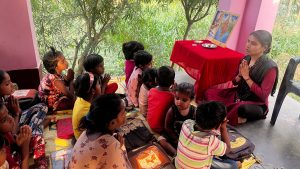
Shammi Shukla teaches Hindu hymns to students, sitting beside photos of Hindu deities in Mishrikh, Uttar Pradesh, India.

Credit: Tarushi Aswani

On a scorching afternoon in Mishrikh, a remote village in northern India’s Uttar Pradesh state, children are gearing up to go to Ekal Vidyalaya. Most children who attend these schools wear tattered clothes and hand-me-down slippers, and carry half-broken and half-chewed pencils.

The school is part of the Ekal Vidyalaya Foundation (EVF), which claims that it aims to ensure children in rural India get access to education. These one-teacher schools are free and offer vocational classes alongside literacy to children aged five to 14 from any caste or religion.

However, the curriculum is firmly rooted in Hindu nationalism.

As children trail behind each other, they can be seen entering a local Hindu temple in their village, where they obediently sit on the floor, which exhales the heat of the sun. Facing a table with photos of Hindu deities neatly placed with the support of incense sticks, children focus all their attention toward the deities.

Shammi Shukla, the teacher at this makeshift school strictly goes by the book. She makes sure that all children, irrespective of their religion, are made to chant Hindu prayers and mantras. “We need to learn who the Adharmis (unrighteous) are and only Hinduism can teach us that,” Shukla said. 

Enjoying this article? Click here to subscribe for full access. Just $5 a month.

“Those who are not Hindus, are Adharmis.

Ekal and Education

This alternate school where Shukla teaches is called Ekal Vidyalaya, meaning a school that belong to the EVF, a U.S.-based organization that sets up private, single-teacher schools in rural India. This concept was conceived in 1986 in India’s Jharkhand;  in 1989, Shyam Gupta, a senior member of the Rashtriya Swayamsevak Sangh (RSS), a Hindu paramilitary organization, stepped in to take over the campaign for Ekal Foundation. 

The Ekal Vidyalaya Foundation of USA was established in 2002. This branch is the primary campaigner for the donations that are received to run schools in India.

Another radical Hindu organization responsible for attacks on Muslims and Christians – the Vishwa Hindu Parishad (VHP) – has boasted of its involvement with the EVF. The VHP’s website states that the launch of the EVF of USA was among “some of the major contributions made by VHP of America.”

Classes at Ekal include a mix of children from all spheres of village life: Hindu upper castes, lower castes, tribals, and Muslims. As of March 2023, Uttar Pradesh housed 17,188 Ekal schools, where more than 519,301 students were enrolled. Students from the ages of five to 14 attend these schools, which provide free non-formal and vocational education.

Shukla, the teacher at the local Ekal school in Mishrikh, feels that Ekals are significantly different from mainstream schools due to their syllabus, which binds together nationalism and Hinduism.

During its investigation, The Diplomat met with Mahender Yadav, the supervisor of Ekal schools in Sitapur district. Yadav, a staunch Hindu, is not shy about proclaiming the Hindu nationalist agenda. 

“Muslims and Christians need to be shown their rightful place in society, they can either accept Hindu supremacy or convert to Hinduism. Ekal prepares children to identify enemies of Hinduism at an early stage,” he told The Diplomat.

Under Yadav, 430 Ekal schools and institutions are able to further their agenda of radicalizing students.

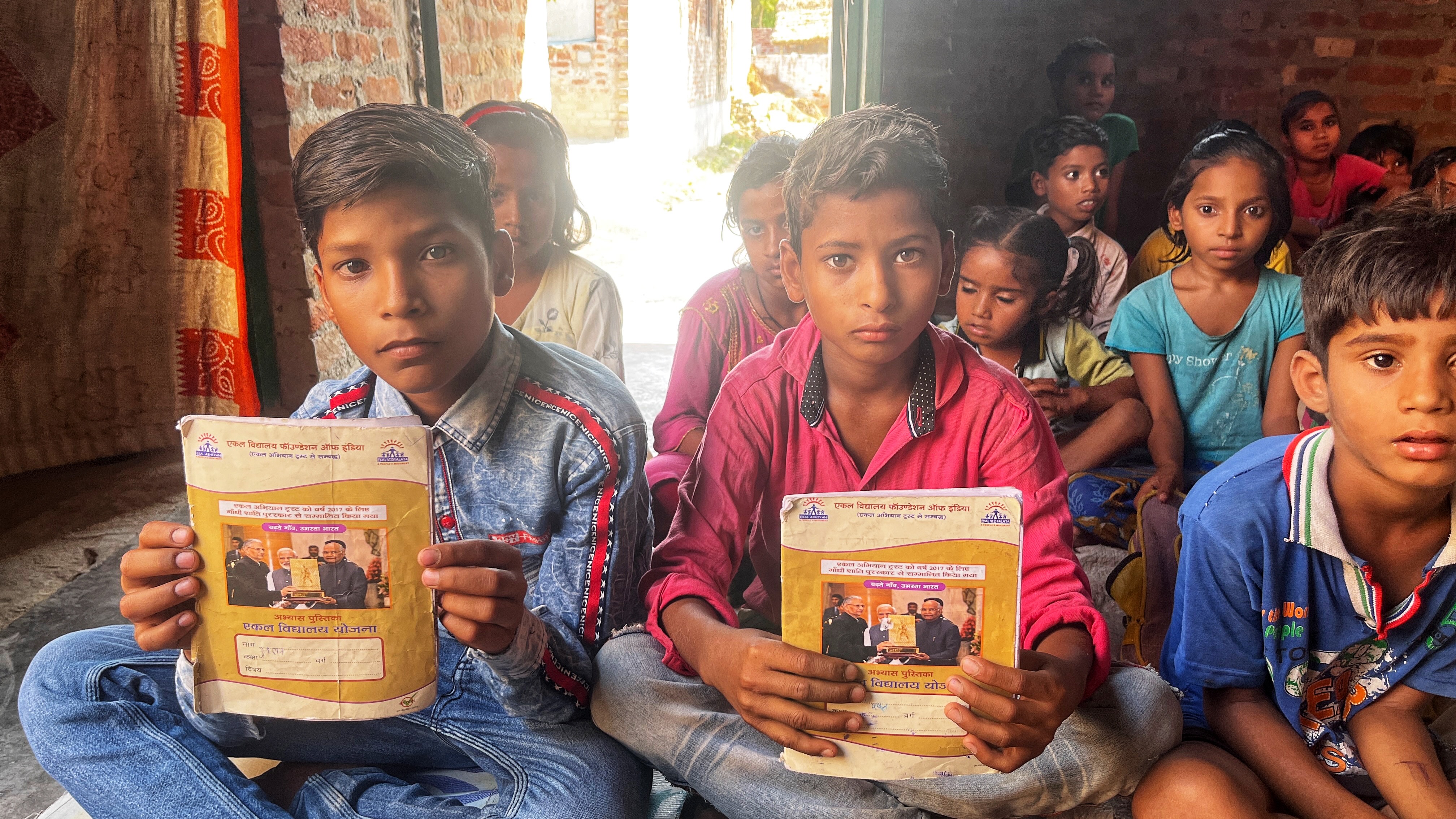
Yadav also shared with The Diplomat a textbook that the teachers follow. Upon even a cursory glance, the reader can glean that the book has doctored stories about how Muslims forcefully convert Hindus to Islam – a narrative that has been pushed since years by radical Hindu organizations in India.

During the lessons that The Diplomat attended at a dozen Ekal schools across Uttar Pradesh, children were being made to correlate the Hindu goddesses to the idea of India as motherland. Teachers at Ekal schools are clear: for them there is no separation between Hinduism and nationalism. 

Hindu students display the textbooks that they received from the Ekal Vidyalaya Foundation in Sitapur, Uttar Pradesh. Photo by Tarushi Aswani

Harnessing Hate

At the same Ekal school, Nikhil Shukla, a 15-year-old student, is an energetic young man who chooses to wear the color saffron, purely because the color is considered holy in Hinduism. Shukla, inspired by his teacher’s understanding of Hinduism, has recently joined the Bajrang Dal, a Hindu nationalist militant organization. 

“Hindu religion is being attacked across India, we need to fight to save it,” Shukla proclaimed. 

Despite being just 15, Ekal has motivated Shukla to join a Hindu militant organization responsible for vandalism at churches and mosques, the murders of several Muslims, and furthering a demand to economically boycott Muslims so as to kill their mode of livelihoods across India.

Owing to the anti-minority harassment, for the the last four years, the United States Commission on International Religious Freedom has recommended that India be designated a “Country of Particular Concern,”a category of governments performing poorly on religious freedom criteria. 

The Diplomat also spoke to two senior officials in the Uttar Pradesh Department of Basic Education regarding the functioning of the Ekal schools. Both officials denied having any information about these schools and their operations. The officials also confirmed that these schools are not affiliated with their department.

Instead, these schools are funded by individual donations and through foundations, including one that was registered with authorities in the United Kingdom until 2020, one in Canada, and one in the United States. According to 990 tax documents, over the last decade, the Ekal Foundation of USA sent over $60 million to its sister organization Ekal Abhiyan in India to run Ekal schools.

In 2009, a report issued by India’s Ministry of Human Resource Development found that the “training to the teachers of Ekal schools was mainly to spread communal disharmony in the communities and also to inculcate a fundamentalist political ideology… creating enmity amongst communities on the basis of religion.” 

Yet, these U.S.-funded schools are allowed to exist in India and those with limited resources are being lured to send their children to these schools.

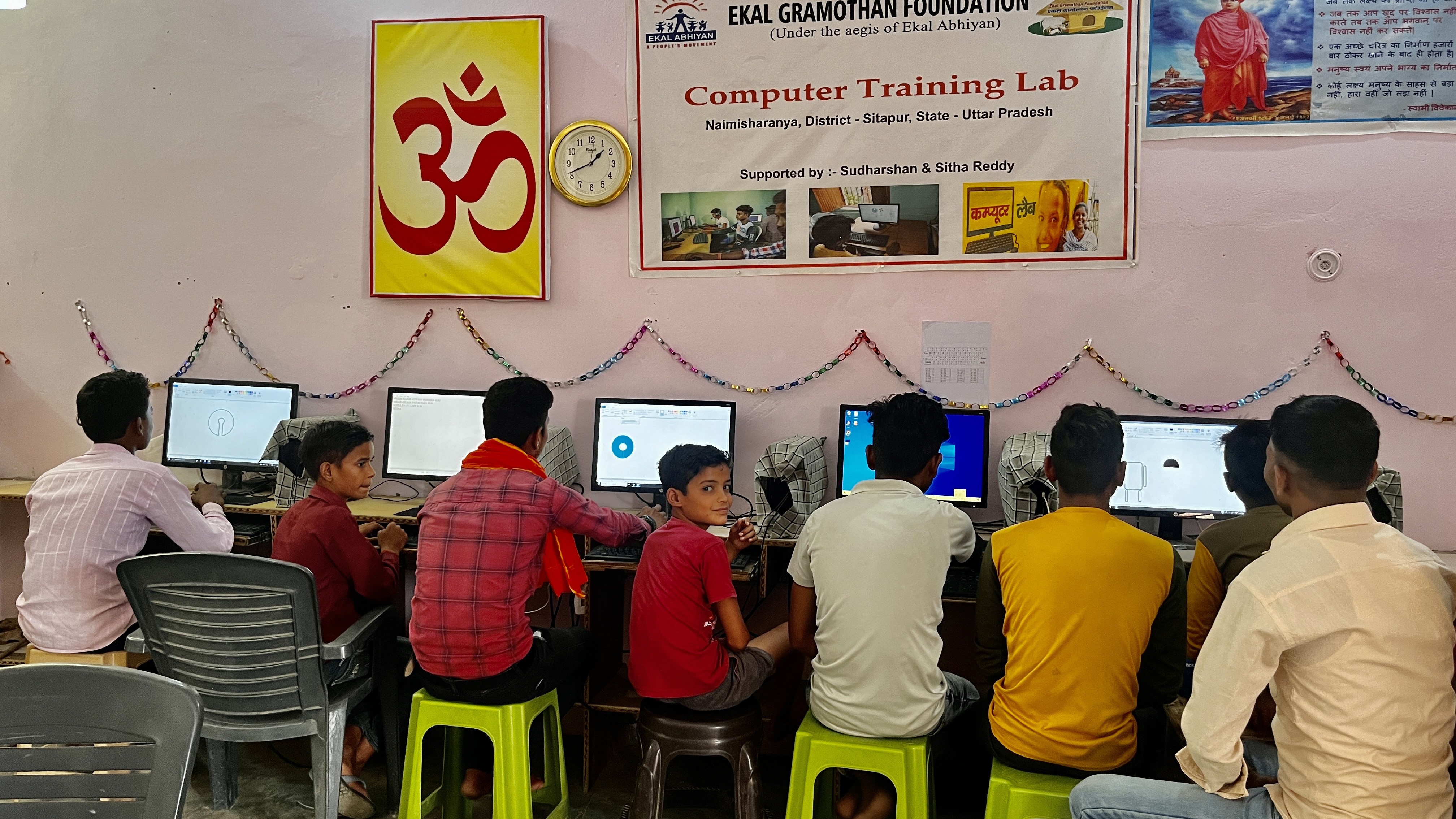
Students learn using computers at an EVF center in Naimisharanya, Uttar Pradesh. Photo by Tarushi Aswani

Poverty and Propaganda

At another school, in Sitapur district’s Naimisharanya village, 30 students await their teacher, Lakshmi Kumari. 

Enjoying this article? Click here to subscribe for full access. Just $5 a month.

As students learned math inside a brick room, Lakhan Pal waited for his daughter, who is a student at this school. Pal, a daily wage laborer at a construction site, said, “I earn $5 a day on good days, so free schools like Ekal are a good option for my daughter, I don’t have to spend on her education then.”

Meethi and Pinky Kumari, two 4-year-olds, also attend the Ekal. While they barely understand anything beyond their ABCs and 123s, their mother Pooja, a recently widowed, unemployed woman sends them there because she is unable to send them to a public or private school. 

Pooja, a Hindu, who chooses to stay indoors since the death of her husband, has no agency to earn money for her daughters and herself. Since her in-laws and parents have mandated her to not venture into the village, Ekal Vidyalaya is the only place where her daughters can learn. 

“I don’t earn and the family is not willing to invest in the education of two girls. Government schools are subsidized, but I don’t have any way even to afford basics such as uniforms, books, and transportation,” Pooja lamented.

The Ekal school is not only free, but provides amenities many of the rural residents can only dream of – such as access to a computer lab, a luxury in a village that is barely electrified. That serves as a potent attraction, drawing students into receiving the Hindu nationalist teachings on offer. 

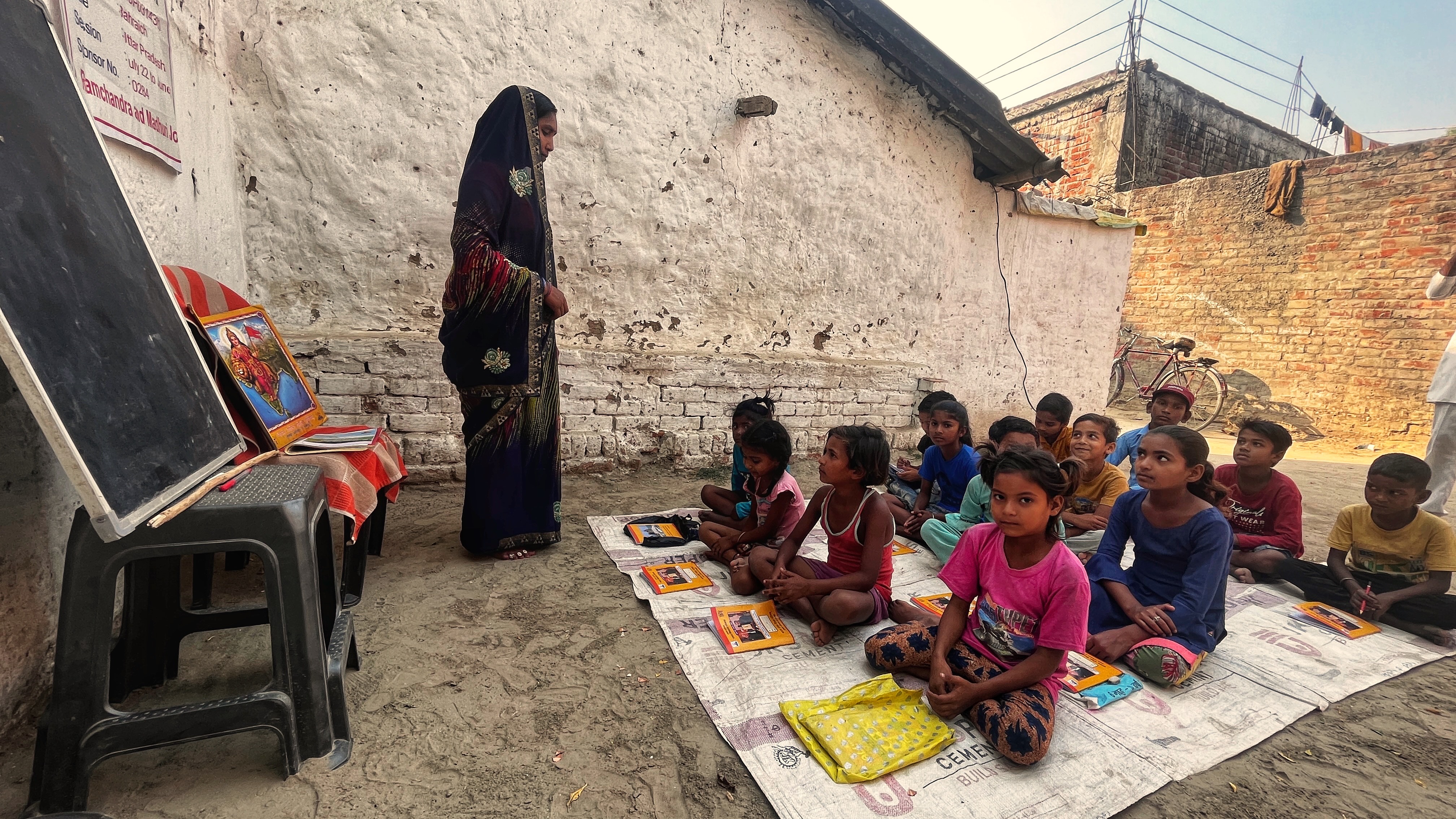
Nidhi Maurya stands in front of Muslim students at an Ekal Vidyalaya in Bahraich, Uttar Pradesh. Photo by Tarushi Aswani.

Sitting 100 kilometers away from Naimisharanya is a Muslim-dominated district, Bahraich. In another Ekal school, Nidhi Maurya in Bahraich’s Gulra village has accomplished a task that has fetched her admiration from her superiors: during her eight-month tenure, Maurya has made Muslim children into Hindu-prayer-reciting students. 

Maurya beamed at the sight of the Muslim girls sitting near her feet. “These Muslim girls know three Hindu prayers – the Gayatri Mantra, the Saraswati Vandana and  Pratah Kaal prayer – by heart,” she boasted.

On being asked why the Muslim girls were being sent to Hindu schools where the goal of the syllabus is to glorify Hinduism and demean others, a Muslim girl named Muskan told The Diplomat, “This school is free, our parents send us here to learn whatever little we can.”

The Muslim students at Maurya’s school are essentially being made to give up Islam in order to gain a free education. 

Filling the gaps in access to education, Ekal is a unique model. While providing decentralized, non-formal education, it mandates that its students to follow and believe in Hindutva, a radicalized form of Hinduism, by making it a part of the compulsory curriculum. Students across Ekal schools are being made to believe that being Hindu equates to being more “Indian” than following another religion. 

While the schools may be free for individual families, they do come at a steep cost for society: deepening communal divisions and further marginalizing hundreds of millions of non-Hindu Indians.

Authors
Tarushi Aswani
Guest Author

Tarushi Aswani

Tarushi Aswani is an independent journalist based in New Delhi, India. She covers stories on human rights, governance, refugee rights, communalism, religion and politics in India.

View Profile
Tags


December 14, 2014

India: Sowing saffron in the north east (Furquan Ameen Siddiqui, Hindustan Times, Dec 13, 2014)

Hindustan Times

Sowing saffron in the north east
Furquan Ameen Siddiqui, Hindustan Times  New Delhi, December 13, 2014

Historically, the north eastern states have been cut off geographically and culturally from the rest of India. Largely populated by tribes- many of whom continue to follow their ancient animist religions- the Seven Sisters of Assam, Meghalaya, Mizoram, Manipur, Tripura, Nagaland and Arunachal Pradesh have always attracted proselytizers, whether it was the Vaishnavites who influenced Manipur in the late medieval period or the Christian missionaries of the colonial period.
http://www.hindustantimes.com/Images/popup/2014/12/North-East-.jpg
RSS-styled assemblies and shakha activities is part of the physical activities assigned for the children. The daily routine includes morning and evening prayers which include singing RSS prescribed patriotic songs and devotional songs praising Hindu gods and goddesses (Photo: Subrata Biswas/HT)
Now, the battle for the hearts and minds of the north east seems set to intensify with the growing presence of the Rashtriya Swayamsevak Sangh (RSS) and its affiliates in the region, who are working to further the Hindutva agenda there. Indeed, the saffron bodies seem to have learnt a good deal from the Christian missionaries they so deride and their message is being successfully propagated through education.
This could have been unremarkable, perhaps even welcome in the absence of a robust secular educational system provided by the state, except that the work of right wing Hindu organisations and the government's deep interest in north east raises several questions; questions about the erasure of indigenous cultures through the indoctrination of children and the propagation of the idea that the
area's animist cultures are actually a strand of the ur-Vedic religion that's also the precursor of modern mainstream Hinduism.
The eventual hope seems to be to reap political dividends. 
Last week, RSS affiliates in north India caused controversy by conducting public 'reconversions'. Another bigger event is planned for Christmas in Aligarh. Under attack, the government mooted an anti-conversion law to be followed by all states and the Centre. During a debate in Parliament on the same topic, union minister Venkaiah Naidu, while quoting Sardar Patel, said: "It is well known that in this country there are mass conversions by force, conversions by coercion and influence. And, we cannot deny the fact that children have also been converted."
"We consider every tribe to be a part of Hindu or Sanatan Dharma. We consider all Vanvasis a part of this larger Dharma," says Rajesh Das, Sangathan Mantri (organisation secretary) of Vanvasi Kalyan Ashram, which runs a growing network of schools, hostels and temples in the north east. Das, who supervises the ashram's projects in Tripura and Mizoram, believes the tribals of the region are being guided to the right path through a holistic and nationalistic approach. Das, just like other karyakartas in north east, is not in a hurry either. "We'll see what happens to them [tribal identity] after 100 or 200 years."
In February this year, the long-standing conflict between the Mizo and the Bru (Reangs in Tripura) tribes took me to that corner of the country. In 1998, thousands of Bru tribals had fled Mizoram following ethnic clashes with Mizos. They had taken refuge in the bordering areas of Tripura. Today, some 35,000 refugees remain stranded in the camps scattered around the remote reaches of Kanchanpur, a sleepy hamlet in Tripura.
In 1998, the Vanvasi Kalyan Ashram (VKA), an RSS affiliate in tribal areas that provided relief at the camps, had stirred trouble by claiming that the Brus were Hindus. 17 years later, in February 2014, there was no overt sign of the VKA's relief work at the camps. Instead, there were religious mandalis or groups. At the Santipara camp, I met Manikya Reang, a Bru tribal who had fled Mizoram at 14 and sought refuge in one of the seven camps in Tripura.
When I first met Manikya as a Hindustan Times reporter, he didn't care about my name but was insistent about finding out my religion. I gave him a fictitious Hindu name, Sanjay, which stuck as my chain of contacts expanded through him.
The Brus, like many northeasterners, were originally animists - many still are- and believed in the spiritual essence that inhabit inanimate. The concept of worshipping idols or symbols is completely alien to them. Many were initially converted by Christian missionaries. Some of those who escaped Mizoram after the troubles continued to follow animism.
http://www.hindustantimes.com/Images/popup/2014/12/SBS-MN_North-East-.jpg
Lighting up of incense, diyas and praying to symbols and images have replaced some traditional Apatani rituals blurring the lines between indigenous practices and north Indian Hindu rituals (Photo: Subrata Biswas/HT)
After the VKA reached the camps, a large number have turned toward Hindu deities. A Bru priest of the Shiva mandali recalls that his people accepted Hindu gods, and eventually formed Ram or Shiva mandalis or groups. Manikya didn't just turn toward these mandalis, he became a purna kaaleen pracharak (full time worker) of the Vishwa Hindu Parishad (VHP).
Since 2006, Manikya has been preaching to displaced tribals about the Hindu way of life and about Bhartiya sanskaar (Indian values), and has been involved in opening schools in remote areas. Soft-spoken, short and lean, Manikya, who is in his thirties, spoke in the fluent Hindi that he had picked up during his stay at a VHP-affiliated hostel in Banswara, Rajasthan, which he also credits with his 'return' to Hindu dharma.
"The daily routine involved learning about our motherland, patriotic songs and our history," he says. When asked why he was converting animists to Hinduism, he insisted that his people had always been Hindu. "It's just because of the lack of education and awareness that we call ourselves different," says Manikya who claims to have opened, in the last six years, more than 340 Ekal Vidyalayas or one-teacher schools in Tripura, Assam and Manipur. More than 12,000 children now attend these schools.
A concept introduced by the Ekal Vidyalaya Foundation of India (EVFI), which is involved in setting up non-formal schools in remote areas, the Ekal Vidyalays have one trained local teacher and about 40 students, who are taught for three hours. The emphasis is on imparting 'holistic education', which includes Hindu prayers, 'Indian values' and promoting nationalism.
Posters of Swami Vivekananda and Goddess Saraswati look down from the walls of one thatch-roofed, makeshift Ekal Vidyalaya on the banks of a small stream at a refugee camp. Here, about 15 students of different ages are listening to a local 'Guruji'. On being urged by Manikya, the students recited a few prayers in Sanskrit.
Ekal Vidyalaya is just one of the many initiatives run by RSS affiliates in the region. Others like Sewa Bharati, Vidya Bharati, Vanvasi Kalyan Ashram, Friends of Tribal Society (FTS) or Van Bandhu Parishad (VBP), Vishwa Hindu Parishad, Bharat Kalyan Prathisthan (a unit of the VHP), Bharatiya Jan Seva Sansthan (BJSS) and the Rashtriya Shaikshik Mahasangh have also been running both formal and informal education units including balwadis (pre-schools), Bal Sanskar Kendras, hostels, residential schools, night schools, coaching centres and primary, secondary and senior secondary schools across the north eastern states.
Much has been written about the growth and spread of the saffron influence in the tribal pockets of western and central India. However, the campaign to saffronise the tribal belts of the north east has gone almost unnoticed. According to Seva Disha, a five-yearly RSS report on the activities of the Sangh Parivar, its presence has grown at a steady pace.
http://www.hindustantimes.com/Images/popup/2014/12/SBS-MN_North-East.jpg
Students in a hostel run by Vidya Bharati affiliated Abotani Vidya Niketa in Old Ziro. Children, as young as six or seven, are brought in from remote border parts of the state to this residential school (Photo: Subrata Biswas/HT)
In 1995, the RSS and its subordinate associates had only 656 units in the north east, which is divided into two prants or regions- Uttar Assam and Dakshin Assam. According to the last available report, the figure had reached 5,198 units by 2009.
Looking for clean slatesSince its inception in 1925, the RSS has recognised the centrality of education in any project to gain prominence and power. Towards this end, it has focused its energy primarily on propagating its ideology through education. Going by their own figures and claims in Seva Disha reports from 1995 to 2009, nearly 50% of all their sewa karyas is dedicated to educational activities.
In the book Khaki Shorts and Saffron Flags: A Critique of the Hindu Right, Tapan Basu, Pradip Datta, Sumit Sarkar, Tanika Sarkar and Sambuddha Sen wrote: 'It is not surprising that Hedgewar (RSS founder Dr KB Hedgewar) began with boys of 12 to 15, and that RSS has always tried to catch its recruits at a very tender and impressionable age. "Leave aside the minds already crammed with well-formed opinions," RSS workers are told, "and concentrate on clean slates."
The utter failure of the secular Indian state to provide even primary education in large swathes of the north east has left a void there. Despite registers showing growing numbers of schools opened and teachers, the truth is that the scene is grim. For many decades, the only major private educational enterprise in far-flung parts of the country was the Catholic church with its schools and colleges.
Christian missionaries of different denominations have been working in the area since colonial times. Today, more than 70% of the population of Mizoram, Nagaland and Meghalaya are Christian and the numbers are growing in Manipur and Arunachal too.
"It is a fact that the whole north east owes a great deal to the Christian missionaries," says Bishop John Thomas Kattrukudiyil of St Joseph Cathedral, Itanagar, referring to the large percentage of the educated population of these states who attended Christian schools. The RSS and its sister organisations, however, beg to differ.
 http://www.hindustantimes.com/Images/popup/2014/12/DLI-BK-WE_TripuraVHPSc.jpg
Manikya Reang, a VHP karyakarta working in the Bru refugee camps near Kanchanpur, Tripura claims to have opened, in the last six years, more than 340 Ekal schools in Tripura, Assam and Manipur with more than 12,000 children attending (Photo: Burhaan Kinu/HT)
"In the garb of providing them with a good education, the Christians have converted the uneducated tribals. We are just trying to bring them back," says Srikrishna Bhide, sangathan mantri or organising secretary of VKA in the north east.
The latent animosity among some tribals towards Christian proselytisation and their own fears about losing their cultural identity has, in a convoluted way, helped the spread of Hindu nationalist organisations.
From Guwahati in Assam, to Agartala in Tripura, to the small towns of Pasighat and Ziro in Arunachal Pradesh, every worker of the RSS, VKA or VHP that I met repeated the same words when asked why they considered the area's tribals to be Hindu- "Sanatan Dharma". A term of antiquity, it became popular in the 19th century as a 'native' name for Hinduism during the Vedic period and was liberally used during the Hindu revivalist movement of the period.
Of brainwashing and indoctrination
In its January 16, 2005 edition, RSS mouthpiece, Organiser quoted the-then VHP general secretary Pravin Togadia as saying, at a gathering in Rohtak, Haryana: "With a view to create awareness among the villagers, the VHP has decided to start Ekal Vidyalayas and other service projects in 25,000 villages of the country".
He added that "the VHP wanted to expand its work in such a way that the Hindus, whenever the need arose, could foil any conspiracy in the society".
The anti-Christian sub-text is strong in all the branches that I visit in Tripura, Assam, Meghalaya and Arunachal Pradesh. Nibaran Mahato, a full-time member of Arunachal Vikas Parishad (AVP), an offshoot of VKA, whom I met in Itanagar in April this year, puts the organisation's fear bluntly: "We work with the community and prevent them from becoming Bharat Vidrohi (anti-India)".
Mahato claims that the focus of the Christian missionaries has always been to target tribes that are relatively richer and occupy a higher rank in the hierarchy.
"This way, they can convert the weaker ones easily," he says. "We work with all the communities and help them develop without any discrimination."
http://www.hindustantimes.com/Images/popup/2014/12/DLI-SBS-MN_North-East-.jpg
A Christian dominated neighbourhood in Itanagar. Throughout Arunachal Pradesh religious allegiance is evident with these symbolic assertions. A white triangular flag with a red sun is symbolizes that the house follows Donyi-Polois and helps in warding off Christian missionaries (Photo: Subrata Biswas/HT)
Mahato, who is from West Bengal, is a product of VKA's education programme and is in charge of a balwadi where his wife teaches. Like many other karyakartas working in the north east, Mahato believes that once a tribal community adopts a 'foreign' religion like Christianity or Islam their nationalism starts to diminish.
Khawang Lowang, principal of the Abotani Vidya Niketan school (a branch of Vidya Bharati schools, an educational front of the Sangh with several branches in the north east) in Ziro has been a part of the RSS since the 1990s when the organisation first entered the region.
Located in picturesque Old Ziro, where most people belong to the Apatani tribe, the school runs a hostel for children from remote border villages that are not even connected by road. Its students belong to tribes that follow different forms of animism including Donyi Polo, Intay and Rangfra, apart from Christianity and Buddhism.
Lowang, a Nocte tribal from Changlang district says young people are being seduced by the Western influences that the Christian missionaries bring. "It's the lure of an English education and western culture that attracts young ones to the Church and their schools," said Lowang. "When we started there was a lot of opposition against opening a 'Hindu school'; now we get students from all the tribes."
A day in the hostel starts with pratah vandana (morning prayers) that involves reciting Sanskrit slokas. The evening assembly complete with the RSS salute is held in front of a saffron flag. This is followed by sandhya vandana (evening prayers). The vandana session involves singing devotional songs or bhajans before pictures of Hindu gods followed by patriotic songs prescribed by the RSS.
The prayer room is adorned with portraits of Swami Vivekananda, Sangh leaders like KB Hedgewar and MS Golwalkar, and of Bharat Mata holding a saffron flag instead of the tricolor! Students are required to recite the Ekatmata Stotr in praise of Bharat Mata at the start of the day. The stotr names places associated with Hindu saints, poets, kings and queens, Hindu sacred geography, myth, and the sacred books of the Hindus, Jains, Buddhists and Sikhs, and finally praises RSS leaders Hedgewar and Golwalkar.
The curriculum makes it clear that the Bharatiya sanskriti followed in these schools is actually mainstream north Indian Hindu sanskriti. Following on the RSS ideology of Hindi-Hindu-Hindustan, Hindi is part of the 'core curriculum' and extra effort is expended to promote it.
While inaugurating a Vidya Bharati school in a village in Gujarat's Bharuch district, in June this year, RSS sarsanghchalak Mohan Bhagwat said, "Five years ago, we started a Vidya Bharati school in Nagaland. Today, the children studying there speak Hindi. We are glad that we have been able to spread the spirit of nationalism there."
http://www.hindustantimes.com/Images/popup/2014/12/MN_1North-East-.jpg
A Donyi-Polo Gangging in Pasighat, Arunachal Pradesh. Ganggings are temple-like congregational halls constructed during the Donyi-Polo movement to revive and promote indigenous practices. The Ganggings stand heavily influenced by Hindu rituals (Photo: Subrata Biswas/HT)
He added that it was unfortunate that people see Vidya Bharati as a violent organisation when it was just educating tribals to make them aware of what is happening around them. "It is untrue. The aim is to educate through the tenets of the Hindu way of life," he said.
In 1996, the National Council of Educational Research and Training (NCERT) evaluated school textbooks in Vidya Bharati run schools and pointed out that 'the Vidya Bharati schools are being clearly used for the dissemination of blatantly communal ideas' and that their Sanskrit Jnan series (taught in every Vidya Bharati school) is 'designed to promote bigotry and religious fanaticism in the name of inculcating knowledge of culture'.
School of thought
According to the statistics on their website, Vidya Bharati has more than 13,000 formal schools and nearly 10,000 Sanskar Kendras and one-teacher schools (run primarily in rural and Vanvasi areas) with a combined strength of over 33.5 lakh students all over the country. In Assam alone, Vidya Bharati affiliated Shishu Shiksha Samiti- that runs Sankardev Shishu and Vidya Niketans- claims to operate 470 schools with around 1.19 lakh students.
Formal schools affiliated to Vidya Bharati functions within the parameters of an organised, formal education system, where the school follows the syllabus and books prescribed by state or central examination boards- usually deviating in a few respects: the inclusion of yoga, Sanskrit and moral and spiritual education.
Similar to Vidya Bharti, the Vivekananda Kendra Vidyalayas (VKV) of the Kanyakumari-based Vivekananda Kendra operates a number of schools in the north east, primarily in Assam and Arunachal Pradesh. The Vivekananda Kendra is another beneficiary of the foreign funding that the Sangh receives. In July 2014, a report (Hindu Nationalism in the United States: A Report on Nonprofit Groups) on non-profit groups in the US affiliated with the Sangh Parivar mentions Vivekananda Kendra International as one of those that receive funding.
In Arunachal alone, under the aegis of the Vivekananda Kendra Shiksha Prasar Vibhag (VKSPV), the VKV is administering 33 schools, whereas in Assam, the number stands at 18 schools. VKVs too promise 'value-based education' and patriotic upbringing of 16,000 students that go to these schools.
What makes the Ekal Vidyalayas - run by VHP, VKA, Vidya and Sewa Bharati in tribal pockets of Assam, Manipur, Nagaland, Mizoram and Tripura, and VBP or FTS in the tea estates of Upper Assam - different from these formal schools is the apparent lack of interest in professionally running the schools or training teachers, and the lack of a concrete curriculum. The spread of Ekal Vidyalayas in the north east has been exponential. The current count of such non-formal schools stands at 3923 with more than 1.13 lakh tribal students.
http://www.hindustantimes.com/Images/popup/2014/12/DLI-SBS_North-East-.jpg
Children in one of the villages inside a tea estate in Dibrugarh recite a prayer from the notebook distributed by RSS affiliated Van Bandhu Parishad that runs several Ekal schools in the tribal/rural villages across the country (Photo: Subrata Biswas/HT)
A one-teacher school entirely depends on the acharya/guruji or the teacher. Gurujis are mostly local youth who are supposed to be selected by the gram samitis, but in reality, are selected by the regional pracharak. These gurujis are trained in steps: first through a five-day training shivir (camp), then a three month teaching probation and a final ten-day training shivir. These schools serve a medium of contact with the villagers and the teacher is the eyes and ears of the Sangh.
"They aren't just teachers," says Rajesh Das. "The teacher is also a karyakarta, and that karyakarta keeps the organisation updated of what is happening in the village."
In one bagani (estate) tribal colony buried deep in one of the tea estates of Dibrugarh, some 30 kms from the city, Van Bandhu Parishad or FTS runs a one-teacher school. In the district alone, the Ekal Vidyalaya Foundation claims to operate 271 schools attended by more than 8000 children. Most of the baganis who live in these tea estates hardly knew about Ekal Vidyalayas.
All they had heard about was a school that functions for three hours soon after the government schools are over. Run in the government structure designated for aanganwadi, this Ekal school is overseen by a 22-year-old guruji, Mithuram.
When I asked Mithuram about the need for a school when there was already a government school nearby, he told me what every other karyakarta has been saying - the curriculum includes teaching good manners to the students and learning about Hindu Dharma, daily recitation of Saraswati and Guru Vandana and Deshbhakti and Omkar geet (devotional and patriotic songs) that are not taught in government schools.

Going by the text
A committee setup by the Ministry of Human Resource Development (MHRD) in 2005 headed by human rights activist Avdhash Kaushal submitted a report that found communalisation rampant in Ekal Vidyalayas and in their textual materials and curriculum. The committee surveyed Ekal schools in Jharkhand's Singhbhum district and in Assam's Tinsukia and Dibrugarh districts.
These Ekal Vidyalayas run by FTS, as the committee found, were even funded by the then BJP-led NDA government. The funds sanctioned were not only from the HRD Ministry but also the Ministries of Rural Development, Tribal Welfare, Science and Technology and Women & Child Development. The funding was later stopped by the UPA government after the committee recommended that the grants given to FTS be frozen. As if communalisation wasn't bad enough, the students at the non-formal educational units are not even receiving a halfway decent education.
http://i.imgur.com/bv1oBrF.gif
Take the case of the balwadis run by VKA in many parts of Arunachal. They work on similar lines to Ekal Vidyalayas that function as a pre-school of sorts. A visit to these balwadis in Itanagar, Ziro and Pasighat revealed a lack of interest in running such schools professionally. Many are run out of shacks or abandoned structures and basic amenities were absent.
The teachers hired quit quite often. But perhaps, as Mahato himself admits, the idea is not to run these 'institutions' professionally. "We don't want to run these schools as professionals. Schools, balwadis or health centres that we run are all set up to create a way into the community. Then we work with the community to counter Christian missionaries," he says.
Going local to go national
In Meghalaya, the model of the Sangh's educational network is markedly different. Several schools that operate in the villages do so as local Seng Khasi schools. Seng Khasi, an indigenous cultural and socio-religious organisation in Meghalaya started a school and a college in Shillong.
However, several independent Seng Khasi schools mushroomed in the remote reaches of the state and were named after the mother organisation.
VKA organising secretary of Meghalaya, Dr Vishwamitra Batra, said the Sangh funds and supports several independently running Seng Khasi schools in the state. Support ranges from helping set up a school, to providing books and stationery to hiring and paying teachers.
Another RSS supported organisation Lei Synshar Cultural Society (LSCS), hardly known outside the small town of Jowai in the Jaintia hills, has been sending scores of kids from Meghalaya to Karnataka. After the 2009 Tehelka story about the saffronisation of young minds and about children being sent to other states with the help of RSS volunteers, locals are wary of speaking about it, but continue to send their children to Karnataka.
In 2011, 165 children were reportedly sent by the society to southern states. The society claims to have sent more than 1000 children to various schools in Karnataka, Kerala and Tamil Nadu run by Trusts, Sadhus and Mutts. According to Swear, a local businessman and a member of LSCS who supervises the running of one such school, the Sangh is spreading the spirit of nationalism and supports them in safeguarding their identity.
"People in the villages are too poor to afford even food for their children; then how are they going to bear the expenses of a decent education? This is where RSS and Lei Synshar steps in by helping kids to get education outside the state," he says.
In February this year, the Madras High Court took up an alleged trafficking case of 20 minor girls between the ages of 8 and 13 from Jowai and nearby Pynursla. The girls were rescued from a Trust that ran a hostel in Hosur, Tamil Nadu and were sent by LSCS. Batra denies an RSS role in sending children outside the state.
The VKA and VHP also run several hostels in different parts of the country. According to the VHP website, it runs 89 hostels, 34 orphanages and 15 residential schools across the country. The VKA operates 225 hostels with a strength of 7,774 children in various parts of the country.
North eastern children are primarily sent to hostels in the states of UP, Delhi, Haryana, Rajasthan, Maharashtra, Chhattisgarh, Karnataka and Kerala. With so many schools run by the Sangh and its affiliates in the region, why send the children to hostels outside the state?
According to Sewa Disha, the 'hostels for students belonging to north eastern states and other vanvasi areas [are run] to counter separatist mentality and convince the students that they are a part of the mainstream of our country.' The hostels also help the Parivar to propagate their Guruji's ideology and mould these children. Indeed, Manikya says it was his time at the VHP hostel in Banswara that made him realise that he has always been a Hindu.
Smells of social engineering      Speaking during the launch of his book Jyotipunj in Rajkot in 2008 - attended by RSS sarsanghchalak Mohan Bhagwat and VHP leader Sadhvi Rithambara- the then chief minister of Gujarat, Narendra Modi had quoted an instance where political leader Jayaprakash Narayan had attended one of the Sangh meetings and found it surprising when every worker introduced himself with his Sangh aayu (sangh age) - a measure of how much one worker has spent his life as a Sangh worker.
He says that Narayan was surprised and wondered how anyone can give 30-40 years of his life for one work, one thought and one mission. The karyakartas or pracharaks that I met in the north east were no different. They were in different stages of their Sangh aayu, working towards one mission- to convince animist tribals that they have always been a part of the larger 'Hindu fold', a part of Sanatan Dharma.
http://www.hindustantimes.com/Images/popup/2014/12/MN_North-East-.jpg
An Apatani village just outside the small town of Ziro in Arunachal Pradesh. The traditional prayer rituals in Apatani has now been Hinduised after the Hindu organisations like RSS and AVP started working in the area (Photo: Subrata Biswas/HT)
Arunachal Pradesh holds a special place among the RSS cadre as the state shares a border with China. Both Chinese claims over the parts of the state and the spread of Christian missionaries is a major concern and their call for nationalism across the state is much louder.
"There was a conscious effort by the state to keep Christianity out of Arunachal. Hindi and Hinduism were promoted to make Arunachalis different, a buffer zone between Indians and Chinese," says John Dayal, civil rights activist and co-founder of the All India Christian Council.
About 30% of the state's population - Arunachal prohibited the use of bribery or coercion for conversion in 1978 - follows animistic traditions like Donyi-Polo.
In the late 1980s, the small town of Pasighat, home to the Adi tribe began to see a revival of the Donyi-Polo religion. Talom Rukbo emerged as the father of Donyi-Polo and suggested recovering and recording endangered rituals, prayers, and hymns on paper. Soon, other tribes of Tani and Apatani followed. In the decade that followed, Rukbo was heavily influenced by the RSS and its affiliate the Arunachal Vikas Parishad (AVP), a front that the Vanvasi Kalyan Ashram took when objections were raised about starting the organisation in the state.
Rukbo was made the first president of AVP and received support for his movement. Twelve years after the death of Rukbo, the AVP seems to have gradually taken over the movement. As a result, the difference between local rituals and Hinduism as practiced in north India has blurred. Traditional practices have mingled with borrowed Hindu ones like the lighting of diyas and incense during prayer.
The Ganggings, the Donyi-Polo congregation-prayer halls, now have a bell like the one in a Hindu temple. Symbolism is prominent in the AVP's promotional work and Donyi-Polo followers are asked to put up a flag, a white triangular one with the image of the sun on it, to ward off Christian missionaries. Books and pamphlets on Donyi-Poloism are published and distributed by the AVP, along with lockets and an image designed by the AVP for the tribals to pray to.
Talum Rukbo's counterpart and a leader of the Donyi-Polo Mission, Kaling Borang, who is involved in the documentation of indigenous scriptures, thinks Rukbo had made a mistake by seeking the help of Hindu organisations like the AVP and the RSS who later hijacked the movement. Borang, however, believes their influence has faded out after Rukbo's death.
So smooth, they can't tell
However, the Parishad and RSS pracharaks in the Apatani and Adi belt are very influential and their success lies in how their ideas have been absorbed and internalised by tribal people like Yabor Tagbo and Taga Borang, who belong to the Adi community. Tagbo and Borang, who are teachers, are convinced that their local beliefs overlapped with that of Hindus.
"We tribals didn't have any religion; we just had different tribal practices. Even though they look different, they have come from the same source," they say.
Tapan Basu, one of the authors of Khaki Shorts Saffron Flags believes a kind of colonisation is underway in many parts of central and eastern India. "There are little traditions or indigenous practices present in these [tribal] regions that can't be in any way be called or associated with Hindu traditions or practices," he says.
The extent of the internalisation of north Indian Hindu belief can be seen in the subtle shift in dietary habits. Traditionally, meat forms a major part of the diet of the Adis. Both Tagbo and Borang said that once they became part of the AVP, they started going to Hindu temples and tried not to eat meat when they went.
http://i.imgur.com/YzeuoEc.gif
One of them had even taken a dip in the Ganga at Haridwar and had brought back Gangajal for the local temples. Earlier, the holy river revered by mainstream Hindus had no religious significance in the tribal belts of the north east.
The Sangh's social engineering project also continues in Ziro valley's seven villages, home to the Apatanis. Gyati Pada, a forest official, is a member of the local AVP and looks after the balwadis. While many in the Adi tribe are convinced that their faith is part of the Hindu fold, most Apatanis disagree. Pada said he joined the AVP because it offered to support their struggle to preserve their faith, but maintains that their faith and Hinduism are very different.
Pada, who has been to several religious places of northern and southern India on a trip sponsored by the AVP, is unhappy that many native practices have started to resemble those of the Hindus. The Hindu influence has seeped into the local temples too. People living in Ziro now know the Shiva temple as the Donyi-Polo Shiva temple, a name that's engraved on the entrance. Similar to the concept of Donyi-Polo Ganggings built in Adi areas, a Meder Nello (the newly-adopted Apatani place of worship) was started with the support of the AVP in one of the seven villages occupied by the tribe near Old Ziro.
In eastern Changlang district, a separate project has developed a version of idol worship which was absent in the traditional Rangfraaism followed by the Tangsa, Tutsa and Nocte tribes. Earlier, the supreme spirit Rangfra revered by these tribes wasn't bound to temples, idols or any form earlier.
Political dividends
While the Sangh Parivar tries to bring the tribes of the north east into the Sanatana Dharma fold, it can be assumed that the political fruits of these efforts will be reaped by its political face, the ruling  Bharatiya Janata Party. Although these projects are yet to lead to any political gains for the BJP, the election results in Assam this time might shed some light on the future benefits of the RSS' massive social engineering project.
For the first time, the BJP won seven out of the 14 parliamentary seats in Assam. More remarkably, it made inroads into a traditional Congress stronghold - the tea garden workers and Adivasi communities in upper and northern Assam, in Dibrugarh, Lakhimpur, Jorhat and Tezpur.
Political outcomes in the central part of the country might shed some light on how the RSS's political arm is sweeping across the tribal regions. BJP won 32 of the 39 tribal reserved seats it contested during the Lok Sabha elections - clinching proof of the party's popularity among tribals. It also won 10 of 11 seats, controlling two of the four tribal reserved seats in Chhattisgarh. 
"It's a long-term investment. The RSS continues to try and build an opinion in civil societies, through education, for example. Once they do so, it is very easy for them to capture power because when people go to vote, they'll think of voting for a Hindu party," says Tapan Basu.
The changing dynamics in the tribal areas of Chhattisgarh has led to some communal unrest. The VHP along with a BJP MP from Bastar conducted a 'ghar wapasi' (Home returning) ceremony claiming to 'reconvert' 35 tribals to Hinduism. The event prompted attacks on church goers. Several such incidents have been reported from nearby Jhabua and Dhar, and from states like Odisha, Gujarat and Jharkhand. The north east seems to be headed for a similar fate.
Opium of the masses?
However, the Hindu nationalist RSS has always claimed to be a cultural organisation with no interest in politics but with one thought, one mission - the dream of achieving a Hindu Rashtra. To achieve that objective, the RSS and its affiliates run projects that recognise the part that education plays in moulding young minds.
"The school is embedded within a tight and comprehensive range of institutions that would, in calibration, coordinate the child's leisure, education, ideological growth and religious understanding', writes Tanika Sarkar in a paper on the Historical pedagogy of the Sangh Parivar.
Patriotic songs, disciplinary drills, sports and special curricula that favours a surrendering of individuality is as much a part of the educational experience at these schools as it is at any neighbourhood shakha. This method of combining both physical and psychological tools to propagate ideology among children can be gleaned from a story that Golwalkar loved to relate: A rich man who saw a beautiful peacock in his garden gave it food mixed with opium. The peacock started coming every day. Eventually, it got so habituated that it came regularly at the appointed hour even without the opium.

http://i.imgur.com/ZGplGro.gif

Source: http://www.hindustantimes.com/india-news/sowing-saffron-in-the-north-east/article1-1296264.aspx

July 04, 2014

India: Interview with Hartosh Bal on Ekal Vidyalayas | Anand Ranganathan

Interviewing Hartosh Bal on Ekal Vidyalayas

by Anand Ranganathan
July 4, 2014
http://www.newslaundry.com/2014/07/04/interviewing-hartosh-bal-on-ekal-vidyalayas/


July 01, 2014

A report on the Hindu nationalist circuit in the US

released by sacw.net - 1 July 2014
http://www.sacw.net/article9057.html

February 07, 2012

Communalism in School curriculum via Sangh Parivar's “Indianisation reforms”

From: Frontline, 11 February 2012

Communal curriculum

VENKITESH RAMAKRISHNAN

The Sangh Parivar is systematically following its “Indianisation reforms” in schools run by its affiliates.

SAJJAD HUSSAIN/AFP

A BJP leader holds a copy of the Bhagvad Gita. In November 2011, the BJP governments in Madhya Pradesh and Karnataka introduced lessons on the Bhagvad Gita in schools.

THE attempts of the Rashtriya Swayamsewak Sangh (RSS)-led Sangh Parivar at “saffronising” education attracted widespread attention between 1998 and 2004 when the Hindutva combine's political arm, the Bharatiya Janata Party (BJP), held the reins of power at the Centre. During that period, especially between 1998 and 2002, the BJP's Human Resource Development Minister Murli Manohar Joshi advanced a number of initiatives self-professedly aimed at making “the content of education in the primary, secondary and higher stages Indianised, nationalised and spiritualised”.

Specific proposals were brought in as part of this effort in various fora, including at the national-level conferences of State Education Ministers and the National Council of Educational Research and Training (NCERT). These proposals argued for the incorporation of studies on the Hindu way of life and also the Vedas and the Upanishads into the curriculum. The strong response and resistance to these moves from academics, educationists and secular political parties forced the Sangh Parivar to give up these “Indianisation reforms”. However, periodic reports emanating from different parts of the country, particularly from the States ruled by the BJP, have underscored the fact that the party and its multifarious associate organisations in the Sangh Parivar are systematically and quietly pursuing the Hindutva agenda in education.

In November 2011, the BJP governments in Madhya Pradesh and Karnataka introduced lessons and discourses on the Bhagvad Gita in schools. They sought to make the teaching of the Gita compulsory. But following widespread opposition from political parties, educationists and even Education Department officials, the governments in both the States were forced to make Gita studies optional. A Central government official told Frontline that officials in Karnataka had cautioned the State government that the introduction of Gita studies in the syllabus would lead to divisions among students from different backgrounds.

According to Father Cedric Prakash Lobo, an Ahmedabad-based social activist, attempts at saffronisation are being pursued in a discreet manner in Gujarat. “On paper, the highly objectionable anti-minority, gender-insensitive contents of various textbooks introduced in Gujarat in 2001 have reportedly been withdrawn. But these portions are still brought into discussion in classrooms across the State.” The portions referred to by Father Prakash Lobo include the ones that brand minority communities as “one of the foremost problems facing the country”. This portion, introduced in the social studies textbook of class IX, was under the chapter titled “Problems of the country and their solutions”. It listed “minority communities” as the foremost problem, followed by the Scheduled Castes and the Scheduled Tribes, smuggling, corruption and bribery. The chapter also termed Muslims, Christians and Parsis as “foreigners”. The government claims that these portions have been erased, but reports from different parts of the State indicate that references are made to these portions even now.

Father Prakash Lobo told Frontline that the elaborate but subtle political and ideological game being played in the State's education sector subverts the constitutionally mandated parameters of the education system. Chief Minister Narendra Modi figures in the classrooms, from the primary to higher levels, in various forms. Modi's life story is part of the suggested reading for classes at the secondary level. On Teachers Day, you see Modi addressing classes across the country through television and the Internet. “In many ways Teacher's Day is not the day of teachers in Gujarat, it is Modi projection day,” Father Prakash Lobo pointed out. According to a senior official in the Central government, the saffronisation initiatives of the BJP-ruled States are at complete variance with the current requirements of the educational system and the curriculum. “What is required is the upgrading of the study material and its orientation to a changing world. But these State governments do not seem to have this as a priority.”

While attempts are being made in fits and starts in all BJP-ruled States, the massive parallel education machinery of the Sangh Parivar is also growing steadily. This machinery, which is spearheaded by organisations such as Vidya Bharati Akhil Bharatiya Shiksha Sansthan, predominantly follows a syllabus that has communal overtones. Take the case of Vidya Bharati, which was established in 1977 as an apex body with the objective of providing a coherent organisational setting for the activities of the RSS in the field of education. Vidya Bharati runs 28,000 educational institutions with approximately 32,50,000 students on their rolls. The organisation employs approximately 1,60,000 teachers. These schools are run in all States except Mizoram.

The organisation's promotional material says: “Vidya Bharati caters to the educational needs of students of pre-primary, primary, secondary & senior secondary schools, colleges and post-graduates training colleges. Vidya Bharati conducts and promotes research in education and has its own publication division which brings out books, magazines and research studies. The organisation is part of the Sangh Parivar and is understood to be integral to promote Hindutva nationalism by targeting areas with limited facilities.” It goes on to add that one of the ultimate objectives of the organisation is to “develop a National System of Education which would help to build a generation of young men and women that is committed to Hindutva and infused with patriotic fervour”.

The organisation's growth underscores the systematic work that has been carried out by the Sangh Parivar in this core area. In the first two decades of its existence, Vidya Bharati set up 14,000 schools at the nursery, primary and secondary levels and had over 18 lakh students under its tutelage. In that period, there were 80,000 teachers on its rolls. These numbers almost doubled in the next 12 years.

In fact, many of these State and regional institutions have been around for more than four decades. The schools themselves are known by a variety of names – Saraswati Shishu Mandir, Bharatiya Vidya Niketan, Gita Vidyalaya, and Saraswati Bal Vidyalaya. Significantly, the State and regional governing bodies of these institutions do not always go by the name of Vidya Bharati. They use different names depending on the socio-political situation in each State.

As early as 1996, an evaluation of Vidya Bharati textbooks carried out by the NCERT found that they were “designed to promote bigotry and religious fanaticism in the name of inculcating knowledge of culture in the young generation”.

PTI

SCHOOLCHILDREN PERFORM SURYANAMASKAR at the Sabarmati river front in Ahmedabad. Chief Minister Narendra Modi's life story is part of the suggested reading for classes at the secondary level in Gujarat.

The NCERT thought it was a matter of “serious concern” that such material was being utilised for instruction in schools, which “presumably, have been accorded recognition”. It found that Vidya Bharati schools prescribed a series of booklets under titles such as Sanskriti Jnan Pareeksha (cultural knowledge examination) and Sanskriti Jnan Pareeksha Prasnottari (cultural knowledge examination questions and answers). These consist of a series of questions and answers, which are provided in a manner that makes the rigour of original thinking superfluous. Students are required to learn by rote this “catechistic series”, as the NCERT characterised it. These booklets stated categorically that the “Ram Janmabhoomi was invaded no fewer than 77 times between A.D. 1528 and A.D. 1914” and “3.5 lakh devotees laid down their lives in defending this holy site in that span of time” and that November 2, 1990, when an attempt by Hindutva hordes to mount an assault on the Babri Masjid in Ayodhya was repulsed by the police, would go down as a “black day” in India's history.

The course material used in Vidya Bharati schools throughout the country is the same.

While Vidya Bharati seeks to function within the parameters of the organised education system, the Sangh Parivar also sponsors a number of Ekal Vidyalayas (one-teacher schools) that focus on the informal illiteracy eradication movement. These schools obtain government grants but in States such as Jharkhand, Chhattisgarh and Madhya Pradesh and even in parts of Assam, the majority of these institutions are under the control of the Sangh Parivar. As a consequence, the teaching material overtly promotes Hindutva communalism.

A study conducted in 2006 by Avdesh Kaushal, renowned social activist based in Dehradun in Uttarakhand and the founder of the Rural Litigation and Entitlement Kendra (RLEK), highlighted this. The study, carried out in Jharkhand and Assam, pointed out that even days of the week were taught by employing metaphors and icons related to Hindutva. He suggested steps to correct this.

However, Kaushal told Frontline, that even after five years he found many of the Ekal Vidyalayas using the same offensive material. “I had occasion to travel in Jharkhand in the last months of 2011 and I found that no course correction had been carried out by the government,” he said.

According to informal estimates, Ekal Vidyalayas function in about 35,000 villages catering to 10 lakh students. The Sangh Parivar's own estimate is that more than 60 per cent of the Ekal Vidyalayas follow its ideological footprint. Clearly, despite being out of power at the Centre for the last seven years and despite the absence of aggressive campaigns on the so-called nationalist reforms in the education sector, the Sangh Parivar's pursuit of the Hindutva agenda in this area continues unabated.

In a sense, it is a pursuit that has imparted to the Sangh Parivar enough clout to force the withdrawal of A.K. Ramnujan's celebrated essay on 300 Ramayanas from Delhi University's syllabus and stop the national seminar and a film show on Kashmir organised by Symbiosis University, Pune.

November 08, 2009

While BJP sinks, RSS is seen as expanding

[A Times of India report below, that picks up mostly what the RSS propaganda journal has to say in this regard.]

The Times of India

RSS service projectsmultiply ten-fold
TNN 4 November 2009, 07:58am IST
Print Email Discuss Bookmark/Share Save Comment Text Size: |
NAGPUR: It's political offshoot, Bharatiya Janata Party, may be in a disarray and desperately trying to get out of the knots it has tied for
itself. But the parent organisation and Hindutva fountainhead Rashtriya Swayamsevak Sangh (RSS) can take immense pride in having spread its wings far and wide through its social service projects. Recording an impressive growth, the service units of the Sangh parivar grew ten times in little over one decade.

'Sewa Disha' a special journal published by RSS front organisation released to the media on Tuesday reveals that its service projects all over the country that numbered 15,063 in 1997 have grown into a massive network of 1,57,776 in 2009. The journal, published once in five years, gives full account of the service work done by the innumerable units of the Sangh parivar, said RSS spokesman Manmohan Vaidya.

The service projects are engaged mainly in four fields-- education, healthcare, social work and economic self-reliance. Of the total 1.5 lakh projects, nearly 40% or 59,498 are into imparting education. This work is mainly done through Vanvasi Kalyan Ashram (3147 units), Rashtriya Sewa Bharti (20,500 schools), Vishwa Hindu Parishad (25, 922 units), Vidya Bharti (9682) units, Rashtriya Sevika Sangh (149 units) and Akhil Bhartiya Vidyarthi Parishad (98 units). Similarly, 38,582 health-related units are being currently operated through mainly Seva Bharti, VHP, Bharat Vikas Parishad and Vanvasi Kalyan Ashrams. While the number of social projects that do village development to disaster management have now grown 42,304, economic activity is being executed through 17,392 projects, according to the journal.

Its in Kerala that the RSS projects have grown the most-- from 688 in 2004 to 8921 this year while Karnataka follows with 9662 projects, up from 2535 in five years ago. Practically every state has RSS presence through these projects. Special attention is paid to north-eastern states that are reeling under insurgency problem and in difficult terrains like jungles, hills and the strife-ridden Jammu and Kashmir to spread education and health in places where the government facilities are non-existent or neglected.

"I can tell my personal experience having been associated with such projects in Gujarat. At Deoghar village in Kutch, the Sangh shakhas have succeeded in eradicating vices like alcoholism and brought harmony by ending group rivalries among villagers," said Vaidya who worked for a long time in the western state. From basic education through 'Ekal Vidyalaya'( one-teacher schools) launched by the Pophali couple in Jharkhand to special projects for higher learning, research and promoting sustainable, organic farming the 'Seva' units are holding the RSS flag high across the nation, said Vaidya.

November 13, 2008

No point denying Sonal Shah's involvement with Hindutva

counter punch
November 13, 2008

Sonal Shah's Membership Has Expired

Guilt by Participation

By Vijay Prashad

Barack Obama’s victory in the U. S. presidential election warmed the hearts of millions around the world. When Jesse Jackson wept, I cried too. I had worked for Jackson’s campaign in 1988. With Jackson’s defeat came the long hibernation of American progressivism. Obama’s victory awoke that tradition. A few days later Obama began to announce his transition team. The names were not from the progressive tradition, but from the more cautious, even conservative side of the Democratic Party. In the list I saw the name Sonal Shah.

That day, I wrote an essay for counterpunch.org calling attention to Sonal Shah’s affiliations with various Hindutva groups. In this viral age, essays such as this leave their locales and take on a life of their own. This one created a little kerfuffle. People excited by the Obama victory and by the ascension of an Asian American to a position of authority were miffed that I had rained on their parade. Some claimed that I had stooped to the Sarah Palin tactic of guilt by association. Just because her parents are closely affiliated with the Hindutva groups does not mean she is associated with them, they said. I agree. Sonal Shah released a statement against “baseless and silly reports” on the Internet. She forthrightly pointed out that her “personal politics have nothing in common with the views espoused by the Vishwa Hindu Parishad (VHP), the Rashtriya Swayamsevak Sangh (RSS) or any such organization.” The VHP and the RSS are well known to spread hate and to have participated in ghastly acts of violence within India against Muslims, Christians, and oppressed castes, not to speak of spreading the general misogyny that their ideology preaches.

Sonal Shah’s statement is gratifying, but unpersuasive. The VHP’s Shyam Tiwari recently said, “Sonal was a member of the VHP of America at the time of the [2001 Kutch, Gujarat] earthquake. Her membership has expired.” This was eight years after the 1993 Gujarat riots, when the VHP had an active, and ghastly role. Ms. Shah was 33 years old then. Her parents were active in Hindutva organizations. How could she not have known of their role, and the controversy surrounding them? She was not from an apolitical household, but an activist one. I brought up her parents only to suggest that she cannot claim now that she was ignorant of the VHP’s role in India. She must have known. And yet she participated in its activities. There were a host of other agencies that raised money for the earthquake survivors. All the earthquake survivors: credible media reports showed that the money raised by the VHP did not go to Muslim survivors, only Hindu ones (for example, “Communalizing Relief: VHP seizes earthquake opportunity,” Statesman, Kolkata, 12 February 2001 and Vijay Dutt, “Discrimination in Distribution of Relief against Dalits in Gujarat Causes Concern,” Hindustan Times, 27 February 2001). This is hardly an act of charity.

The VHP says Ms. Shah left the organization in 2001. Three events from 2004 bear mention:

(1) Ms. Shah delivered a keynote address at the Hindu Swayamsevak Sangh young conference. The HSS is the U. S. branch of the RSS. The University of Chicago’s Martha Nussbaum describes the RSS as “possibly the most successful fascist movement in any contemporary democracy.” The RSS “guru” (teacher) M. S. Golwalkar wrote glowingly about Nazi “race pride,” and called it a “good lesson for us in Hindusthan to learn and profit by.”

(2) Ms. Shah delivered a keynote address at an Ekal Vidyalaya conference in Florida. The Ekal Vidyalaya’s are schools set up in tribal areas. The RSS’s Chief of Service work, Premchand Goel, said that the RSS and the VHP run “thousands of Ekal Vidyalayas.” One Ekal Vidyalaya teacher, Mohan Lal, told Frontline reporter, T. K. Rajalakshmi, “We go for the RSS shakha [branch] meetings regularly. The teachers are selected only if they subscribe to the RSS way of thought.”

(3) On her behalf, her brother Anand Shah received an award from the Gujarat government in the presence of Chief Minister Narendra Modi. When Mr. Modi became Chief Minister of the State in 2001 was the first RSS pracharak (volunteer) to be in the position. The RSS celebrated its victory. Human Rights Watch’s 2002 report calls attention to the way the RSS and Mr. Modi have used Gujarat as “Hindutva’s laboratory,” stacking the higher administration with RSS-VHP cadre. No Muslim police officer has a field posting. As Frontline reporter Praveen Swami wrote at the time, “Chief Minister Narendra Modi has become something of a hero for many Hindus because he presided over the pogrom.”

At none of these events did Ms. Shah or her brother raise their voices for the broken hearts and bodies, the survivors and victims of the 2002 pogrom in Gujarat. By 2004, even mainstream human rights organizations and media outlets had recognized that the Gujarat riots were state-engineered, and that their author was Narendra Modi. In 2005, the U. S. government refused to allow Mr. Modi a visa on these grounds. And yet, Ms. Shah received an award given by Mr. Modi. The novelist Amitav Ghosh refused to be considered for the Commonwealth Prize in 2001 because it commemorated imperialism. That is a sign of sound moral judgment. To have taken an award from a man who conducted a pogrom is a sign of moral turpitude.

It is a dark cold day if high expectations are to be dashed by such convoluted ethics.

Vijay Prashad is the George and Martha Kellner Chair of South Asian History and Director of International Studies at Trinity College, Hartford, CT His new book is The Darker Nations: A People's History of the Third World, New York: The New Press, 2007. He can be reached at: vijay.prashad@trincoll.edu

November 17, 2006

RSS run schools: Indoctrinating in sectarianism

(Issues in Secular Politics
Nov. 2006)

RSS RUN SCHOOLS: INDOCTRINATING IN SECTARIANISM
by Ram Puniyani

RSS run schools are coming under a scanner, with MHRD minister contemplating action against them (Oct 2006). In last three decades thousands of schools of different variety have mushroomed, Ekal Vidyalaya, Sarswati Shishu Mandirs, and Vidya Bharati, run by RSS combine. Those working in the remote interiors realized that communalism which was an urban phenomenon so far, now is making stronger inroads into rural, Adivasi areas as well. As if well planned, a parallel phenomenon of the incidents of sectarian violence, have gone up during the same period. Is there any correlation between the two? While one awaits the publication of Central Advisory Board for Education (CABE) report, one also knows that already various social activists and academics have analyzed the books being taught in Shishu Mandirs and Vidya Bharati. Some of these studies/reports were put together by many organizations like Sahmat and Communalism Combat amongst others.

These reports did point out the dangers posed by the types of books being taught in these schools published by RSS combine. That the books being taught in these outfits are divisive to the core is beyond any shade of doubt. The type of social common sense, which is becoming strong in the country all over, and the type of hate which communities are developing for each other have come from various sources, one of them being the type of books, the type of education being given in these chains. One realizes that RSS shakha bauddhiks were the progenitors of hate ideology right from 1925. They kept working silently, spreading that this is a Hindu nation, Muslims and Christians are aliens, secularism is being imposed on 'us' by those influenced by Western culture like Nehru, there is a need to keep the Muslims and Christians 'in place', we need to restore the glory of ancient Hindu India in the exalted position of the World teacher, the fountain head of wisdom for the all other countries of the World, as we are chosen for the World Mission.

This kept percolating in the society and the indoctrination of sections of community started taking place, followed by the infiltration of RSS elements in Media and formal education, giving the process a further boost. The later stage of this process of sectarian indoctrination is through distortion of educational books at all the levels and that's what Sarswati Shishu Mandirs are doing.

The reports and analysis of these books so far has revealed that the sectarian ideology of Hindu nation, the hate and denigration of other religious communities, the upholding of caste and gender hierarchy and the glorification repressive ideology of fascism have been blatantly propagated through these. These books have listed all the Hindu festivals as national festivals, excluding the ones of Sikhs, Jain, Buddha, Christian and Muslims. They blatantly propagate that Islam spread on the strength of sword, it is a violent religion, and lakhs of people have sacrificed their lives to save the attacks on Ram temple. There is a subtle attempt to undermining of the acts of violence done by RSS swaymsevaks, like Gandhi's date of birth is mentioned but his death and how he was murdered by Godse does not find any mention. ( L.S.Hardenia, Socialist Secular Bharat Jan 2002) Similarly a more detailed study in Communalism Combat, October 1999, goes on to show the pattern of distortion of facts, the way presentation is slanted to demonize other religious communities is elaborated. This is what they have to say about Christianity, "It is because of the conspiratorial policies of the followers of this religion that India was partitioned. Even today Christian missionaries are engaged in fostering anti–national tendencies in Nagaland, Meghalaya, Arunachal, Bihar, Kerala, and other regions of our country because of which there is a grave danger to the integrity of present day India". Muslims and Islam are given a similar treatment, "Thousands of opponents of idol worship, the followers of Islam, go to the pilgrimage centre of Islamic community at Kaaba to worship 'Shivalinga'. In Muslim society, the greatest wish is to have a darshan of that black stone (Shivalinga)".

In one of the questions, children are asked to fill in the blanks 'rivers of blood' as the means by which Prophet Mohammad spread Islam. Meghanad Saha is supposed to have written the history of Hindu science, the water of river Ganga, whose pollution is phenomenal, is supposed to be so pure that it never gets bad and is pious. The obscurantism and sectarianism walk hand in hand in this and they boost each other. One of the questions in these books relates to the demolition of Babri Masjid, if x number of Kar sevaks can demolish the mosque in so many hours how much time will be taken by y number of Kar Sevaks. One is reminded of a similar question regarding Kalashnikov rifles being put forward by Taliban. It goes without saying that institutions like Markazi Maktaba and Madrassas also need to be brought under scrutiny for the content of their curriculum and similar action needs to be taken against them also if the syllabus and books being taught there have divisive content.

The violence in the society rests on the pillars of Hatred of other communities, hatred which is deep and takes hysterical proportions when incited around temple issue or such one's or other make believe incidents. The violence cannot go on without this deep hatred for others, without a mindset indoctrinated into hating others. That's what these books are doing; supplementing to the work which Shakha bauddhik was doing/ is doing. It broadens the scope of its reach far and wide and that too starting from an early age. Is it not against the national integration? Is it not against the values of Indian constitution? There is an urgent need to make public the CABE report and to take stern and immediate action against these hate spewing factories.

June 15, 2005

RSS supported Ekal Vidyalayas tie up with Zee TV to fund raise

Sangh aims at 100,000 Ekal schools in Tribal India by 2011, ties up with Zee TV ato collect funds


The RSS supported Ekal Vidyalaya movement, widely held to be heavily financed by NRIs from the US as it spreads a network of institutions in tribal India, has been on the internet, soliciting funds worldwide. It wants to expand from its current 14,000 schools to one lakh, 100000 schools in the next five years or so.

The movement received wide support from state and central governments during the regime of the BJP led NDA government, which lost power last year.

The Ekal school group (website ) has now roped in the Zee Television media group to help it sell its appeal for funds for what it says is its Vivekananda inspired pedagogy.


According to the web site, the Ekal schools‚ latest statistics are:


Current Schools: 14108
No. Of Students: 437806
(Updated on April, 2005)

The site gives the following answers to FAQ (Frequently Asked Questions), freely admitting its links with the RSS and Seva Bharati.

1) What is your ultimate goal?

Nation building though educational empowerment of the weaker section of society.

2) Who is your source of inspiration?

Swami Vivekananda. He is the first person in last 100 years, who have pleaded very emphatically for the educational empowerment of these forgotten people.

3) Why have you focused on tribal population?

Because our history says that they are the cultural base line of India and our present experience confirms that they are the development fate line of India.

4) Why so much propaganda against you?

Vested interest elements are afraid, as because of the education empowerment of these poor people, they are likely to be questioned.

5) Why do you call it as people's movement?

Because we welcome every body who is interested in this cause and moreover we know that without mass participation, this goal can not be achieved.

6) Have you any activist belonging to other social organisations? Can you mention those organisations?

Yes, we have the list of organisations in very large, but some of them are.

1. Chinmaya Mission
8. Sanatan Dharma Sabha
2. Ram Krishna Mission
9. Agroha Vikas Trust
3. Swadhyaya Pariwar
10. Rashtriya Swayansevak Sangh
4. Vishwa Hindu Organisation
11. Maheshwari Pragati Mandal
5. Swami Narain Organisation
12. Sindhu Sabha
6. Vivekanand Kenda
13. Vidya Bharati
7. Arya Samaj
14. Gayatri Pariwar


7) Do you discriminate on the basis of cast, creed and religion?

No, everybody is welcomed in our schools. When we serve, we serve humanity.

8) Do you have Christian, Muslims in your students, teachers and full timers?

Yes, we have. In states like Kerala, North East percentage is very high as for as Christian students are concerned, over all percentage is 4% which is more than the national percentage of population.

9) Do you have any link with any political party?

No, absolutely not. Rather we are very much specific party must not find any place in our different local committee.

10) Who collects fund?

The enlightened and successful urban families, who are dedicated to this cause.

11) What is your USP(Unique Selling Points)?

1. Definition of functional literacy - 3R- Reading, Writing, Arithmatic.

2. Definition of functional education -

1. Literacy

2. Health

3. Development

4. Empowerment.

3. Vision of 100,000 schools by 2011-12.

4. Concept of overall development of the villagers.

5. Emotional connectivity of urban families with tribal families.

6. Involvement of ladies and youth.

7. Self sufficiency of the school in five years.

8. Absolute transparancy.

9. Low cost model.

10. Administrative cost is around 10 %.

12) How do you maintain transparancy ?

1. Communications of reporting in a year through -

1. Website

2. Email

3. Post

4. Personal contact.

2. Facility to interact with following care families through email/telephone

1. School Care Family

2. Cluster Care Family

3. Project Area Care Family

4. State care family.

3. Regular persuation of school visit.

13) Who does audit the account of Ekal Vidyalaya Foundation of India?

14) Do you get government aid ?

Yes, we have, but very little.

15) How do you copensate drop out donors?

Our rate of drop out donors in a year is arround 20%, but rate of new addition in donor list is around 40%.

16) What makes you so confident for achieving the target of 100,000 schools by 2011-12?

Overwhelming enthusiasm of eminent industrialists involved in this movement.

17) How do you expect self-suficiency of school in 5 years?

Our past experience of local involvement.


Through vermi compost activities we would be able to generate required resources.

18) How do you get dedicated workers in remote area ?

With the help of different State Voluntary Organisations having very good service track record for so many years.

19) What is the ratio of female child and teachers in your school ?

Almost more than 48%.

In same states like Kerala, W.Bengal almost all the teachers are ladies.

20) Do you have any plan for futher study of bright students of your school ?

Yes, we have. The planning is in process.

21) What is the dropout rate of student, teachers and fulltimer worker in your school?

Drop out rate for students is - 9%

Drop out rate for teacher is - 15%

Drop out rate for full timers is - 12%

22) What is the further option for students after compliting the syllebus in ekal vidyalaya ?

They get admission in nearby govt. schools in class 3 or 4.


Some of our school become formal primary & middle schools with local help.

For rest of students we conduct weekly coaching classes.

23) What is the ratio of students getting admission in govt. schools?

In the states where we have completed 5 years, the ratio of such students with the pass out students from Ekal Vidyalaya is 72%.

24) What is your future plan for family care of teachers and full time workers getting such a meager honorarium?

There is one full department consisting of separate trusts in different states to take care of the their occasional family need.

Through vermicompost and self help group the families of our workers would be getting sufficient financial support very soon.

25) Are you working against anybody ?

No, absolutely not. Ours approach is very positive.

26) Then how the exploitation of these poor people will be stopped ?

After getting empowered through functional educations, the villagers would be so organised that no body would dare to think of exploiting them.

One of the world's prominent company, Ernst & Young does audit the account of Ekal Vidyalaya Foundation of India.

Address:

S. R. BATLIBOI & CO.
Ernst & Young Tower
B-26, Qutab Institutional Area
New Delhi 110 016, India
Tel.: +91 11 2661 1004
Fax : +91 11 2661 1012