The Indian Express
Editorial, October 20 2010
It is unremarkable that Aditya Thackeray, as a dutiful young apprentice in the Shiv Sena, should flip through a novel and flip out. He was being perfectly conventional, as he prepares for a larger role in the family business. Rohinton Mistry’s Such a Long Journey, published in 1991, has been on Mumbai University’s English syllabus for a few years now — but after Thackeray grand-fils chanced upon a few unflattering references to his political patrimony, it was summarily excised from the curriculum. Mumbai University Vice Chancellor Rajan Welukar leapt to action in 24 hours, in order to placate the Sena’s student wing, and using emergency powers at his disposal. And now, that decision has been bolstered by the Congress chief minister, Ashok Chavan, declaring the book “highly objectionable” and unsuitable for academic attention.
It’s just another instance of Maharashtra’s pattern of parochialism, offence-taking and, ultimately, all institutions conspiring to constrict freedom. The Sena does what it has always done, nurse the small injuries of the Marathi manoos and build its political fortune on that sense of disenfranchisement. Any act that signals cultural machismo and embattled pride is good enough for the Thackerays and their ilk to exploit. But the Congress disgraces itself by seconding that intolerance. Perhaps Ashok Chavan had his own set of stakes in dismissing the Mistry novel, which doesn’t enlarge Indira Gandhi’s aura either. Either way, this is just one more in a long line of sorry examples where all mainstream political forces acquiesce, and let the most resentful extreme set the state’s agenda.
Maharashtra’s deep and dangerous illiteracy was last on display when James Laine’s book on the Shivaji legend was opposed by every political party, who read it as an assault on Maharashtra’s moral fabric. Then as in now, unofficial censorship prevailed. Free thinking is a university’s fundamental project — and by letting a 20-year-old on the make commandeer the academic agenda, Mumbai University has sold itself terribly short. Instead of being the last haven of inquiry and free scholarship, the campus has become another flashpoint in the cultural war.
|

Showing posts with label James Laine. Show all posts
Showing posts with label James Laine. Show all posts
October 20, 2010
July 09, 2010
Good news for Free Speech: Court Lifts Ban on James Laine's Shivaji Book
The Times of India
Writers welcome SC judgment on Shivaji book
TNN, Jul 10, 2010, 12.56am IST
MUMBAI: Friday’s Supreme Court judgment lifting the ban on James Laine’s controversial book Shivaji - Hindu King in Islamic India has received mixed reactions. While most have welcomed the lifting of the ban, some feel that the author should have shown restraint in publishing controversial material that was not backed by documentary evidence.
Sharada Dwivedi, a Mumbai-based historian and researcher, said she was delighted that the ban on the book had been lifted. "Shivaji was undoubtedly a great man who was highly revered, but we live in a democracy and people should have the freedom of speech," she said. Dwivedi referred to the despicable attack on Pune’s Bhandarkar Oriental Research Institute in 2004 by a politically motivated group, the Sambhaji Brigade, who vandalised the premises merely because the author had conducted his research for the book there. "It was unforgivable," she said. "They were protecting the reputation of someone who has been gone for centuries, but in the process destroyed something that could have been a treasure trove for future generations."
Writer Chetan Bhagat said he was against the very of idea books being banned. "To ban or not to ban a book becomes a very subjective choice. If a book has hurt sentiments or is offensive, people can condemn it, ignore it or ask for an apology, but banning a book shows high-handedness. We should not turn into a society that doesn’t allow voices of dissent," said Bhagat, adding, "If the book hurt sentiments, the author should apologise. Like in the case of a recently published article in Time magazine by Joel Stein that offended Indian sensibilities. Ultimately, they published an apology."
Shyam Pakhre, history lecturer at KC College, said that when foreigners write books based on Indian history, they are often unable to understand the moral code of conduct of our society. "Writing sensational things without supporting them with evidence is bound to hurt sentiments. I support freedom of speech and expression only when due respect is given to people’s sentiments," he said.
Writer Shanta Gokhale said this was a small issue blown out of proportion. "It was not as if James Laine was saying anything new, but there has always been someone to claim championship of the Marathas. Today, it is impossible for anyone to say or write anything about Shivaji. It’s almost like 10 people or so have a monopoly over the man. I’m happy for Laine and the rest of us," she said.
Aroon Tikekar, a journalist and historian, felt that the Maharashtra government was hasty in banning the book. "There is nothing controversial in the book. It is the theory that the Portuguese had come up with that Shivaji was born in the fort of Bafir and was the son of a man named Menezes. This theory was even mentioned in Gerson da Cunha’s book, 'The Origin of Bombay'. However, this theory has been exploded, which is also mentioned in the book."
Writers welcome SC judgment on Shivaji book
TNN, Jul 10, 2010, 12.56am IST
MUMBAI: Friday’s Supreme Court judgment lifting the ban on James Laine’s controversial book Shivaji - Hindu King in Islamic India has received mixed reactions. While most have welcomed the lifting of the ban, some feel that the author should have shown restraint in publishing controversial material that was not backed by documentary evidence.
Sharada Dwivedi, a Mumbai-based historian and researcher, said she was delighted that the ban on the book had been lifted. "Shivaji was undoubtedly a great man who was highly revered, but we live in a democracy and people should have the freedom of speech," she said. Dwivedi referred to the despicable attack on Pune’s Bhandarkar Oriental Research Institute in 2004 by a politically motivated group, the Sambhaji Brigade, who vandalised the premises merely because the author had conducted his research for the book there. "It was unforgivable," she said. "They were protecting the reputation of someone who has been gone for centuries, but in the process destroyed something that could have been a treasure trove for future generations."
Writer Chetan Bhagat said he was against the very of idea books being banned. "To ban or not to ban a book becomes a very subjective choice. If a book has hurt sentiments or is offensive, people can condemn it, ignore it or ask for an apology, but banning a book shows high-handedness. We should not turn into a society that doesn’t allow voices of dissent," said Bhagat, adding, "If the book hurt sentiments, the author should apologise. Like in the case of a recently published article in Time magazine by Joel Stein that offended Indian sensibilities. Ultimately, they published an apology."
Shyam Pakhre, history lecturer at KC College, said that when foreigners write books based on Indian history, they are often unable to understand the moral code of conduct of our society. "Writing sensational things without supporting them with evidence is bound to hurt sentiments. I support freedom of speech and expression only when due respect is given to people’s sentiments," he said.
Writer Shanta Gokhale said this was a small issue blown out of proportion. "It was not as if James Laine was saying anything new, but there has always been someone to claim championship of the Marathas. Today, it is impossible for anyone to say or write anything about Shivaji. It’s almost like 10 people or so have a monopoly over the man. I’m happy for Laine and the rest of us," she said.
Aroon Tikekar, a journalist and historian, felt that the Maharashtra government was hasty in banning the book. "There is nothing controversial in the book. It is the theory that the Portuguese had come up with that Shivaji was born in the fort of Bafir and was the son of a man named Menezes. This theory was even mentioned in Gerson da Cunha’s book, 'The Origin of Bombay'. However, this theory has been exploded, which is also mentioned in the book."


July 01, 2008
Jihadi Hindutva
(Published in: Mail Today, July 1, 2008)
Hindu Jihadis are a threat to the Hindus themselves | ||
by Jyotirmaya Sharma | ||
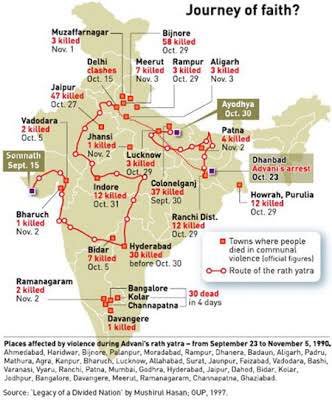
AS if the verbal and actual assaults of his estranged nephew on north Indians was not enough, Bal Thackeray’s recent advocacy for building Hindu jihadi squads is not surprising, coming from someone who has advocated militant Hindu nationalistic responses to every real and perceived threat to what he understands Hinduism to be. The problem with the idea, however, is that it is hardly new or innovative, except perhaps in the way he has chosen to brand it. L. K. Advani’s Rath Yatra culminating in the demolition of the Babri Masjid, Narendra Modi’s complicity in the riots in Gujarat in 2002, Raj Thackeray’s spewing venom on north Indians living in Maharashtra, regular assaults by a medley of Hindu nationalist organisations on artists, writers, events and observances are very much the face of a malignant jihadi Hindutva that has been on the rise in the last two decades. The jihadi Hindutva votaries are no longer satisfied with spewing sanctimonious and self- righteous rhetoric. Their electoral successes since the 1980s have impelled them to use the state machinery in carrying out acts of violence against groups they consider their natural foes. At the same time, they also recognise the fragility of India’s legal and constitutional processes and have carried out violent acts with impunity and without fear of punishment. While their rhetoric invariably points towards unity and oneness, more than any historical figure or force, the Hindu nationalists have worked overtime in order to divide, and win elections. Savarkar The single most significant point about jihadi Hindutva is that it is based entirely on creating a caricatured version of the enemy. Every single instance of articulating Hindu nationalism has led to a severe distortion of Islam, Christianity, the West and scientific modernity. What is even more crucial is that the Hindu nationalists believe in these caricatures and these constitute for them the basis of reality. In doing so, they also tend to reduce, limit and shrink what they understand of the entity they seem committed to protecting. This leads to a disneyfied version of Hinduism as well, aversion in which the Advanis, Modis and Sudarshans of the world participate and revel in its fragile mockery. Everything becomes arbitrary and selective: history, memory and identity. The criminals of the Sambhaji Brigade, an outfit owing allegiance to the NCP, who attacked the Bhandarkar Institute in Pune in 2004 in the name of protecting Hindu culture and in the name of defending Chatrapati Shivaji’s reputation ended up breaking a statue of Goddess Saraswati, burning rare Sanskrit manuscripts and destroying aprecious copy of the Rig Veda .One is safe to assume that members of the mob that attacked the Bhandarkar Institute had little access to James Laine’s book on Shivaji, the ostensible reason for their protest. Laine had used the Institute’s library fifteen years prior to the publication of the book. Lending this service to Laine was the only “crime” that the Institute was “guilty” of and the reason for the vandalism. But equally so, the illiterate mob that attacked the Bhandarkar Institute knew even less of the worth of the literature they were destroying in the name of protecting an abstraction called Hinduism. Savarkar articulated this process of caricaturing, and, in turn, became the caricature itself better than any Hindu nationalist. The Thackerays of this world are merely footnotes to the diabolical and limited vision that Savarkar put forth in his works. In his book, Hindu- Pad- Padshahi , Savarkar speaks of the qualities that made the Muslims unassailable. These qualities included the art of building a commonly shared national life and consolidating the place of faith in their lives. The Muslims had a unified church, which made them better equipped to take on their opponents. They acted directly under the command of God, had a notion of theocracy and a sense of community, all of which helped their militant campaign against the kafirs . These virtues of the Muslims made them “irresistible”, says Savarkar. He concludes by saying that historically the Hindus had much to learn from the Muslims, and “slowly they [the Hindus] absorbed much that contributed to the success of the Muhammadans.” Jihadi Hindutva, therefore, is a continued process of absorption of the virtues of the caricature. What is significant is that in creating the caricature and believing in it, Hindu nationalist have surpassed the grossness of the caricature itself. Intolerance Jihadi Hindutva, and its counterparts in Islam, Christianity, Communism and other faiths, has little to do with real issues of faith, doctrine and ideology, but more to do with introduction of such ideas as modern nationalism, self- determination, representation and democracy in a society that is full of paradoxes and complexities. Jihadi Hindutva and its cognates in other faiths have a great deal in common with modern nationalism and ideas of self- determination and representation, since all of them are ways of contending with diversity and the tensions arising out of its constant play in the real world. The classical way to deal with this problem was to build liberal institutions that would deal with threats to identity and variety. This latter process has not taken strong roots in India, as it has failed to provide adequate answers in Europe, the land of its birth and initial flourishing. Therefore, it is a mistake to assume that intolerance and bigotry are limited in India to parties owing allegiance to a sectoral identity. Congress governments in Punjab and Andhra Pradesh banned the Da Vinci Code with alacrity, while MLAs belonging to a Muslim party in Hyderabad were able to attack Taslima Nasrin and escape any punitive repercussion by virtue of their alliance with the ruling Congress party in the state. All this is admirably supported by the rise of a middle class in India that is largely amoral and indifferent to everything but instant gratification, which also includes ready access to instant, pre- cooked and easy to digest information. This group’s impatience with democracy and politics is complimented by their fondness for technocratic- managerial solutions to all problems in the world. It also accounts for the popularity of 24- hour news channels, those graveyards of unfinished sentences and breathless inanities. But more so, it manifests in the mushrooming of new age sects and gurus, shrill and hysterical preoccupation with issues such as national security and quixotic vision statements of India as a superpower. While all this happens, the ability of ordinary Indians to deal with one of the most difficult of things diminishes by the hour —the ability to deal with the complexity of life, thought and feeling. But at a more practical level, a time will come when the very idea of “belonging” within the country will be questioned by limited men like Raj Thackeray. The likes of Raj have unleashed a process where different parts and fragments within the country would create their own version of the mlecchas (foreigner or barbarian or outsider) and prevent people from moving freely within the country. There is a misperception that Hindu nationalism and its jihadi versions are primarily a threat to Muslims and Christians. Rather, the greatest threat Hindutva poses is to Hindus themselves who do not subscribe to the narrowness of their vision and the mindlessness of their interpretative machinery. The moment ordinary Hindus understand this, the Shiv Sena, RSS and BJP will have to declare their clearance sale. The writer teaches at the University of Hyderabad and is author of Hindutva :Exploring the Idea of Hindu Nationalism |


February 29, 2008
Delete 4 paras, SC 'suggests' to Shivaji author James Laine
Indian Express, 29 Feb 2008
Tannu Sharma
NEW DELHI, FEBRUARY 28: The Supreme Court has suggested that if certain “objectionable” portions were deleted from Shivaji: Hindu King of Islamic India by US academic James W Laine, “the interest of justice would be best served.” This suggestion from the bench, comprising Justices Dr Arijit Pasayat and P Sathasivam, came during the hearing of an appeal filed by the Maharashtra government that banned the book in 2004 fearing more of the protests and large-scale vandalism following its publication. The court clarified that this suggestion “shall not in any way affect the merits of the issues involved in the case” and said that it would wait for the author’s views on this.
Claiming that Laine’s book allegedly portrayed Shivaji in a bad light, there were wide protests in Pune by the Shambhaji Brigade. On January 5, 2004, a mob even ransacked the Bhandarkar Oriental Research Institute. Apprehending more such violence, the state government came out with a notification dated December 28, 2006 declaring that every copy of the said book be forfeited to the Government.
In the last hearing on Tuesday, the apex court said: “We feel paragraphs 2, 5, 7 and 8 (four of the eight)...are omitted, interest of justice would be best served.”
These paragraphs comment on the attacks carried out by him, his parents and his secular credentials. For example, Para 2 questioned the killing of Afzal Khan in 1659: “...looking back from coronation, it was not simply an act of courage but a pre-mediated violence in the service of Brahaminic world order.”
Para 5 contains the quote: “...in other words, Shivaji’s secularism can only be assured if we see him as motivated less by patriotism than by simple quest of power.”
As there was no response to an earlier notice to Laine, who’s a professor of religious studies at Macalester College in the US, the bench ordered the Registry to serve a notice upon him along with the “suggestion.” On October 11, 2007, Laine was made a party in the case and was issued notice.
This time, the court also specifically asked him to consider as to “whether he is agreeable to the suggestion given for deletion of the aforesaid four paragraphs.” The other two paragraphs advised to be deleted, include one that comments on Shivaji’s “absentee father.”
While suggesting what it thought as an amicable solution to the entire controversy, the court took strong note of the violence that followed the book’s release as pointed out by Prashant Bhushan, advocate for Sangharaj Damodar Rupawate who filed petitions in the Bombay High Court questioning the notification and the ban it ensued.
“In the name of protecting the image of Shivaji, large scale violence was unleashed resulting in the destruction of properties, valuable books and damage to persons and properties physically. This issue shall be considered separately,” the Court agreed. However posting the matter after 10 weeks, the judges made it clear that they would look into it in detail only after receiving Laine’s response.
The state government had approached the apex court after the High Court on April 5, 2007, quashed the notification banning the book in the state.
Tannu Sharma
NEW DELHI, FEBRUARY 28: The Supreme Court has suggested that if certain “objectionable” portions were deleted from Shivaji: Hindu King of Islamic India by US academic James W Laine, “the interest of justice would be best served.” This suggestion from the bench, comprising Justices Dr Arijit Pasayat and P Sathasivam, came during the hearing of an appeal filed by the Maharashtra government that banned the book in 2004 fearing more of the protests and large-scale vandalism following its publication. The court clarified that this suggestion “shall not in any way affect the merits of the issues involved in the case” and said that it would wait for the author’s views on this.
Claiming that Laine’s book allegedly portrayed Shivaji in a bad light, there were wide protests in Pune by the Shambhaji Brigade. On January 5, 2004, a mob even ransacked the Bhandarkar Oriental Research Institute. Apprehending more such violence, the state government came out with a notification dated December 28, 2006 declaring that every copy of the said book be forfeited to the Government.
In the last hearing on Tuesday, the apex court said: “We feel paragraphs 2, 5, 7 and 8 (four of the eight)...are omitted, interest of justice would be best served.”
These paragraphs comment on the attacks carried out by him, his parents and his secular credentials. For example, Para 2 questioned the killing of Afzal Khan in 1659: “...looking back from coronation, it was not simply an act of courage but a pre-mediated violence in the service of Brahaminic world order.”
Para 5 contains the quote: “...in other words, Shivaji’s secularism can only be assured if we see him as motivated less by patriotism than by simple quest of power.”
As there was no response to an earlier notice to Laine, who’s a professor of religious studies at Macalester College in the US, the bench ordered the Registry to serve a notice upon him along with the “suggestion.” On October 11, 2007, Laine was made a party in the case and was issued notice.
This time, the court also specifically asked him to consider as to “whether he is agreeable to the suggestion given for deletion of the aforesaid four paragraphs.” The other two paragraphs advised to be deleted, include one that comments on Shivaji’s “absentee father.”
While suggesting what it thought as an amicable solution to the entire controversy, the court took strong note of the violence that followed the book’s release as pointed out by Prashant Bhushan, advocate for Sangharaj Damodar Rupawate who filed petitions in the Bombay High Court questioning the notification and the ban it ensued.
“In the name of protecting the image of Shivaji, large scale violence was unleashed resulting in the destruction of properties, valuable books and damage to persons and properties physically. This issue shall be considered separately,” the Court agreed. However posting the matter after 10 weeks, the judges made it clear that they would look into it in detail only after receiving Laine’s response.
The state government had approached the apex court after the High Court on April 5, 2007, quashed the notification banning the book in the state.
May 17, 2007
Maharashtra style Moditva
(Indian Express
May 17, 2007)
Maharashtra style Moditva
by Suhas Palshikar
A research institute demands a ban on a book. A ‘secular’ government ignores it and ‘secular’ parties behave like Gandhi’s three monkeys. Academia remains silent
The vandalism at MS University and the abject complicity of the university authorities in the episode are a sad sign of the failure to expand democracy to our civil and social lives. But before the MS University controversy arose, a small news item appeared in section of the media and then died down without much attention from media and the intellectuals alike.
This concerned the infamous controversy over a reference to Shivaji Maharaj in James Lane’s book Shivaji: Hindu King in Islamic India. The Maharashtra government banned the book. The ban was challenged in the Bombay High Court and only recently the court ruled that the ban was indefensible. The aggrieved parties decided to appeal to the Supreme Court as the apex court had almost at the same time upheld a ban on a book in another case originating in Karnataka.
But one research institution decided that books not only need to be banned but that research institutions can serve the academic cause better by demanding a ban on books. So, the Bhandarkar Oriental Research Institute of Pune (BORI) formally passed a resolution and its office bearer, Vijay Bhatkar, publicly stated that the BORI has demanded that the book be banned. Ironically, it is the same book that brought BORI into trouble three years ago when angry protestors stormed into the institute’s library and ransacked it on charges that the institute was complicit in the “insulting” writing in Lane’s book. Following that incident, public sympathy and support flooded the BORI; large amounts of public funds were allocated to it for modernisation and digitisation of its library. Having benefited from the attack, now the BORI finds it convenient to demand a ban on the book.
Let us keep out the details of the controversy. What is painful is that the institute crawled when it may have simply be expected to bend. This episode shows the importance our academic institutions give to the issue of freedom of expression and autonomy of academic establishments.
In the case of the MS University, it is a well-known fact that the university, which once used to be a matter of pride for Gujarat, has recently turned into a playground of narrow-minded politics propped up by self-appointed protectors of Hindutva. So, while it is sad that the vice chancellor and the establishment have thrown academic freedom to the wind; it is something one was not ignorant about. In contrast, the BORI case poses an even more serious challenge.
Both when the controversy emerged and today, the state government is run by parties that have avowedly come together to counter the communal menace. The Congress-NCP government did not protect academic freedom; nor did any of the other secular parties in progressive Maharashtra come forward to intervene on behalf of freedom of expression. That was when the Lok Sabha elections were round the corner and at least the NCP tried to derive mileage from the controversy; some sections even tried to revive the old brahmin-non-brahmin dispute. The issue of academic freedom was quickly overshadowed by pseudo-progressivism based on one’s caste origin.
Two, when the ban had to be lifted following court orders, the book was publicly burnt in a number of places to create an atmosphere of terror. Again, the government chose to ignore it and the secular parties together constituted Mahatma Gandhi’s three monkeys.
Three, a research institute entrusted with thousands of valuable manuscripts and rare books demanded a ban on the book. Could one trust it for retaining the intellectual heritage with fortitude in the light of this act? Four, ever since the BORI passed this resolution, there is no whimper of protest from the academic community. Is not the BORI a public institution and does it not have to answer to the academic community?
The episode at the MS University Baroda only showcases what may be a more generic ailment with the academic and intellectual community in India. The idea of creative and academic autonomy is not ingrained in Indian academia. It is easy to blame it on parties and governments and protestors. But are we as academics really interested in the idea of academic freedom? Are we too afraid to pay the price of upholding the freedom? Or is it just that we are so callous as an intellectual community, and so removed from the world of ideas and creativity, that we genuinely do not appreciate the value of academic autonomy? Combined with the near unanimous disregard of academic freedom by the entire political establishment across party lines, the abdication of its role by the academic community is indicative of our democratic pretensions.
The writer teaches political science at the University of Pune
May 17, 2007)
Maharashtra style Moditva
by Suhas Palshikar
A research institute demands a ban on a book. A ‘secular’ government ignores it and ‘secular’ parties behave like Gandhi’s three monkeys. Academia remains silent
The vandalism at MS University and the abject complicity of the university authorities in the episode are a sad sign of the failure to expand democracy to our civil and social lives. But before the MS University controversy arose, a small news item appeared in section of the media and then died down without much attention from media and the intellectuals alike.
This concerned the infamous controversy over a reference to Shivaji Maharaj in James Lane’s book Shivaji: Hindu King in Islamic India. The Maharashtra government banned the book. The ban was challenged in the Bombay High Court and only recently the court ruled that the ban was indefensible. The aggrieved parties decided to appeal to the Supreme Court as the apex court had almost at the same time upheld a ban on a book in another case originating in Karnataka.
But one research institution decided that books not only need to be banned but that research institutions can serve the academic cause better by demanding a ban on books. So, the Bhandarkar Oriental Research Institute of Pune (BORI) formally passed a resolution and its office bearer, Vijay Bhatkar, publicly stated that the BORI has demanded that the book be banned. Ironically, it is the same book that brought BORI into trouble three years ago when angry protestors stormed into the institute’s library and ransacked it on charges that the institute was complicit in the “insulting” writing in Lane’s book. Following that incident, public sympathy and support flooded the BORI; large amounts of public funds were allocated to it for modernisation and digitisation of its library. Having benefited from the attack, now the BORI finds it convenient to demand a ban on the book.
Let us keep out the details of the controversy. What is painful is that the institute crawled when it may have simply be expected to bend. This episode shows the importance our academic institutions give to the issue of freedom of expression and autonomy of academic establishments.
In the case of the MS University, it is a well-known fact that the university, which once used to be a matter of pride for Gujarat, has recently turned into a playground of narrow-minded politics propped up by self-appointed protectors of Hindutva. So, while it is sad that the vice chancellor and the establishment have thrown academic freedom to the wind; it is something one was not ignorant about. In contrast, the BORI case poses an even more serious challenge.
Both when the controversy emerged and today, the state government is run by parties that have avowedly come together to counter the communal menace. The Congress-NCP government did not protect academic freedom; nor did any of the other secular parties in progressive Maharashtra come forward to intervene on behalf of freedom of expression. That was when the Lok Sabha elections were round the corner and at least the NCP tried to derive mileage from the controversy; some sections even tried to revive the old brahmin-non-brahmin dispute. The issue of academic freedom was quickly overshadowed by pseudo-progressivism based on one’s caste origin.
Two, when the ban had to be lifted following court orders, the book was publicly burnt in a number of places to create an atmosphere of terror. Again, the government chose to ignore it and the secular parties together constituted Mahatma Gandhi’s three monkeys.
Three, a research institute entrusted with thousands of valuable manuscripts and rare books demanded a ban on the book. Could one trust it for retaining the intellectual heritage with fortitude in the light of this act? Four, ever since the BORI passed this resolution, there is no whimper of protest from the academic community. Is not the BORI a public institution and does it not have to answer to the academic community?
The episode at the MS University Baroda only showcases what may be a more generic ailment with the academic and intellectual community in India. The idea of creative and academic autonomy is not ingrained in Indian academia. It is easy to blame it on parties and governments and protestors. But are we as academics really interested in the idea of academic freedom? Are we too afraid to pay the price of upholding the freedom? Or is it just that we are so callous as an intellectual community, and so removed from the world of ideas and creativity, that we genuinely do not appreciate the value of academic autonomy? Combined with the near unanimous disregard of academic freedom by the entire political establishment across party lines, the abdication of its role by the academic community is indicative of our democratic pretensions.
The writer teaches political science at the University of Pune
April 30, 2007
Shiv Sainiks instructed to burn Laine's book
Bookshop owners won't stock Laine's Shivaji
By: Urvashi Seth
(Mid-Day, April 30, 2007) After Bal Thackeray’s announcement that he instructed Sainiks to burn the copies of the James Laine’s book, Shivaji — Hindu King in Islamic India, in public, book sellers have become apprehensive about stocking copies of the book.
On Thursday, the Bombay High Court lifted the ban on the book.
According to sources, the Bharatiya Vidhyarthi Sena (BVS) has warned bookshop owners not to keep copies of the book or face strict action.
“Being a part of the Sena, we have requested all bookshop owners not to stock James Laine’s book,” said Abhijeet Panse, president of BVS.
Mandar Nerulkar, owner of the Ideal Book Depot, Dadar, said they won’t be selling the book after Bal Thackeray’s comments.
“The book has many defaming statements against Shivaji. Even though the court has lifted the ban we won’t be selling it, especially after we heard that Shiv Sena has taken an aggressive stance on the issue.”
“It’s very likely that the book won’t be coming into the market. If it comes, we will decide whether to stock it,” said Rohit Tengle of Book Zone at CST
By: Urvashi Seth
(Mid-Day, April 30, 2007) After Bal Thackeray’s announcement that he instructed Sainiks to burn the copies of the James Laine’s book, Shivaji — Hindu King in Islamic India, in public, book sellers have become apprehensive about stocking copies of the book.
On Thursday, the Bombay High Court lifted the ban on the book.
According to sources, the Bharatiya Vidhyarthi Sena (BVS) has warned bookshop owners not to keep copies of the book or face strict action.
“Being a part of the Sena, we have requested all bookshop owners not to stock James Laine’s book,” said Abhijeet Panse, president of BVS.
Mandar Nerulkar, owner of the Ideal Book Depot, Dadar, said they won’t be selling the book after Bal Thackeray’s comments.
“The book has many defaming statements against Shivaji. Even though the court has lifted the ban we won’t be selling it, especially after we heard that Shiv Sena has taken an aggressive stance on the issue.”
“It’s very likely that the book won’t be coming into the market. If it comes, we will decide whether to stock it,” said Rohit Tengle of Book Zone at CST
April 11, 2007
History and Hindu nationalism: Charges against James W. Laine dropped
http://www.salon.com/
April 11, 2007
History and Hindu nationalism: A call to arms
Andrew Leonard
On Monday, India's Supreme Court ordered the Maharashtra state police to drop all charges of inciting "racial hatred" against an American professor of religious studies, James W. Laine, author of a book about the 17th century Maharashtra warrior-king Shivaji. (Thanks to the wonderfully named Pass the Roti on the Left Hand Side blog for the alert.)
In Maharashtra, home to the Indian cities Mumbai and Pune and about 90 million people, Shivaji is a figure of near demi-god status, revered by Hindu nationalists for establishing an independent kingdom in a region dominated by Muslim rulers. His portrait is ubiquitous and his life story a staple of children's history textbooks.
The Oxford University Press published Laine's book, "Shivaji: Hindu King in Islamic India," in 2003. It was initially well-received, generating a few "bland and positive" reviews, according to Laine's own account. But then some Hindu nationalist firebrands, possibly seeking a campaign issue to rally voters around, seized upon one specific sentence, in which Laine recounted, presumably from his personal experience, that Maharashtrians occasionally joked about Shivaji's parentage, speculating as to whether the person historically known as Shivaji's father was in fact his biological parent.
It is no understatement to say that from that point on, all hell broke loose, kind of like the recent http://www.salon.com/opinion/walsh/misc/2007/03/29/chocolate_jesus/index.htmlchocolate Jesus debacle in New York, only amplified by about a trillion orders of magnitude. Laine's book became ammunition in a multifronted war that crossed caste, ethnic, political and religious lines. Scholars who had been thanked in Laine's acknowledgments were physically attacked by Hindu fundamentalist extremists -- one had his face blackened with tar. A group calling itself the Sambhaji Brigade ransacked the research library in Pune where Laine had spent years, destroying, in the process, irreplaceable historical documents and artifacts.
Laine's own account of the turmoil, published in the Los Angeles Times in 2004, stated, somewhat plaintively:
The vast majority of Indians are appalled at what happened in Pune. And yet no one has stepped forward to defend my book and no one has called for it to be distributed again. Few will read it for themselves. Instead, many will live with the knowledge that India is a country where many thoughts are unthinkable or, if thought, best kept quiet.
In this light, the decision of the Indian Supreme Court is to be applauded, at least by anyone who believes that scholarly inquiry should be combatted with battling footnotes, and not mob violence. But perhaps the most fascinating part of the whole story is how the reaction to Laine's book can be seen as an integral part of the very narrative he was trying to explicate.
Laine's goal was not a traditional biography, but a deconstruction of how "the Shivaji story" had evolved over 300 years; how the facts of his historically verifiable existence had been manipulated and massaged and morphed in ways that served emerging political, ideological and religious needs. It should go without saying that in a country where "communal" tensions are as intense as they are in India, such an investigation, by an outsider, of one of India's most legendary Hindu "heroes" could be inflammatory. Indeed, it seems almost as if Laine expected something to happen. Witness these words from the introduction to "Shivaji":
The task I have set myself is not that of providing a more accurate account of Shivaji's life by stripping away the legends attributed to him by worshipful myth makers or misguided ideologues, but rather to be a disturber of the tranquility with which synthetic accounts of Shivaji's life are accepted...
The italics are mine. Laine succeeded. Tranquility was disturbed. The reaction to the book serves as a perfect afterword flowing directly from the main narrative, as the very same cultural impulses that shaped the evolution of Shivaji's cultural significance also formed its critical reception.
For example: One pair of reviewers could barely contain a mounting sense of outrage as they deconstructed Laine's deconstruction. They called it "vicious," "willful, calculated sensationalism," and "an exercise in skullduggery" that "might well qualify as yet another attempt at fragmentation of the steadily developing strength of a society that is waking up to a realization of the many historical frauds perpetrated on itself for centuries."
For them, any attempt to recontextualize the popular conception of Shivaji betrayed a profound misunderstanding of how important the warrior king was to Hindu Maharashtrian identity.
The learned author, in spite of his protracted contact with the region since 1977, failed to realize that the "Shivaji story," as narrated in every Maharashtrian home, has far more significance and enjoys immensely greater credibility than all history taught in academia...
But another reviewer, revealing his own antipathy to the politics of Hindu fundamentalism by noting that Shivaji is "a key cultural idol in the chauvinistic repertoire of contemporary Hindu nationalism," applauded Laine for raising "fundamental questions about a range of identities -- religious, linguistic, economic, caste, moral, regional, national and political -- relevant to contemporary Maharashtra, India and Hindus." Moreover, the reviewer lambasted "a myopic state that has routinely created purist superhuman icons out of historical figures for the sake of particular populist ends. In the process, the state, in deference to the radical end of the citizenry, has produced a socio-political culture accommodative of violent public displays of disregard for scholarly plain-speak about those icons."
This is identity politics on a mind-boggling scale. The telling of history is often -- some cynics might say always -- an exercise in propaganda, shaped as much by the attitude and ideology the scholar brings to the archives as by the facts and data unearthed there. And it is certainly not unusual for a work of history that explores a politically and religiously fraught topic to be caught up in those currents itself.
But when scholars thanked in acknowledgments are physically attacked and research libraries are ransacked and historians are brought up on charges of inciting racial hatred, the stakes seem a bit greater than with your run-of-the-mill monograph. And that brings out its own moral imperative: The singular intensity of "the Laine controversy" is a call to arms, a clear mandate for the practice of more history, more deconstruction of how identity is inculcated and manipulated in the modern world, and more unraveling of the threads that make up the warp and woof of contemporary Indian society.
April 11, 2007
History and Hindu nationalism: A call to arms
Andrew Leonard
On Monday, India's Supreme Court ordered the Maharashtra state police to drop all charges of inciting "racial hatred" against an American professor of religious studies, James W. Laine, author of a book about the 17th century Maharashtra warrior-king Shivaji. (Thanks to the wonderfully named Pass the Roti on the Left Hand Side blog for the alert.)
In Maharashtra, home to the Indian cities Mumbai and Pune and about 90 million people, Shivaji is a figure of near demi-god status, revered by Hindu nationalists for establishing an independent kingdom in a region dominated by Muslim rulers. His portrait is ubiquitous and his life story a staple of children's history textbooks.
The Oxford University Press published Laine's book, "Shivaji: Hindu King in Islamic India," in 2003. It was initially well-received, generating a few "bland and positive" reviews, according to Laine's own account. But then some Hindu nationalist firebrands, possibly seeking a campaign issue to rally voters around, seized upon one specific sentence, in which Laine recounted, presumably from his personal experience, that Maharashtrians occasionally joked about Shivaji's parentage, speculating as to whether the person historically known as Shivaji's father was in fact his biological parent.
It is no understatement to say that from that point on, all hell broke loose, kind of like the recent http://www.salon.com/opinion/walsh/misc/2007/03/29/chocolate_jesus/index.htmlchocolate Jesus debacle in New York, only amplified by about a trillion orders of magnitude. Laine's book became ammunition in a multifronted war that crossed caste, ethnic, political and religious lines. Scholars who had been thanked in Laine's acknowledgments were physically attacked by Hindu fundamentalist extremists -- one had his face blackened with tar. A group calling itself the Sambhaji Brigade ransacked the research library in Pune where Laine had spent years, destroying, in the process, irreplaceable historical documents and artifacts.
Laine's own account of the turmoil, published in the Los Angeles Times in 2004, stated, somewhat plaintively:
The vast majority of Indians are appalled at what happened in Pune. And yet no one has stepped forward to defend my book and no one has called for it to be distributed again. Few will read it for themselves. Instead, many will live with the knowledge that India is a country where many thoughts are unthinkable or, if thought, best kept quiet.
In this light, the decision of the Indian Supreme Court is to be applauded, at least by anyone who believes that scholarly inquiry should be combatted with battling footnotes, and not mob violence. But perhaps the most fascinating part of the whole story is how the reaction to Laine's book can be seen as an integral part of the very narrative he was trying to explicate.
Laine's goal was not a traditional biography, but a deconstruction of how "the Shivaji story" had evolved over 300 years; how the facts of his historically verifiable existence had been manipulated and massaged and morphed in ways that served emerging political, ideological and religious needs. It should go without saying that in a country where "communal" tensions are as intense as they are in India, such an investigation, by an outsider, of one of India's most legendary Hindu "heroes" could be inflammatory. Indeed, it seems almost as if Laine expected something to happen. Witness these words from the introduction to "Shivaji":
The task I have set myself is not that of providing a more accurate account of Shivaji's life by stripping away the legends attributed to him by worshipful myth makers or misguided ideologues, but rather to be a disturber of the tranquility with which synthetic accounts of Shivaji's life are accepted...
The italics are mine. Laine succeeded. Tranquility was disturbed. The reaction to the book serves as a perfect afterword flowing directly from the main narrative, as the very same cultural impulses that shaped the evolution of Shivaji's cultural significance also formed its critical reception.
For example: One pair of reviewers could barely contain a mounting sense of outrage as they deconstructed Laine's deconstruction. They called it "vicious," "willful, calculated sensationalism," and "an exercise in skullduggery" that "might well qualify as yet another attempt at fragmentation of the steadily developing strength of a society that is waking up to a realization of the many historical frauds perpetrated on itself for centuries."
For them, any attempt to recontextualize the popular conception of Shivaji betrayed a profound misunderstanding of how important the warrior king was to Hindu Maharashtrian identity.
The learned author, in spite of his protracted contact with the region since 1977, failed to realize that the "Shivaji story," as narrated in every Maharashtrian home, has far more significance and enjoys immensely greater credibility than all history taught in academia...
But another reviewer, revealing his own antipathy to the politics of Hindu fundamentalism by noting that Shivaji is "a key cultural idol in the chauvinistic repertoire of contemporary Hindu nationalism," applauded Laine for raising "fundamental questions about a range of identities -- religious, linguistic, economic, caste, moral, regional, national and political -- relevant to contemporary Maharashtra, India and Hindus." Moreover, the reviewer lambasted "a myopic state that has routinely created purist superhuman icons out of historical figures for the sake of particular populist ends. In the process, the state, in deference to the radical end of the citizenry, has produced a socio-political culture accommodative of violent public displays of disregard for scholarly plain-speak about those icons."
This is identity politics on a mind-boggling scale. The telling of history is often -- some cynics might say always -- an exercise in propaganda, shaped as much by the attitude and ideology the scholar brings to the archives as by the facts and data unearthed there. And it is certainly not unusual for a work of history that explores a politically and religiously fraught topic to be caught up in those currents itself.
But when scholars thanked in acknowledgments are physically attacked and research libraries are ransacked and historians are brought up on charges of inciting racial hatred, the stakes seem a bit greater than with your run-of-the-mill monograph. And that brings out its own moral imperative: The singular intensity of "the Laine controversy" is a call to arms, a clear mandate for the practice of more history, more deconstruction of how identity is inculcated and manipulated in the modern world, and more unraveling of the threads that make up the warp and woof of contemporary Indian society.
March 28, 2004
The controversy in India over US scholar
South Asia Citizens Wire | 28 March, 2004
** India seeks to arrest US scholar **
India seeks the arrest of an American scholar who wrote a controversial
biography of Shivaji.
URL: < news.bbc.co.uk/go/em/fr/-/2/hi/south_asia/3561499.stm >
o o o
[March 27, 2004]
Dear Friends:
I write in regards to the recent controversy over a US scholar's history
book in India. As some of you may know, James Laine, a professor of
religious studies at Macalester College in MN, has published a book through
Oxford University Press entitled SHIVAJI: HINDU KING IN ISLAMIC INDIA. As a
result of its publication, Indian scholars and scholarly institutes in
Western India (Maharashtra) have been harassed and ransacked. The
controversy has grown to such ridiculous proportions that the Indian Prime
Minister has commented on the book, "warning" Laine, and the Maharashtra
government has called for his ARREST through Interpol. See the above BBC
story.
If you don't have the book, get it! It is quite good. As with The Satanic
Verses and The Myth of the Holy Cow (or Harry Potter for that matter), those
who seek its ban have usually not read the book in question and certainly
have no desire for nuance or precision.
SHIVAJI: HINDU KING IN ISLAMIC INDIA is about the role of myth and legend in
the construction of historical memory. One claim in the book in particular
has raised people's ire---that Shivaji's mother may have had an affair with
someone other than his "real" father. For this, Indian politicians have
claimed that Indian pride has been insulted and that this is an insult to
the nation.
It's a shame that the nation has such thin skin, but it is also easy to see
why nationalists would be so threatened by this book. I've looked at the
passages in question. They are in Chapter 5 of the book, especially in the
first, full paragraph on p. 93. Without a doubt in my mind, this
controversy is a bunch of nonsense---politically motivated through and
through. Laine begins this chapter with a quote from W.E.B. DuBois. Let
me requote it for you: "[O]ne is astonished in the study of history at the
recurrence of the idea that evil must be forgotten, distorted, skimmed
over.... We must forget that George Washington was a slaveowner...and simply
remember the things we regard as creditable and inspiring. The difficulty
with this philosophy is that history loses its value as an incentive and
example; it paints perfect men and noble nations, but does not tell the
truth." (p. 89)
Shivaji is one of these perfect heroes in mythic history. Laine's goal is
to illustrate the tensions between myth and history, not by historically
proving one thing or another, but by raising a panoply of "questions that
haven't or can't be asked." By revealing the gap between what is known or
thought to be known, and the unasked (let alone unanswered) questions, Laine
hopes to provide foundation for further serious, historical inquiry.
To this end, he begins with a discussion of Texas and myths related to Davy
Crockett and the Alamo (timely, given the new movie coming out on this
topic). He then states: "My primary claim is not that I have a truer, more
objective history than the standard accounts. What I would prefer to do is
look once again at the emerging narrative that we have considered to see
those places where the authors themselves have carefully avoided saying
something, or where they say something rather abruptly in order to answer
some unexpressed concern. Such a pursuit will allow us NOT TO SEE THE
"REAL" SHIVAJI BUT TO BETTER APPRECIATE THE IDEOLOGICAL CONCERNS OF THE MANY
AUTHORS WHO HAVE SHAPED THE NARRATIVE TRADITION OF SHIVAJI'S LEGENDARY LIFE.
[Caps added for emphasis] The real issue is what the authors are saying
about themselves, about the dreams they hold, the dreams they see expressed
in the tales of their hero." (p. 90)
Laine then broaches the "unthinkable thoughts" and dares to ask questions
that haven't been asked. Among 5 questions, can we imagine, he asks, if
Shivaji had an unhappy family life. In an elaborate multi-page answer to
this question, Laine provides some speculation, not quite idle, but not
"proof of the fact" either. But his goal is not to prove a point of view,
but precisely only to illustrate people's popular ideas versus some
"thoughts that cannot be thought." To this end, Laine states on p. 93: "The
repressed awareness that Shivaji has an absentee father is also revealed by
the fact that Maharashtrians tell jokes naughtily suggesting that his
guardian Dadaji Konddev was his biological father. In a sense, because
Shivaji's father had little influence on his son, for many narrators it was
most important to supply him with father replacements, Dadaji and later
Ramdas. But perhaps we read the story of his life as goverened by
motivations buried deep in his psyche by a mother rejected by her husband.
[This point is discussed on the previous page.] One could then see that
Shivaji's drive to heroism was spurred by his attempt to please his doting
mother, and that she, aware of her Yadava heritage and thinking of her
husband as a collaborator of low birth, instilled in her son the dream of a
revived Hindu kingdom...."
"None of these unseemly facts accord well with the family values of
contemporary middle-class Indians, and are largely ignored in popular modern
accounts...."
"The great man was great because of his public deeds, and as a great man, he
is presumed to be a man whose private virtues informed his domestic life.
But, in fact, we know virtually nothing of his family affairs."
These last lines are critical, because they acknowledge the weakness in our
historical knowledge. More questions need to be asked and more research
done. Laine does not claim that he is providing the definitive answers.
Laine's book and the crisis surrounding it are therefore battlegrounds on
freedom of speech and freedom of expression issues. How can we pursue
ideal, objective scholarship if certain questions cannot even be asked, let
alone certain answers ever be provided?
One does not have to agree with Laine's conclusions or with his assessments.
But that is what scholarly debate is for. Material that "breaks ground"
gets us thinking about new issues, and in new ways. It does not imply that
it is definitive, that it is the "last word." It might or might not be, but
we'll only know after healthy, vigorous debate.
But we can't have that if this debate is clotured before it is even begun.
Banning books only reveals the fear of debate that the banners have. Which
leads to the question: what are they so afraid of? What gives the banners
the right to determine what we can or cannot discuss, what we can and cannot
think or say? Think about DuBois' prescient analysis. Therein lies the
rub.
Sincerely,
Manu Bhagavan
Assistant Professor
Department of History and Political Science
Manchester College
N. Manchester, IN 46962 [USA]
** India seeks to arrest US scholar **
India seeks the arrest of an American scholar who wrote a controversial
biography of Shivaji.
URL: < news.bbc.co.uk/go/em/fr/-/2/hi/south_asia/3561499.stm >
o o o
[March 27, 2004]
Dear Friends:
I write in regards to the recent controversy over a US scholar's history
book in India. As some of you may know, James Laine, a professor of
religious studies at Macalester College in MN, has published a book through
Oxford University Press entitled SHIVAJI: HINDU KING IN ISLAMIC INDIA. As a
result of its publication, Indian scholars and scholarly institutes in
Western India (Maharashtra) have been harassed and ransacked. The
controversy has grown to such ridiculous proportions that the Indian Prime
Minister has commented on the book, "warning" Laine, and the Maharashtra
government has called for his ARREST through Interpol. See the above BBC
story.
If you don't have the book, get it! It is quite good. As with The Satanic
Verses and The Myth of the Holy Cow (or Harry Potter for that matter), those
who seek its ban have usually not read the book in question and certainly
have no desire for nuance or precision.
SHIVAJI: HINDU KING IN ISLAMIC INDIA is about the role of myth and legend in
the construction of historical memory. One claim in the book in particular
has raised people's ire---that Shivaji's mother may have had an affair with
someone other than his "real" father. For this, Indian politicians have
claimed that Indian pride has been insulted and that this is an insult to
the nation.
It's a shame that the nation has such thin skin, but it is also easy to see
why nationalists would be so threatened by this book. I've looked at the
passages in question. They are in Chapter 5 of the book, especially in the
first, full paragraph on p. 93. Without a doubt in my mind, this
controversy is a bunch of nonsense---politically motivated through and
through. Laine begins this chapter with a quote from W.E.B. DuBois. Let
me requote it for you: "[O]ne is astonished in the study of history at the
recurrence of the idea that evil must be forgotten, distorted, skimmed
over.... We must forget that George Washington was a slaveowner...and simply
remember the things we regard as creditable and inspiring. The difficulty
with this philosophy is that history loses its value as an incentive and
example; it paints perfect men and noble nations, but does not tell the
truth." (p. 89)
Shivaji is one of these perfect heroes in mythic history. Laine's goal is
to illustrate the tensions between myth and history, not by historically
proving one thing or another, but by raising a panoply of "questions that
haven't or can't be asked." By revealing the gap between what is known or
thought to be known, and the unasked (let alone unanswered) questions, Laine
hopes to provide foundation for further serious, historical inquiry.
To this end, he begins with a discussion of Texas and myths related to Davy
Crockett and the Alamo (timely, given the new movie coming out on this
topic). He then states: "My primary claim is not that I have a truer, more
objective history than the standard accounts. What I would prefer to do is
look once again at the emerging narrative that we have considered to see
those places where the authors themselves have carefully avoided saying
something, or where they say something rather abruptly in order to answer
some unexpressed concern. Such a pursuit will allow us NOT TO SEE THE
"REAL" SHIVAJI BUT TO BETTER APPRECIATE THE IDEOLOGICAL CONCERNS OF THE MANY
AUTHORS WHO HAVE SHAPED THE NARRATIVE TRADITION OF SHIVAJI'S LEGENDARY LIFE.
[Caps added for emphasis] The real issue is what the authors are saying
about themselves, about the dreams they hold, the dreams they see expressed
in the tales of their hero." (p. 90)
Laine then broaches the "unthinkable thoughts" and dares to ask questions
that haven't been asked. Among 5 questions, can we imagine, he asks, if
Shivaji had an unhappy family life. In an elaborate multi-page answer to
this question, Laine provides some speculation, not quite idle, but not
"proof of the fact" either. But his goal is not to prove a point of view,
but precisely only to illustrate people's popular ideas versus some
"thoughts that cannot be thought." To this end, Laine states on p. 93: "The
repressed awareness that Shivaji has an absentee father is also revealed by
the fact that Maharashtrians tell jokes naughtily suggesting that his
guardian Dadaji Konddev was his biological father. In a sense, because
Shivaji's father had little influence on his son, for many narrators it was
most important to supply him with father replacements, Dadaji and later
Ramdas. But perhaps we read the story of his life as goverened by
motivations buried deep in his psyche by a mother rejected by her husband.
[This point is discussed on the previous page.] One could then see that
Shivaji's drive to heroism was spurred by his attempt to please his doting
mother, and that she, aware of her Yadava heritage and thinking of her
husband as a collaborator of low birth, instilled in her son the dream of a
revived Hindu kingdom...."
"None of these unseemly facts accord well with the family values of
contemporary middle-class Indians, and are largely ignored in popular modern
accounts...."
"The great man was great because of his public deeds, and as a great man, he
is presumed to be a man whose private virtues informed his domestic life.
But, in fact, we know virtually nothing of his family affairs."
These last lines are critical, because they acknowledge the weakness in our
historical knowledge. More questions need to be asked and more research
done. Laine does not claim that he is providing the definitive answers.
Laine's book and the crisis surrounding it are therefore battlegrounds on
freedom of speech and freedom of expression issues. How can we pursue
ideal, objective scholarship if certain questions cannot even be asked, let
alone certain answers ever be provided?
One does not have to agree with Laine's conclusions or with his assessments.
But that is what scholarly debate is for. Material that "breaks ground"
gets us thinking about new issues, and in new ways. It does not imply that
it is definitive, that it is the "last word." It might or might not be, but
we'll only know after healthy, vigorous debate.
But we can't have that if this debate is clotured before it is even begun.
Banning books only reveals the fear of debate that the banners have. Which
leads to the question: what are they so afraid of? What gives the banners
the right to determine what we can or cannot discuss, what we can and cannot
think or say? Think about DuBois' prescient analysis. Therein lies the
rub.
Sincerely,
Manu Bhagavan
Assistant Professor
Department of History and Political Science
Manchester College
N. Manchester, IN 46962 [USA]
January 12, 2004
In India, 'the Unthinkable' Is Printed at One's Peril by James W. Laine
(Los Angeles Times - January 12, 2004)
In India, 'the Unthinkable' Is Printed at One's Peril
By James W. Laine
James W. Laine, a professor of religious studies at Macalester College in Minnesota, is the author of "Shivaji: Hindu King in Islamic India" (Oxford University Press, 2003).
Growing up in Texas in the 1950s, I spent many days roaming my neighborhood wearing a coonskin cap, carrying a toy rifle and singing "Davy, Davy Crockett, King of the Wild Frontier." I was always drawn to stories of heroes.
In western India, not just kids have heroes. In recent years, the figure of Shivaji, a 17th century Hindu king, has attained almost divine status among the Hindu population. He had long been a regional favorite, for he founded an independent kingdom against all odds in the face of the Mughal Empire to the south and other sultans in the north. There is a way to read his story as the first chapter in a tale of Indian independence — first from Muslim rule and then from British. His portrait is everywhere and his name is always invoked with reverence, especially among Hindu fundamentalists, in a time of polarized religious politics in India.
In 1985, I began to translate the Shivabharata, "The Epic of Shivaji." It contained a great story about Shivaji: How, as a young prince, he was attacked in a diplomatic meeting by an arrogant general but, forewarned by a goddess to wear chain mail, he instead fatally stabbed his attacker and led his troops to victory over a much larger force. I was hooked.
I began to realize that everyone knew these tales. Some were historical, some fictive, but they fell into a neat and commonly accepted narrative, reproduced in popular histories, school textbooks and comics. I decided to write about that narrative process, an account of three centuries of storytelling that produced a tale that lived in the minds of people celebrating Shivaji's legacy today. The book came out this summer, and even ranked up with Hillary Rodham Clinton's in the local list of English-language bestsellers in Pune, the city south of Bombay where these cultural traditions are most in evidence and where I had spent months in the library at the Bhandarkar Oriental Research Institute. Back in Pune this summer, I saw a couple of bland but positive reviews in the Indian papers. I thought, "As long as they don't get to the last chapter."
And then someone did. The last chapter is where I entertained what I called "unthinkable thoughts" — questioning "cracks" in the Shivaji narrative. I wondered, for example, why no one considered the possibility that Shivaji's parents were estranged, given that they never lived together during the period the three were alive (1630-1664), and that the tale provided "father substitutes" for the king-to-be. Why not entertain such an idea? What made it unthinkable?
As it turned out, the "owners" of Shivaji's story had their own set of questions, delivered with a punch: Who should be allowed to portray this history? Should an outsider, working with Brahmin English-speaking elites, have a greater say in Shivaji's story than Shivaji's own community?
In November, in response to protests over the book, Oxford University Press stopped distributing it in India. With the book unavailable, rumors piled on rumors. Misreadings lapped the globe by e-mail. A colleague, a man mentioned in the book's preface, distanced himself by condemning its contents but was still roughed up by zealots, who smeared tar on his face. Another Pune scholar tore up his manuscript of a biography of Shivaji, proclaiming scholarship an impossibility in such a context. Horrified, I faxed letters to Indian newspapers, taking full responsibility for my book and apologizing for causing offense.
The furor seemed to die down, but then last week a mob stormed the Bhandarkar research institute, destroying ancient manuscripts and artifacts, reportedly numbering into the thousands. "Not a sapling was spared," one shaken researcher said. The culprits claimed they "did it for Shivaji."
On the other hand, I have also received many letters of support and read many condemnations of these acts. The vast majority of Indians are appalled at what happened in Pune. And yet no one has stepped forward to defend my book and no one has called for it to be distributed again. Few will read it for themselves. Instead, many will live with the knowledge that India is a country where many thoughts are unthinkable or, if thought, best kept quiet.
In India, 'the Unthinkable' Is Printed at One's Peril
By James W. Laine
James W. Laine, a professor of religious studies at Macalester College in Minnesota, is the author of "Shivaji: Hindu King in Islamic India" (Oxford University Press, 2003).
Growing up in Texas in the 1950s, I spent many days roaming my neighborhood wearing a coonskin cap, carrying a toy rifle and singing "Davy, Davy Crockett, King of the Wild Frontier." I was always drawn to stories of heroes.
In western India, not just kids have heroes. In recent years, the figure of Shivaji, a 17th century Hindu king, has attained almost divine status among the Hindu population. He had long been a regional favorite, for he founded an independent kingdom against all odds in the face of the Mughal Empire to the south and other sultans in the north. There is a way to read his story as the first chapter in a tale of Indian independence — first from Muslim rule and then from British. His portrait is everywhere and his name is always invoked with reverence, especially among Hindu fundamentalists, in a time of polarized religious politics in India.
In 1985, I began to translate the Shivabharata, "The Epic of Shivaji." It contained a great story about Shivaji: How, as a young prince, he was attacked in a diplomatic meeting by an arrogant general but, forewarned by a goddess to wear chain mail, he instead fatally stabbed his attacker and led his troops to victory over a much larger force. I was hooked.
I began to realize that everyone knew these tales. Some were historical, some fictive, but they fell into a neat and commonly accepted narrative, reproduced in popular histories, school textbooks and comics. I decided to write about that narrative process, an account of three centuries of storytelling that produced a tale that lived in the minds of people celebrating Shivaji's legacy today. The book came out this summer, and even ranked up with Hillary Rodham Clinton's in the local list of English-language bestsellers in Pune, the city south of Bombay where these cultural traditions are most in evidence and where I had spent months in the library at the Bhandarkar Oriental Research Institute. Back in Pune this summer, I saw a couple of bland but positive reviews in the Indian papers. I thought, "As long as they don't get to the last chapter."
And then someone did. The last chapter is where I entertained what I called "unthinkable thoughts" — questioning "cracks" in the Shivaji narrative. I wondered, for example, why no one considered the possibility that Shivaji's parents were estranged, given that they never lived together during the period the three were alive (1630-1664), and that the tale provided "father substitutes" for the king-to-be. Why not entertain such an idea? What made it unthinkable?
As it turned out, the "owners" of Shivaji's story had their own set of questions, delivered with a punch: Who should be allowed to portray this history? Should an outsider, working with Brahmin English-speaking elites, have a greater say in Shivaji's story than Shivaji's own community?
In November, in response to protests over the book, Oxford University Press stopped distributing it in India. With the book unavailable, rumors piled on rumors. Misreadings lapped the globe by e-mail. A colleague, a man mentioned in the book's preface, distanced himself by condemning its contents but was still roughed up by zealots, who smeared tar on his face. Another Pune scholar tore up his manuscript of a biography of Shivaji, proclaiming scholarship an impossibility in such a context. Horrified, I faxed letters to Indian newspapers, taking full responsibility for my book and apologizing for causing offense.
The furor seemed to die down, but then last week a mob stormed the Bhandarkar research institute, destroying ancient manuscripts and artifacts, reportedly numbering into the thousands. "Not a sapling was spared," one shaken researcher said. The culprits claimed they "did it for Shivaji."
On the other hand, I have also received many letters of support and read many condemnations of these acts. The vast majority of Indians are appalled at what happened in Pune. And yet no one has stepped forward to defend my book and no one has called for it to be distributed again. Few will read it for themselves. Instead, many will live with the knowledge that India is a country where many thoughts are unthinkable or, if thought, best kept quiet.
Subscribe to:
Posts (Atom)