Hindu, 30 April 2008
S. Rajendran
Stiff challenge for Yeddyurappa in the face of ‘understanding’ among three
Congress, JD(S), Samajwadi Party have ‘come together’?
This arrangement follows feedback received after campaigning started
BANGALORE: Though not being stated in clear terms, the Congress, the Janata Dal (Secular) and the Samajwadi Party are gradually coming closer to fight what could be termed a common enemy — the Bharatiya Janata Party — in the Assembly elections in the State.
In the run-up to the elections, the Congress and the Samajwadi Party tried to forge an electoral understanding in vain.
Thereafter, discussions were also stated to have been held between the Samajwadi Party and the Janata Dal (Secular) president, H.D. Deve Gowda, which again did not fructify.
The three parties have now reportedly entered into an informal understanding in certain pockets given the nature of the feedback that they [parties] have been receiving after the election campaign commenced. Four former Chief Ministers — S. Bangarappa, H.D. Kumaraswamy, N. Dharam Singh and B.S. Yeddyurappa, are in the fray and it is only Mr. Yeddyurappa who faces a stiff challenge given the political status of their opponents.
While Mr. Yeddyurappa faces a formidable rival in Mr. Bangarappa apart from a greenhorn in N. Navalesh (who is a Veerashaiva like Mr. Yeddyurappa), Mr. Kumaraswamy faces a political novice in Mamta Nichani.
Mr. Dharam Singh is expected to face Doddappa Gowda Patil of the BJP in the third phase of the elections to be held on May 22. The BJP candidate is the son of the late Shivalingappa who was repeatedly unsuccessful against Mr. Dharam Singh in the Jewargi Assembly constituency of Gulbarga district.
The other chief Ministerial candidate in the Congress, M. Mallikarjun Kharge, who is contesting for the first time from Chitapur constituency (a new constituency reserved for Scheduled Castes after the delimitation exercise), is expected to face Valmiki Naik of the BJP and the battle in all certainty will be one-sided given Mr. Kharge’s popularity.
Both Mr. Dharam Singh and Mr. Kharge have successfully won eight Assembly elections in a row. Mr. Bangarappa has an even more impressive record having won seven Assembly elections since 1967 and five Lok Sabha elections irrespective of the political party from which he has contested.
He has represented the following parties: Samyukta Socialist Party, Karnataka Congress Party, Congress, Janata Party and the Samajwadi Party.
He has lost once to Kagodu Thimmappa in the Sagar Assembly constituency and another time to Ayanur Manjunath in the Shimoga Lok Sabha constituency.
The common feeling is that Mr. Bangarappa has filed his nomination papers before the returning officer of the Shikaripur constituency of Shimoga district following the support extended to him by other political parties only to ensure that there is a direct contest between him and Mr. Yeddyurappa.
In a way, the stage is set for a challenge between Mr. Yeddyurappa on the one side and secular forces on the other.
It is thus a major electoral battle for Mr. Yeddyurappa who has repeatedly contested from Shikaripur since 1983 and has lost only once in 1999. In other words, secular parties have come together to prevent a victory for Mr. Yeddyurappa. Mr. Deve Gowda told The Hindu that the Janata Dal (S) will extend support to Mr. Bangarappa who is a friend of the party.
With filing of nomination papers to the second phase of elections drawing to a close on Tuesday, the stage is set for a royal electoral battle at Shikaripur. Exuding confidence, Mr. Yeddyurappa has said he will campaign only in the last few days in his constituency.
|

April 30, 2008
April 29, 2008
Margao turning into communal flashpoint; NCM told
Herald, 27 April 2008, p 3
PANJIM, ARPIL 26 – The commercial capital of Goa, Margao, is fast turning out to be a flashpoint of communal violence, stated members of the Christian Muslim Dialogue for Life (CMDL) in a submission before Member of the National Commission for Minorities (NCM) Dr Mehroo Bengalee.
Dr Bengalee is in Goa on Saturday to give a hearing to the minority communities. The CMDL stated that the minority community living in the Housing Board Colony and Monte Dongar is being frowned upon by hard core fanatics. The residents of these two localities are looked down upon as 'anti-national elements.
Incidence of intimidations against minority communities — the Christians and the Muslims — have grown in recent times and there's always an attempt to add communal colour to every small incident, submitted Ranjan Solomon, Convener of CMDL.
He submitted a CD to Dr Mehroo that allegedly contains offensive matter against minorities which was openly sold in the city, he stated.
He also complained that the Chief Minister Digambar Kamat, who represents Margao, is not interested in addressing issues concerning minorities — he is always busy.
He further said, "The fanatics need to be reined before they go out of control, lest there would be a repetition of Gujarat riots."
The delegation of All Goa Muslim Jamat (AGMJ) in their representation highlighted serious issue afflicting 8 per cent Muslim population in Goa.
They have no enough burial grounds because other communities have raised objections from time to time.
"We do not get permission from the government for building crematoriums due to public opposition, " complained Salim Kazi, General Secretary of the AGMJ.
The AGMJ also registered their opposition for constitution of Waft Board on the grounds that there are no Waft properties in the State of Goa.
A representation by Catholic Diocesan schools and colleges pointed out the problems they face, because they have to abide by Goa Education Act and the Goa Education Rules.
Members said, posts are lost when recruitments are made from the open category. Intake of faculty from outside Goa is not possible. Local candidate has to be recruited when the right candidates is not available within the fraternity at the time of recruitment.
Juino De Souza, the Convenor of Goan Catholic Welfare Union (GCWU) demanded that the State commission for minorities has to be set-up. He also expressed the need to check the influx of migrants, which he said, "may post a threat to the docile and peace loving Catholic community. "
He also demanded that Catholics should have job reservation in government.
PANJIM, ARPIL 26 – The commercial capital of Goa, Margao, is fast turning out to be a flashpoint of communal violence, stated members of the Christian Muslim Dialogue for Life (CMDL) in a submission before Member of the National Commission for Minorities (NCM) Dr Mehroo Bengalee.
Dr Bengalee is in Goa on Saturday to give a hearing to the minority communities. The CMDL stated that the minority community living in the Housing Board Colony and Monte Dongar is being frowned upon by hard core fanatics. The residents of these two localities are looked down upon as 'anti-national elements.
Incidence of intimidations against minority communities — the Christians and the Muslims — have grown in recent times and there's always an attempt to add communal colour to every small incident, submitted Ranjan Solomon, Convener of CMDL.
He submitted a CD to Dr Mehroo that allegedly contains offensive matter against minorities which was openly sold in the city, he stated.
He also complained that the Chief Minister Digambar Kamat, who represents Margao, is not interested in addressing issues concerning minorities — he is always busy.
He further said, "The fanatics need to be reined before they go out of control, lest there would be a repetition of Gujarat riots."
The delegation of All Goa Muslim Jamat (AGMJ) in their representation highlighted serious issue afflicting 8 per cent Muslim population in Goa.
They have no enough burial grounds because other communities have raised objections from time to time.
"We do not get permission from the government for building crematoriums due to public opposition, " complained Salim Kazi, General Secretary of the AGMJ.
The AGMJ also registered their opposition for constitution of Waft Board on the grounds that there are no Waft properties in the State of Goa.
A representation by Catholic Diocesan schools and colleges pointed out the problems they face, because they have to abide by Goa Education Act and the Goa Education Rules.
Members said, posts are lost when recruitments are made from the open category. Intake of faculty from outside Goa is not possible. Local candidate has to be recruited when the right candidates is not available within the fraternity at the time of recruitment.
Juino De Souza, the Convenor of Goan Catholic Welfare Union (GCWU) demanded that the State commission for minorities has to be set-up. He also expressed the need to check the influx of migrants, which he said, "may post a threat to the docile and peace loving Catholic community. "
He also demanded that Catholics should have job reservation in government.


April 25, 2008
Communalism in Goa: Just say no!
Herald, 24 April 2008, Editorial
Just say no
In a time when religious intolerance is increasing, it comes as a breath of fresh air when ordinary people stand up to say no to those who propagate that the people who worship differently from you are the `enemy'. In that sense,' the faithful of the Madina Masjid in Vasco must be congratulated for seeking the removal of a cleric who through his preachings was trying to create tensions within different sections of the Muslim community in the port town. The recent violence in Malbhat in Margao seems to have added to the urgency of the situation.
However, it is not only among Muslims that intolerance is sought to be spread. The Bajrang Dal, especially its leader in South Goa, one Jayesh Naik, has been making unnecessarily aggressive statements. In a recent Hindu religious meeting in Margao, among other provocative statements, he said that "Margao is no more the city of the Hindus". Cities do not belong to religions. They belong to the residents. And it is up to the people to disown those who seek to sow the seeds of hate and create tension where none is necessary.
Hinduism is in no danger of any kind. Despite being restricted mainly to South Asia -it is the dominant religion in India, Nepal, and among the Tamils in Sri Lanka -Hinduism is the world's third largest religion, after Christianity and Islam, which are the predominant religions of dozens of countries. About 13 per cent of the world's population is Hindu, mostly in India.
In fact, Hinduism differs from Christianity and other Western religions in its essential decentralisation in organisation, values and scriptures. It does not have a single founder, a specific theological system, a single system of morality, or a central religious organisation. It consists of thousands of different religious groups, some of which differ radically from each other, but all of which have evolved in India over thousands of years; Hinduism is universally regarded as the world's oldest organised religion and, owing to its essentially diversified structure, has traditionally been among the world's most religiously tolerant faiths.
It is outfits like the Bajrang Dal that want to change this basic nature of Hinduism, and make it more intolerant. And to do this, they create a bogey that Hinduism is "in danger". It is time that ordinary Hindus in Goa, who have been living in harmony with people of other religions for centuries, say no to people who want to spread hate and mistrust. Religion is an intensely personal thing, and it is best confined to the personal space.
Goa has so far remained a place where there is tolerance among religions. In a country that has seen terrible religious violence, especially in states like Gujarat and Orissa, Goa is an island of calm. We must keep it that way. And, the way to do this is for ordinary citizens to stand up and tell people it who want to incite hatred on religious grounds that we will not stand for it. We have grown up in a peaceful and tolerant state, and we owe it to our children that they too should be able to live their lives happily, without fear of religious tension or violence.
The devotees of the Madina Masjid have shown the way. Just as ordinary citizens in so many villages in Goa are standing up and coming together to fight against large housing and commercial real estate projects that threaten their way of life, they must also unitedly stand up to say no to the peddlers of hate. They are no better than the peddlers of drugs. What they do is destoy lives. And there is only one answer to both these social scourges: just say no!
Just say no
In a time when religious intolerance is increasing, it comes as a breath of fresh air when ordinary people stand up to say no to those who propagate that the people who worship differently from you are the `enemy'. In that sense,' the faithful of the Madina Masjid in Vasco must be congratulated for seeking the removal of a cleric who through his preachings was trying to create tensions within different sections of the Muslim community in the port town. The recent violence in Malbhat in Margao seems to have added to the urgency of the situation.
However, it is not only among Muslims that intolerance is sought to be spread. The Bajrang Dal, especially its leader in South Goa, one Jayesh Naik, has been making unnecessarily aggressive statements. In a recent Hindu religious meeting in Margao, among other provocative statements, he said that "Margao is no more the city of the Hindus". Cities do not belong to religions. They belong to the residents. And it is up to the people to disown those who seek to sow the seeds of hate and create tension where none is necessary.
Hinduism is in no danger of any kind. Despite being restricted mainly to South Asia -it is the dominant religion in India, Nepal, and among the Tamils in Sri Lanka -Hinduism is the world's third largest religion, after Christianity and Islam, which are the predominant religions of dozens of countries. About 13 per cent of the world's population is Hindu, mostly in India.
In fact, Hinduism differs from Christianity and other Western religions in its essential decentralisation in organisation, values and scriptures. It does not have a single founder, a specific theological system, a single system of morality, or a central religious organisation. It consists of thousands of different religious groups, some of which differ radically from each other, but all of which have evolved in India over thousands of years; Hinduism is universally regarded as the world's oldest organised religion and, owing to its essentially diversified structure, has traditionally been among the world's most religiously tolerant faiths.
It is outfits like the Bajrang Dal that want to change this basic nature of Hinduism, and make it more intolerant. And to do this, they create a bogey that Hinduism is "in danger". It is time that ordinary Hindus in Goa, who have been living in harmony with people of other religions for centuries, say no to people who want to spread hate and mistrust. Religion is an intensely personal thing, and it is best confined to the personal space.
Goa has so far remained a place where there is tolerance among religions. In a country that has seen terrible religious violence, especially in states like Gujarat and Orissa, Goa is an island of calm. We must keep it that way. And, the way to do this is for ordinary citizens to stand up and tell people it who want to incite hatred on religious grounds that we will not stand for it. We have grown up in a peaceful and tolerant state, and we owe it to our children that they too should be able to live their lives happily, without fear of religious tension or violence.
The devotees of the Madina Masjid have shown the way. Just as ordinary citizens in so many villages in Goa are standing up and coming together to fight against large housing and commercial real estate projects that threaten their way of life, they must also unitedly stand up to say no to the peddlers of hate. They are no better than the peddlers of drugs. What they do is destoy lives. And there is only one answer to both these social scourges: just say no!
April 22, 2008
A place of one's own
Telegraph, April 22, 2008
Commentary - S.L Rao
Far away from home
My father migrated to Bombay from Tamil Nadu at the age of 17 in 1922 to earn a living. His father was dead and he had a mother and siblings to support. Our mother tongue was Kannada but he ensured that he, my mother and all their children, when in Mumbai, learnt fluent Marathi. My brother marched for a united Maharashtra including Bombay, for the Samyukta Maharashtra Samiti. Yet, in a few years the Shiv Sena started a movement to expel people with our surname and with similar ones originating in south India. We were supposed to be taking jobs away from Maharashtrians whose mother tongue was Marathi. Over the years, the Shiv Sena realized that hostility to all Indians except such Maharashtrians would not win them elections. Becoming pro-Hindu and anti-Muslim would. They were proved right.
The recent agitation against migrants to Mumbai from Uttar Pradesh and Bihar has a similar basis. It raises many questions. Do migrants take jobs away from local people? What about migrants into Mumbai from other parts of Maharashtra? Should not then the original East Indian inhabitants of the Salsette Islands have a superior claim over the Marathi speaking immigrants from outside Mumbai? Who actually made Mumbai into the commercial capital of India — the Marathi inhabitants or the mass of Parsis, Gujaratis, Bohris, Khojas, Mangaloreans, Tamils, Kannadigas, Malayalees, Sindhis and others? Is a Maharashtrian one whose mother tongue is Marathi, or one who is just an inhabitant of Maharashtra? Does Maharashtrian domicile demand living there, speaking Marathi or ownership of property? Does a Marathi-speaking spouse change a person’s status for this purpose? In India, there is considerable intermarriage across gotras. Thus the deshasthas of Tamil Nadu and Karnataka claim to be Marathi-speaking though their Marathi is a mixture of Tamil, Kannada and Marathi and probably undecipherable to a person from Pune. Can they be regarded as Maharashtrians?
In 1955, K.M. Pannikar, a distinguished historian and member of the States Reorganization Commission, talked to us students in Delhi University. He said that the commission’s biggest problem was to take a decisive stand regarding Bombay and Bangalore. Neither had majority Marathi- or Kannada-speaking populations. Bombay was regarded as the commercial capital of India and that status might be affected (it has certainly eroded since 1955) if it were to be given to the new linguistic state of Maharashtra. Ultimately, political agitations and pressure from Y.B. Chavan, made Bombay the capital of Maharashtra. The commission could not conceive of giving Bangalore to Andhra Pradesh, although the majority of the population was Telugu-speaking. It kept Bangalore in Karnataka and instead gave Hindupur on the border, to Andhra Pradesh.
Mumbai has been for long the most meritocratic city in India. It is where competence and hard work have brought success, unlike in other parts of India till recently. If Maharashtra had not been part of India, with Indians coming from other states, Mumbai would certainly not have become the commercial capital of India.
The Constitution guarantees freedom of movement over India to any Indian, and the right to visit and reside anywhere (unless there are military restrictions as in Kashmir or parts of the Northeast). It is the duty of every state government to give equal protection under the law to a migrant from Bihar or elsewhere in Mumbai as it does to someone born there.
India has been very permissive in allowing internal migration as well as migration from other countries. The illegal influx of unknown millions, mostly from Bangladesh, has changed the linguistic and communal pattern of Assam. It is changing the voting blocks by language (Bengali) and religion (Muslim) in parts of Delhi and other big cities, as these migrants move. There is also rural-urban migration. No political party has made this a major issue.
Delhi is today largely a Punjabi city as even its lieutenant-governor, a Punjabi, has said. It was not so before Partition. Bangalore, after the information technology boom, has become even less of a Kannada-speaking city than before, with a huge influx of people from all parts of India. Its culture has changed. Much property is owned by non-Kannadigas. This is also happening in many other cities. In rural Punjab and Haryana, migrant farm labour from Bihar and Uttar Pradesh make up for the reluctance of local youth to take up farming as an occupation. Even brides are imported because of the high rate of female infant mortality, from as far as Kerala.
There have been violent reactions against migrant labourers in Punjab and Haryana. A high-level government committee defined a Kannadiga as one who could read and write the language. But the Karnataka government and leadership have been relaxed about this definition.
Linguistic chauvinism is common in other countries. Belgium is tearing itself apart because of the disagreements between its French, Dutch and German-speaking populations. Conflict in Pakistan between the ruling Punjabi elites and others — Sindhi, Pashtoon, and so on — are similar to the earlier conflict with the Bengali-speaking population of East Bengal. The United States of America is poised for similar conflicts as Spanish-speaking immigrants begin to dominate large parts of the country.
Political parties, their leaderships and governments, have a duty to protect freedom of movement and residence. But neither the Congress nor the Left, fearing electoral consequences, have come down heavily in the past on Balasaheb Thackeray and his violent statements and actions against linguistic and communal minorities in Mumbai. Even his nephew, Raj Thackeray, trying to establish his political leadership, escapes because of this fear. Governments and political parties are subverting the Constitution by not dealing quickly and firmly with the advocates and perpetrators of violence.
Raj Thackeray says that in other parts of India spewing hate against Indian migrants is not punished. The agitation in Bengal when Sourav Ganguly was dropped as captain of the Indian cricket team is an example of linguistic and regional loyalties at the forefront. Even a ‘secular’, communist minister in the state government made extremely provocative remarks at that time.
The Central government did not scold the West Bengal government for failing to protect Taslima Nasreen, who was in Calcutta on a valid visa. Maharashtra has not punished those practising violence against migrants from Bihar and Uttar Pradesh. Nor has it acted against violence to migrants in Punjab and Haryana.
The television provokes violence by blatantly prejudicial reporting. There is no action against TV journalism and other media which spread hostility. A single visual of a solitary man breaking the rear-window of a car was flashed for days, suggesting widespread violence against Bihari taxi-drivers in Bombay.
The world over, immigrants have to conform to local cultural norms. In France, it is forbidden for schoolchildren to display outward symbols of religion — the hijab, turban, kirpan, cross, and so on. In Britain, there is a tightening of English-language requirements. In the US there are similar tough language and other requirements.
India’s internal migrants and their leaders should help their community, migrating from one to another part of India, to learn the local language and recognize local customs. Their children must learn the local language in school.
We should not legislate on this or impose rules making it compulsory, especially for adults. But we must encourage this. The media could play a useful role in propagating this than in exaggerating pictures of violence against migrants. People migrate, not to live in crowded and unhygienic slums, but to earn a living with dignity. They will go back when their original states are run better and there are better opportunities there.
Meanwhile, it is essential that there are voluntary attempts to learn the local culture and language. This would be a good way for migrants to live peacefully with the ‘original’ inhabitants.
The author is former director- general, National Council for Applied Economic Research
Commentary - S.L Rao
Far away from home
My father migrated to Bombay from Tamil Nadu at the age of 17 in 1922 to earn a living. His father was dead and he had a mother and siblings to support. Our mother tongue was Kannada but he ensured that he, my mother and all their children, when in Mumbai, learnt fluent Marathi. My brother marched for a united Maharashtra including Bombay, for the Samyukta Maharashtra Samiti. Yet, in a few years the Shiv Sena started a movement to expel people with our surname and with similar ones originating in south India. We were supposed to be taking jobs away from Maharashtrians whose mother tongue was Marathi. Over the years, the Shiv Sena realized that hostility to all Indians except such Maharashtrians would not win them elections. Becoming pro-Hindu and anti-Muslim would. They were proved right.
The recent agitation against migrants to Mumbai from Uttar Pradesh and Bihar has a similar basis. It raises many questions. Do migrants take jobs away from local people? What about migrants into Mumbai from other parts of Maharashtra? Should not then the original East Indian inhabitants of the Salsette Islands have a superior claim over the Marathi speaking immigrants from outside Mumbai? Who actually made Mumbai into the commercial capital of India — the Marathi inhabitants or the mass of Parsis, Gujaratis, Bohris, Khojas, Mangaloreans, Tamils, Kannadigas, Malayalees, Sindhis and others? Is a Maharashtrian one whose mother tongue is Marathi, or one who is just an inhabitant of Maharashtra? Does Maharashtrian domicile demand living there, speaking Marathi or ownership of property? Does a Marathi-speaking spouse change a person’s status for this purpose? In India, there is considerable intermarriage across gotras. Thus the deshasthas of Tamil Nadu and Karnataka claim to be Marathi-speaking though their Marathi is a mixture of Tamil, Kannada and Marathi and probably undecipherable to a person from Pune. Can they be regarded as Maharashtrians?
In 1955, K.M. Pannikar, a distinguished historian and member of the States Reorganization Commission, talked to us students in Delhi University. He said that the commission’s biggest problem was to take a decisive stand regarding Bombay and Bangalore. Neither had majority Marathi- or Kannada-speaking populations. Bombay was regarded as the commercial capital of India and that status might be affected (it has certainly eroded since 1955) if it were to be given to the new linguistic state of Maharashtra. Ultimately, political agitations and pressure from Y.B. Chavan, made Bombay the capital of Maharashtra. The commission could not conceive of giving Bangalore to Andhra Pradesh, although the majority of the population was Telugu-speaking. It kept Bangalore in Karnataka and instead gave Hindupur on the border, to Andhra Pradesh.
Mumbai has been for long the most meritocratic city in India. It is where competence and hard work have brought success, unlike in other parts of India till recently. If Maharashtra had not been part of India, with Indians coming from other states, Mumbai would certainly not have become the commercial capital of India.
The Constitution guarantees freedom of movement over India to any Indian, and the right to visit and reside anywhere (unless there are military restrictions as in Kashmir or parts of the Northeast). It is the duty of every state government to give equal protection under the law to a migrant from Bihar or elsewhere in Mumbai as it does to someone born there.
India has been very permissive in allowing internal migration as well as migration from other countries. The illegal influx of unknown millions, mostly from Bangladesh, has changed the linguistic and communal pattern of Assam. It is changing the voting blocks by language (Bengali) and religion (Muslim) in parts of Delhi and other big cities, as these migrants move. There is also rural-urban migration. No political party has made this a major issue.
Delhi is today largely a Punjabi city as even its lieutenant-governor, a Punjabi, has said. It was not so before Partition. Bangalore, after the information technology boom, has become even less of a Kannada-speaking city than before, with a huge influx of people from all parts of India. Its culture has changed. Much property is owned by non-Kannadigas. This is also happening in many other cities. In rural Punjab and Haryana, migrant farm labour from Bihar and Uttar Pradesh make up for the reluctance of local youth to take up farming as an occupation. Even brides are imported because of the high rate of female infant mortality, from as far as Kerala.
There have been violent reactions against migrant labourers in Punjab and Haryana. A high-level government committee defined a Kannadiga as one who could read and write the language. But the Karnataka government and leadership have been relaxed about this definition.
Linguistic chauvinism is common in other countries. Belgium is tearing itself apart because of the disagreements between its French, Dutch and German-speaking populations. Conflict in Pakistan between the ruling Punjabi elites and others — Sindhi, Pashtoon, and so on — are similar to the earlier conflict with the Bengali-speaking population of East Bengal. The United States of America is poised for similar conflicts as Spanish-speaking immigrants begin to dominate large parts of the country.
Political parties, their leaderships and governments, have a duty to protect freedom of movement and residence. But neither the Congress nor the Left, fearing electoral consequences, have come down heavily in the past on Balasaheb Thackeray and his violent statements and actions against linguistic and communal minorities in Mumbai. Even his nephew, Raj Thackeray, trying to establish his political leadership, escapes because of this fear. Governments and political parties are subverting the Constitution by not dealing quickly and firmly with the advocates and perpetrators of violence.
Raj Thackeray says that in other parts of India spewing hate against Indian migrants is not punished. The agitation in Bengal when Sourav Ganguly was dropped as captain of the Indian cricket team is an example of linguistic and regional loyalties at the forefront. Even a ‘secular’, communist minister in the state government made extremely provocative remarks at that time.
The Central government did not scold the West Bengal government for failing to protect Taslima Nasreen, who was in Calcutta on a valid visa. Maharashtra has not punished those practising violence against migrants from Bihar and Uttar Pradesh. Nor has it acted against violence to migrants in Punjab and Haryana.
The television provokes violence by blatantly prejudicial reporting. There is no action against TV journalism and other media which spread hostility. A single visual of a solitary man breaking the rear-window of a car was flashed for days, suggesting widespread violence against Bihari taxi-drivers in Bombay.
The world over, immigrants have to conform to local cultural norms. In France, it is forbidden for schoolchildren to display outward symbols of religion — the hijab, turban, kirpan, cross, and so on. In Britain, there is a tightening of English-language requirements. In the US there are similar tough language and other requirements.
India’s internal migrants and their leaders should help their community, migrating from one to another part of India, to learn the local language and recognize local customs. Their children must learn the local language in school.
We should not legislate on this or impose rules making it compulsory, especially for adults. But we must encourage this. The media could play a useful role in propagating this than in exaggerating pictures of violence against migrants. People migrate, not to live in crowded and unhygienic slums, but to earn a living with dignity. They will go back when their original states are run better and there are better opportunities there.
Meanwhile, it is essential that there are voluntary attempts to learn the local culture and language. This would be a good way for migrants to live peacefully with the ‘original’ inhabitants.
The author is former director- general, National Council for Applied Economic Research
April 21, 2008
Rajasthan: BJP Govt refuses sanction to prosecute VHP activists
The Hindu
21 April 2008
Sanction to prosecute VHP activists refused
Special Correspondent
They were accused of attacking a Christian priest
Investigation in the case has been closed
Civil rights groups register strong protest
JAIPUR: The Bharatiya Janata Party-led government in Rajasthan has refused sanction to prosecute 14 Vishwa Hindu Parishad (VHP) activists, accused of attacking a Christian priest here a year ago. It has ordered the closure of police investigation while asking the trial court to accept a previous charge sheet as valid.
A gang of 20 VHP activists, led by its Jaipur unit general secretary Virendra Singh Ravana, allegedly attacked Pastor Walter Masih in his prayer room – situated barely one km away from the Chief Minister’s official residence here – on April 29 last and ransacked his house. The priest was allegedly thrashed with lathis and rods and left profusely bleeding.
Police arrested 14 accused and registered a case against them under six sections of the Indian Penal Code, relating to rioting, causing hurt, house trespass and causing damage. The prosecution filed a charge sheet against the accused in the trial court in August 2007, but informed the court that the charge sheet was incomplete as the probe under some other charges was pending.
Police added IPC Sections 153-A (hate speech), 295-A (insulting a religion or religious beliefs) and 505(3) (offensive statements made at a place of worship) to the charges against the accused during investigation and sought the State government’s sanction for prosecution as required by Section 196 of the Criminal Procedure Code.
Meanwhile, the accused were released on bail by the Rajasthan High Court after its denial, first by the trial court and later by the Sessions Court, on the basis of prima facie evidence produced against them.
The case in the court of Judicial Magistrate No. 16, Jaipur city, has since been pending for arguments on charges.
The in-charge of Sodala police station has now informed the trial court that the State government has refused sanction for prosecution of the accused under the new IPC sections and the investigation in the case has been closed in compliance with an order of the Superintendent of Police.
Police have requested the court to treat the previous charge sheet as final and valid even though the government’s order has not specified any ground for denial of sanction. Interestingly, the District Magistrate is empowered to give sanction under Sec. 505(3) without referring it to the government, while the latter’s sanction is needed for prosecution under Sec. 153-A and 295-A.
Civil rights groups here on Sunday registered a strong protest against the government’s decision, saying it was “patently illegal” and aimed at protecting the criminal elements of the VHP by ensuring that they faced trial under mild sections of IPC.
They accused the BJP-led government of pursuing a policy to intimidate religious minorities.
‘Fascist approach’
People’s Union for Civil Liberties State president Prem Krishna Sharma told journalists that this “fascist approach” of the ruling BJP was dangerous in view of the Assembly elections due this year.
“With the elections coming nearer, there are clear indications that the BJP will openly threaten the minorities and give a free hand to its rank and file to attack them.”
While Pastor Walter Masih demanded justice, the activist groups pointed out that the government had followed a “communal pattern” by giving prompt sanction in a case against Father Thomas of Emmanuel Mission in 2006 and withdrawing the case against VHP leader Praveen Togadia in 2007.
The government also withdrew in 2004 more than 250 criminal cases, in which several Ministers were involved.
PUCL lawyer A.K. Jain said the activists would take recourse to the Right to Information Act to demand that the government spell out reasons for denying sanction to prosecute the VHP activists and lodge a complaint with the Governor S.K. Singh.
The civil rights activists will also organise a rally on the issue before the case comes up in the court for the next hearing on April 25.
Copyright © 2008, The Hindu.
21 April 2008
Sanction to prosecute VHP activists refused
Special Correspondent
They were accused of attacking a Christian priest
Investigation in the case has been closed
Civil rights groups register strong protest
JAIPUR: The Bharatiya Janata Party-led government in Rajasthan has refused sanction to prosecute 14 Vishwa Hindu Parishad (VHP) activists, accused of attacking a Christian priest here a year ago. It has ordered the closure of police investigation while asking the trial court to accept a previous charge sheet as valid.
A gang of 20 VHP activists, led by its Jaipur unit general secretary Virendra Singh Ravana, allegedly attacked Pastor Walter Masih in his prayer room – situated barely one km away from the Chief Minister’s official residence here – on April 29 last and ransacked his house. The priest was allegedly thrashed with lathis and rods and left profusely bleeding.
Police arrested 14 accused and registered a case against them under six sections of the Indian Penal Code, relating to rioting, causing hurt, house trespass and causing damage. The prosecution filed a charge sheet against the accused in the trial court in August 2007, but informed the court that the charge sheet was incomplete as the probe under some other charges was pending.
Police added IPC Sections 153-A (hate speech), 295-A (insulting a religion or religious beliefs) and 505(3) (offensive statements made at a place of worship) to the charges against the accused during investigation and sought the State government’s sanction for prosecution as required by Section 196 of the Criminal Procedure Code.
Meanwhile, the accused were released on bail by the Rajasthan High Court after its denial, first by the trial court and later by the Sessions Court, on the basis of prima facie evidence produced against them.
The case in the court of Judicial Magistrate No. 16, Jaipur city, has since been pending for arguments on charges.
The in-charge of Sodala police station has now informed the trial court that the State government has refused sanction for prosecution of the accused under the new IPC sections and the investigation in the case has been closed in compliance with an order of the Superintendent of Police.
Police have requested the court to treat the previous charge sheet as final and valid even though the government’s order has not specified any ground for denial of sanction. Interestingly, the District Magistrate is empowered to give sanction under Sec. 505(3) without referring it to the government, while the latter’s sanction is needed for prosecution under Sec. 153-A and 295-A.
Civil rights groups here on Sunday registered a strong protest against the government’s decision, saying it was “patently illegal” and aimed at protecting the criminal elements of the VHP by ensuring that they faced trial under mild sections of IPC.
They accused the BJP-led government of pursuing a policy to intimidate religious minorities.
‘Fascist approach’
People’s Union for Civil Liberties State president Prem Krishna Sharma told journalists that this “fascist approach” of the ruling BJP was dangerous in view of the Assembly elections due this year.
“With the elections coming nearer, there are clear indications that the BJP will openly threaten the minorities and give a free hand to its rank and file to attack them.”
While Pastor Walter Masih demanded justice, the activist groups pointed out that the government had followed a “communal pattern” by giving prompt sanction in a case against Father Thomas of Emmanuel Mission in 2006 and withdrawing the case against VHP leader Praveen Togadia in 2007.
The government also withdrew in 2004 more than 250 criminal cases, in which several Ministers were involved.
PUCL lawyer A.K. Jain said the activists would take recourse to the Right to Information Act to demand that the government spell out reasons for denying sanction to prosecute the VHP activists and lodge a complaint with the Governor S.K. Singh.
The civil rights activists will also organise a rally on the issue before the case comes up in the court for the next hearing on April 25.
Copyright © 2008, The Hindu.
April 18, 2008
Communalism, Secularism and Indian Historical Films (1940-46)
Economic and Political Weekly
April 12, 2008
Communalism, Secularism and Indian Historical Films (1940-46)
by Urvi Mukhopadhyay
This article investigates invocations of the medieval period in the popular historical films made during the height of communalised politics before Partition.
The themes were chosen to reveal a complex process of negotiation between the elite and popular interpretations of the medieval period that affected the political culture in the 1940s. The historical narratives of figures in the film industry, who responded to the contemporary political culture of the time, explain the role of agency of people of the non-elite. The partisan nature of communalist/secularist positions of the time can be understood by a study of these films.
READ MORE
April 12, 2008
Communalism, Secularism and Indian Historical Films (1940-46)
by Urvi Mukhopadhyay
This article investigates invocations of the medieval period in the popular historical films made during the height of communalised politics before Partition.
The themes were chosen to reveal a complex process of negotiation between the elite and popular interpretations of the medieval period that affected the political culture in the 1940s. The historical narratives of figures in the film industry, who responded to the contemporary political culture of the time, explain the role of agency of people of the non-elite. The partisan nature of communalist/secularist positions of the time can be understood by a study of these films.
READ MORE
April 16, 2008
Swayamsevak's Story
Advani's Aurobiography is RSS version of Events
Ram Puniyani
Many reviews have already come out of this book, spanning the life of Lal Krishna Advani, known for thrusting the RSS-BJP politics on the body politic of democratic India. Starting from his role in initiating campaign around Ram temple issue, rath yatra Babri demolition, BJP's becoming a significant power in the electoral arena, NDA rule and the Gujarat carnage, he has played a major role in implementing the RSS agenda of abolishing the democracy and gradually imposing Hindu nation. That's why the comments of Mohan Bhagawat, RSS General Secretary, at the time of release of the book, that Advani has written the book like a swaymsevak are most apt in describing the book and in understanding the agenda of the man who has been a major player in the policy rooms of RSS-BJP.
Undoubtedly there are some serious mistakes like the narration of the hanging of Bhagat Singh, but how can one expect a Hindu nationalist to know the life events of an atheist, communist, dead against the politics promoted in the name of religion, which Advani practices. Then there is a deliberate presentation that he, despite being Home minister, was not the part of decision making process of Jaswant Singh accompanying the terrorists to Kandhar. This is a deliberate lie, but with a purpose. The idea is to present himself as someone who is 'hard' against terrorism, and not responsible for the mistakes of NDA regime. At the same time he takes the credit for the all the supposedly good actions during NDA regime. Than there is a deliberate silence at places, that of details of death of his political mentor, Shyama Prasead Mukerjee, or expulsion of hardliner Balraj Madhok from President ship of Bhartiya Jan Sangh, the previous avatar of BJP. All this should be expected as being primarily a swayamsevak, who has taken oath to work for the Hindu nation, meaning there by to usurp the democracy, he will tell us what suits his political goals and leave out the uncomfortable incidents from his log book of history.
What comes out from this massive volume is the mind set, the politics which RSS has been pursuing and its actualization in the political arena from the decade of 1980s. What comes out is the very sophisticated presentation of the ideology of RSS, its view of history, nationalism, culture and politics and what have you. Indoctrinated in the shakha baudhhiks (RSS branch ideological sessions) and inspired by Mookerjee and Deendayal Upadhyay, this swaymsevak does the best advocacy of the 'divisive' ideology and its role in pushing back the values of freedom movement.
One also wonders about his very title, My country: My Life. By My country, apparently he refers to India, as it came to be after it attained independence. During that time, the whole country, the Indian nation was striving to fight against the British colonialists, barring of course the Muslim League-RSS-Hindu Mahsabha. How can the followers of RSS, or religious nationalism of any variety for that matter, call this democratic secular nation as their country as their notion of nationalism is far removed from what most of the people of this country accepted and there by followed the path shown by Gandhi and the values delineated by the likes of Bhagat Singh and Ambedkar.
While currently, Advani ilk talks of nationalism in an aggressive manner, as a matter of fact when this Nation was coming into being, they were conspicuous by their absence from the process of nation formation. When as a young recruit of RSS he was digesting the indoctrination of RSS ideology, the youth of his age were breaking the British laws to ensure that our motherland gets freedom. When he was imbibing the 'cultural nationalism' of RSS, Ambedkar was condemning the Brahminic theology of Hinduism, the very base of RSS cultural nationalism.
His crocodile tears at the death of Gandhi are displayed a wee bit shamelessly. While talking of Gandhi murder as a sad event, the rath yatri forgets to mention that the murder was done by none other that his fellow swaymasevak, Nathuram Godse, who was also holding concepts of nationalism about which the author talks so gloriously all through in the book. His fascination for Deendayal Upadhyay reveals the deeper ideology of Hindu Rashtra. Upadhyay is credited with the ideology of Ekatma Manvad, Integral humanism, the indirect defense of the Varna system in current times.
The fortunes of RSS changed for better with Jaya Prakash Narayan letting RSS combine become part of the movement led by him. Now it comes out that this movement was to be the turning point in Indian politics, by giving legitimacy to the murderers of the father of the nation and by opening the way of Hindu nationalism, which came to assert itself over a period of time. While describing the break down of Janata Party, he puts the blame on others, while the real issue was that socialists like Fernandes and Rajnarayan were very forthright in saying that Jana Sangh faction should dissociate from RSS if it wants to continue being part of janata party. The Janasangh faction of Janata Party, (Vajpayee, Advani, Varma) decided to break the Janata party rather than severe the connection with RSS, and that's how the party broke. Interestingly at that time and till quite late George Fernandes was the most vocal critics of RSS-BJP and its fascist ideology. In this book Fernandes finds a very cozy mention, as the political opportunism of Fernandes and political expediency of BJP brought them together and is keeping them together as NDA, so much for the 'honesty' of the narrative.
The shift away from Gandhian Socialism, the ideology of BJP as enunciated at the time of its formation finds no ideological treatment in this tome. Why they picked it up in the first place and what made them abandon this ploy? One is raising these questions knowing fully well that one does not expect RSS volunteers to answer them, as the goals justify the means for this brand of politics. The taking up of Ram Temple issue is elaborated in great detail and with this the communal historiography, Muslim kings destroyed Hindu temples, and all other Shakha baudhik outpouring, which is strengthening communal divide is dished out by him in a very clever manner. What also becomes apparent here is that Advani was never shaken or disturbed by the real life deprivations of dalits, poor or the workers. What comes clearly is that the major problem for Advani has been the issues related to identity, in contrast to issues of bread, butter, shelter and rights. It is this identity polices which made Advani what he is.
With Ram Temple issue, the national identity is made to veer around lord almighty. And while asserting that, this Hindutva warrior does state that he does not want a theological state, thank you sir! But what else can he say. While the whole nation was talking of India, multi religious, diverse and multicultural, RSS was talking of a political system based on monolithic, Brahimised Hinduism called Hindutva. So Advani's effort to project Lord Ram as the symbol of Indian nationalism is ludicrous but it did help his political agenda to no end. It did lead to demolition of a centuries old mosque and the carnage targeted against minorities. Babri dispute is also presented through the prism of Hindu fanatical ideology, never questioning how British introduced the divisive communal historiography through their gazettes and through the history books. The sources he cites for Ramjanm Bhumi temple being there, the courtier account etc. should be laughing matter for serious historians. But that's what suits his politics.
Life has many contradictions and surprises. This man wants to build a Ram temple at the site, where Babri masjid stood. He says that the Kar Seva on 6th December 1992 will be done with bricks and shovels. His colleagues, the part of Ram Temple movement assert that they will destroy the mosque and the debris will be thrown in river Saryu. Then his followers do precisely what is told to them and what is desired by the Advani clan. If that is what they have been saying then how come they should endeavor to stop them while kar sevaks are demolishing the mosque, is beyond one's comprehension. The claim that the RSS combine leadership on the stage tried to stop the demolition, is probably amongst the biggest and most convenient political lies of the history of current times. His colleagues are celebrating, hugging each other, distributing sweets and this gentleman wants us to believe that it was the dark day of his life! Probably he is too shrewd and astute in his political calculations for posterity.
As a build up to the demolition he propagates that the masjid is a sore on the eyes of nationalism. Probably he knows indoctrinated history only as much as is needed as an ideal RSS swaymsevak. Who will tell him that the mosques and temples were destroyed and built more as a political calculation by the kings rather than for religious considerations alone. He will not like to know that the biggest temple in Ayodhya, Hanuman Garhi was built on the land donated by Nawab of Awadh or that the same Aurangzeb who destroyed many a temples also gave huge donations to many a Hindu Temples.
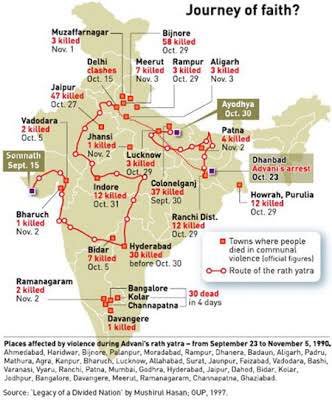
The build up to Babri demolition was preceded by implementation of Mandal Commission, some thing which his party could not handle. If they support it they loose their core upper caste Hindu constituency, if they oppose it they weaken themselves on electoral wicket, so they seek the help of Lord Ram at this juncture. His revered other leader, the one famous as the Mask of RSS, Vajpayee, put it very aptly by saying that they brought in Mandal so we had to resort to Kamandal (Religiosity) in our politics. Post Bari violence is totally bypassed, violence following the Rath yatra is underplayed and attributed to everything else except their real cause the Yatra. Yatra is all milk and honey, pseudo secular trouble makers are doing the violence and projecting is as Blood yatra, how wrong of them, Mr. Ram Sevak!
The whole view of things is 'genuinely saffron', in this account. If one wants to know the trajectory of RSS combine on political chess board, here is the book. The nuclear arms race triggered by the Pokhran and then Advani's, threat to Pakistan, now we have a bomb, dare you assert yourself. And then in reply to India's five explosions Pakistan does six and silently tells Advani yes we also have it and if we occupy Kargil, what will you do baring requesting Uncle Sam to make us withdraw? But all this is not the part of Advani story, where the nuclear explosion is a national honor and his colleagues celebrate it by planning to spread the 'holy' Pokhran sand all over the country so that their ideological cancer is supplemented by physical cancer! Any way mercifully the later was not done and nation needs to thank these 'nuclear nationalists' for their kindness in sparing us the spread of radioactive nuclear material!
How to defend a fellow swaymasevak who has presided over a mass carnage can be nicely learnt from the chapter on Gujarat. Advani bypasses all other versions and reports to defend Modi's actions. If Godhra train was burnt (implication, by Muslims) why you should at all consider the Banerjee report whose opinion is contrary to that of his fellow swaymasevak. If Gujarat Forensic lab gives the report that fire could not have been put from outside, how can we take that into consideration. And see there were so many other acts of violence, so why single out Modi for this one. The reports by various human rights groups have no meaning. All is well in Gujarat, the Supreme court is transferring cases out of Gujarat as the possibility of getting justice there does not exist, so what? Gujarat is prospering and Modi as a true RSS worker is ushering in Hindu Rashtra there, relegating minorities to the second class citizen status, what can be a bigger joy for this 'nationalism', as his nation is coming to fruition by and by. He doggedly defends Modi, and anoints this mass murderer of Gujarat as his successor, what more can speak of his politics.
There is enough material in the book to understand the politics and planning of RSS. The trivial things apart, Advani shows the glimpse of things planned by RSS. Gujarat is the way and BJP will gradually bring in such a state of affairs as outlined by their most revered Guruji, Madhav Sadashiv Golwalkar, who ordained that Minorities submit to the wish of majority (RSS) else they will have to live as second class citizens. And one does get this frightening picture after going through this book.
It shows the mechanism of RSS combine also. You need a suave, soft spoken person at the top till you come to full power. That's why Vajapyee had to be the Primer minister despite the fact that it was Advani who led the Babri demolition and Hindutva onslaught on Indian democracy. With Vajpayee, retired, some one has to take that place and Advani with his mannerism and expressions which are soft, fits the bill till they come to power and than of course it will be Modi's day, Modi, with classic fascist persona (a la Ashish Nandy), is already waiting in the wings to impose the Hindu Rashtra. What is most frightening about the book is that communal common sense manufactured by RSS shakhas and propagated by various other means has been presented as a sugar coated pill by this wily swayamsevak turned politician in the service of Hindu Rashtra.
Ram Puniyani
Many reviews have already come out of this book, spanning the life of Lal Krishna Advani, known for thrusting the RSS-BJP politics on the body politic of democratic India. Starting from his role in initiating campaign around Ram temple issue, rath yatra Babri demolition, BJP's becoming a significant power in the electoral arena, NDA rule and the Gujarat carnage, he has played a major role in implementing the RSS agenda of abolishing the democracy and gradually imposing Hindu nation. That's why the comments of Mohan Bhagawat, RSS General Secretary, at the time of release of the book, that Advani has written the book like a swaymsevak are most apt in describing the book and in understanding the agenda of the man who has been a major player in the policy rooms of RSS-BJP.
Undoubtedly there are some serious mistakes like the narration of the hanging of Bhagat Singh, but how can one expect a Hindu nationalist to know the life events of an atheist, communist, dead against the politics promoted in the name of religion, which Advani practices. Then there is a deliberate presentation that he, despite being Home minister, was not the part of decision making process of Jaswant Singh accompanying the terrorists to Kandhar. This is a deliberate lie, but with a purpose. The idea is to present himself as someone who is 'hard' against terrorism, and not responsible for the mistakes of NDA regime. At the same time he takes the credit for the all the supposedly good actions during NDA regime. Than there is a deliberate silence at places, that of details of death of his political mentor, Shyama Prasead Mukerjee, or expulsion of hardliner Balraj Madhok from President ship of Bhartiya Jan Sangh, the previous avatar of BJP. All this should be expected as being primarily a swayamsevak, who has taken oath to work for the Hindu nation, meaning there by to usurp the democracy, he will tell us what suits his political goals and leave out the uncomfortable incidents from his log book of history.
What comes out from this massive volume is the mind set, the politics which RSS has been pursuing and its actualization in the political arena from the decade of 1980s. What comes out is the very sophisticated presentation of the ideology of RSS, its view of history, nationalism, culture and politics and what have you. Indoctrinated in the shakha baudhhiks (RSS branch ideological sessions) and inspired by Mookerjee and Deendayal Upadhyay, this swaymsevak does the best advocacy of the 'divisive' ideology and its role in pushing back the values of freedom movement.
One also wonders about his very title, My country: My Life. By My country, apparently he refers to India, as it came to be after it attained independence. During that time, the whole country, the Indian nation was striving to fight against the British colonialists, barring of course the Muslim League-RSS-Hindu Mahsabha. How can the followers of RSS, or religious nationalism of any variety for that matter, call this democratic secular nation as their country as their notion of nationalism is far removed from what most of the people of this country accepted and there by followed the path shown by Gandhi and the values delineated by the likes of Bhagat Singh and Ambedkar.
While currently, Advani ilk talks of nationalism in an aggressive manner, as a matter of fact when this Nation was coming into being, they were conspicuous by their absence from the process of nation formation. When as a young recruit of RSS he was digesting the indoctrination of RSS ideology, the youth of his age were breaking the British laws to ensure that our motherland gets freedom. When he was imbibing the 'cultural nationalism' of RSS, Ambedkar was condemning the Brahminic theology of Hinduism, the very base of RSS cultural nationalism.
His crocodile tears at the death of Gandhi are displayed a wee bit shamelessly. While talking of Gandhi murder as a sad event, the rath yatri forgets to mention that the murder was done by none other that his fellow swaymasevak, Nathuram Godse, who was also holding concepts of nationalism about which the author talks so gloriously all through in the book. His fascination for Deendayal Upadhyay reveals the deeper ideology of Hindu Rashtra. Upadhyay is credited with the ideology of Ekatma Manvad, Integral humanism, the indirect defense of the Varna system in current times.
The fortunes of RSS changed for better with Jaya Prakash Narayan letting RSS combine become part of the movement led by him. Now it comes out that this movement was to be the turning point in Indian politics, by giving legitimacy to the murderers of the father of the nation and by opening the way of Hindu nationalism, which came to assert itself over a period of time. While describing the break down of Janata Party, he puts the blame on others, while the real issue was that socialists like Fernandes and Rajnarayan were very forthright in saying that Jana Sangh faction should dissociate from RSS if it wants to continue being part of janata party. The Janasangh faction of Janata Party, (Vajpayee, Advani, Varma) decided to break the Janata party rather than severe the connection with RSS, and that's how the party broke. Interestingly at that time and till quite late George Fernandes was the most vocal critics of RSS-BJP and its fascist ideology. In this book Fernandes finds a very cozy mention, as the political opportunism of Fernandes and political expediency of BJP brought them together and is keeping them together as NDA, so much for the 'honesty' of the narrative.
The shift away from Gandhian Socialism, the ideology of BJP as enunciated at the time of its formation finds no ideological treatment in this tome. Why they picked it up in the first place and what made them abandon this ploy? One is raising these questions knowing fully well that one does not expect RSS volunteers to answer them, as the goals justify the means for this brand of politics. The taking up of Ram Temple issue is elaborated in great detail and with this the communal historiography, Muslim kings destroyed Hindu temples, and all other Shakha baudhik outpouring, which is strengthening communal divide is dished out by him in a very clever manner. What also becomes apparent here is that Advani was never shaken or disturbed by the real life deprivations of dalits, poor or the workers. What comes clearly is that the major problem for Advani has been the issues related to identity, in contrast to issues of bread, butter, shelter and rights. It is this identity polices which made Advani what he is.
With Ram Temple issue, the national identity is made to veer around lord almighty. And while asserting that, this Hindutva warrior does state that he does not want a theological state, thank you sir! But what else can he say. While the whole nation was talking of India, multi religious, diverse and multicultural, RSS was talking of a political system based on monolithic, Brahimised Hinduism called Hindutva. So Advani's effort to project Lord Ram as the symbol of Indian nationalism is ludicrous but it did help his political agenda to no end. It did lead to demolition of a centuries old mosque and the carnage targeted against minorities. Babri dispute is also presented through the prism of Hindu fanatical ideology, never questioning how British introduced the divisive communal historiography through their gazettes and through the history books. The sources he cites for Ramjanm Bhumi temple being there, the courtier account etc. should be laughing matter for serious historians. But that's what suits his politics.
Life has many contradictions and surprises. This man wants to build a Ram temple at the site, where Babri masjid stood. He says that the Kar Seva on 6th December 1992 will be done with bricks and shovels. His colleagues, the part of Ram Temple movement assert that they will destroy the mosque and the debris will be thrown in river Saryu. Then his followers do precisely what is told to them and what is desired by the Advani clan. If that is what they have been saying then how come they should endeavor to stop them while kar sevaks are demolishing the mosque, is beyond one's comprehension. The claim that the RSS combine leadership on the stage tried to stop the demolition, is probably amongst the biggest and most convenient political lies of the history of current times. His colleagues are celebrating, hugging each other, distributing sweets and this gentleman wants us to believe that it was the dark day of his life! Probably he is too shrewd and astute in his political calculations for posterity.
As a build up to the demolition he propagates that the masjid is a sore on the eyes of nationalism. Probably he knows indoctrinated history only as much as is needed as an ideal RSS swaymsevak. Who will tell him that the mosques and temples were destroyed and built more as a political calculation by the kings rather than for religious considerations alone. He will not like to know that the biggest temple in Ayodhya, Hanuman Garhi was built on the land donated by Nawab of Awadh or that the same Aurangzeb who destroyed many a temples also gave huge donations to many a Hindu Temples.
The build up to Babri demolition was preceded by implementation of Mandal Commission, some thing which his party could not handle. If they support it they loose their core upper caste Hindu constituency, if they oppose it they weaken themselves on electoral wicket, so they seek the help of Lord Ram at this juncture. His revered other leader, the one famous as the Mask of RSS, Vajpayee, put it very aptly by saying that they brought in Mandal so we had to resort to Kamandal (Religiosity) in our politics. Post Bari violence is totally bypassed, violence following the Rath yatra is underplayed and attributed to everything else except their real cause the Yatra. Yatra is all milk and honey, pseudo secular trouble makers are doing the violence and projecting is as Blood yatra, how wrong of them, Mr. Ram Sevak!
The whole view of things is 'genuinely saffron', in this account. If one wants to know the trajectory of RSS combine on political chess board, here is the book. The nuclear arms race triggered by the Pokhran and then Advani's, threat to Pakistan, now we have a bomb, dare you assert yourself. And then in reply to India's five explosions Pakistan does six and silently tells Advani yes we also have it and if we occupy Kargil, what will you do baring requesting Uncle Sam to make us withdraw? But all this is not the part of Advani story, where the nuclear explosion is a national honor and his colleagues celebrate it by planning to spread the 'holy' Pokhran sand all over the country so that their ideological cancer is supplemented by physical cancer! Any way mercifully the later was not done and nation needs to thank these 'nuclear nationalists' for their kindness in sparing us the spread of radioactive nuclear material!
How to defend a fellow swaymasevak who has presided over a mass carnage can be nicely learnt from the chapter on Gujarat. Advani bypasses all other versions and reports to defend Modi's actions. If Godhra train was burnt (implication, by Muslims) why you should at all consider the Banerjee report whose opinion is contrary to that of his fellow swaymasevak. If Gujarat Forensic lab gives the report that fire could not have been put from outside, how can we take that into consideration. And see there were so many other acts of violence, so why single out Modi for this one. The reports by various human rights groups have no meaning. All is well in Gujarat, the Supreme court is transferring cases out of Gujarat as the possibility of getting justice there does not exist, so what? Gujarat is prospering and Modi as a true RSS worker is ushering in Hindu Rashtra there, relegating minorities to the second class citizen status, what can be a bigger joy for this 'nationalism', as his nation is coming to fruition by and by. He doggedly defends Modi, and anoints this mass murderer of Gujarat as his successor, what more can speak of his politics.
There is enough material in the book to understand the politics and planning of RSS. The trivial things apart, Advani shows the glimpse of things planned by RSS. Gujarat is the way and BJP will gradually bring in such a state of affairs as outlined by their most revered Guruji, Madhav Sadashiv Golwalkar, who ordained that Minorities submit to the wish of majority (RSS) else they will have to live as second class citizens. And one does get this frightening picture after going through this book.
It shows the mechanism of RSS combine also. You need a suave, soft spoken person at the top till you come to full power. That's why Vajapyee had to be the Primer minister despite the fact that it was Advani who led the Babri demolition and Hindutva onslaught on Indian democracy. With Vajpayee, retired, some one has to take that place and Advani with his mannerism and expressions which are soft, fits the bill till they come to power and than of course it will be Modi's day, Modi, with classic fascist persona (a la Ashish Nandy), is already waiting in the wings to impose the Hindu Rashtra. What is most frightening about the book is that communal common sense manufactured by RSS shakhas and propagated by various other means has been presented as a sugar coated pill by this wily swayamsevak turned politician in the service of Hindu Rashtra.
April 05, 2008
Karnataka: Holy Cow and other hindutva tricks
From Tehelka Magazine, Vol 5, Issue 13, Dated April 5, 2008
Curse Of The Holy Cow
Bajrang Dal men strip and beat in public two Muslims and a Dalit for killing a cow. Karnataka quietly watches. SANJANA reports
" God? I think God is on holiday or has run away."
– Kunimaydu, 61 years old
ON MARCH 4, 2008, two Muslims and a Dalit were stripped, beaten mercilessly and publicly humiliated by Bajrang Dal activists in Shantipura in Karnataka's Chikmaglur district. The three had been declared guilty of having killed a cow. Around 500 people watched for over two hours as the mob attacked Kunimaydu KA, Bawa K. and Jayaram K. Says a bitter Kunimaydu, 'Most of the boys who attacked me were half my age.'
Earlier in the day Kunimaydu had purchased a cow, intending to slaughter it for meat as part of a family celebration. The fact that he refused to deny this incensed the Bajrang Dal brigade even more. But it was Jayaram, a daily wage worker, who faced the brunt of the attack. Being a Dalit and hence a supposed 'Hindu', his mere presence on the farm was collusion enough. He had betrayed Hindus all over Karnataka, claimed the Bajrangis. ' They used absolutely filthy language... even dogs are shown more mercy. Jayaram had nothing to do with the meat,' says Bawa, blinking hard to avoid the tears. Stripped, the three men were forced to march to the centre of the village with the meat on their heads. The beatings continued there.
Kunimaydu’s neighbour Sundaresh Gowda led the attack. ' He was the one who sneaked into the house from the back door. He was looking for the meat, even as he abused Muslims in general. I fell at his feet and asked him to spare us,” recounts Kunimaydu. Sundaresh only whistled for others to join in. “This boy grew up in my vicinity. His grandfather and I were good friends. Now that he is a Bajrang Dal leader, he doesn’t remember his past,” says Kunimaydu. What happened in Shantipura is only a reminder of the rapid communal polarisation taking place in Karnataka. Two days after the Shantipura incident, a hotel-owner in the nearby town of Mudigere was threatened by the Bajrang Dal for serving beef at his hotel.
A couple of days later, Helen Mary, a school prinicipal, was attacked by the Bajrang Dal on charges of attempting to forcibly convert students. Ghouse Mohiuddin, a local activist with the Karnataka Communal Harmony Forum, says Shantipura is the first time that the Sangh Parivar has attacked a Dalit in the state for killing a cow. “Otherwise, a daily scan of local newspapers in the region will show at least one communal incident every day.”
THE BATTLELINES between the saffron brigade and those who consume beef and trade in cattle have been drawn for a long while now. October 2006 saw fullfledged riots rocking Mangalore, BC Road, Farangipet, Ullal and other towns in coastal Karnataka for over three days. The immediate spark for the riots were rumours that a Muslim trader who was driving a tempo with cows for slaughter had knocked down a Hindu woman. In March 2005, in Adi Udupi, a town in coastal Karnataka, two Muslims were attacked for transporting cows for slaughter — they were stripped, paraded naked and beaten mercilessly for over four hours before 400 onlookers.
The Karnataka Prevention of Cow Slaughter and Cattle Preservation Act (Cow Slaughter Legislation) was passed in 1964, though amended several times over. The Act does not completely ban cow slaughter but does lay down strict guidelines — cows can be slaughtered following an official certification that “the animal is over 12 years old, has become permanently incapacitated for breeding, draught or giving milk due to injury, deformity or any other cause.”
Mahesh Kumar, an activist with the Peoples’ Law Forum, says there is a need to look afresh at the cow slaughter law. “Right now the argument is based on two facts — that the sacrifice of a cow is not a religious mandate for Muslims and that killing a cow offends a particular community’s religious sentiments. Why do we have to prove religious mandate? Why aren’t social practices taken into account? Also, if members of a community claiming to be hurt by beef-eating consume beef themselves, it is a bit hypocritical for them to cast judgements on others,” he says. The law aside, the Sangh Parivar forgets that the Vajpayee-led NDA government itself recommended a removal of the ban on beef export as part of the Tenth Five Year Plan proposal in 2002. It had allocated Rs 5,137 crore to modernise slaughterhouses across the country.
There is hardly any dispute that Muslims are not the only community that consumes beef. Many Hindus eat beef and have always done so, a fact that is well documented in historian DN Jha’s 2001 book, The Myth of the Holy Cow. This is a question that the Sangh Parivar does not want to address. The violence instigated by the Sangh Parivar comes at a time when the BJP has been trying to reinvent itself as a party focused on development issues. Ahead of the Assembly elections in May, the violence practised by its allied outfits and its avowed development plank pose a contradiction difficult to ignore.
WRITER'S EMAIL:
sanjana@tehelka.com
Curse Of The Holy Cow
Bajrang Dal men strip and beat in public two Muslims and a Dalit for killing a cow. Karnataka quietly watches. SANJANA reports
" God? I think God is on holiday or has run away."
– Kunimaydu, 61 years old
ON MARCH 4, 2008, two Muslims and a Dalit were stripped, beaten mercilessly and publicly humiliated by Bajrang Dal activists in Shantipura in Karnataka's Chikmaglur district. The three had been declared guilty of having killed a cow. Around 500 people watched for over two hours as the mob attacked Kunimaydu KA, Bawa K. and Jayaram K. Says a bitter Kunimaydu, 'Most of the boys who attacked me were half my age.'
Earlier in the day Kunimaydu had purchased a cow, intending to slaughter it for meat as part of a family celebration. The fact that he refused to deny this incensed the Bajrang Dal brigade even more. But it was Jayaram, a daily wage worker, who faced the brunt of the attack. Being a Dalit and hence a supposed 'Hindu', his mere presence on the farm was collusion enough. He had betrayed Hindus all over Karnataka, claimed the Bajrangis. ' They used absolutely filthy language... even dogs are shown more mercy. Jayaram had nothing to do with the meat,' says Bawa, blinking hard to avoid the tears. Stripped, the three men were forced to march to the centre of the village with the meat on their heads. The beatings continued there.
Kunimaydu’s neighbour Sundaresh Gowda led the attack. ' He was the one who sneaked into the house from the back door. He was looking for the meat, even as he abused Muslims in general. I fell at his feet and asked him to spare us,” recounts Kunimaydu. Sundaresh only whistled for others to join in. “This boy grew up in my vicinity. His grandfather and I were good friends. Now that he is a Bajrang Dal leader, he doesn’t remember his past,” says Kunimaydu. What happened in Shantipura is only a reminder of the rapid communal polarisation taking place in Karnataka. Two days after the Shantipura incident, a hotel-owner in the nearby town of Mudigere was threatened by the Bajrang Dal for serving beef at his hotel.
A couple of days later, Helen Mary, a school prinicipal, was attacked by the Bajrang Dal on charges of attempting to forcibly convert students. Ghouse Mohiuddin, a local activist with the Karnataka Communal Harmony Forum, says Shantipura is the first time that the Sangh Parivar has attacked a Dalit in the state for killing a cow. “Otherwise, a daily scan of local newspapers in the region will show at least one communal incident every day.”
THE BATTLELINES between the saffron brigade and those who consume beef and trade in cattle have been drawn for a long while now. October 2006 saw fullfledged riots rocking Mangalore, BC Road, Farangipet, Ullal and other towns in coastal Karnataka for over three days. The immediate spark for the riots were rumours that a Muslim trader who was driving a tempo with cows for slaughter had knocked down a Hindu woman. In March 2005, in Adi Udupi, a town in coastal Karnataka, two Muslims were attacked for transporting cows for slaughter — they were stripped, paraded naked and beaten mercilessly for over four hours before 400 onlookers.
The Karnataka Prevention of Cow Slaughter and Cattle Preservation Act (Cow Slaughter Legislation) was passed in 1964, though amended several times over. The Act does not completely ban cow slaughter but does lay down strict guidelines — cows can be slaughtered following an official certification that “the animal is over 12 years old, has become permanently incapacitated for breeding, draught or giving milk due to injury, deformity or any other cause.”
Mahesh Kumar, an activist with the Peoples’ Law Forum, says there is a need to look afresh at the cow slaughter law. “Right now the argument is based on two facts — that the sacrifice of a cow is not a religious mandate for Muslims and that killing a cow offends a particular community’s religious sentiments. Why do we have to prove religious mandate? Why aren’t social practices taken into account? Also, if members of a community claiming to be hurt by beef-eating consume beef themselves, it is a bit hypocritical for them to cast judgements on others,” he says. The law aside, the Sangh Parivar forgets that the Vajpayee-led NDA government itself recommended a removal of the ban on beef export as part of the Tenth Five Year Plan proposal in 2002. It had allocated Rs 5,137 crore to modernise slaughterhouses across the country.
There is hardly any dispute that Muslims are not the only community that consumes beef. Many Hindus eat beef and have always done so, a fact that is well documented in historian DN Jha’s 2001 book, The Myth of the Holy Cow. This is a question that the Sangh Parivar does not want to address. The violence instigated by the Sangh Parivar comes at a time when the BJP has been trying to reinvent itself as a party focused on development issues. Ahead of the Assembly elections in May, the violence practised by its allied outfits and its avowed development plank pose a contradiction difficult to ignore.
WRITER'S EMAIL:
sanjana@tehelka.com
The big fraud called LK Advani
The News International
April 05, 2008
Advani: the truth behind the mask
by Praful Bidwai
From time to time, the Indian media appoints itself the spin-master of certain political leaders. Take former Prime Minister Narasimha Rao. This cynical advocate of defeatism in the face of Hindutva and globalisation was glorified as both a scholar extraordinary who knew 14 languages, and a master tactician. Reality was more prosaic. Rao was no linguist. He allowed the Babri mosque to be razed through "masterly" inaction. And he accelerated his Congress party's decline.
Now, the media is building up LK Advani as a leader whose swearing-in as PM is only waiting for the general election. Advani, we're also told, is an erudite person, with analytical faculties and eager to engage with ideas. He has a gentle, even humane, side too. Those who have followed Advani's career will find it hard to believe this. His autobiography My Country, My Life should confirm their worst assessments. Reading it doesn't lead to the conclusion, set out in Vajpayee's Foreword, that it's authored by an "outstanding leader whose best… is yet to come".
Advani emerges as a leader whose time has already passed. His ideology and politics have no relevance for most Indians who want an open and just society free of discrimination on grounds of birth or religion, who long to be emancipated from deprivation, and who are yet to enjoy real, substantive democracy. Advani's 986-page book is a descriptive account, with numerous anecdotes, some interesting, but most without insights into events or personalities. One doesn't expect full, candid disclosures about the past from practising politicians because that would limit their options. But one can hope for some analysis, honest reflection, new information, or self-doubt.
Advani doesn't rise to the mark. He doesn't take distance from events to look at them critically. The book is compulsively self-justificatory. It also reveals some obsessions: "Hindu India's" centuries-long victimhood, prejudice against efforts (e.g. Gandhiji's) to forge a citizen-based identity independent of religion, blind faith in aggressive nationalism and India's emergence as a Great Power. Even in the book's best part, pertaining to the Emergency, Advani doesn't rise above petty, person-centric polemics. He makes no attempt to understand the deeper causes of the structural crisis of governance it represented. He condemns Indira Gandhi for saying that "the nation is more important than democracy", and invoking "the foreign hand" to violate civil liberties. He accuses her of having "explored the possibility of installing a presidential system of government".
But Advani's own party is distinguished by placing the nation before democracy. As home minister, he himself attributed the Kashmir unrest to "the foreign hand" (Pakistan). And it's the BJP-led NDA which established the Commission to Review the Constitution--expressly, but unsuccessfully, to promote presidential government. Advani closely observed or played a role in some momentous events--the Emergency, the Ram Janmabhoomi mobilisation, the 1998 nuclear tests, strategic embrace of the US, and India's worst state-sponsored violence, in Gujarat. But there's no self-critical reflection into these. Totally missing is the larger social-political context which made these events possible--including the historic decline of the Congress, rise of identity politics, neoliberal economic changes and rise of a new middle class.
The book doesn't once mention the RSS's interference in day-to-day governance, which became starkly visible when it vetoed Jaswant Singh's appointment as finance minister. Advani also hides the rationale of the 1998 nuclear blasts. He presents the decision as a straightforward corollary of the Jana Sangh's 1964 resolution calling for an Indian Bomb. Advani's entire discourse on national security is banal, and his understanding of terrorism driven by a Pakistan obsession--as if the Kashmir militancy never had indigenous roots in popular discontent and Indian policies. Terrorism must be, can only be, smashed with force. There's no need for addressing its root-causes. This thinking befits a small-town thanedar, not India's home minister.
Advani always advocated a matching answer to "threats" from Pakistan. But he doesn't explain why India's 10 months-long post-December 2001 mobilisation of 7 lakh troops was no answer. Nor does he explain why Vajpayee extended "the hand of peace" to Pakistan in April 2003, barely a week after he had ruled this out Advani held 20 secret meetings with former Pakistan high commissioner Qazi Jehangir Ashraf, but doesn't explain why they produced no results at Agra or later.
The book contains outright lies too. During Advani's June 2003 US visit, India all but agreed--subject to "clarifications"--to send troops to Iraq. He says: "Right from the beginning … Atalji and I were firmly of the view that sending …troops… was out of the question…".
However, it was officially reported that India agreed in principle to send troops. A June 8 statement by the Indian embassy in Washington says Advani told Secretary Rumsfeld "that the matter was under consideration …" He was quoted by Aaj Tak that those opposed to sending troops were "uninformed" and had a "one-sided opinion".
Advani is silent on who pressed for his resignation after his remarks on Qaide Azam Jinnah's "secularism" during his 2005 Pakistan visit, but it's known they included his own protégés (e.g. Arun Jaitley). He recalls: "One day,… I was told I should step down from the presidentship of the BJP..." He calls this "profoundly agonising", but doesn't gather the courage to say it was the RSS which issued the directive!
Advani's account of the Kandahar hijack episode is a white lie. He repeatedly claims the BJP would never compromise with "terrorists"--when it actually exchanged hostages with them. He ludicrously says he was unaware that Jaswant Singh was asked by the Cabinet Committee on Security to go to Kandahar and carry out the exchange. This is contradicted by every available account, including George Fernandes'.
Whatever the truth, this gravely damages Advani's USP as Loh Purush (Iron Man). If he was unaware of Singh's brief, he was unfit to be Home Minister. If he was party to the CCS decision, that demolishes his claimed resolve to fight terrorism Either way, Advani loses.
Advani's idea of "secularism" is grotesque. He never rises above the religion-based "us" and "them" identities. He condemns missionary Graham Staines' killing, and repeats the cliche, "some of my best friends are Christians", but reverts to crass Hindutva on the freedom of religion: conversion is "a threat both to Hindu society and national integration".
The most nauseating part of the book pertains to Gujarat. Advani rejects the settled truth that the post-Godhra violence was state-sponsored. As proof, he narrates two instances in which he interceded with Narendra Modi and prevented Muslims from being killed. But for every such example, there are probably 10 instances of premeditated murder, including the gruesome dismembering alive of former MP Ehsan Jafri, which Advani/Modi didn't prevent.
Advani ends up tailing Modi and lionising him as "the most viciously, consistently and persistently maligned leader, both nationally and internationally". Modi logically emerges as Advani's successor--a shameful comment on the BJP's evolution. Advani wanted to use the book as a launching-pad for the next election and put the Congress in a spot. Why, he even went uninvited to gift Sonia Gandhi a copy on Holi day--to score a PR point. All he has succeeded in doing is expose his own pettiness.
April 05, 2008
Advani: the truth behind the mask
by Praful Bidwai
From time to time, the Indian media appoints itself the spin-master of certain political leaders. Take former Prime Minister Narasimha Rao. This cynical advocate of defeatism in the face of Hindutva and globalisation was glorified as both a scholar extraordinary who knew 14 languages, and a master tactician. Reality was more prosaic. Rao was no linguist. He allowed the Babri mosque to be razed through "masterly" inaction. And he accelerated his Congress party's decline.
Now, the media is building up LK Advani as a leader whose swearing-in as PM is only waiting for the general election. Advani, we're also told, is an erudite person, with analytical faculties and eager to engage with ideas. He has a gentle, even humane, side too. Those who have followed Advani's career will find it hard to believe this. His autobiography My Country, My Life should confirm their worst assessments. Reading it doesn't lead to the conclusion, set out in Vajpayee's Foreword, that it's authored by an "outstanding leader whose best… is yet to come".
Advani emerges as a leader whose time has already passed. His ideology and politics have no relevance for most Indians who want an open and just society free of discrimination on grounds of birth or religion, who long to be emancipated from deprivation, and who are yet to enjoy real, substantive democracy. Advani's 986-page book is a descriptive account, with numerous anecdotes, some interesting, but most without insights into events or personalities. One doesn't expect full, candid disclosures about the past from practising politicians because that would limit their options. But one can hope for some analysis, honest reflection, new information, or self-doubt.
Advani doesn't rise to the mark. He doesn't take distance from events to look at them critically. The book is compulsively self-justificatory. It also reveals some obsessions: "Hindu India's" centuries-long victimhood, prejudice against efforts (e.g. Gandhiji's) to forge a citizen-based identity independent of religion, blind faith in aggressive nationalism and India's emergence as a Great Power. Even in the book's best part, pertaining to the Emergency, Advani doesn't rise above petty, person-centric polemics. He makes no attempt to understand the deeper causes of the structural crisis of governance it represented. He condemns Indira Gandhi for saying that "the nation is more important than democracy", and invoking "the foreign hand" to violate civil liberties. He accuses her of having "explored the possibility of installing a presidential system of government".
But Advani's own party is distinguished by placing the nation before democracy. As home minister, he himself attributed the Kashmir unrest to "the foreign hand" (Pakistan). And it's the BJP-led NDA which established the Commission to Review the Constitution--expressly, but unsuccessfully, to promote presidential government. Advani closely observed or played a role in some momentous events--the Emergency, the Ram Janmabhoomi mobilisation, the 1998 nuclear tests, strategic embrace of the US, and India's worst state-sponsored violence, in Gujarat. But there's no self-critical reflection into these. Totally missing is the larger social-political context which made these events possible--including the historic decline of the Congress, rise of identity politics, neoliberal economic changes and rise of a new middle class.
The book doesn't once mention the RSS's interference in day-to-day governance, which became starkly visible when it vetoed Jaswant Singh's appointment as finance minister. Advani also hides the rationale of the 1998 nuclear blasts. He presents the decision as a straightforward corollary of the Jana Sangh's 1964 resolution calling for an Indian Bomb. Advani's entire discourse on national security is banal, and his understanding of terrorism driven by a Pakistan obsession--as if the Kashmir militancy never had indigenous roots in popular discontent and Indian policies. Terrorism must be, can only be, smashed with force. There's no need for addressing its root-causes. This thinking befits a small-town thanedar, not India's home minister.
Advani always advocated a matching answer to "threats" from Pakistan. But he doesn't explain why India's 10 months-long post-December 2001 mobilisation of 7 lakh troops was no answer. Nor does he explain why Vajpayee extended "the hand of peace" to Pakistan in April 2003, barely a week after he had ruled this out Advani held 20 secret meetings with former Pakistan high commissioner Qazi Jehangir Ashraf, but doesn't explain why they produced no results at Agra or later.
The book contains outright lies too. During Advani's June 2003 US visit, India all but agreed--subject to "clarifications"--to send troops to Iraq. He says: "Right from the beginning … Atalji and I were firmly of the view that sending …troops… was out of the question…".
However, it was officially reported that India agreed in principle to send troops. A June 8 statement by the Indian embassy in Washington says Advani told Secretary Rumsfeld "that the matter was under consideration …" He was quoted by Aaj Tak that those opposed to sending troops were "uninformed" and had a "one-sided opinion".
Advani is silent on who pressed for his resignation after his remarks on Qaide Azam Jinnah's "secularism" during his 2005 Pakistan visit, but it's known they included his own protégés (e.g. Arun Jaitley). He recalls: "One day,… I was told I should step down from the presidentship of the BJP..." He calls this "profoundly agonising", but doesn't gather the courage to say it was the RSS which issued the directive!
Advani's account of the Kandahar hijack episode is a white lie. He repeatedly claims the BJP would never compromise with "terrorists"--when it actually exchanged hostages with them. He ludicrously says he was unaware that Jaswant Singh was asked by the Cabinet Committee on Security to go to Kandahar and carry out the exchange. This is contradicted by every available account, including George Fernandes'.
Whatever the truth, this gravely damages Advani's USP as Loh Purush (Iron Man). If he was unaware of Singh's brief, he was unfit to be Home Minister. If he was party to the CCS decision, that demolishes his claimed resolve to fight terrorism Either way, Advani loses.
Advani's idea of "secularism" is grotesque. He never rises above the religion-based "us" and "them" identities. He condemns missionary Graham Staines' killing, and repeats the cliche, "some of my best friends are Christians", but reverts to crass Hindutva on the freedom of religion: conversion is "a threat both to Hindu society and national integration".
The most nauseating part of the book pertains to Gujarat. Advani rejects the settled truth that the post-Godhra violence was state-sponsored. As proof, he narrates two instances in which he interceded with Narendra Modi and prevented Muslims from being killed. But for every such example, there are probably 10 instances of premeditated murder, including the gruesome dismembering alive of former MP Ehsan Jafri, which Advani/Modi didn't prevent.
Advani ends up tailing Modi and lionising him as "the most viciously, consistently and persistently maligned leader, both nationally and internationally". Modi logically emerges as Advani's successor--a shameful comment on the BJP's evolution. Advani wanted to use the book as a launching-pad for the next election and put the Congress in a spot. Why, he even went uninvited to gift Sonia Gandhi a copy on Holi day--to score a PR point. All he has succeeded in doing is expose his own pettiness.
April 04, 2008
Cry for justice! Fresh Probe Ordered into Gujarat Carnage Cases
Ram Puniyani
The Supreme Court order of 25 March 2008 for fresh probes into some Gujarat riot cases, like Naroda Patia, Naroda, etc. comes as welcome relief in these dark times, when most of the time justice is conspicuous by its absence. In Gujarat, we witnessed the case of Zahira Sheikh being wrecked, the judiciary quietly watching and ignoring all the witnesses turning hostile, but preferring to accept the version of the state despite all the holes in its argument. It was the transfer of the case to Maharashtra that brought to light the truth. The same story was repeated in the case of Bilkis Bano. The transfer of cases away from the state gave some justice to her. Now, with the intervention of the National Human Rights Commission (NHRC) and Teesta Setalvad, many other cases with tremendous bearing on the fate of justice for the victims will be reinvestigated properly.
By now it is crystal-clear that communal carnage is a total violation of democratic norms and laws. To begin with, some political forces that stand to benefit from this violence, the post-violence polarization and these political forces' consequent electoral strengthening look for a pretext to launch the carnage. By now the biases against minorities have become ingrained very deeply into the social psyche. Thus, during the carnage large sections of society come to believe that since the majority of victims are members of the minorities, what is going on is acceptable. A silent sanction for the violence prevails. This social, communal common sense against minorities makes the job of communalists easy, as the image of minorities has now been successfully demonized through various mechanisms, both globally and at home here in India.
As far as the political leadership is concerned, there are three types of attitudes. The first is seen at times when the ruling party workers lead the carnage from the front -- for example, the Delhi Anti Sikh massacre (Congress) or the Gujarat carnage (RSS combine). The second manifests itself when the leadership keeps quiet and lets the merchants of carnage do their job, as in Mumbai (1992-93), where Shiv Sena led the charge, the BJP assisted and the Congress (the party in power) watched. Most of the riots in India fall in this category. That is one of the reasons for the BJP trying to claim till the Gujarat violence that there are no riots when it rules. Some people bought this argument, and projected that the BJP is better than the Congress. And then Gujarat happened. Even in the majority of cases where the Congress ruled when violence took place, it was the BJP that was spearheading the violence while the Congress leadership was letting the violence take place, even when it could have put a stop to it. This is silent collusion.
In the third variety the political leadership ignores the issue, looking the other way when violence is on, and thereby lets the communal brigade do its job. Such was the case of the Samajvadi Party letting the communalists rampage freely in Mau in Uttar Pradesh. There is another variety too, the one favoured by communists. They have ensured that violence against minorities does not take place when they are ruling, but they have also not acted to prevent the communalization of minds, which is the base of communal riots. The CPM-led coalition in West Bengal or the Left coalition in Kerala falls in this category.
The role of the police is pretty much along a set pattern. Its partisan attitude has been demonstrated in most of the inquiry committee reports. It actively aids the rioters, as in Gujarat, or keeps quiet to let the rioters do their work, with its blessings. During the Mumbai violence, many Muslim victims said that they were capable of protecting themselves but for the police which shields the attackers and paralyses the Muslims. Both these roles are complementary. Research by a police officer, Dr. V.N. Rai, shows that no riot can go on beyond 48 hours unless it is blessed by the political leadership and supported by police officials. The bureaucracy also has powers which can put a stop to the violence but it prefers not to use these powers, as a large section of it is already busy using its powers in other directions.
During and after the violence, another role of the police comes to the fore: that of registering First Information Reports (FIRs). In such situations it prefers to believe in a 'forget it' policy by not registering FIRs as far as possible. If forced to register them, it ensures that there are sufficient clauses built into the FIR which would act as an escape route for the guilty. After this come the investigation done by police. Here again the work is deliberately meant to protect the guilty. It is at this stage that the SC has now intervened, and set up a committee with some upright officials from outside the state. In all such cases in Gujarat, it is by now clear that the communalized state apparatus is politically biased, and it is therefore impossible to obtain justice through its machinery. This is a glorious achievement of Hindu Rashtra's first state! Bravo Modi! Now one knows beyond any shadow of doubt as to why he is the darling of the RSS bosses and the heir-apparent of the current Prime Minister in waiting, Lal Krishna Advani!
The role of the police in particular has come under investigation in different inquiry commission reports -- the Madon Commission in the Bhivandi Jalgaon riots, the Jagmohan Reddy Commission in the Ahmedabad riots, the Vythyathil Commission in the Tellicherry riots, and the Shrikrisha Commission in the Mumbai riots. Most of these have pointed out that the police has without any exception aided and abetted the riots. These reports, meticulous and sincere to the core also highlight the rot that has infected the whole system, right from the political leadership and bureaucracy to the police. One significant observation is that most of the planning of the carnage has been done by one or the other affiliate of the RSS, which has also been taking the leading role.
Even the judiciary has not remained unaffected by the communal virus as witnessed in Gujarat. So by now, the basic dictum of a just society -- punish the guilty and protect the innocent -- is threatened. The recent step of the Supreme Court rekindles the hope that the process of degeneration of the justice delivery system may be halted at various stages. One has been waiting for years for justice for the victims of the anti-Sikh pogrom. One is also witnessing the deceptive attitude of the Maharashtra Government in the implementation of the Shrikrishna Commission report. In a shrewd and dishonest manner, it promised that the implementation of the report will be on the top of its agenda if elected to power. This election promise was made twice, but after winning it has been throwing dust in the eyes of victims and human rights activists by dodging the issue in one way or the other.
Gujarat is of course the worst case as far as justice delivery is concerned. With polarization along religious lines more or less complete, there are few victims who will dare to speak out for justice, as their very survival is at stake. The chief perpetrator of the crime, Narendra Modi, with his second victory due to polarization, is beating his chest and hiding his blood-stained hands. Will -- or can -- justice catch up? Will there be a possibility of putting in the dock the twin 'Emperors of Hindu Hearts', Thackeray and Modi, who were anointed in the aftermath of their leadership of the carnages in Mumbai and Gujarat respectively? Will they be put on trial as per the laws of the land, restoring a sense of justice in the country where communalization has eroded the values of our freedom movement, the values of pluralism, the values of syncretism, and the value of 'diversity as celebration'!
One sees a ray of hope in this move of the Supreme Court. Simultaneously one sees the NHRC and social activists staking their all to ensure that democratic norms survive in the face of the growth of the politics of hate.
The Supreme Court order of 25 March 2008 for fresh probes into some Gujarat riot cases, like Naroda Patia, Naroda, etc. comes as welcome relief in these dark times, when most of the time justice is conspicuous by its absence. In Gujarat, we witnessed the case of Zahira Sheikh being wrecked, the judiciary quietly watching and ignoring all the witnesses turning hostile, but preferring to accept the version of the state despite all the holes in its argument. It was the transfer of the case to Maharashtra that brought to light the truth. The same story was repeated in the case of Bilkis Bano. The transfer of cases away from the state gave some justice to her. Now, with the intervention of the National Human Rights Commission (NHRC) and Teesta Setalvad, many other cases with tremendous bearing on the fate of justice for the victims will be reinvestigated properly.
By now it is crystal-clear that communal carnage is a total violation of democratic norms and laws. To begin with, some political forces that stand to benefit from this violence, the post-violence polarization and these political forces' consequent electoral strengthening look for a pretext to launch the carnage. By now the biases against minorities have become ingrained very deeply into the social psyche. Thus, during the carnage large sections of society come to believe that since the majority of victims are members of the minorities, what is going on is acceptable. A silent sanction for the violence prevails. This social, communal common sense against minorities makes the job of communalists easy, as the image of minorities has now been successfully demonized through various mechanisms, both globally and at home here in India.
As far as the political leadership is concerned, there are three types of attitudes. The first is seen at times when the ruling party workers lead the carnage from the front -- for example, the Delhi Anti Sikh massacre (Congress) or the Gujarat carnage (RSS combine). The second manifests itself when the leadership keeps quiet and lets the merchants of carnage do their job, as in Mumbai (1992-93), where Shiv Sena led the charge, the BJP assisted and the Congress (the party in power) watched. Most of the riots in India fall in this category. That is one of the reasons for the BJP trying to claim till the Gujarat violence that there are no riots when it rules. Some people bought this argument, and projected that the BJP is better than the Congress. And then Gujarat happened. Even in the majority of cases where the Congress ruled when violence took place, it was the BJP that was spearheading the violence while the Congress leadership was letting the violence take place, even when it could have put a stop to it. This is silent collusion.
In the third variety the political leadership ignores the issue, looking the other way when violence is on, and thereby lets the communal brigade do its job. Such was the case of the Samajvadi Party letting the communalists rampage freely in Mau in Uttar Pradesh. There is another variety too, the one favoured by communists. They have ensured that violence against minorities does not take place when they are ruling, but they have also not acted to prevent the communalization of minds, which is the base of communal riots. The CPM-led coalition in West Bengal or the Left coalition in Kerala falls in this category.
The role of the police is pretty much along a set pattern. Its partisan attitude has been demonstrated in most of the inquiry committee reports. It actively aids the rioters, as in Gujarat, or keeps quiet to let the rioters do their work, with its blessings. During the Mumbai violence, many Muslim victims said that they were capable of protecting themselves but for the police which shields the attackers and paralyses the Muslims. Both these roles are complementary. Research by a police officer, Dr. V.N. Rai, shows that no riot can go on beyond 48 hours unless it is blessed by the political leadership and supported by police officials. The bureaucracy also has powers which can put a stop to the violence but it prefers not to use these powers, as a large section of it is already busy using its powers in other directions.
During and after the violence, another role of the police comes to the fore: that of registering First Information Reports (FIRs). In such situations it prefers to believe in a 'forget it' policy by not registering FIRs as far as possible. If forced to register them, it ensures that there are sufficient clauses built into the FIR which would act as an escape route for the guilty. After this come the investigation done by police. Here again the work is deliberately meant to protect the guilty. It is at this stage that the SC has now intervened, and set up a committee with some upright officials from outside the state. In all such cases in Gujarat, it is by now clear that the communalized state apparatus is politically biased, and it is therefore impossible to obtain justice through its machinery. This is a glorious achievement of Hindu Rashtra's first state! Bravo Modi! Now one knows beyond any shadow of doubt as to why he is the darling of the RSS bosses and the heir-apparent of the current Prime Minister in waiting, Lal Krishna Advani!
The role of the police in particular has come under investigation in different inquiry commission reports -- the Madon Commission in the Bhivandi Jalgaon riots, the Jagmohan Reddy Commission in the Ahmedabad riots, the Vythyathil Commission in the Tellicherry riots, and the Shrikrisha Commission in the Mumbai riots. Most of these have pointed out that the police has without any exception aided and abetted the riots. These reports, meticulous and sincere to the core also highlight the rot that has infected the whole system, right from the political leadership and bureaucracy to the police. One significant observation is that most of the planning of the carnage has been done by one or the other affiliate of the RSS, which has also been taking the leading role.
Even the judiciary has not remained unaffected by the communal virus as witnessed in Gujarat. So by now, the basic dictum of a just society -- punish the guilty and protect the innocent -- is threatened. The recent step of the Supreme Court rekindles the hope that the process of degeneration of the justice delivery system may be halted at various stages. One has been waiting for years for justice for the victims of the anti-Sikh pogrom. One is also witnessing the deceptive attitude of the Maharashtra Government in the implementation of the Shrikrishna Commission report. In a shrewd and dishonest manner, it promised that the implementation of the report will be on the top of its agenda if elected to power. This election promise was made twice, but after winning it has been throwing dust in the eyes of victims and human rights activists by dodging the issue in one way or the other.
Gujarat is of course the worst case as far as justice delivery is concerned. With polarization along religious lines more or less complete, there are few victims who will dare to speak out for justice, as their very survival is at stake. The chief perpetrator of the crime, Narendra Modi, with his second victory due to polarization, is beating his chest and hiding his blood-stained hands. Will -- or can -- justice catch up? Will there be a possibility of putting in the dock the twin 'Emperors of Hindu Hearts', Thackeray and Modi, who were anointed in the aftermath of their leadership of the carnages in Mumbai and Gujarat respectively? Will they be put on trial as per the laws of the land, restoring a sense of justice in the country where communalization has eroded the values of our freedom movement, the values of pluralism, the values of syncretism, and the value of 'diversity as celebration'!
One sees a ray of hope in this move of the Supreme Court. Simultaneously one sees the NHRC and social activists staking their all to ensure that democratic norms survive in the face of the growth of the politics of hate.
Ghettoisation and religious segregation in housing continues in cities
Indian Express
April 03, 2008
Not allowed to sell her flat to a Muslim, Pune woman takes on entire ‘society’
by Sunanda Mehta
PUNE, APRIL 2: When Madhavi Kapoor decided to sell her 1500 sq ft apartment in Pune’s upmarket Boat Club Road area and move to a new house in Koregaon Park, she thought it would be a breeze because in an emerging metropolis, an apartment such as hers is sold in no time. But Kapoor, a former principal of the Rewachand Bhojwani Academy, was in for a shock when others in the building told her she had no right selling her apartment to a Muslim family.
Related Stories
India meet to woo SingaporeSoon, national database of driving licencesAdivasi clash: probe skips stripping, blames govtVaishnavite monastery body accuses Church of conversions in MajuliWhy grow more?
Ad Links
Ahmedabad Gujarat India Companies Irish News Newspaper
And because she had her way, Kapoor says she has been made to run around for the requisite paper work. Till date, the building society — Cozy Corner has 16 apartments, 14 occupied by Sindhis — hasn’t handed her a No Objection Certificate.
“It all started when I took the prospective buyers to the society meeting last month to introduce them to the other residents as has been the practice. Because the buyers’ surname was Hirani, members assumed they were Sindhis, like 80 per cent of others in the society building. But when the buyers introduced themselves and residents realised that they were Bohra Muslims, their faces fell. They openly said they had agreed to the sale because they thought they were Sindhis, that had they known they were Muslims, they would have never agreed,” said Kapoor , shocked by the behaviour of her neighbours. She recalled how the prospective buyers were so hurt that one of them even walked out of the meeting.
From the very next day, Kapoor said, society members began telling her not to sell the apartment to the Bohris. Some even sent word that there were others willing to pay Rs five lakh more for the apartment. “But I had given my word to these people. Anyway, after realising the reason for the opposition, it became a matter of principle,” she said. “Imagine such an attitude in this day and age. This is how we nurture hatred among communities and divide people.”
While the NOC has still not been given to her, Kapoor managed the No Dues certificate last week after several reminders. “Even there, they have put in a line saying that this document cannot be used for the sale or purchase of the apartment,” said Kapoor.
The two parties, however, went ahead and registered the sale of the apartment on March 31, taking advantage of the clause apartment on March 31, taking advantage of the clause which says that since the society in question is a condominium, the NOC is not needed for the transaction to take place.
The buyer’s family refused comment, only confirming that the deal had become somewhat controversial.
When contacted, Sanjay Ajwani, chairman of the society, admitted that members were opposing the sale to the buyers. But he gave a different reason, alleging that the prospective buyers had “behaved badly” at the introductory meeting which raised doubts about their “ability to fit in”.
Real estate consultant Srinivas Iyengar said such incidents were quite common now in the city with many societies openly trying to prevent Muslims from buying apartments in their colonies. “It’s unfortunate but they do that all the time,” he said.
As for Kapoor, she is planning to take up the issue with the Human Rights Commission. She said she would move court if the new owners of the apartment were harassed because of their religion.
April 03, 2008
Not allowed to sell her flat to a Muslim, Pune woman takes on entire ‘society’
by Sunanda Mehta
PUNE, APRIL 2: When Madhavi Kapoor decided to sell her 1500 sq ft apartment in Pune’s upmarket Boat Club Road area and move to a new house in Koregaon Park, she thought it would be a breeze because in an emerging metropolis, an apartment such as hers is sold in no time. But Kapoor, a former principal of the Rewachand Bhojwani Academy, was in for a shock when others in the building told her she had no right selling her apartment to a Muslim family.
Related Stories
India meet to woo SingaporeSoon, national database of driving licencesAdivasi clash: probe skips stripping, blames govtVaishnavite monastery body accuses Church of conversions in MajuliWhy grow more?
Ad Links
Ahmedabad Gujarat India Companies Irish News Newspaper
And because she had her way, Kapoor says she has been made to run around for the requisite paper work. Till date, the building society — Cozy Corner has 16 apartments, 14 occupied by Sindhis — hasn’t handed her a No Objection Certificate.
“It all started when I took the prospective buyers to the society meeting last month to introduce them to the other residents as has been the practice. Because the buyers’ surname was Hirani, members assumed they were Sindhis, like 80 per cent of others in the society building. But when the buyers introduced themselves and residents realised that they were Bohra Muslims, their faces fell. They openly said they had agreed to the sale because they thought they were Sindhis, that had they known they were Muslims, they would have never agreed,” said Kapoor , shocked by the behaviour of her neighbours. She recalled how the prospective buyers were so hurt that one of them even walked out of the meeting.
From the very next day, Kapoor said, society members began telling her not to sell the apartment to the Bohris. Some even sent word that there were others willing to pay Rs five lakh more for the apartment. “But I had given my word to these people. Anyway, after realising the reason for the opposition, it became a matter of principle,” she said. “Imagine such an attitude in this day and age. This is how we nurture hatred among communities and divide people.”
While the NOC has still not been given to her, Kapoor managed the No Dues certificate last week after several reminders. “Even there, they have put in a line saying that this document cannot be used for the sale or purchase of the apartment,” said Kapoor.
The two parties, however, went ahead and registered the sale of the apartment on March 31, taking advantage of the clause apartment on March 31, taking advantage of the clause which says that since the society in question is a condominium, the NOC is not needed for the transaction to take place.
The buyer’s family refused comment, only confirming that the deal had become somewhat controversial.
When contacted, Sanjay Ajwani, chairman of the society, admitted that members were opposing the sale to the buyers. But he gave a different reason, alleging that the prospective buyers had “behaved badly” at the introductory meeting which raised doubts about their “ability to fit in”.
Real estate consultant Srinivas Iyengar said such incidents were quite common now in the city with many societies openly trying to prevent Muslims from buying apartments in their colonies. “It’s unfortunate but they do that all the time,” he said.
As for Kapoor, she is planning to take up the issue with the Human Rights Commission. She said she would move court if the new owners of the apartment were harassed because of their religion.
Hindutva's attack on AK Ramanujan essay on ramayana
Hard News
April 2008
This Ram is My Ram
The Right-wing is the final authority on the Ramayana, there's no space for debate or scholarly discussion
Khalid Akhter Delhi
In the recent past, Ram's legend and exploits have been more in the news for political reasons than religious or historical - be it over Ayodya, the Ram Setu or the recent controversy surrounding an essay by eminent scholar AK Ramanujan. It was included in the BA Honours text book for Delhi University's second year history course. Ramanujan had shown how the Ramayana is interpreted in different ways across India. This was not to the liking of a certain intellectually bereft section of India's rightists, and they reacted by vandalising university premises. This showdown by self-appointed moral policemen is yet another expression of their intolerance of liberal views. Although they say Ramanujan's essay is anti-Hindu, the entire issue is nothing but a carefully constructed controversy.
Acts of violence and vandalism by the Akhil Bhartiya Vidyarthi Parishad (ABVP), the student wing of the RSS, is nothing new, and that too in the presence of the police and administration. Such attempts from the part of their long-term agenda to impose a dominant hegemonic Right-wing ideology that defines every aspect of Indian-ness in their own way, at the expense of a secular democratic space. Vinoj Abraham, faculty, Centre for Development Studies (CDS), Thiruvanthapuram, tells Hardnews, "The attack on AK Ramanujan's work on Ramayana is particularly worrying; that any form of plurality of thought, even within the same faith, is snuffed out. The right to freedom of expression, even when Constitutionally guaranteed, acquires little significance in the face of such institutionalised silencing, within or without the groups."
At the time of the inclusion of the essay 'Three Hundred Ramayanas: Five Examples and Three Thoughts on Translation' by the late Padmashri scholar AK Ramanujan in the recommended reading list for Delhi University's second year history BA Honours course, one would have thought that the dissemination of various interpretations and narratives of the Hindu epic would have pleased the ABVP. After all, Ramanujan's essay in question illustrates and gives point-by-point analyses of the great dynamism and variety in what the scholar describes as the "telling" of the story of Ram within India and across the world. However, according to Manisha Sethy, faculty in the Department of Comparative Religion at Jamia Milia Islamiya University, this plurality and multiplicity does not fit in the paradigm of 'uniform nation, uniform civil code, uniform culture and now the uniform Ramayana' of the RSS.
A recent incident that took place in Baroda University, where an exhibition depicting Hindu gods and goddesses was vandalised, should also be seen in this context. Right-wing conservative parties want to capture political power and also the intellectual and cultural domain and redefine everything to fit into their own paradigm. The controversy and attacks on SZH Jaffrey, head of the Department of History at Delhi University, have everything to do with rewriting and redefining India's past from a particular perspective. Jaffrey in an All India History Congress recently criticised history books written during the previous NDA regime.
Criticising the ABVP vandalism, Jawaharlal Nehru University professor Avijit Pathak says, "Any serious research is possible in a society that allows freedom of expression," and added, "Ramanujan may not be liked, but this calls for a debate and his views should be protested through counter arguments. It can't be resolved through lumpenism." He unleashed an array of bullet points against the Right-wing parties and also thinks that the space for debate and dialogue has shrunk even in a Left-ruled state like West Bengal. "Civil space is becoming anti-dialogue," he says.
Mukul Manglik, professor at Ramjas College, concludes by saying that such sentiments and violence can never be the base for what is to be taught and thinks this whole episode is an attack on the secular democratic political structure of the country.
April 2008
This Ram is My Ram
The Right-wing is the final authority on the Ramayana, there's no space for debate or scholarly discussion
Khalid Akhter Delhi
In the recent past, Ram's legend and exploits have been more in the news for political reasons than religious or historical - be it over Ayodya, the Ram Setu or the recent controversy surrounding an essay by eminent scholar AK Ramanujan. It was included in the BA Honours text book for Delhi University's second year history course. Ramanujan had shown how the Ramayana is interpreted in different ways across India. This was not to the liking of a certain intellectually bereft section of India's rightists, and they reacted by vandalising university premises. This showdown by self-appointed moral policemen is yet another expression of their intolerance of liberal views. Although they say Ramanujan's essay is anti-Hindu, the entire issue is nothing but a carefully constructed controversy.
Acts of violence and vandalism by the Akhil Bhartiya Vidyarthi Parishad (ABVP), the student wing of the RSS, is nothing new, and that too in the presence of the police and administration. Such attempts from the part of their long-term agenda to impose a dominant hegemonic Right-wing ideology that defines every aspect of Indian-ness in their own way, at the expense of a secular democratic space. Vinoj Abraham, faculty, Centre for Development Studies (CDS), Thiruvanthapuram, tells Hardnews, "The attack on AK Ramanujan's work on Ramayana is particularly worrying; that any form of plurality of thought, even within the same faith, is snuffed out. The right to freedom of expression, even when Constitutionally guaranteed, acquires little significance in the face of such institutionalised silencing, within or without the groups."
At the time of the inclusion of the essay 'Three Hundred Ramayanas: Five Examples and Three Thoughts on Translation' by the late Padmashri scholar AK Ramanujan in the recommended reading list for Delhi University's second year history BA Honours course, one would have thought that the dissemination of various interpretations and narratives of the Hindu epic would have pleased the ABVP. After all, Ramanujan's essay in question illustrates and gives point-by-point analyses of the great dynamism and variety in what the scholar describes as the "telling" of the story of Ram within India and across the world. However, according to Manisha Sethy, faculty in the Department of Comparative Religion at Jamia Milia Islamiya University, this plurality and multiplicity does not fit in the paradigm of 'uniform nation, uniform civil code, uniform culture and now the uniform Ramayana' of the RSS.
A recent incident that took place in Baroda University, where an exhibition depicting Hindu gods and goddesses was vandalised, should also be seen in this context. Right-wing conservative parties want to capture political power and also the intellectual and cultural domain and redefine everything to fit into their own paradigm. The controversy and attacks on SZH Jaffrey, head of the Department of History at Delhi University, have everything to do with rewriting and redefining India's past from a particular perspective. Jaffrey in an All India History Congress recently criticised history books written during the previous NDA regime.
Criticising the ABVP vandalism, Jawaharlal Nehru University professor Avijit Pathak says, "Any serious research is possible in a society that allows freedom of expression," and added, "Ramanujan may not be liked, but this calls for a debate and his views should be protested through counter arguments. It can't be resolved through lumpenism." He unleashed an array of bullet points against the Right-wing parties and also thinks that the space for debate and dialogue has shrunk even in a Left-ruled state like West Bengal. "Civil space is becoming anti-dialogue," he says.
Mukul Manglik, professor at Ramjas College, concludes by saying that such sentiments and violence can never be the base for what is to be taught and thinks this whole episode is an attack on the secular democratic political structure of the country.
Advani’s cloistered world
The Tribune
4 April 2008
Op-ed
Advani’s cloistered world
“He lit the fire, but blames the wind”
by B.G. Verghese
Political biographies constitute a relatively new literary genre in India. L.K.Advani’s “My Country, My Life” therefore aroused expectations as he has played a critical role as a Hindutva ideologue, president of the BJP, Home Minister and, now, Leader of the Opposition and prime minister-designate of his party. The outcome, a voluminous tome, is frankly disappointing. No big picture emerges of what was attempted or what is now envisioned. Instead, we have a self-righteous justification of what are described as “transformational” actions and events with “My Country” being used as little more than a stage on which to portray “My Life”.
Mr Advani acknowledges his spiritual debt to the RSS which has made and mentored him and writes in that mould. “Cultural nationalism” is the essence of nationhood for him. Though he describes this as a way of life and not adherence to any religion, his argument becomes tautological in so far as India’s cultural nationalism is said to stem from the primordial soul of sanatan dharam which is equated with Hindutva, Bharatiyata or Indianness. He was dismayed by the Partition of India and rejects Jinnah’s two-nation theory, yet forgets this concept was first enunciated by Savarkar who spelt out the meaning of nationhood in his “Who is a Hindu” and, later, by Golwalkar, who apparently ghost wrote “We or Our Nationhood Defined”.
More recently, as Home Minister, Mr Advani eulogised a volume entitled “Religious Demography in India” which classified and saw menace in the alleged demographic growth of “non-Indian religionists” such as Muslims and Christians who in Golwalkar’s terminology needed to be Indianised. From this followed Narendra Modi’s taunt, “Hum pancch, woh pachees” and the justification for pernicious “anti-conversion” Acts and Bills. None of this is inclusive; much is divisive.
So where does this leave “cultural nationalism”? Mr Advani describes the 1992 Babri demolition as a “Hindu awakening” and is pleased to cite Girilal Jain’s certificate that “You have made history”. Having taken a bow, Mr Advani describes the day as the “saddest” in his life. Yet he laid the ground for that day with his 1990 Rath Yatra that sowed dragon seeds of hate. The event was followed by a trail of riots that took 600 lives. He lit the fire but blames the wind.
The same with the Gujarat riots, one of the worst blots in India’s record since Independence. Mr Advani commends Modi, but disowns any responsibility as a leading BJP stalwart, Gandhinagar MP and Union Home Minister. He cites the communal count of those killed in police firing to suggest even handedness and promptitude of action, setting aside contemporary evidence of official complicity which continues to this day. Police officers who stood firm were promptly “promoted” and transferred! Speaking over AIR, Mr Modi told terrified victims of the holocaust that if they desired peace they should not seek justice. Nothing more despicable could have been said. Alas, Mr Advani fiddled while Gujarat burned.
To say that similar crimes had been committed in Delhi in 1984 is to show utter contempt for justice and the rule of law. And when Mr Vajpayee wanted Mr Modi to at least resign, his Home Minister thwarted the move. Even as the Supreme Court is again constrained to order retrials in Gujarat, Mr Advani holds Modi was a victim of vilification.
For the most part, the book is a bald narrative of salient events during Mr Advani’s eventful life. He came to realise the importance of “aggregative” politics or alliance building as the BJP simply cannot come to power on its own. Joining JP’s “Total Revolution” Movement and the Janata experiment were first steps in that endeavour. Pokhran-II is retold but there is no semblance of a larger strategic doctrine underlying the decision to go nuclear other than nationalist pride.
Mr Advani dissembles in telling the IC 814 hijack story. He informed Shekhar Gupta that he did not know that the Foreign Minister was to accompany the special flight to Kandahar to bring back the hostages. This has been denied by the then Defence Minister, Mr Fernandes, who has asserted that Mr Jaswant Singh’s journey was cleared by the Cabinet with Mr Advani present. The veracity of his account apart, it is remarkable that the Home Minister never subsequently inquired into the matter which he casually dismisses as “a side issue”!
Mr Advani has, however, shown imagination and courage in admitting Jinnah’s return to secularism while addressing the Pakistan constituent assembly in August 1947 — for which the Parivar savaged him. He has also boldly advocated two federally and regionally autonomous parts of J&K coming together with India and Pakistan in a confederation. This could sublimate Partition in a new model of togetherness as envisaged by Nehru and Abdullah in1964 and now restored to the agenda by Dr Manmohan Singh and Mr Musharraf.
But that has a logic bearing on larger Indo-Pakistan and Hindu-Muslim/secular relationships that Mr Advani has apparently yet to explore and understand. His understanding of the relevance of a uniform civil code- an urgent option in a socially mobile India — and building a common citizenship, seems sadly limited. He pleads for social justice, equality and reform in Hindu society but fails to spell out how this is to be accomplished.
4 April 2008
Op-ed
Advani’s cloistered world
“He lit the fire, but blames the wind”
by B.G. Verghese
Political biographies constitute a relatively new literary genre in India. L.K.Advani’s “My Country, My Life” therefore aroused expectations as he has played a critical role as a Hindutva ideologue, president of the BJP, Home Minister and, now, Leader of the Opposition and prime minister-designate of his party. The outcome, a voluminous tome, is frankly disappointing. No big picture emerges of what was attempted or what is now envisioned. Instead, we have a self-righteous justification of what are described as “transformational” actions and events with “My Country” being used as little more than a stage on which to portray “My Life”.
Mr Advani acknowledges his spiritual debt to the RSS which has made and mentored him and writes in that mould. “Cultural nationalism” is the essence of nationhood for him. Though he describes this as a way of life and not adherence to any religion, his argument becomes tautological in so far as India’s cultural nationalism is said to stem from the primordial soul of sanatan dharam which is equated with Hindutva, Bharatiyata or Indianness. He was dismayed by the Partition of India and rejects Jinnah’s two-nation theory, yet forgets this concept was first enunciated by Savarkar who spelt out the meaning of nationhood in his “Who is a Hindu” and, later, by Golwalkar, who apparently ghost wrote “We or Our Nationhood Defined”.
More recently, as Home Minister, Mr Advani eulogised a volume entitled “Religious Demography in India” which classified and saw menace in the alleged demographic growth of “non-Indian religionists” such as Muslims and Christians who in Golwalkar’s terminology needed to be Indianised. From this followed Narendra Modi’s taunt, “Hum pancch, woh pachees” and the justification for pernicious “anti-conversion” Acts and Bills. None of this is inclusive; much is divisive.
So where does this leave “cultural nationalism”? Mr Advani describes the 1992 Babri demolition as a “Hindu awakening” and is pleased to cite Girilal Jain’s certificate that “You have made history”. Having taken a bow, Mr Advani describes the day as the “saddest” in his life. Yet he laid the ground for that day with his 1990 Rath Yatra that sowed dragon seeds of hate. The event was followed by a trail of riots that took 600 lives. He lit the fire but blames the wind.
The same with the Gujarat riots, one of the worst blots in India’s record since Independence. Mr Advani commends Modi, but disowns any responsibility as a leading BJP stalwart, Gandhinagar MP and Union Home Minister. He cites the communal count of those killed in police firing to suggest even handedness and promptitude of action, setting aside contemporary evidence of official complicity which continues to this day. Police officers who stood firm were promptly “promoted” and transferred! Speaking over AIR, Mr Modi told terrified victims of the holocaust that if they desired peace they should not seek justice. Nothing more despicable could have been said. Alas, Mr Advani fiddled while Gujarat burned.
To say that similar crimes had been committed in Delhi in 1984 is to show utter contempt for justice and the rule of law. And when Mr Vajpayee wanted Mr Modi to at least resign, his Home Minister thwarted the move. Even as the Supreme Court is again constrained to order retrials in Gujarat, Mr Advani holds Modi was a victim of vilification.
For the most part, the book is a bald narrative of salient events during Mr Advani’s eventful life. He came to realise the importance of “aggregative” politics or alliance building as the BJP simply cannot come to power on its own. Joining JP’s “Total Revolution” Movement and the Janata experiment were first steps in that endeavour. Pokhran-II is retold but there is no semblance of a larger strategic doctrine underlying the decision to go nuclear other than nationalist pride.
Mr Advani dissembles in telling the IC 814 hijack story. He informed Shekhar Gupta that he did not know that the Foreign Minister was to accompany the special flight to Kandahar to bring back the hostages. This has been denied by the then Defence Minister, Mr Fernandes, who has asserted that Mr Jaswant Singh’s journey was cleared by the Cabinet with Mr Advani present. The veracity of his account apart, it is remarkable that the Home Minister never subsequently inquired into the matter which he casually dismisses as “a side issue”!
Mr Advani has, however, shown imagination and courage in admitting Jinnah’s return to secularism while addressing the Pakistan constituent assembly in August 1947 — for which the Parivar savaged him. He has also boldly advocated two federally and regionally autonomous parts of J&K coming together with India and Pakistan in a confederation. This could sublimate Partition in a new model of togetherness as envisaged by Nehru and Abdullah in1964 and now restored to the agenda by Dr Manmohan Singh and Mr Musharraf.
But that has a logic bearing on larger Indo-Pakistan and Hindu-Muslim/secular relationships that Mr Advani has apparently yet to explore and understand. His understanding of the relevance of a uniform civil code- an urgent option in a socially mobile India — and building a common citizenship, seems sadly limited. He pleads for social justice, equality and reform in Hindu society but fails to spell out how this is to be accomplished.
Rajasthan: Saffron dress code in Ajmer government college
The Hindu
Apr 04, 2008
Furore over saffron dress code in Ajmer government college
Sunny Sebastian
JAIPUR: An alleged attempt by authorities to impose a code of dress in saffron colours for teachers and students has created furore in the Government College, Ajmer. At least four women lecturers were sent back last week for sporting salwar kameez and not adhering to the new code — sari and blouse.
Two of them were Muslims and they were turned away after they had signed the duty register. The college authorities have reportedly asked the teachers, who were shown leaving the college premises on local television, to keep quiet.
The dress code instructions, pasted on the door of the staff room and on the noticeboard, have, however, disappeared in the wake of wide-ranging protests. The authorities wanted men teachers not to wear jeans and T-shirts and switch to white pyjama and kurta. The recommended dress for girls was a saffron coloured pyjama and a pink kurta, while boys were asked to wear black trousers and white shirts.
The college, affiliated to the Maharshi Dayanand Saraswati University, is a co-educational institution with perhaps the largest student enrolment in the State. Over 100 of its 225-strong faculty are women.
The dress code “is a blatant attempt on the part of the Bharatiya Janata Party government in the State to saffronise education,” alleged P.C. Vyas, educationist and former chairman of the Rajasthan Board of Secondary Education, Ajmer.
“The BJP plan is to take over the education sector to run it according to its own agenda. There is already unease among the managements of minority institutions over their future in the wake of the passage of the Rajasthan Religious Freedom Bill,” Prof. Vyas said.
One of the victims, Sunita Pachori, told The Hindu on the phone that she was not allowed to take classes on the day (last week) on account of her “disobedience.” Her colleagues Bharti Prakash, Kosar Aliya and Sabiya Khan had a similar experience.
“As such, over 50 per cent of the women teachers in our college already wear sari. However it is difficult to accept the Principal’s assertion that salwar suit is not a modest dress,” Ms. Pachori said.
“Muslim teachers are feeling victimised as they find the switchover from salwar kameez to sari difficult. Moreover, salwar suit is considered more modest than sari by the Muslim community,” pointed out Muzaffar Bharti, secretary, Muslim Ekta Manch, an apex body of the Ajmer Muslim panchayats. However, Principal Sher Singh Dochaniya, when contacted, denied government pressure to adopt the dress code or any attempt at saffronisation. “It is a well meaning attempt on our part,” he said conceding that there was opposition to it. “We were not acting on the directions of the government or the Minister,” Mr. Dochaniya said when asked about the charge that Minister of State for Education Vasudev Devnani, an RSS hardliner, was behind the move.
“The code was tried for three days in March and we were successful to a great extent,” he said expressing optimism over its acceptance.
Apr 04, 2008
Furore over saffron dress code in Ajmer government college
Sunny Sebastian
JAIPUR: An alleged attempt by authorities to impose a code of dress in saffron colours for teachers and students has created furore in the Government College, Ajmer. At least four women lecturers were sent back last week for sporting salwar kameez and not adhering to the new code — sari and blouse.
Two of them were Muslims and they were turned away after they had signed the duty register. The college authorities have reportedly asked the teachers, who were shown leaving the college premises on local television, to keep quiet.
The dress code instructions, pasted on the door of the staff room and on the noticeboard, have, however, disappeared in the wake of wide-ranging protests. The authorities wanted men teachers not to wear jeans and T-shirts and switch to white pyjama and kurta. The recommended dress for girls was a saffron coloured pyjama and a pink kurta, while boys were asked to wear black trousers and white shirts.
The college, affiliated to the Maharshi Dayanand Saraswati University, is a co-educational institution with perhaps the largest student enrolment in the State. Over 100 of its 225-strong faculty are women.
The dress code “is a blatant attempt on the part of the Bharatiya Janata Party government in the State to saffronise education,” alleged P.C. Vyas, educationist and former chairman of the Rajasthan Board of Secondary Education, Ajmer.
“The BJP plan is to take over the education sector to run it according to its own agenda. There is already unease among the managements of minority institutions over their future in the wake of the passage of the Rajasthan Religious Freedom Bill,” Prof. Vyas said.
One of the victims, Sunita Pachori, told The Hindu on the phone that she was not allowed to take classes on the day (last week) on account of her “disobedience.” Her colleagues Bharti Prakash, Kosar Aliya and Sabiya Khan had a similar experience.
“As such, over 50 per cent of the women teachers in our college already wear sari. However it is difficult to accept the Principal’s assertion that salwar suit is not a modest dress,” Ms. Pachori said.
“Muslim teachers are feeling victimised as they find the switchover from salwar kameez to sari difficult. Moreover, salwar suit is considered more modest than sari by the Muslim community,” pointed out Muzaffar Bharti, secretary, Muslim Ekta Manch, an apex body of the Ajmer Muslim panchayats. However, Principal Sher Singh Dochaniya, when contacted, denied government pressure to adopt the dress code or any attempt at saffronisation. “It is a well meaning attempt on our part,” he said conceding that there was opposition to it. “We were not acting on the directions of the government or the Minister,” Mr. Dochaniya said when asked about the charge that Minister of State for Education Vasudev Devnani, an RSS hardliner, was behind the move.
“The code was tried for three days in March and we were successful to a great extent,” he said expressing optimism over its acceptance.
Sangh dividing medical community by pushing swastika instead of red cross
The Telegraph
4 April 2008
Sangh doctors drop Red Cross for Swastika
OUR CORRESPONDENT
Amin’s clinic with the Swastika. Telegraph picture
Ahmedabad, April 3: Gujarat doctors leaning towards the Sangh parivar are promoting the use of the Swastika instead of the Red Cross.
Several, like Dr Bharat Amin, have already switched over to the Swastika. His clinic in Paldi sports the symbol, long used in major world religions such as Hinduism, Roman Catholicism, Buddhism and Jainism.
Once in common use around the world without stigma, the Swastika became controversial after the Nazis adopted it as their symbol.
Amin said those who associated the Swastika with the Nazis were ignorant. “The Swastika was well known for centuries before the Nazis adopted it. This is very much our cultural symbol, described in our scriptures,” he said.
The Swastika being used by the doctors is different from the Nazi Iron Cross, he said. The doctors are using the Hindu variation with four dots in the four segments.
Amin says that within a month, over 1,000 doctors in Gujarat who are affiliated to Arogya Bharti are likely to switch over to the Swastika from the Red Cross.
Arogya Bharti, an organisation of medical practitioners that is attached to the Rashtriya Swayamsevak Sangh, will request other doctors to use the Swastika, too. “It is our cultural symbol; no one should have any problems with it,” Amin said.
Doctors affiliated to the Arogya Bharti have begun printing fresh visiting cards, letter pads, and clinic and hospital banners that sport the Swastika, said Pravin Bhavsar, treasurer of the organisation.
The Indian Medical Association has sought an explanation from its Ahmedabad arm on the use of the Swastika. Amin and Bhavsar find this strange.
They said that the souvenir for the IMA convention in Nagpur last year had carried an article, Red Cross versus Swastika, which was reproduced in the bulletin of the Ahmedabad Medical Association last February. “Why should the IMA object to it now?” Bhavsar said.
He said the idea took shape after widespread “misuse” of the Red Cross.
The symbol can only be used by members of the Red Cross Society or the armed forces medical service. “Ever since we learnt that there were objections to the misuse of the Red Cross symbol, known the world over as the sign of medical help, we have been thinking of an alternative,” he said.
“In November, when we met in Bhopal during our national convention, we started the campaign for the Swastika. Doctors and medical practitioners affiliated to the Arogya Bharti then decided to promote the Swastika and issued an appeal to their colleagues asking them to switch over,” Bhavsar said.
M.C. Patel, president of the Ahmedabad Medical Association, feels there is nothing wrong in using the Swastika. Although he claims he is not affiliated to the Arogya Bharti, he argued the Swastika was an auspicious sign.
4 April 2008
Sangh doctors drop Red Cross for Swastika
OUR CORRESPONDENT
Amin’s clinic with the Swastika. Telegraph picture
Ahmedabad, April 3: Gujarat doctors leaning towards the Sangh parivar are promoting the use of the Swastika instead of the Red Cross.
Several, like Dr Bharat Amin, have already switched over to the Swastika. His clinic in Paldi sports the symbol, long used in major world religions such as Hinduism, Roman Catholicism, Buddhism and Jainism.
Once in common use around the world without stigma, the Swastika became controversial after the Nazis adopted it as their symbol.
Amin said those who associated the Swastika with the Nazis were ignorant. “The Swastika was well known for centuries before the Nazis adopted it. This is very much our cultural symbol, described in our scriptures,” he said.
The Swastika being used by the doctors is different from the Nazi Iron Cross, he said. The doctors are using the Hindu variation with four dots in the four segments.
Amin says that within a month, over 1,000 doctors in Gujarat who are affiliated to Arogya Bharti are likely to switch over to the Swastika from the Red Cross.
Arogya Bharti, an organisation of medical practitioners that is attached to the Rashtriya Swayamsevak Sangh, will request other doctors to use the Swastika, too. “It is our cultural symbol; no one should have any problems with it,” Amin said.
Doctors affiliated to the Arogya Bharti have begun printing fresh visiting cards, letter pads, and clinic and hospital banners that sport the Swastika, said Pravin Bhavsar, treasurer of the organisation.
The Indian Medical Association has sought an explanation from its Ahmedabad arm on the use of the Swastika. Amin and Bhavsar find this strange.
They said that the souvenir for the IMA convention in Nagpur last year had carried an article, Red Cross versus Swastika, which was reproduced in the bulletin of the Ahmedabad Medical Association last February. “Why should the IMA object to it now?” Bhavsar said.
He said the idea took shape after widespread “misuse” of the Red Cross.
The symbol can only be used by members of the Red Cross Society or the armed forces medical service. “Ever since we learnt that there were objections to the misuse of the Red Cross symbol, known the world over as the sign of medical help, we have been thinking of an alternative,” he said.
“In November, when we met in Bhopal during our national convention, we started the campaign for the Swastika. Doctors and medical practitioners affiliated to the Arogya Bharti then decided to promote the Swastika and issued an appeal to their colleagues asking them to switch over,” Bhavsar said.
M.C. Patel, president of the Ahmedabad Medical Association, feels there is nothing wrong in using the Swastika. Although he claims he is not affiliated to the Arogya Bharti, he argued the Swastika was an auspicious sign.
Subscribe to:
Posts (Atom)